

Most competitor decks die in a folder. They take a week to build. By the time anyone reads them, the market has moved on.
AI competitor analysis changes the math. The grind of pulling data, sorting it, and spotting patterns now takes hours, not weeks. That frees you to do the part that matters. Thinking.
This is a playbook, not a tool list. You will get a repeatable framework. You will see the right tool for each job, with real pricing. You will get copy-paste prompts for teardowns. And you will learn how to turn findings into moves.
Why does this matter now? Because the old way was slow and shallow. A junior analyst spent days copying rival data by hand. The output was a static PDF nobody trusted.
AI flips that. You can read more rivals, in more depth, in less time. The bottleneck moves from collection to judgement. That is a better place for your team to spend its hours.
The AI adoption wave is real. Some 88% of organisations now use AI in at least one function. (Source: McKinsey, 2025. mckinsey.com) Your rivals are in that number. So the edge is no longer having AI. It is using it with a system. Let's build yours.
What AI Actually Changes About Competitor Analysis
Old competitor analysis was a snapshot. You checked rivals once. Then you forgot for six months.
AI makes it a live feed. Tools watch pricing pages, ad creative, and new content around the clock. They flag what changed and why it matters.
The market reflects this shift. The competitive intelligence tools market hit $0.71 billion in 2025. (Source: Fortune Business Insights, 2025 — fortunebusinessinsights.com)
That market is set to grow fast. It should see a 21.17% CAGR through 2034. (Source: Fortune Business Insights, 2025 — fortunebusinessinsights.com)
But speed is not the real gift. Synthesis is.
You can now dump a rival's whole ad set, blog list, and pricing table into one model. It reads all of it. Then it tells you the pattern in plain words. No junior analyst can match that pace.
There is a catch. AI surfaces infinite signal. Without a clear question, you drown in it. So the skill is not collection. It is knowing what to ask.
There is a second shift worth naming. AI reads unstructured data well. Reviews, ad copy, and long pages used to be hard to compare. Now a model reads them all and finds the theme.
That means you can analyse the messy stuff. Not just clean keyword tables. The soft signals, like tone and positioning, become searchable too.
Speed also changes team shape. You no longer need a lone analyst gatekeeping the data. Any operator can run a teardown in an afternoon. The work spreads across the team.
Q: Does AI competitor analysis replace human judgement?
A: No. AI collects and reads data fast. It still misses context and invents facts. You frame the question, check the output, and decide the move. Treat it as a quick junior analyst you always fact-check.
The 6-Lens Competitor Teardown Framework
You need one model you can run on any rival. We use the 6-Lens Teardown. Six angles, always the same order.
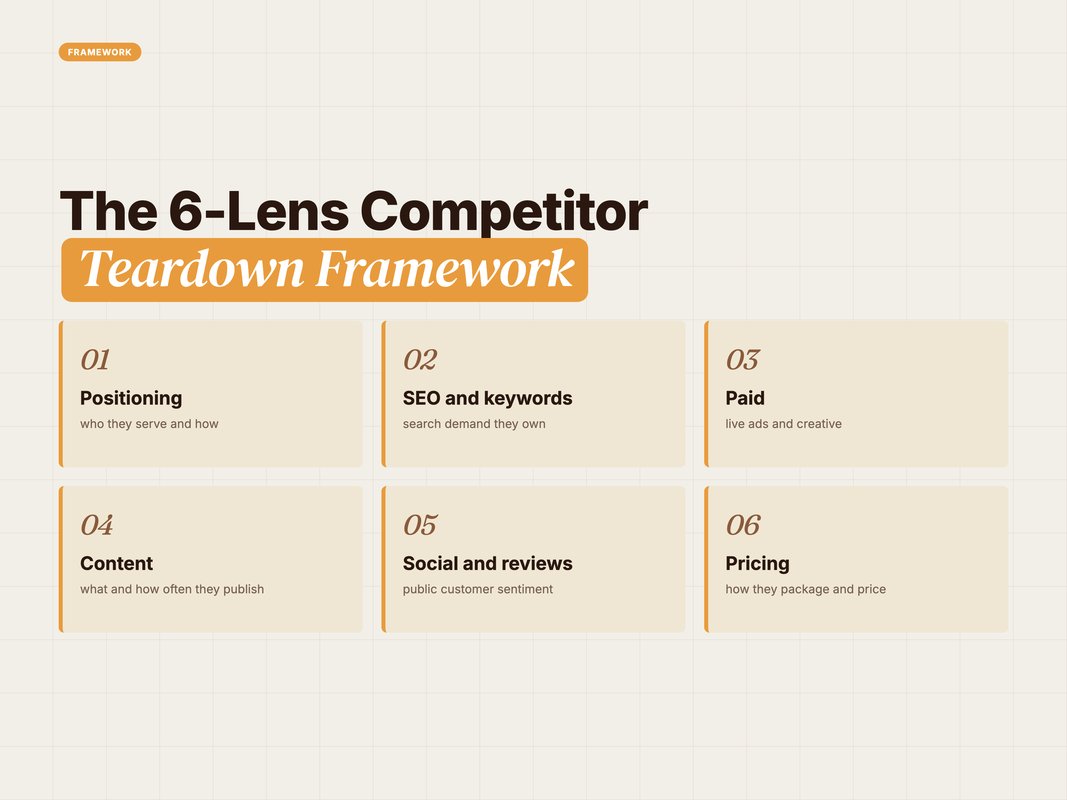
Each lens answers one question. Together they give a full picture.
- Positioning — Who do they claim to serve, and how?
- SEO and keywords — What search demand do they own?
- Paid — What ads and creative are they running now?
- Content — What are they publishing, and how often?
- Social and reviews — What do customers say in public?
- Pricing — How do they package and price the offer?
Run all six on your top three rivals. That is your baseline. Then set alerts so the picture stays current.
Here is what each lens looks for in practice.
Positioning reads the homepage and the about page. You want their core promise. Who is it for? What pain do they claim to fix?
SEO and keywords maps their search footprint. You pull the terms they rank for. You flag the ones you do not own yet.
Paid shows their live ad angles. You scan creative, hooks, and offers. You note which message they repeat most.
Content tracks their publishing habit. You log topic themes and cadence. You spot the gaps they never cover.
Social and reviews reads public sentiment. You mine app reviews, comments, and threads. You find the complaints they keep ignoring.
Pricing exposes their packaging. You study tiers, anchors, and free trials. You learn where your offer can undercut or out-value them.
The order matters. Positioning frames everything. If you skip it, the other five lenses have no anchor. You end up copying tactics that fit their strategy, not yours.
Focus beats coverage here. Pick one or two questions per quarter, not ten. AI gives you endless data. A tight question turns that data into a decision.
Q: How many competitors should I track with this framework?
A: Start with three direct rivals. Run all six lenses on each. Add a watchlist of five more for alerts only. Depth on a few beats shallow notes on many.
Match the Tool to the Job
There is no single best tool. There is a best tool per lens. Here is the map we use, with real pricing.
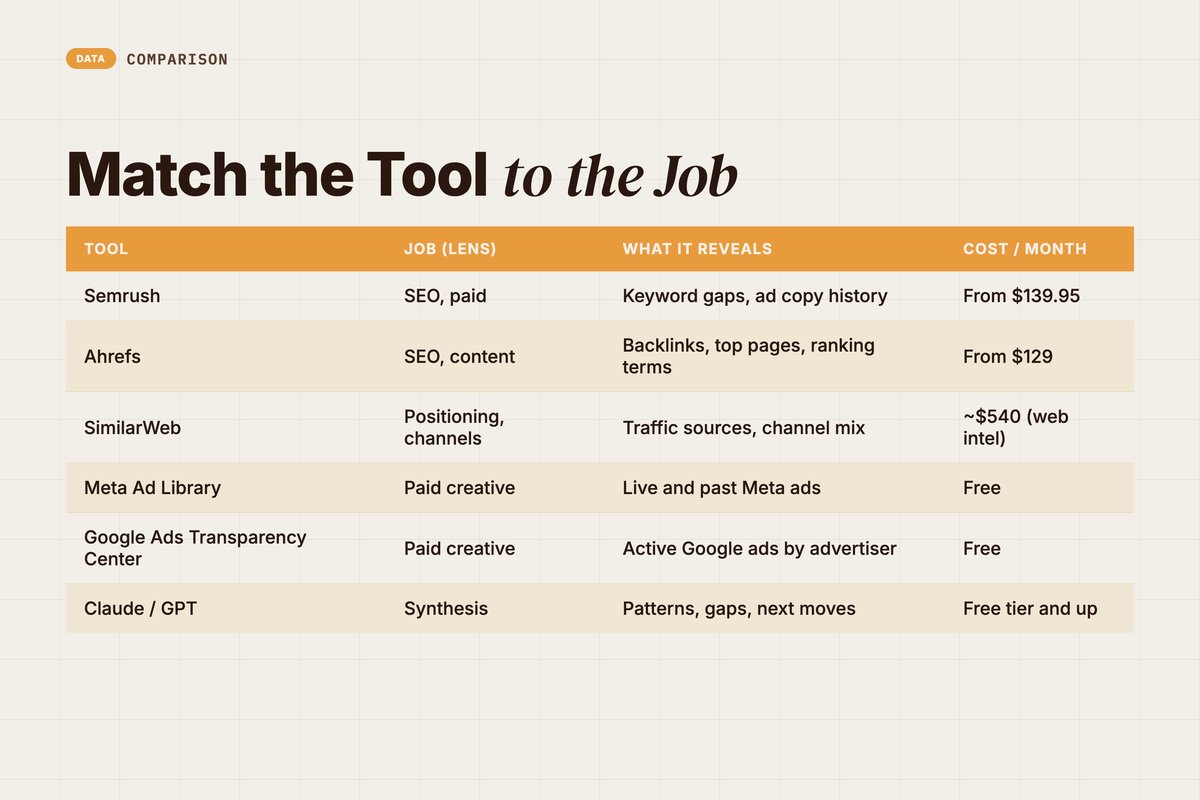
Prices reflect entry tiers at time of writing. (Source: Semrush, 2026. semrush.com) (Source: Ahrefs, 2026 — ahrefs.com) (Source: SimilarWeb, 2026 — similarweb.com)
Two of the sharpest tools are free. Meta Ad Library shows every live ad a brand runs. (Source: Meta, 2026 — transparency.meta.com)
Google's Ads Transparency Center does the same across its network. It covers Search, YouTube, and Display. (Source: Google, 2026 — adstransparency.google.com)
Run both ad libraries side by side. Same message on each usually means it is validated. Different messages often signal a channel test. That contrast is a free strategy read.
Match each lens to its tool, then stop. Do not buy five tools you touch once. The stack should map to the questions you actually ask. Anything else is shelf-ware.
SimilarWeb suits the positioning and channel view. Semrush and Ahrefs overlap on SEO, so pick one. The ad libraries cover paid for free. Your LLM ties it all together.
The synthesis layer is where AI earns its keep. Nearly half of marketers already use generative AI for research like this. (Source: HubSpot, 2025. blog.hubspot.com) You feed raw exports to a model. It hands back the story.
Q: Do I need paid SEO tools for competitor analysis?
A: Not to start. Free ad libraries plus a free LLM cover a lot. Paid tools like Ahrefs or Semrush add depth on keywords and links. Buy the paid tier only for the lens that needs it.
The Techniques: Copy-Paste Prompts for Teardowns
Tools give you data. Prompts turn data into insight. Here are the two we lean on most.
First, the teardown prompt. Export a rival's data, then paste it in.
You are a competitive strategy analyst.
Here is raw data on a competitor: [PASTE keywords, ads,
pricing, top pages].
Do a teardown across 6 lenses: positioning, SEO, paid,
content, social, pricing.
For each lens, give: one strength, one weakness,
one gap I could exploit.
End with the single move I should steal first.
Be specific. Cite the data row you used.
That prompt forces structure. It also forces the model to point at the source row. That last line cuts hallucination.
Second, the synthesis prompt. Use it once you have torn down all three rivals.
I have three competitor teardowns below: [PASTE all three].
Compare them side by side.
Find: shared blind spots, crowded angles to avoid,
and one white-space position no rival owns.
Give me a 3-bullet action plan for the next 30 days.
Rank by effort versus payoff.
This second prompt is where the value spikes. It reads across rivals, not just one. That cross-view is hard to do by hand.
There is a third technique worth adding. Turn your monitoring alerts into a weekly digest. Feed the raw change log to your model.
Here is this week's competitor change log: [PASTE alerts].
Group the changes by lens: positioning, SEO, paid,
content, social, pricing.
For each group, tell me: what changed, why it matters,
and whether I should react now or watch.
Flag only the changes that need a decision this week.
Keep it to five bullets or fewer.
That digest prompt kills alert fatigue. Raw alerts pile up and get ignored. A weekly synthesis keeps only what needs a call.
One rule. Always verify. AI still invents numbers and facts. Only 6% of firms count as true AI high performers. (Source: McKinsey, 2025. mckinsey.com) The gap is usually process, not the model. Check every claim against the source data.
Q: Which AI model is best for competitor teardowns?
A: Any strong general model works. Claude and GPT both handle long, messy exports well. Pick the one your team already pays for. The prompt structure matters more than the brand.
Quick Facts: AI Competitor Analysis in 2026
Quick Facts: AI Competitor Analysis at a Glance
- The competitive intelligence tools market reached $0.71 billion in 2025. (Source: Fortune Business Insights, 2025 — fortunebusinessinsights.com).
- That market is set to grow at a 21.17% CAGR through 2034. (Source: Fortune Business Insights, 2025 — fortunebusinessinsights.com).
- Organisations using AI in at least one function reached 88%. (Source: McKinsey, 2025 — mckinsey.com).
- Marketers who use AI in their role stand at 66%. (Source: HubSpot, 2025 — blog.hubspot.com).
- Marketers using generative AI for research reached 48%. (Source: HubSpot, 2025 — blog.hubspot.com).
These numbers point one way. Adoption is near-universal. So the moat is method, not access.
North America leads this market with a 43.61% share in 2025. (Source: Fortune Business Insights, 2025. fortunebusinessinsights.com) But the framework here works in any market. The tools are global.
The Step-by-Step Process to Run It
Here is the exact sequence. Five steps. Run it end to end on one rival first.
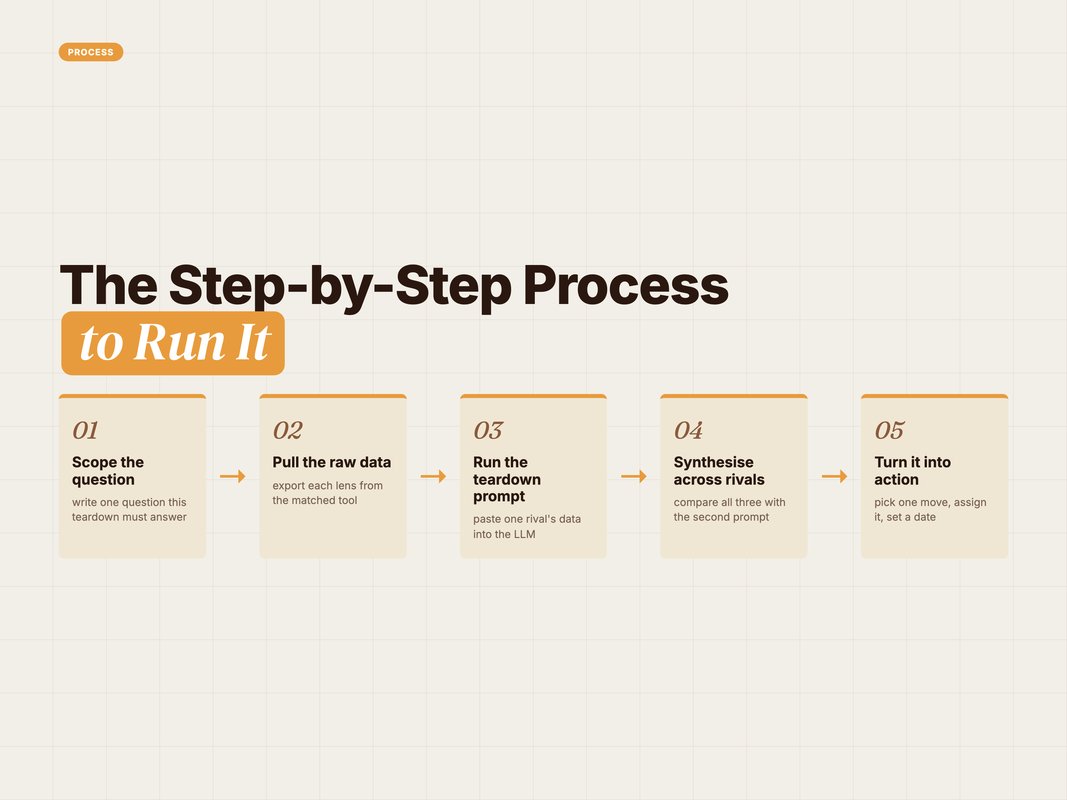
- Scope the question. Write one question this teardown must answer.
- Pull the raw data. Export each lens from the matched tool.
- Run the teardown prompt. Paste one rival's data into the LLM.
- Synthesise across rivals. Compare all three with the second prompt.
- Turn it into action. Pick one move. Assign it. Set a date.
Step one is the one teams skip. Do not skip it. A vague question gives you a vague deck.
Step five is where most analysis dies. A finding with no owner is a note. A finding with an owner and a date is a plan.
Keep the loop tight. Run the full teardown each quarter. Between runs, let alerts do the watching. That rhythm keeps you sharp without the busywork.
Q: How long does one full teardown take with AI?
A: A single rival takes about two hours once your tools are set. The three-rival synthesis adds an hour. That is a day of work compressed from a week. Setup is the slow part, and you only do it once.
Turn Findings Into Action
Analysis is worthless until it changes a decision. This is where most teams stall.
Sort every finding into three buckets. Steal, avoid, or own.
Steal is the fast win. A rival runs an offer that works. You test your own version this month.
Avoid saves you money. Every rival crowds the same tired angle. You skip it and spend your budget elsewhere.
Own is the long game. It is the gap nobody fills. You plant your flag there and defend it.
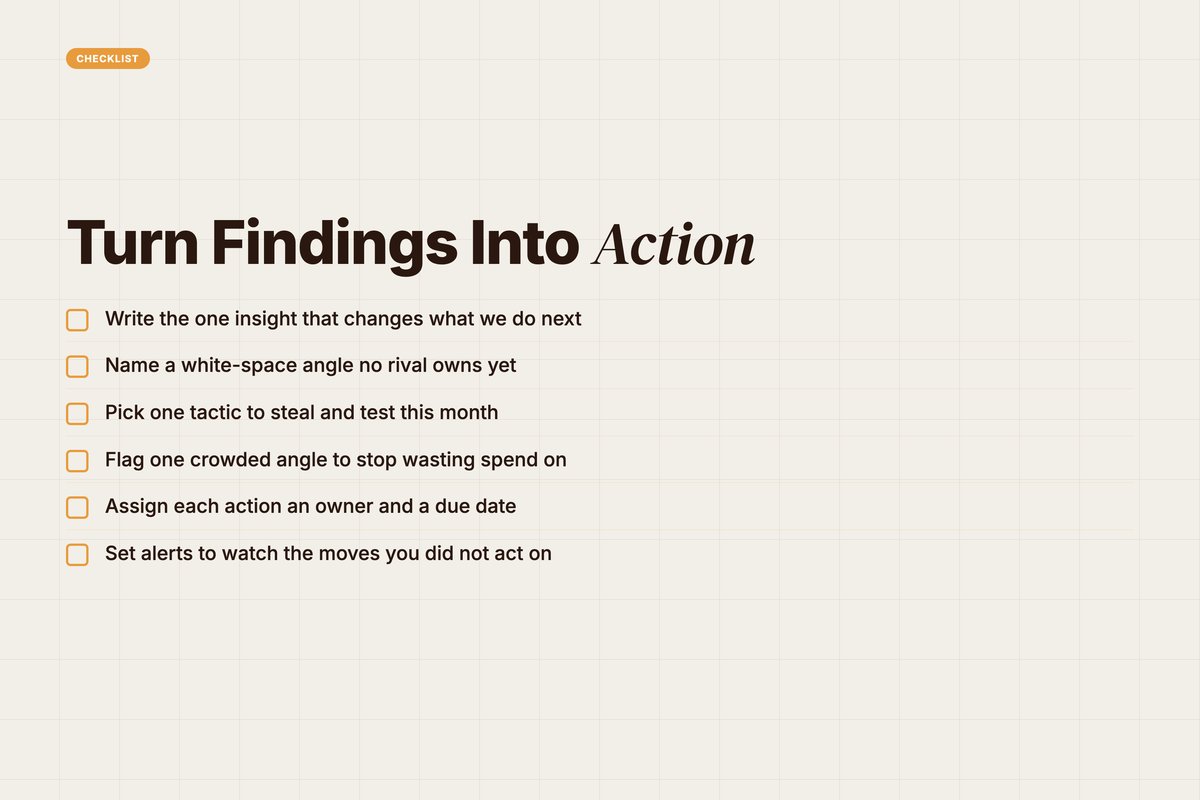
Use this checklist after every teardown.
- Write the one insight that changes what we do next.
- Name a white-space angle no rival owns yet.
- Pick one tactic to steal and test this month.
- Flag one crowded angle to stop wasting spend on.
- Assign each action an owner and a due date.
- Set alerts to watch the moves you did not act on.
Notice the last item. You will not act on everything. That is fine. Park the rest under a watch, not in a folder.
The white-space bucket is the prize. Every rival crowds the same three claims. The gap they all ignore is your opening. AI is good at spotting that gap across many pages at once.
Then close the loop. Revisit the plan next quarter. Did the stolen tactic work? Did the white-space angle land? That review is what makes the next teardown sharper.
Keep a simple scoreboard. One row per action. Track the owner, the date, and the result.
The scoreboard does two jobs. It holds people to their commitments. It also builds a record of what worked, so your next plan starts smarter.
Do not chase every rival move. Some changes are noise. A price tweak or a new blog post rarely needs a same-week response.
React only when a change threatens your core. A new pricing model or a bold repositioning is worth a fast reply. The rest can wait for the quarterly review.
Q: How do I avoid overreacting to competitor moves?
A: Sort each change by impact first. Ask if it threatens your core offer. Small tweaks go on the watch list. Only big, strategic shifts earn a fast, deliberate response.Q: What is the biggest mistake in AI competitor analysis?
A: Collecting more than you use. Teams pull endless data and act on none. Fix it by starting with one question and ending with one owned action. Signal without a decision is just noise.
Where an AI-First Partner Fits
You can run this playbook in-house. Many teams do. But the setup and the discipline are the hard parts.
That is where an AI-first growth partner helps. We are an AI-first growth marketing agency. We run performance marketing, LLM SEO, AI creatives, and AI funnels for D2C and B2B brands.
Competitor analysis sits inside that work. We build the tool stack, wire the alerts, and write the prompts once. Then your team runs the loop without the heavy lift.
We lean on Claude and MCP workflows to pull, sort, and synthesise rival data. The output is not a static deck. It is a live system your team can act on each quarter.
The stack is only half the value. The other half is the habit. We help your team ask sharper questions and act on fewer, better findings.
We work across D2C and B2B. The lenses stay the same. Only the tools and the questions shift to fit your market.
The point is not more reports. It is fewer, sharper decisions. A tight competitor read that actually changes the plan.
If your competitor analysis keeps ending in a folder, the fix is process, not more tools. That is the part we set up for you. Then we hand you the keys.
Conclusion: Build the System, Not the Deck
AI competitor analysis is not about having the smartest tool. Nearly everyone has the tools now. The edge is a repeatable system.
Run the 6-Lens Teardown. Match each lens to the right tool. Use the two prompts to turn raw data into a read. Then force every finding into one owned action.
Do that each quarter, with alerts in between. You will spend less time building decks. You will spend more time making moves.
Start small. Pick one rival. Ask one question. Run the loop once, end to end. The system gets sharper every time you use it.
Then widen it. Add a second rival. Add a second question. The framework scales without breaking, because the six lenses never change.
The teams that win here are not the ones with the most tools. They are the ones with the tightest habit. Consistency beats intensity every quarter.
Want a competitor analysis engine built for your brand? Let's map your rivals and your white space together.
FAQ
Q: What is AI competitor analysis?
A: AI competitor analysis uses AI tools to gather, sort, and read rival data at scale. It pulls SEO, ads, pricing, content, and reviews, then synthesises the patterns for you. You still set the questions and make the calls. The AI just does the heavy lifting faster.
Q: Which AI tools are best for competitor analysis?
A: Use the right tool per job. Semrush or Ahrefs for SEO and keywords. SimilarWeb for traffic and channel mix. Meta Ad Library and Google Ads Transparency Center for creative. Then Claude or GPT to synthesise raw exports into a clear read.
Q: How do I use AI to analyse a competitor?
A: Pick one rival and one question. Export the raw data from your tools. Paste it into an LLM with a clear teardown prompt. Ask for gaps, patterns, and one move you can steal. Then verify the output against the source before you act.
Q: Can AI replace a competitive intelligence analyst?
A: No. AI speeds up collection and first-pass reading. It still hallucinates, misses context, and cannot set priorities. A human frames the question, checks the facts, and decides what to do. Treat AI as a fast junior analyst, not the final word.
Q: How often should I run competitor analysis?
A: Run a full teardown each quarter. Set alerts for the rest. Watch pricing pages, ad creative, and new content weekly with automated monitoring. A deep review every 90 days keeps strategy fresh without drowning your team in noise.
Q: Is free AI enough for competitor research?
A: Free tools cover a lot. Meta Ad Library and Google Ads Transparency Center are free. A free LLM tier can synthesise pasted data. Paid SEO tools add depth on keywords and backlinks. Start free, then pay only for the job that needs more.
Insights from Our Experts
Explore our latest articles on digital marketing strategies.