

Content marketing ROI has one stubborn problem. The cost is easy to see. The return is not.
AI just made that gap wider. It slashes production cost fast. It does far less to the return side. So the ratio moves, but not the way most decks claim.
This is a playbook for the economics. We will rebuild the model from the unit up. Cost per asset. Cost per lead. Payback period. Return per program.
You will get a numbered ROI framework you can copy. An old-way versus AI-way comparison. A stat cluster with cited benchmarks. A step-by-step way to calculate your own number. And a checklist to run before you sign off on a budget.
The goal is simple. Stop guessing at content marketing ROI. Start doing the math at the level where AI actually moves it.
Why The Old ROI Model Breaks And What Replaces It
The old model priced content by the post.
You paid a writer. You paid an editor. You added tools and design. That was your cost per post. Simple.
Then you tried to link posts to revenue. That part was never simple. More than half of B2B marketers still name attribution as a top problem (Source: Content Marketing Institute, 2025 — contentmarketinginstitute.com).
So most teams tracked cost tightly and return loosely. That worked when output was slow. One post a week. A clear line item.
AI broke that pace. Output can now jump without the cost jumping with it. The per-post frame stops making sense.
You need a model that separates two things. What one asset costs. And what a program of assets returns. They move on different clocks now.
So the new model is AI-native. It changes where the money goes. Not just how much.
In the old stack, labour was the biggest line. Drafting, research, and edits ate the budget. Tools were a rounding error.
AI flips the mix. Drafting time drops. Research and repurposing speed up. Marketers report saving one to two hours a day with generative AI (Source: HubSpot, 2025 — blog.hubspot.com).
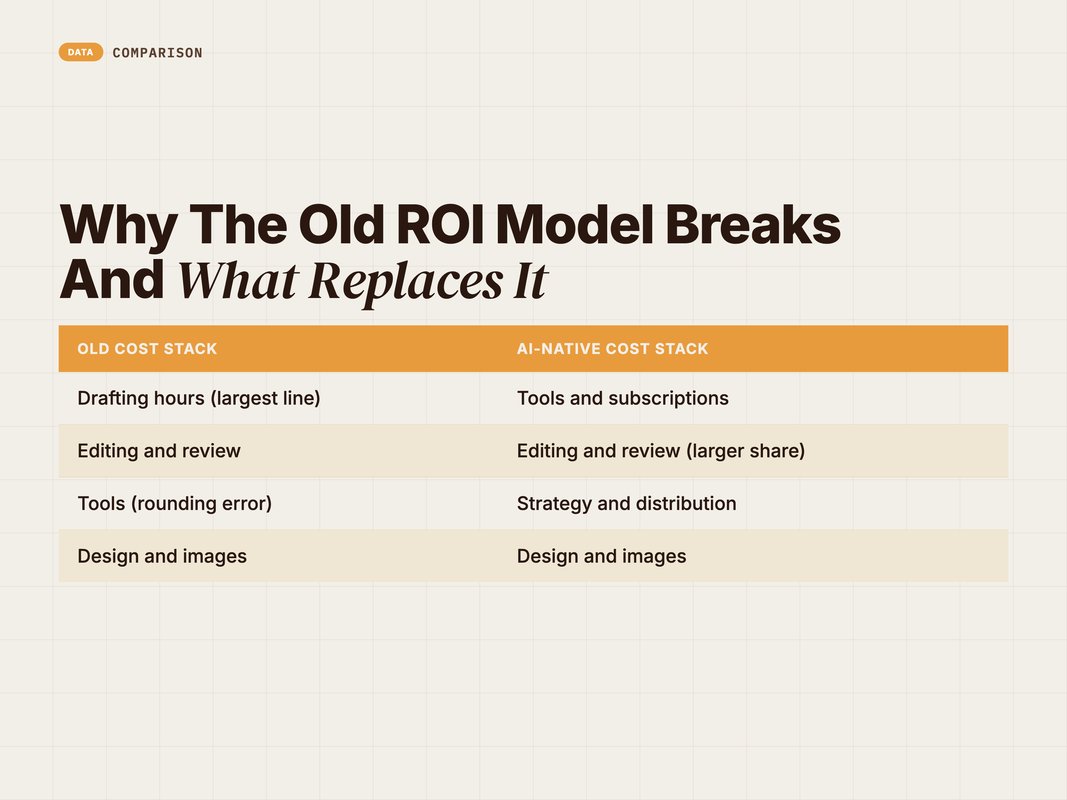
That saved time is real money. It shifts spend from raw production toward strategy, distribution, and quality control.
Here is the key move. AI lowers cost per asset. It does not raise return per asset by default. Returns still come from ranking, trust, and a real offer.
So the smart play is volume with quality held firm. More good assets per dollar. Not more assets at any cost. Teams that use AI well report a 70% average lift in content ROI (Source: Semrush, 2025 — semrush.com).
Q: Does AI make content cheaper or more valuable?
A: Mostly cheaper. It cuts the cost side of the ratio through speed. Value per asset still depends on quality and fit. So the ROI gain shows up as lower cost per outcome, not higher price per piece.
The C.O.S.T. Content ROI Framework
Use a simple named model to keep the math honest. Call it C.O.S.T.
It splits content marketing ROI into four parts you can track. Each part has one clear question.

1. Cost per asset. What does one finished asset cost, fully loaded? Count people, tools, editing, images, and review. This is your input unit.
2. Output per dollar. How many finished assets do you ship per dollar? AI moves this number the most. Watch it rise as drafting time falls.
3. Signal per asset. What does one asset earn? Track leads, rankings, sign-ups, or pipeline. This is the return side. AI barely touches it on its own.
4. Time to payback. How long until return covers cost? This is your patience budget. It decides if a program is worth it.
Run all four together. Cost and output tell you efficiency. Signal and payback tell you value. You need both to see true content marketing ROI.
Most teams only track one or two. That is why their numbers feel wrong. The C.O.S.T. model forces the full picture.
Q: What is the C.O.S.T. framework for content ROI?
A: It is a four-part model: Cost per asset, Output per dollar, Signal per asset, and Time to payback. The first two measure efficiency. The last two measure value. AI mainly improves the first two, so you must watch all four.
Old Way vs AI-Native Way: The Economics Compared
The shift is easiest to see side by side.
The old way optimised the writer's hour. The AI-native way optimises the system's output. Different levers, different math.

Notice the risk row. The old danger was scarcity. The new danger is slop.
Cheap output tempts teams to publish more of everything. That can hurt content marketing ROI, not help it. Distribution and trust do not scale as fast as drafting.
So the AI-native model wins only with a hard quality gate. The cost savings are real. The return depends on keeping the bar high.
Q: Is AI content marketing cheaper than traditional content?
A: Usually yes, at the unit level. AI lowers cost per asset by cutting drafting time. But it adds a new cost: heavier editing and review. Net cost still falls when you gate quality well.
The Numbers That Prove The Shift
The benchmarks tell a clear story. AI cuts cost. Returns follow only with quality.
Here is a grouped view of what current research shows.

Quick Facts: AI and Content Marketing ROI in 2025
- Adoption is now mainstream: 81% of B2B marketing teams use generative AI tools, up from 72% a year earlier — (Source: Content Marketing Institute, 2025 — contentmarketinginstitute.com).
- Returns are rising: 68% of businesses see higher content marketing ROI thanks to AI — (Source: Semrush, 2025 — semrush.com).
- Leaders agree: 75% who invested in AI report positive ROI, while only 4% report negative ROI — (Source: HubSpot, 2025 — blog.hubspot.com).
A few more numbers frame the cost side.
Most small teams already spend little. 48% of small business owners who skip AI put $1,000 or less a month into content (Source: Semrush, 2025 — semrush.com). AI stretches that budget further.
On the return side, organic content stays efficient. In SaaS, organic search shows a cost per lead near $147 versus about $280 for paid search (Source: Ahrefs, 2025 — ahrefs.com). That gap is where content earns its keep.
And the payoff is slow. B2B SaaS SEO often shows around 702% ROI with a break-even near month seven over a three-year window (Source: Ahrefs, 2025 — ahrefs.com). AI lowers the upfront spend you must recover in that window.
Q: What ROI do marketers actually get from AI content?
A: Most report gains. 68% of businesses see higher content ROI from AI, and 75% of AI investors report positive ROI overall. But those gains come from cheaper, faster output, not from AI writing that ranks by itself.
Cost Per Asset: The Real AI Math
Cost per asset is where the story gets concrete. Let us build it up.
Fully loaded cost per asset means everything. Not just the writer's fee.
Include these lines:
- Writer or drafting time.
- Editor and review time.
- Subject-expert input.
- Tools and subscriptions.
- Images and design.
- Publishing and QA.
Add them for one finished asset. Divide by assets shipped. That is your true unit cost.
Here is where AI hits. It shrinks the drafting line the most. It leaves editing, expertise, and design roughly the same.
So the blended cost falls, but not to zero. A team that halves drafting time does not halve total cost. The other lines still stand.
Think of it as a mix shift. Drafting drops from the biggest line to a smaller one. Editing and strategy rise in share. Your total falls, and your quality control matters more.
This is why "AI made content free" is a myth. AI made drafting cheap. Content is not just drafting. The edit is where content marketing ROI is won or lost.
Track cost per asset monthly. Watch the drafting share fall. If total cost is not dropping, your editing or tool spend is eating the gain. Fix the leak.
Q: How much does AI lower cost per asset?
A: It depends on your mix. AI mainly cuts drafting time, which is often the largest line. Editing, expertise, and design stay. So total cost per asset falls, but by less than the drafting saving alone. Track the blended number.
Where AI Moves The Numbers, And Where It Does Not
Be honest about the limits. AI is a cost lever, not a demand lever.
It moves some numbers a lot. It barely touches others.
AI moves these:
- Cost per asset, through faster drafting.
- Output per dollar, through speed and repurposing.
- Time to first draft, from days to hours.
- Payback period, by lowering upfront spend.
AI does not move these on its own:
- Real demand for your topic.
- The strength of your offer.
- Distribution reach and audience trust.
- A genuine point of view or fresh data.
That split is the whole game. Cost is where AI shines. Return still comes from strategy and quality.
Weak AI content can even hurt. Thin posts waste distribution and dilute trust. That raises effective cost per lead, not lowers it.
So the rule holds. Use AI to lower cost per good asset. Keep the quality bar fixed. Then the ROI ratio improves from both sides over time.
Q: Where does AI fail to improve content ROI?
A: AI cannot create demand, fix a weak offer, or build distribution for you. It also cannot replace real expertise or a distinct viewpoint. Those drive the return. AI only makes producing content cheaper and faster.
How To Calculate Your Content Marketing ROI
Now put it together. Here is a step-by-step way to get a real number.
Run this once per program. Not per post.
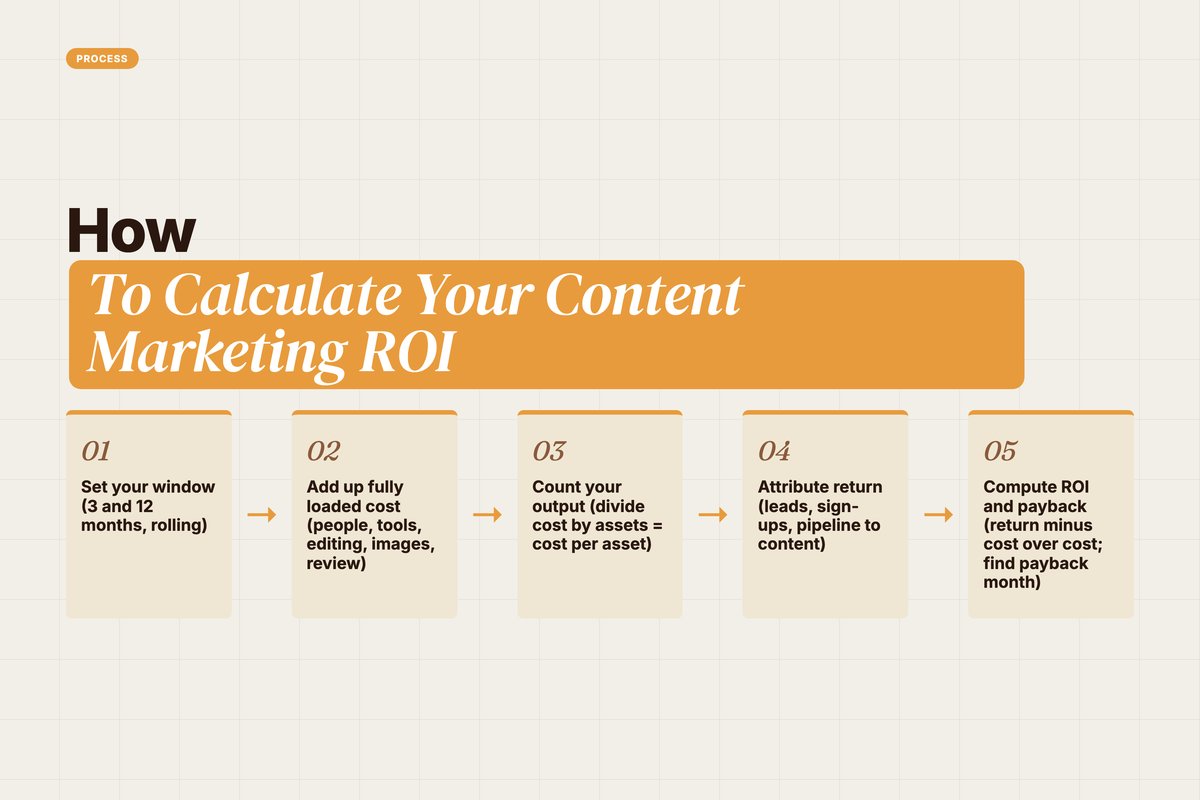
Step 1: Set your window. Pick a rolling period. Use three months for pace and twelve for payback. Content pays off slowly, so short windows lie.
Step 2: Add up fully loaded cost. Sum people, tools, editing, images, and review across the window. This is your total content spend.
Step 3: Count your output. Tally finished, published assets. Divide cost by output to get cost per asset. This is your efficiency number.
Step 4: Attribute return. Assign leads, sign-ups, or pipeline to content. Use last-touch as a floor and multi-touch if you can. Value it with a cost-per-lead benchmark or real revenue.
Step 5: Compute ROI and payback. ROI equals return minus cost, divided by cost. Payback is the month cumulative return covers cumulative cost. Track both over the window.
Do this and the AI effect shows up clearly. Cost per asset falls in step three. Payback shortens in step five. If return per program holds, your content marketing ROI climbs.
One caution on value. Organic traffic has a real dollar value. Ahrefs defines it as what the same clicks would cost via paid search (Source: Ahrefs, 2025 — help.ahrefs.com). Use that to price traffic you earn but do not pay for.
Q: How do you calculate content marketing ROI step by step?
A: Set a rolling window. Add fully loaded cost. Count published assets to get cost per asset. Attribute leads and revenue to content. Then compute ROI as return minus cost over cost, and find the payback month. Do it per program, not per post.
Your Content ROI Audit Checklist
Before you approve a content budget, run this. It catches the common ways the math goes wrong.
- Calculate fully loaded cost per asset, not just the writer fee.
- Separate drafting cost from editing and strategy cost.
- Set a rolling window of three and twelve months.
- Attribute return to content with a clear model.
- Price earned organic traffic at its paid-search value.
- Compute payback month, not just a raw ratio.
- Hold a fixed quality gate before you scale output.
- Kill thin assets that waste distribution.
- Review cost per lead against a benchmark each quarter.
- Reinvest AI savings into distribution and depth.
Work this list top to bottom. Most ROI failures hide in the first two lines and the quality gate.
The pattern is always the same. Teams cut cost with AI, then let quality slip. The savings vanish into wasted reach. This checklist keeps that from happening.
Q: What should a content ROI audit include?
A: It should include fully loaded cost per asset, a clear attribution model, a payback calculation, and a fixed quality gate. It should also price earned organic traffic and review cost per lead each quarter. Skip any of these and your ROI number will mislead you.
Getting The Economics Right With YARD
We are an AI-first growth marketing agency. Performance marketing, LLM SEO, AI creatives, and AI funnels for D2C and B2B brands.
The content ROI mistake we see most is simple. Teams treat AI as a volume switch. They flood the calendar and hope the numbers follow.
That is backwards. AI is a cost lever, not a demand lever. We build the economics first, then scale.
That means a fully loaded cost model per asset. A hard quality gate. And attribution that survives a long payback window.
We wire AI into the drafting and repurposing layer. Then we spend the saved time and budget where return actually lives. Distribution, depth, and a real point of view.
The result is a content engine that gets cheaper per asset without getting thinner. Cost per lead trends down. Payback shortens. The ratio improves from both sides.
If your content marketing ROI feels fuzzy, that is usually a model problem, not a content problem. We fix the model first.
Want the framework applied to your numbers? Grab our content ROI playbook and run your own audit. See our related guide on AI content strategy for the next step.
Conclusion: Do The Unit Math
AI did not make content marketing ROI a mystery. It made the old model obsolete.
The per-post frame is dead. The new frame is cost per asset, output per dollar, signal per asset, and payback. Track those four and the picture clears up.
AI moves the cost side hard. It leaves the return side to strategy, quality, and distribution. So the winning move is more good assets per dollar, with a fixed quality bar.
Run the C.O.S.T. framework. Calculate your real number over a rolling window. Use the checklist before you approve spend.
Do the unit math, and content marketing ROI stops being a guess. It becomes a lever you can pull with confidence. That is the whole point of the AI shift.
Ready to rebuild your content economics? Download the playbook and put the numbers to work.
FAQ
Q: How does AI change content marketing ROI?
A: AI mostly cuts the cost side of the ratio. It lowers cost per asset by speeding drafting, research, and repurposing. Returns still depend on distribution, quality, and demand. So the biggest gains show up as more assets per dollar, not magically higher revenue per asset.
Q: What is a good content marketing ROI?
A: A healthy target is a positive return once you count multi-month gains. SEO and content often break even around month seven and compound after that. Track return per program over a rolling window, not per post in week one.
Q: How do you calculate cost per asset?
A: Add up the fully loaded cost of one asset. That means people, tools, editing, images, and review time. Then divide by the number of finished assets. AI lowers the labour share, so watch the blended figure fall as your team ships more.
Q: Does AI content actually lower customer acquisition cost?
A: It can, but not on its own. AI cuts production cost, which lowers cost per lead if the content still ranks and converts. Weak or unedited AI content can raise cost by wasting distribution. The lever is more good assets, not more assets.
Q: What is the payback period for content marketing?
A: Payback is the time until cumulative return covers cumulative cost. For organic content it often lands near seven months. AI shortens it by lowering the upfront production spend you need to recover.
Q: Where does AI not improve content ROI?
A: AI does not fix weak strategy, thin distribution, or a bad offer. It does not create demand that is not there. It also cannot replace real expertise, live data, or a distinct point of view. Those still drive the return side.
Insights from Our Experts
Explore our latest articles on digital marketing strategies.