
Most ad teams want video. Few want the cost.
Shoots take weeks. Rendering eats hours. Iteration costs money you do not have. AI video generation now closes that gap. And fal.ai marketing video generation is one of the cleanest ways in.
This guide is a playbook. You will pick the right model. You will write prompts that ship. You will see real cost numbers and copy-pasteable API calls.
By the end you can build a 6-second ad in under an hour.
We focus on the marketing workflow. Not the research side. Not deep code.
You will get a 5-stage pipeline. A model price and use case map. A QA checklist. And rules for choosing Veo, Kling, Hailuo, Runway, or Vidu.
Let us get into it.
Why fal.ai matters for marketing video
fal.ai is a model-hosting platform. One API gives you access to over 1,000 image, video, and audio models. You pay per use (Source: fal.ai, 2026 — fal.ai pricing).
That is the core unlock for marketers.
You do not need a Veo contract. You do not need a Kling enterprise account. You hit one endpoint and switch models with one string.
That is why fal.ai marketing video generation works at agency speed.
Short-form video is also where ad dollars now sit. Marketers rank short-form video as the number one ROI format for the third year running (Source: HubSpot State of Marketing, 2026 — hubspot.com/marketing-statistics).
And 91% of businesses use video as a marketing tool in 2026, up from 86% in 2024 (Source: Wistia State of Video via HubSpot, 2026 — blog.hubspot.com/marketing/state-of-video-marketing-new-data).
Demand is climbing. Production budgets are not.
41% of companies spent under $20,000 on video production in 2025 (Source: HubSpot State of Marketing, 2026 — hubspot.com/marketing-statistics). That is the gap fal.ai fills.
Most marketers also work under tighter ad budgets this year. 40% of teams plan to increase video spend in 2026, down from 57% in 2023 (Source: HubSpot State of Marketing, 2026 — hubspot.com/marketing-statistics).
You need more output. From a smaller budget. With more variants. That is the brief.
fal.ai answers it on three counts. One API key. One billing line. Zero idle cost when you are not rendering.
Q: Is fal.ai the same as Veo or Kling?
A: No. fal.ai hosts those models. You get Veo, Kling, Hailuo, Vidu, Runway, and more behind one API key. You pay fal.ai per second or per video, not the model maker.
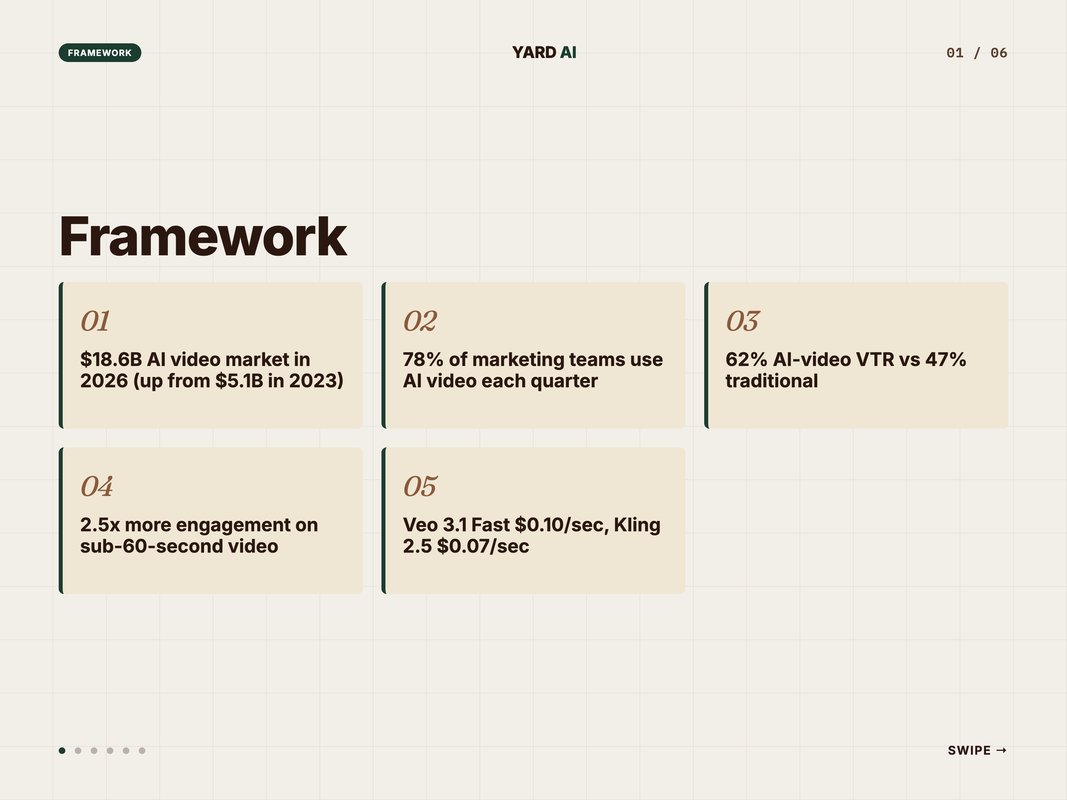
Quick Facts: fal.ai marketing video at a glance
- Market size. The AI video marketing market hit $18.6 billion in 2026, up from $5.1 billion in 2023 (Source: Vivideo AI Video Statistics, 2026 — vivideo.ai/blog/ai-video-statistics-2026).
- Adoption rate. Seventy-eight percent of marketing teams now use AI-generated video in at least one campaign per quarter (Source: Vivideo AI Video Statistics, 2026 — vivideo.ai/blog/ai-video-statistics-2026).
- View-through rate. AI video ads see a 62% view-through rate versus 47% for traditional video (Source: Vivideo AI Video Statistics, 2026 — vivideo.ai/blog/ai-video-statistics-2026).
- Engagement lift. Videos under 60 seconds drive 2.5x more engagement per impression than other formats (Source: Wistia State of Video, 2026 — blog.hubspot.com/marketing/state-of-video-marketing-new-data).
- Top pricing. Veo 3.1 Fast on fal.ai is ten cents per second at 720p. Kling 2.5 Turbo Pro is seven cents per second (Source: fal.ai pricing page, 2026 — fal.ai/pricing).
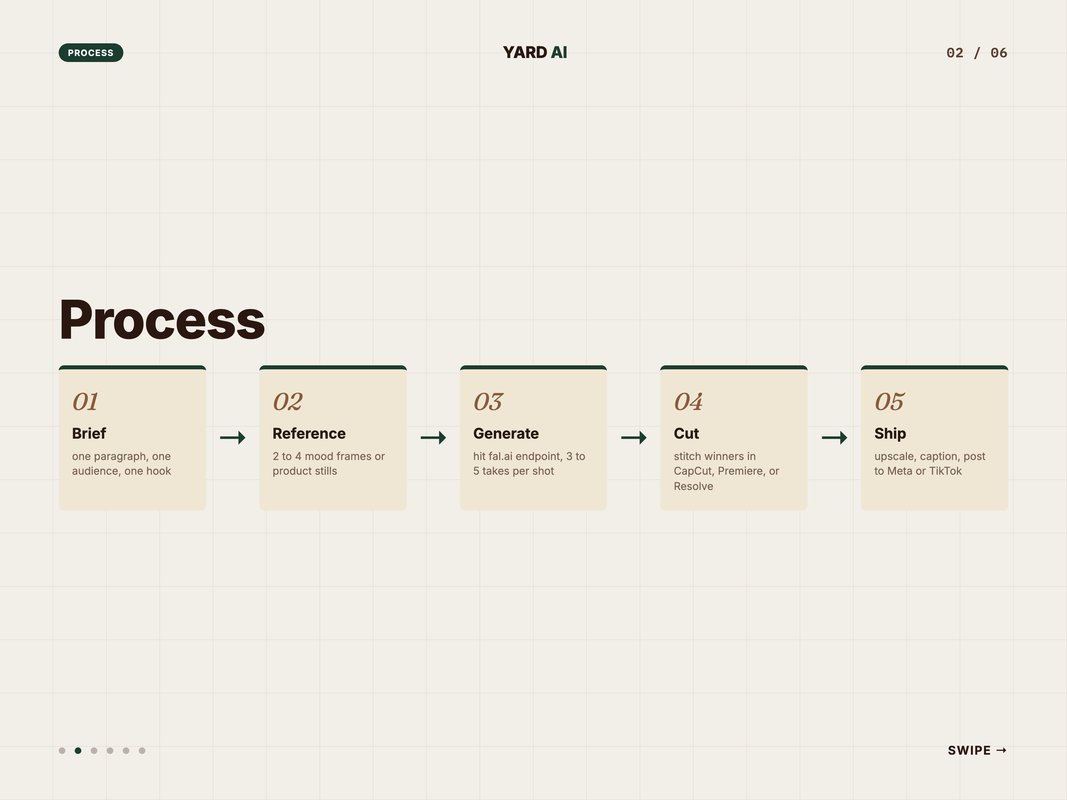
The 5-stage fal.ai marketing video pipeline
Most agency teams use one shape. Five stages. Each owns one job.
You can run it solo. You can run it as a team. The shape does not change.
Stage 1 is brief. You write the spot in one paragraph. One audience. One hook. One CTA.
Keep it tight. If the brief is fuzzy, the ad will be fuzzy too.
Stage 2 is reference. You collect 2-4 mood frames. A product still. A pose. A light direction.
The fal.ai reference-to-video endpoints accept up to 7 frames (Source: fal.ai Vidu API, 2026 — fal.ai/models/fal-ai/vidu/q1/reference-to-video/api). Use them.
Stage 3 is generate. You hit a fal.ai endpoint. You render 3-5 takes per shot.
Renders take 30-120 seconds each. Queue them and move on.
Stage 4 is cut. You pick winners and stitch in CapCut, Premiere, or Resolve.
This is where you add captions, music, and the logo. Do not bake those in upstream.
Stage 5 is ship. You upscale, add open captions, and post to Meta, TikTok, or YouTube.
Each stage takes 10-30 minutes. That is the new floor.
Q: How long does one fal.ai ad take end to end?
A: A 6 to 8 second ad takes 45-90 minutes for a single operator. A full 30-second cutdown with B-roll takes 3-5 hours. That includes briefing, three takes per shot, and final cut.
Picking the right fal.ai video model
This is the most important call you will make. The wrong model wastes credits and re-shoots.
fal.ai hosts dozens of video models. For marketing, five matter.
Veo 3.1 is Google's flagship. It generates 720p or 1080p with native audio. It is the strongest for cinematic ads with dialogue (Source: Google AI Studio, 2026 — aistudio.google.com/models/veo-3).
Kling 2.5 Turbo Pro is the motion specialist. Strong physics. Up to 10 seconds. Native audio in some modes (Source: fal.ai model catalog, 2026 — fal.ai/learn/tools/ai-video-generators).
Hailuo 2.3 Pro renders 1080p clips at a fixed per-video price. Best for short product loops (Source: fal.ai pricing, 2026 — fal.ai/pricing).
Vidu Q1 is the reference-to-video pick. Up to 7 reference images per call. It keeps character and product identity locked (Source: fal.ai Vidu API docs, 2026 — fal.ai/models/fal-ai/vidu/q1/reference-to-video/api).
Runway Gen-4 ships through Runway's own API and via fal.ai's model card. Use it for long-form cuts and VFX-style edits (Source: Runway API docs, 2026 — docs.dev.runwayml.com/guides/models).
A simple rule. Lead with the job. Not the model.
If the ad has a face talking, pick Veo. If the ad has a product spinning, pick Kling. If the ad is a 6-second loop, pick Hailuo. If the ad needs the same hero across five scenes, pick Vidu.
Q: Which model handles dialogue best?
A: Veo 3.1. It is the only model on fal.ai with full audio-synced dialogue at 720p and 1080p. Kling supports speech and singing but motion is the headline.

fal.ai model price and use case map
Pick by job. Not by hype. Here is the short list.
- Veo 3.1 Fast 720p. $0.10 per second. Up to 8 seconds. Native audio yes. Best for talking-head ads.
- Veo 3.1 Standard. $0.40 per second with audio. Up to 8 seconds. Best for premium hero ads.
- Kling 2.5 Turbo Pro. $0.07 per second. Up to 10 seconds. Partial audio. Best for motion product reels.
- Hailuo 2.3 Pro 1080p. $0.49 per video. Up to 6 seconds. No native audio. Best for fast social cutdowns.
- Vidu Q1 Reference. Pay per call. Up to 5 seconds. Best for character or product consistency.
- Runway Gen-4. Credits-based. Up to 60 seconds. Native audio yes. Best for long-form cuts and VFX.
All numbers from fal.ai's pricing page and the linked model cards (Source: fal.ai, 2026 — fal.ai/pricing).
The cheapest model is not always the best fit. Veo costs more per second. But it ships with sync audio. Kling is cheap but you must add voiceover in post.
The right call is the one that hits the brief with the fewest re-renders. Test two models on the same prompt before you pick a workhorse.
Q: Can I switch models without rewriting code?
A: Yes. fal.ai uses one client. You change the model ID string and the rest stays the same. That is why A/B testing creative is cheap on fal.ai.
How to write fal.ai marketing video prompts and ship API calls
Bad prompts waste credits. Good ones do not.
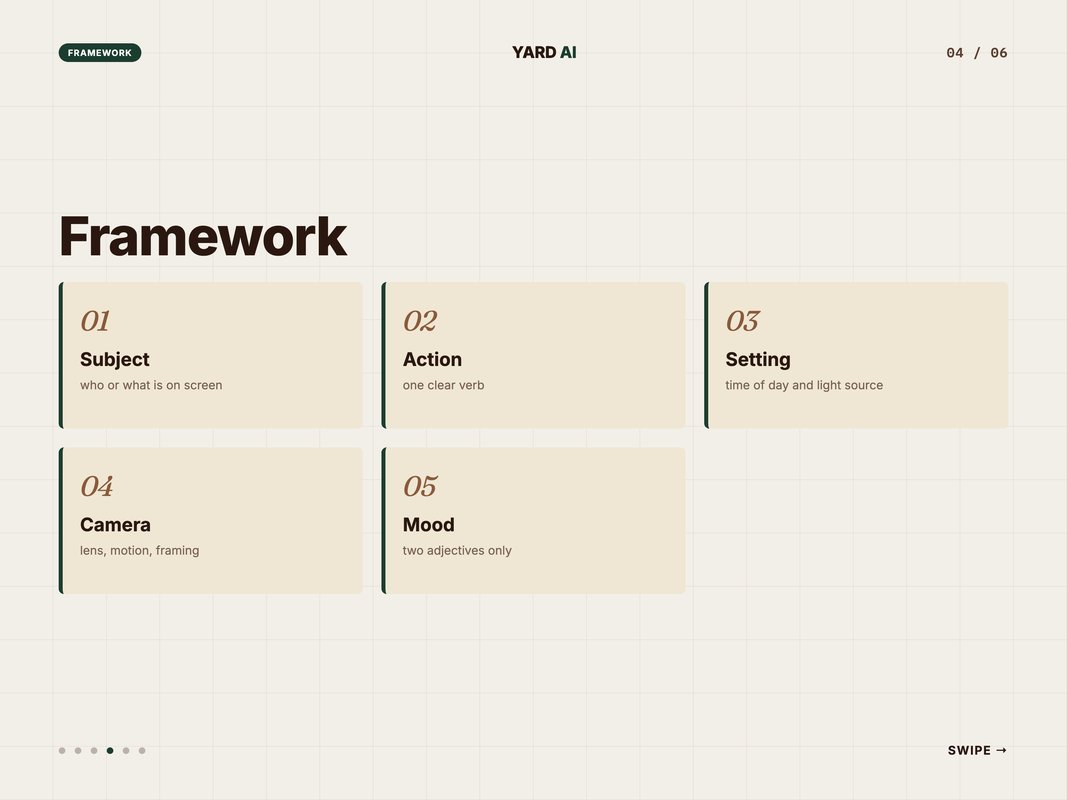
The shape that works for ads has five parts. Use it for every model.
- Subject. Who or what is on screen. Be specific.
- Action. One clear verb. No combos.
- Setting. Time of day, light source, location.
- Camera. Lens, motion, framing.
- Mood. Two adjectives. No more.
Here is a working example for a footwear ad.
A young runner in matte black trainers laces up on a cold morning step. Wide-angle 24mm shot. Slow push-in. Cinematic, soft fog. Tungsten warm key light from frame left.
That is 35 words. It renders in 6 seconds on Veo 3.1.
For product clips, lead with the product. For brand spots, lead with emotion. For UGC-style content, lead with the actor.
You can call fal.ai from Python, JavaScript, or Swift (Source: fal.ai docs, 2026 — docs.fal.ai).
Here is a minimal Python call for Veo 3.1 Fast.
import fal_client

result = fal_client.subscribe( "fal-ai/veo3.1/fast", arguments={ "prompt": "A young runner laces up matte black trainers on a cold step. Wide 24mm. Slow push-in.", "duration": "8s", "aspect_ratio": "9:16", "generate_audio": True, }, with_logs=True, )

print(result["video"]["url"])
Here is the same call in JavaScript.
import { fal } from "@fal-ai/client";

const result = await fal.subscribe("fal-ai/veo3.1/fast", { input: { prompt: "A young runner laces up matte black trainers on a cold step. Wide 24mm.", duration: "8s", aspect_ratio: "9:16", generate_audio: true, }, logs: true, });

console.log(result.video.url);
For long jobs use the queue. Submit a request, get a job ID, then poll or webhook (Source: fal.ai docs, Asynchronous Inference, 2026 — docs.fal.ai/model-apis/model-endpoints/queue).
handle = fal_client.submit(
    "fal-ai/kling-video/v2.5/turbo/pro/text-to-video",
    arguments={"prompt": "..."},
)

status = fal_client.status(handle.request_id)
result = fal_client.result(handle.request_id)
That pattern scales to 50 renders per hour without blocking your app.
Q: What ruins an AI video prompt?
A: Three things. Vague verbs like "showing" or "depicting". Too many actions in one shot. And overly poetic adjectives that the model cannot ground. Cut all three.
The 6 ad formats that work with fal.ai
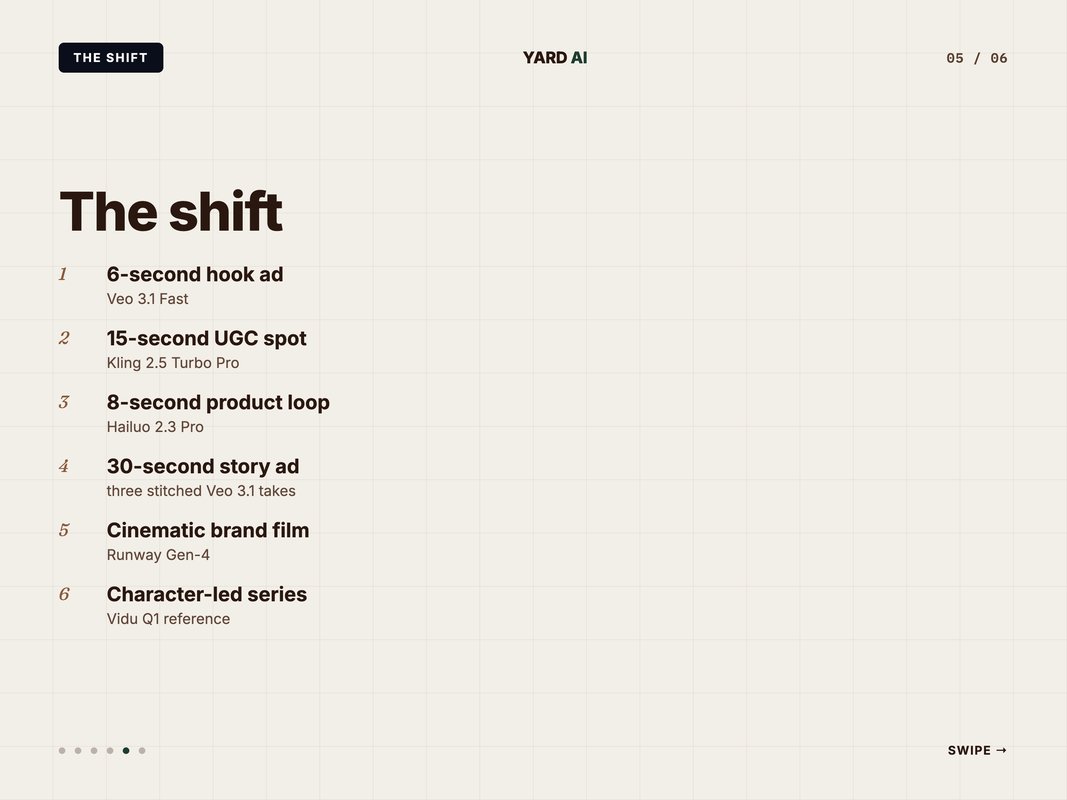
Most marketing teams over-think this. There are six formats that earn money.
- The 6-second hook ad. One product shot. One line. One CTA. Veo 3.1 Fast handles this in 12 seconds of render.
- The 15-second UGC-style spot. A creator-style actor on camera. Kling 2.5 for motion. Add captions in post.
- The 8-second product loop. Hailuo 2.3 Pro. Renders sharp at 1080p. Use for Meta Reels and Shorts.
- The 30-second story ad. Stitch three 8-second Veo 3.1 takes. Add a voiceover. Cut to beat.
- The cinematic brand film. Runway Gen-4. Use Motion Brush for hand-painted motion direction.
- The character-led series. Vidu Q1 with reference images. Lock your hero. Drop them into new scenes.
Each format has a known cost. A 6-second Veo 3.1 ad with audio runs about $0.80 in credits. A 15-second Kling clip runs about $1.05.
You can ship 50 ads a month for under $100. That is the part most teams miss.
The cost lever is not just the model. It is the take count. Three takes per shot is plenty for ad creative. Anything more is procrastination.
You should also batch by model. Render all your Veo shots in one queue. Then all your Kling shots. Then all your Hailuo loops. Context-switching between models slows you down.
Q: Should I use the same model for every ad format?
A: No. Different models win different jobs. Use Veo 3.1 for dialogue. Use Kling for motion. Use Hailuo for fast loops. Use Vidu for consistency. Mixing models is the point of fal.ai.
QA checklist before you ship a fal.ai video
Most teams skip QA. That is why their ad gets pulled.
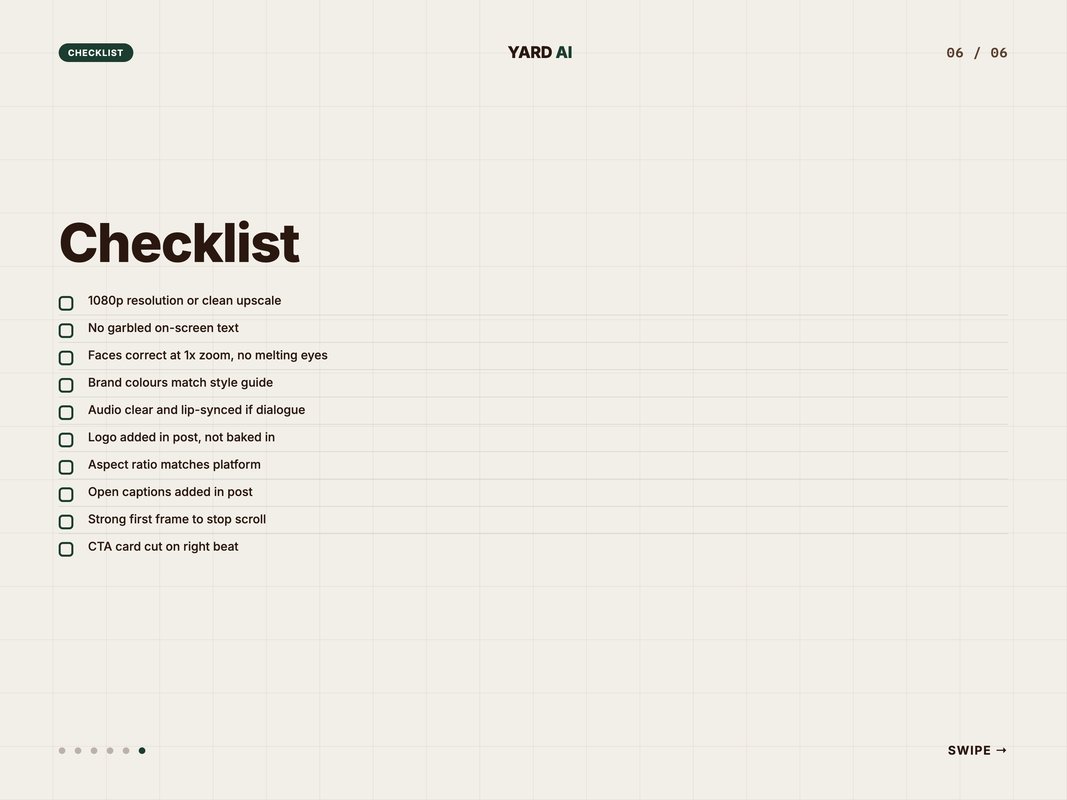
Run this list on every render before you push to Meta, TikTok, or YouTube.
- Check resolution. It must be at least 1080p or upscaled cleanly.
- Watch for garbled text in the frame. AI models still struggle with on-screen copy.
- Confirm faces look right at 1x zoom. Look for melting eyes or warped fingers.
- Match brand colours to the style guide. Lock the palette.
- Confirm audio is clear. The mouth shape should match if dialogue is used.
- Place the logo in post. Do not bake it in upstream.
- Set aspect ratio per platform. Use 9:16 for Reels, 1:1 for feed, 16:9 for YouTube.
- Add open captions in post. Most viewers watch on mute.
- Test the first frame. It must pause the scroll on its own.
- Cut the CTA card on the right beat. Wrong timing kills the click-through.
You should fail at least one render in three. If you are passing everything you are not looking hard enough.
A good QA habit is to watch the cut three times. Once with sound on. Once on mute. Once at half speed. Each pass catches a different class of bug.
Q: How do I fix garbled on-screen text in AI video?
A: You do not. Add the text in post. Render the video clean and overlay typography in CapCut, Premiere, or After Effects. This is faster and cheaper than re-rendering.
Prompt templates you can copy for fal.ai
Most teams burn credits writing prompts from scratch. Do not. Start from a known shape.
Here are three prompt templates that work for fal.ai marketing video generation. Each one fills in the five-part structure from earlier. Swap the brackets for your brief.
The product hero shot. Veo 3.1 Fast handles this best at 720p with audio.
A [product] sits on a [surface] in [light type]. The camera slowly orbits 90 degrees clockwise. Macro 50mm lens. Shallow depth of field. Cinematic, warm. Soft key light from above.
The UGC-style testimonial. Kling 2.5 Turbo Pro nails the motion and lip-sync feel.
A [age]-year-old [audience descriptor] holds [product] up to the camera. Says one short line. Handheld shaky cam. Vlog-style. Natural daylight from a window. Warm, casual.
The lifestyle action clip. Hailuo 2.3 Pro for fast 6-second renders.
A [subject] in [outfit] [verb] across a [setting]. Wide shot, then push-in. Cinematic colour grade. Golden hour. Energetic, aspirational. 24fps, slight motion blur.
These three templates cover 80% of D2C ad work. The remaining 20% needs custom prompts.
For best results, run each prompt three times. Vary the seed. Pick the best take. Then re-render with the same seed and minor tweaks to nail the final.
You should keep a prompt library doc. Note which prompts worked. Note which model and which seed. That doc becomes your fastest tool inside six weeks.
Q: Should I fine-tune a model on my brand?
A: Not yet. Most marketers do not need fine-tuning. Use reference-to-video endpoints with 4-7 brand images instead. That gets you 80% of the visual lock at zero training cost.
Cost math and where AI-native agencies plug in
Here is how to budget. Assume one operator. Five ad concepts. Three takes per concept.
That is 15 renders of 8 seconds each.
On Veo 3.1 Fast with audio at $0.10 per second, the math is 15 x 8 x $0.10 = $12. Add 25% for failed takes and the round number is $15 (Source: fal.ai pricing, 2026 — fal.ai/pricing).
For a full month of 50 ads, you are looking at $50 to $100 in fal.ai credits.
Compare that to traditional production. Production costs have dropped 91% with AI-assisted workflows, from $4,500 per minute to $400 per minute (Source: Vivideo AI Video Statistics, 2026 — vivideo.ai/blog/ai-video-statistics-2026).
You can fund the entire toolchain with one saved shoot.
That is the move. Ship more variants. Test faster. Kill losers earlier.
Most teams pick up fal.ai but stall on the workflow. They have credits and no system.
A working AI-native marketing stack uses fal.ai for video generation. An image model for stills. An LLM for ad copy and prompts. And a single ops layer to glue it all together.
We build this stack. We run it daily. We have shipped video ad systems for D2C and B2B brands across paid social, YouTube, and connected TV.
We pair fal.ai with Claude for prompt orchestration. With Webflow and Shopify for landing pages. With MCP-based tools for routing creative into Meta and Google Ads.
If you want one team that owns the model selection, the prompts, the renders, the QA. The media buy, that is what we do.
Talk to us about an AI video pilot. We can stand up a 10-ad-per-week pipeline in two weeks. You bring the brief, the brand assets, and a media budget. We bring the rest.
See more on the yardagency.ai site.
Wrapping up
fal.ai marketing video generation is the cheapest way into AI video right now.
You get one API. You get every major model. You get pay-per-use pricing. You get a workflow that fits inside an agency week.
Pick Veo 3.1 for dialogue. Pick Kling for motion. Pick Hailuo for speed. Pick Vidu for consistency.
Use the 5-stage pipeline. Write five-part prompts. Run the QA checklist before you ship.
The teams that win here are not the ones with the biggest budget. They are the ones who test the most.
Start small. Ship 10 ads this month. Cut the losers. Scale the winners.
That is the play.
A final note on creative discipline. AI video tempts you to over-render. Resist that pull. Three takes per shot is the right ceiling. Anything more is procrastination dressed as polish.
Also track your spend per shipped ad. Not per render. Per ad that actually went live on a paid platform. That number is the only one that matters.
Most teams find their cost-per-shipped-ad lands between two and five dollars on fal.ai. If yours is higher, your QA bar is too low. If it is much lower, you may not be filtering hard enough.
The system above is opinionated by design. Use it as a starting point. Tweak it for your brand. Then come back and tweak it again in a month. The space moves fast.
One last call. Track creative fatigue. AI video is cheap to make. That means it gets old fast on a feed. Rotate hooks every two weeks. Refresh the opening frame every week. Kill any single ad creative after ten thousand impressions if the CTR is below the platform median.
You will burn through your library. That is the point. The agencies that win are the ones that view every ad as disposable. The library is the moat. Not any one clip.
This is the marketing edge fal.ai unlocks. Cheap variants at scale. Fast iteration. Lower waste. Better signal on what your audience actually wants.
Build the system. Run it weekly. Watch your CPM fall.
FAQ
Q: What is fal.ai used for in marketing? A: fal.ai is a model-hosting API. Marketers use it to generate video ads, product clips, and social cutdowns from one endpoint. You pick a model like Veo, Kling, or Hailuo and pay per second of output.
Q: Which fal.ai video model is best for ads? A: For 6 to 8 second hooks with sound, Veo 3.1 is the strongest. For motion-heavy product shots, Kling 2.5 Turbo Pro is the value pick. For fast 1080p cutdowns, Hailuo 2.3 Pro works well.
Q: How much does fal.ai cost for video? A: Pricing is per second or per video. Veo 3.1 Fast is about $0.10 per second at 720p. Kling 2.5 Turbo Pro is about $0.07 per second. Hailuo 2.3 Pro 1080p is about $0.49 per video.
Q: Can I use fal.ai videos in paid ads? A: Yes. Most fal.ai models grant commercial-use rights through their license. Always confirm the model card. Render at 1080p or higher and upscale where needed.
Q: How do I get consistent characters across clips? A: Use reference-to-video endpoints like Veo 3.1 reference, Vidu Q1, or Kling image-to-video. Feed the same hero image and lock the seed where supported. Keep wardrobe and lighting tokens identical in the prompt.
Q: Is fal.ai better than calling each model directly? A: For most marketing teams, yes. One API, one bill, no idle cost. You can switch models by changing one string. That matters when you A/B test creative.
Insights from Our Experts
Explore our latest articles on digital marketing strategies.