
You do not need a budget to start with AI.
In 2026, the best free AI marketing tools 2026 can plan a campaign, write the copy, design the creative, send the email. Tell you what worked. All on a zero-rupee plan. That used to take a small team and a real software bill.
Most small business owners still pay for tools they could replace today.
This guide picks the free tiers worth keeping. We sort them by job: content, design, email, ads, and analytics. We flag the real limits on each one. We close with a soft path for when you outgrow them.
You will not see fluff. You will see what to install, what to ignore, and what to upgrade.
Why Free AI Marketing Tools 2026 Are Finally Good Enough
A few years ago, "free AI" meant a watermark and a trial.
That has shifted. The big providers now ship real free tiers because the upgrade path pays for itself later. Most small business owners can run for many months on free plans before they ever hit a limit.
The numbers say the same thing.
Quick Facts: Small Business AI Use in 2026.
- Sixty-eight percent of US small businesses now use AI tools regularly, up from 48% in mid-2024 — (Source: Capsule CRM, 2026 — Small business AI adoption statistics for 2026).
- Over half (54%) of small businesses use AI for marketing as their primary use case — (Source: SBE Council Tech Use Survey, 2026 — SBE Council Tech Use Survey 2026).
- Nine in ten SMBs using AI say it boosts revenue, and 90% say it improves efficiency — (Source: Capsule CRM, 2026 — Small business AI adoption statistics).
- The median small business now runs five AI tools at once — (Source: SBE Council, 2026 — SBE Council AI Tools Report).
Marketing is the entry point for almost every SMB.
It is where the savings show first. A task that used to eat up most of the morning now wraps up in a fraction of the time. The numbers translate fast. You do not have to wait a quarter to see if AI works.
So the question is not "should I use AI?" anymore. It is "which free tier covers the job I need today?"
Q: Are free AI marketing tools worth using in 2026?
A: Yes. The 2026 free tiers cover most early-stage marketing jobs end to end. You can run content, email, design, and basic automation without paying. Most owners only outgrow free plans once their contact list, send volume, or ad spend crosses a clear threshold.
The 5 Jobs a Small Business Marketing Stack Must Cover
Free tools work best when you pick one per job.
The trap is stacking ten AI tools that do the same thing. You end up with three writers, no designer, and no email list. We use a simple model to keep stacks tight.
Use the 5-job stack below. Each job gets one primary tool. You add a second only when the first hits a hard limit.

This model maps to how 2026 buyers actually research. They search by job, not by tool. A query like free email tool for small business beats best AI tool overall.
Pick your top job first. If your bottleneck is content, start there. If it is replies, start with email.
You can add the others later in any order.
Q: How many AI tools should a small business use?
A: The 2026 average is five (Source: SBE Council, 2026 — SBE Council AI Tools Report). Start with one tool per job: one for copy, one for design, one for email, one for automation, one for analytics. Add more only when a real bottleneck shows up.
The Best Free AI Tools for Content and Copy
Content is where most SMBs start with AI.
It is also where free tiers are strongest. You can write a month of social, two emails, and a landing page without paying. The trick is the prompt, not the tool.
Below are the picks worth installing this week.

ChatGPT is the default. Gemini wins on research-heavy work. Claude is sharper for brand tone if you do not mind the smaller free quota. Grammarly catches the things AI still misses.
The rule is to pick two, not six.
One main writer. One quality check. That is the whole content stack for most small business owners in 2026.
Q: Which free AI tool is best for writing marketing copy?
A: ChatGPT and Gemini are the two strongest free picks. ChatGPT is sharper for ad copy and product descriptions. Gemini is better at research and long-form drafts. Most owners use both for different tasks.
Free AI Tools for Design and Visual Content
You do not need a designer to ship modern creatives.
Canva AI is the SMB workhorse. The free tier covers social posts, ad creatives, presentations, and basic video. It now includes text-to-image generation on the free plan. That used to be a paid feature.
Adobe Express is the second pick. It is closer to a "real" design tool. The free tier gives you limited AI credits each month. Use it for hero images and ad mockups. Save Canva for daily volume.
Below is a quick split of when to use which.
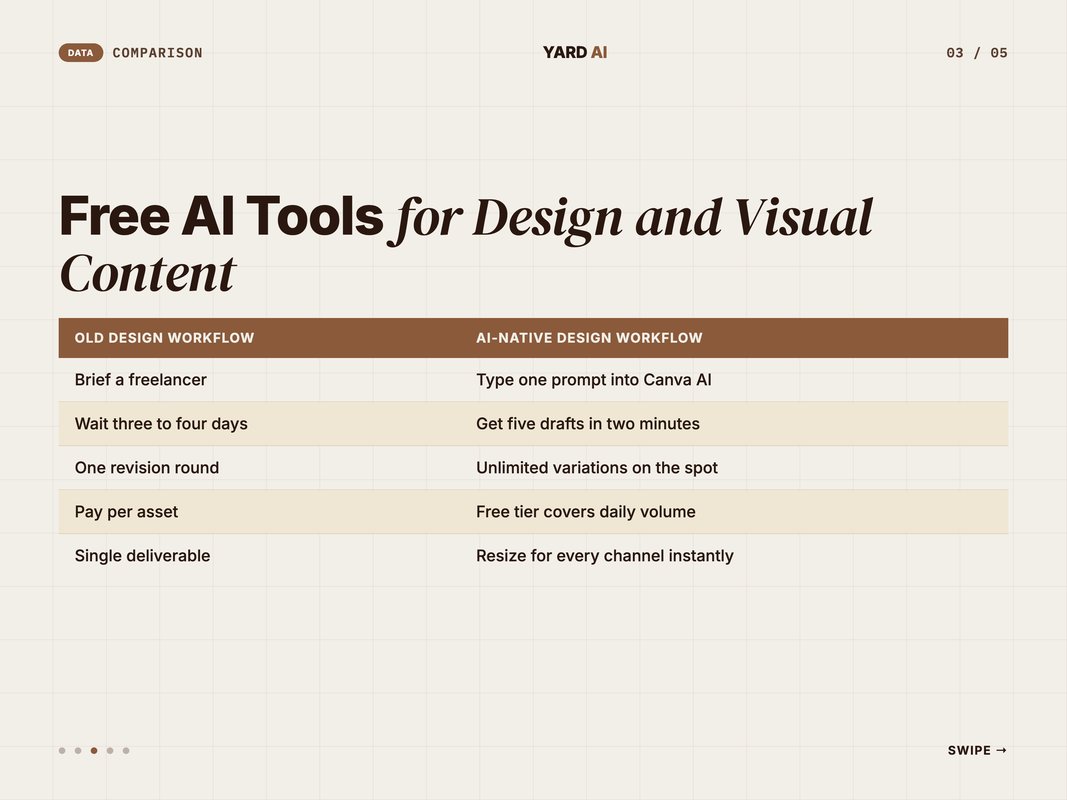
The old way meant briefing a freelancer and waiting four days. The new way means typing one line and choosing from five drafts.
The free tier limits show up in two places. Canva caps the number of premium templates. Adobe caps AI credits per month. Neither will stop a small business in its first six months.
Q: Can I run all my design needs on a free AI tool?
A: For most early-stage brands, yes. Canva AI free covers daily social, ads, and presentations. Adobe Express free handles occasional higher-fidelity work. You only need a paid tier when you scale to weekly video, brand templates, or team access.
Email, CRM, and Marketing Automation on a Free Plan
Email is the highest-ROI free job in 2026.
Three platforms cover almost every small business need. None of them charge until your list or send volume crosses a clear line.
Below is the side-by-side. Pick one. Do not mix.
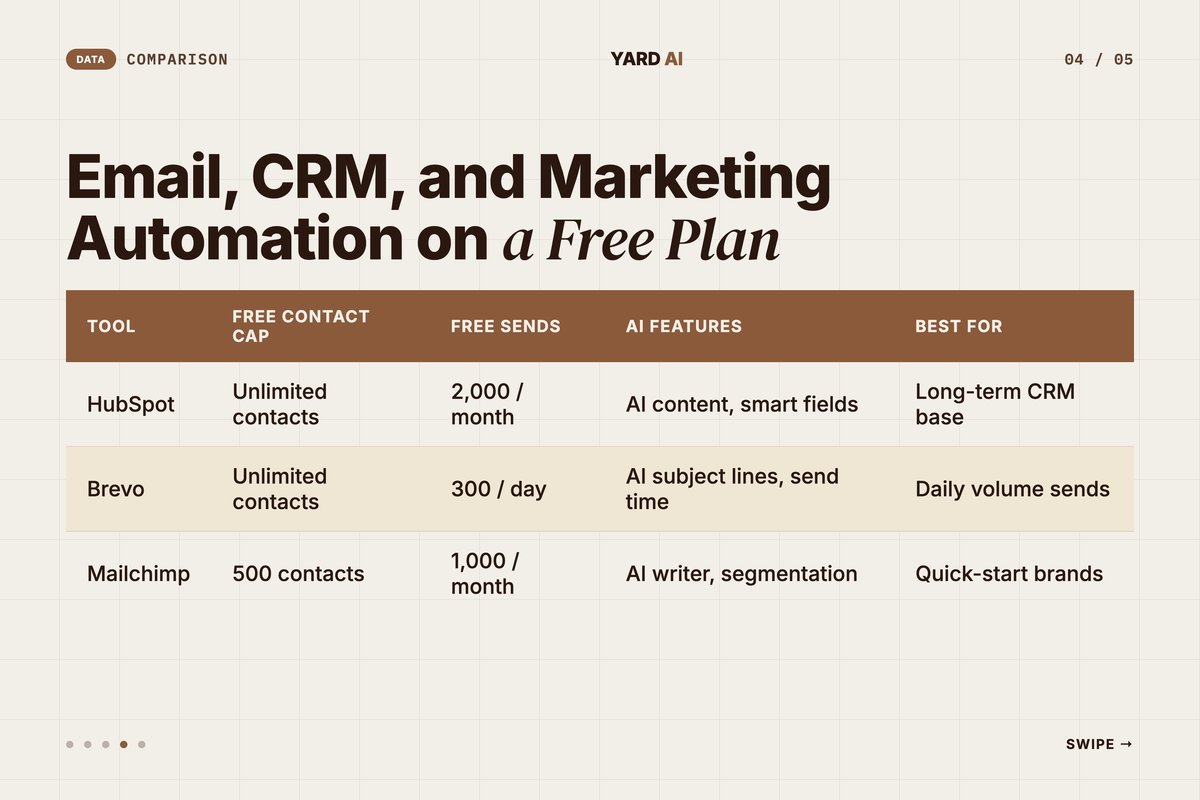
HubSpot free is the best long-term bet. Its CRM is genuinely useful at zero cost. The free Marketing Hub adds email, landing pages, and basic AI content tools. You only pay when you want full automation.
Brevo wins on daily send volume. Three hundred emails per day is more than most SMBs need in a week (Source: Brevo, 2026 — Brevo Pricing Plans). The free tier includes AI subject lines and send-time picks.
Mailchimp is the safe default. The free plan now covers 250 contacts and 500 sends per month after a February 2026 cut (Source: Mailchimp Pricing Help Center, 2026 — About Mailchimp Pricing Plans). Its AI writer is built into the editor. The list cap shows up fast on a growing brand.
Q: Do free AI tools work for marketing automation?
A: Yes, for small lists. Zapier free runs basic multi-step flows. HubSpot and Brevo handle welcome sequences and lead routing. Heavy multi-channel workflows or large lists usually need a paid tier.
Free AI for Ads, Funnels, and Analytics
You cannot run ads for free.
But you can plan, write, design, and measure them at no cost. That is the gap most small business owners miss. The media spend is the only bill that has to be paid.
The 4-step audit below uses only free tools.

Step one finds the real bottleneck. Step two checks the brief. Step three rebuilds creative. Step four measures the result. Step five decides what to scale or kill.
Google Analytics is the free baseline. Its AI insights flag drop-offs in your funnel. Microsoft Clarity adds free session recordings on top. Looker Studio (free) turns the numbers into one dashboard for your team.
For ads, ChatGPT writes the copy. Canva builds the creative. Brevo or HubSpot lands the click. None of it costs anything until the ad spend.
Q: Can I run paid ads using only free AI tools?
A: You cannot run the ads themselves for free. But you can plan, write, design, and analyse campaigns at no cost. You only pay the ad platforms for the media spend.
When to Outgrow Free Tools (and What to Watch)
Free plans break in three places.
First, list size. Second, send or query volume. Third, team seats. None of these are surprises. They are written into every free tier.
Below is the SMB upgrade signal list. Use it as a quarterly check.
Upgrade signals checklist:
- You hit your email contact cap two months in a row.
- Your team needs more than one user seat on the same tool.
- You need multi-step automation across more than three apps.
- You want to remove platform branding from emails or landing pages.
- You start running paid ads above a meaningful monthly spend threshold.
Hitting two or more means it is time to move one tool to paid. Not all of them. Just the one with the loudest bottleneck.
Most small business owners stay on free plans for many months. After that, one or two tools graduate to paid. The rest stay free for years.
Q: What is the right time to switch from free to paid AI marketing tools?
A: When two or more upgrade signals fire in a month. That is the rule. Move the one tool that blocks the most work first. Keep the rest on free until each one trips its own signal.
Where AI Tools Stop and a Real Stack Begins
Free AI tools are a great start.
They are not a finished marketing engine. At some point you want fewer tools, not more. You want one stack that runs content, ads, email, and analytics together. That is where a partner helps.
YARD is an AI-first growth marketing agency. We build performance marketing, LLM SEO, AI creatives, and AI-native funnels for D2C and B2B brands. The free tools above sit inside a much larger system when we run it for clients.
The shift is not from no AI to more AI.
It is from five free tools an owner runs alone to one stack that runs itself. That stack uses paid tiers where it matters. It uses free tiers where it does not. The mix is the work.
If you have outgrown your free stack and want a single system instead, [internal link: book-a-call] is the next step. We will look at what you are already running and tell you what to keep, swap, or kill. No pitch deck. Just a real audit.
You can also keep using free tools for now. They are good enough to carry an early-stage brand through its first wave of traction. After that, the math usually flips.
Conclusion
The 2026 free tier is the best deal in marketing.
You can run a real brand for months without paying a software bill. Pick one tool per job. Start with the bottleneck. Add a second only when the first hits a hard limit.
Most small business owners will stay on free plans for a year. A few will graduate one or two tools to paid. The rest will stay free for the long run.
The work is not the tools. The work is the system around them. Get the system right and the free tools do more than most paid stacks ever did.
Pick one job today. Install one tool. Ship one campaign this week.
FAQ
Q: What are the best free AI marketing tools in 2026?
A: The strongest free stack uses ChatGPT or Gemini for copy. Canva AI handles design. HubSpot or Brevo runs email. Zapier covers automation. Google Analytics gives you AI insights. Each has a real free tier.
Q: Are free AI marketing tools good enough for a small business?
A: Yes, for early-stage brands they are more than enough. Free tiers cover content, image creation, basic email, and light automation. You only outgrow them once your list crosses a paid-tier threshold.
Q: How many AI tools should a small business use?
A: The 2026 survey average is about five tools per small business (Source: SBE Council, 2026 — SBE Council AI Tools Report). Start with one tool per job: copy, design, email, automation, analytics. Add more only when a real bottleneck shows up.
Q: Do free AI tools work for marketing automation?
A: Yes, on small lists. Free plans on Zapier, HubSpot, and Brevo handle basic flows. You can run welcome sequences, lead routing, and small drips at no cost. Heavy workflows need a paid tier.
Q: Which free AI tool is best for writing marketing copy?
A: ChatGPT and Gemini are the two strongest free picks. ChatGPT is sharper for ad copy and product descriptions. Gemini is better at research and long-form drafts. Most owners use both for different tasks.
Q: Can I run paid ads using only free AI tools?
A: You cannot run the ads themselves for free. But you can plan, write, design, and measure campaigns at no cost. Free tools cover copy, creative, and reporting. You only pay the ad platforms for media spend.
Insights from Our Experts
Explore our latest articles on digital marketing strategies.