
On 13 October 2026, Google launched Gemini 4 Argon. It is Google's newest and most capable AI model (Source: Google, 2026 — Gemini 4 Argon: Built to solve your hardest problems).
Google's post is long. It covers code, science, robots and safety.
But one short demo in the middle is the part a marketing team should watch.
In it, a small catering firm gets a request from a client. Argon reads the notes in Google Drive. It builds a pitch deck in Google Slides. It writes the email to the client.
Then it sets up a task that does the same thing for every new request. And it logs each lead in a sheet.
That is not a chat answer. That is a junior account manager's whole week.
This piece is a read of Google's launch post and one outside leaderboard. Where a claim is Google's own, we say so.
What Google actually shipped
Gemini 4 Argon is the first model in the Gemini 4 family. Google says more Gemini 4 models are coming.
It is out now in a lot of places at once. Here is the plain version:
- In the Gemini app, if you pay for Google AI Pro or Ultra.
- In AI Mode in Search, on the same two plans.
- For builders, through the Gemini API in AI Studio.
- For companies, through Gemini for business and Google's cloud platform.
- In Google Antigravity, Google's coding tool, on the Ultra plan.
To use it in the Gemini app, pick "Argon" in the model menu. That is it.
So unlike some launches, most teams can try this today. If someone on your team already pays for Gemini Pro, they have it.
Google also says the model has a very large working memory. Through the API, it can take in and write out up to one million tokens in total.
In plain words, it can read a very large pile of files in one go. Think a full brand archive, not just one brief.
The demo: from client notes to a sent pitch
Let us go back to that catering demo, step by step. Google says the steps were shortened and the screens simulated, so treat it as a demo.
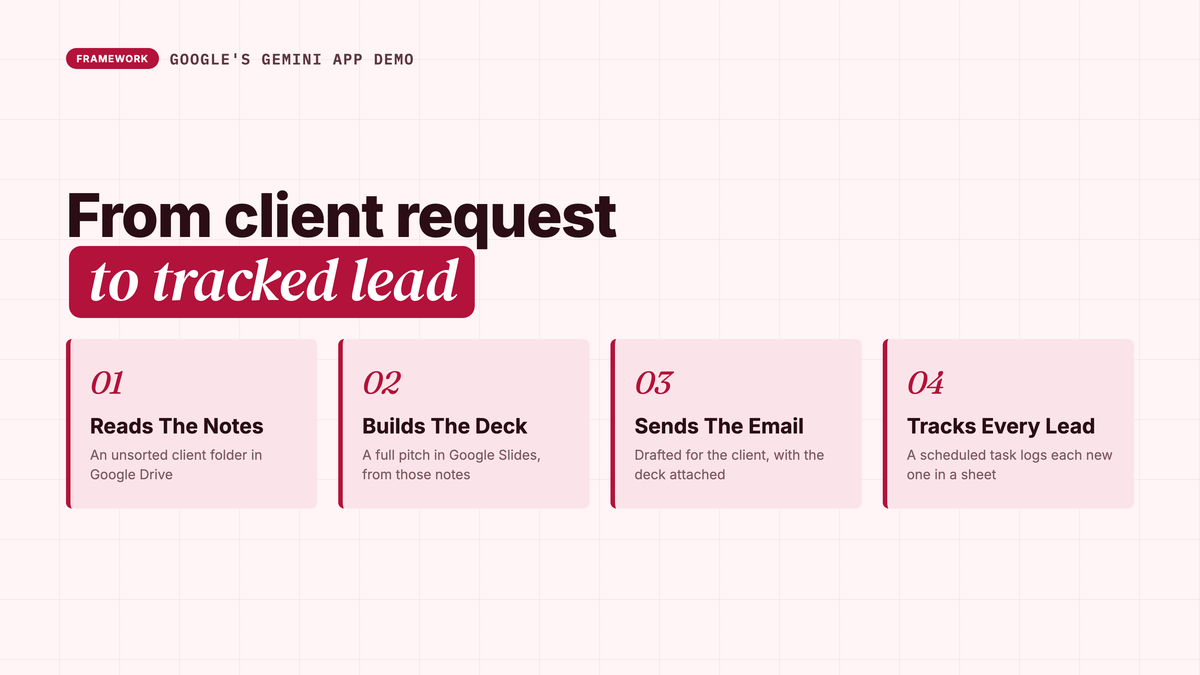
Step one. A client asks for a private dinner for 20 guests. The firm's notes on past events sit in a Drive folder.
Step two. Argon reads that folder. Google says it was messy and unsorted. Then it turns it into a clean pitch deck using a custom skill.
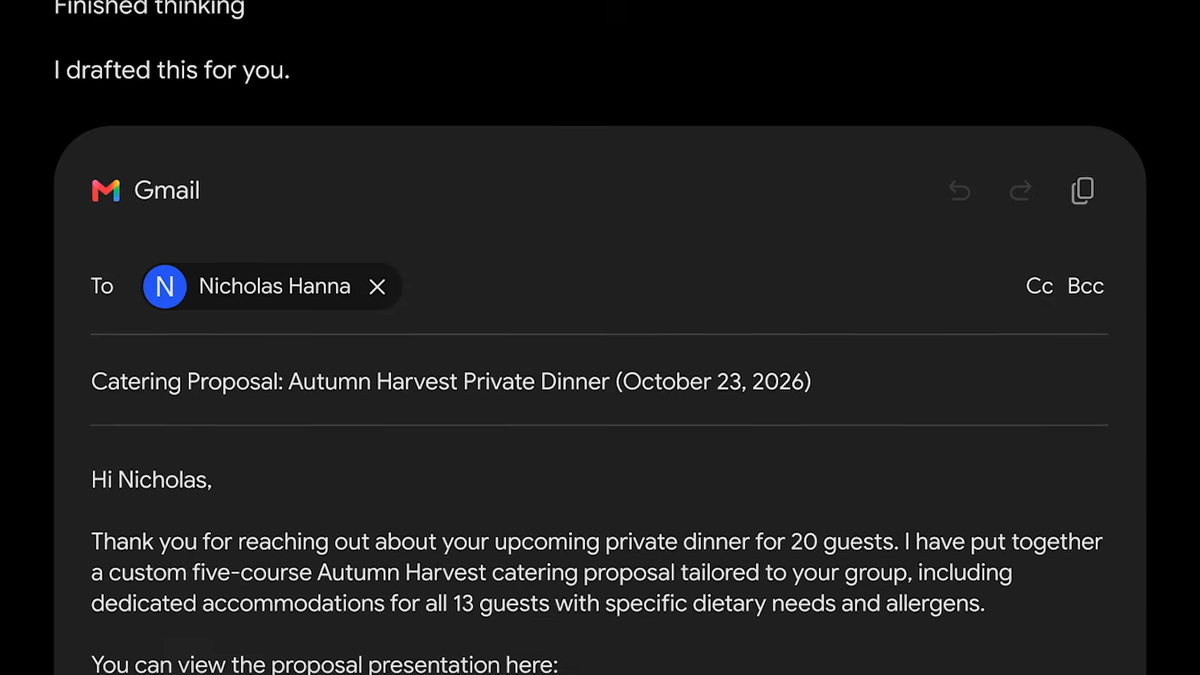
Step three. It drafts an email to the client with the deck attached. The draft even notes the guests with special dietary needs.
Step four. It sets up a scheduled task. From now on, each new request gets its own deck. Each lead lands in a tracker sheet with a status like "Proposal Sent" or "Deposit Paid".
Google sums it up in one line. Argon "formats it into a clean proposal deck for a client using a custom skill" and then drafts and emails it (Source: Google, 2026 — launch post).
Now read that as an agency. Swap catering for your own pitch work.
A brief comes in. Someone digs through old decks. Someone builds a new one. Someone writes the cover email. Someone updates the pipeline sheet.
That is four handoffs. In Google's demo, it is one tool.

It writes in your style, Google says
Every agency has fought the same fight with AI copy. It hedges. It repeats itself. It reaches for the same tired phrases.
Google says Argon is better on all three.
In its words, the model follows style instructions better than any earlier Gemini model. It answers more directly, with less hedging. It does not repeat itself more than it needs to. And it skips clichés.
Those are Google's claims, not test results. But they are easy to check.
Take your client's tone guide. Give it to Argon with one real brief. Then read the output against the guide, line by line.
Count the hedges. Count the banned words. Count the lines your editor would cut.
That takes an hour. It will tell you more than any chart.
The scores, and what they really say
Google says Argon is number one on the Vals Index. That claim checks out.
The Vals Index is run by an outside firm. It tests models on finance, coding, legal and tax work.
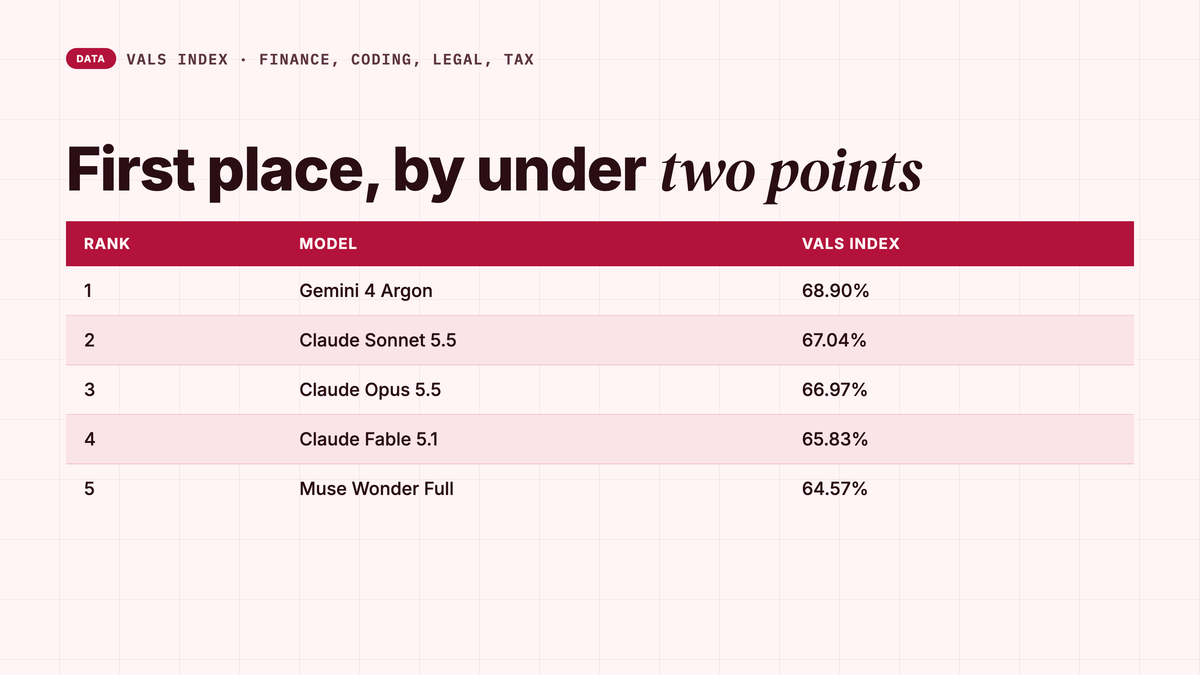
On the current board, Gemini 4 Argon scores 68.90%. Claude Sonnet 5.5 is next with 67.04%. Claude Opus 5.5 scores 66.97%. Claude Fable 5.1 scores 65.83%. Meta's Muse Wonder Full is fifth with 64.57% (Source: Vals AI, 2026 — Vals Index).
So yes, it leads. But look at the size of the lead. It is under two points.
Vals also notes that no single model leads every part of the test. Argon leads on finance work. Claude models lead on tax, coding and terminal tasks.
There is one fair point in Argon's favour. Vals says some Claude scores used a fallback model on a few tasks. Argon needed no fallbacks.
On a second outside chart, the picture is less rosy. On the Artificial Analysis Intelligence Index, Argon scored 53. Claude Opus 5.5 scored 58, and Muse Wonder Full scored 56 (Source: Artificial Analysis, 12 October 2026, via Meta).
So the honest summary is this. Argon is at the top of the pack, not miles ahead of it.
For a marketer, that changes the question. You are not picking the one smart model. You are picking the one that fits your tools.
If your team lives in Google Drive, Gmail and Sheets, that fit is the real advantage. The demo only works because the model sits inside those apps.
What it costs, and the date to watch
There are two prices here, and they work in different ways.
If you use the Gemini app, Argon comes with your plan. It is part of Google AI Pro and Ultra. There is no extra charge per task.
If you build with it, you pay per use. And that price is about to change.
Right now, the API price is $2 per million input tokens and $10 per million output tokens. Cached input costs 95% less.
That is an introductory price. After 30 November 2026, it goes up to $4 per million input tokens and $20 per million output tokens (Source: Google, 2026 — launch post footnote).
In plain words, the builder price doubles on 1 December.
So if you plan to build a tool on Argon, cost it at the higher rate. Do not let a six-week discount set your budget for the year.
There is a useful hint on the Vals page too. It lists what each model cost to run the full test.
Argon cost $15.68. Claude Opus 5.5 cost $32.14. Muse Wonder Full cost $8.56 (Source: Vals AI, 2026 — Vals Index).
So Argon is not the cheapest. But it beat models that cost twice as much to run.

The safety part that matters when AI reads your inbox
The demo has one quiet risk. An AI that reads your inbox also reads whatever lands in it.
That includes emails written to trick it. Security people call this prompt injection. A hidden line in an email or web page tells the AI to do something you never asked for.
Google says Argon is much harder to trick this way. On the Gray Swan test for this attack, Google says attack success fell to 0.7% across 15 tries (Source: Google, 2026 — launch post).
Google also says it trained Argon to pause and ask before any step that cannot be undone. And it says the model takes far fewer shortcuts when it hits a wall.
Both of those are good signs. Neither is a reason to switch the brakes off.
For any workflow that sends email to a client, keep a human on the send button. At least for the first month.
Let it draft. Let it build the deck. Let it fill the tracker. Then have a person read the email before it goes.
A wrong number in a pitch is embarrassing. A wrong name on a client email is worse.
What early customers said
Google's post quotes a long list of early users. Treat these as hand-picked, because they are. Still, a few are useful.
Box said Argon was 14% more accurate than Gemini 3.1 Pro on its knowledge work tests.
Kepler said Argon matched its analysts' financial models on more than 99% of figures.
Amplitude said Argon scored near the top of its tests for building charts that help customers see their data (Source: Google, 2026 — customer quotes in the launch post).
That last one matters for reporting work. If your team builds client dashboards, test it on a real one.
There is also a fun demo for creative teams. Argon turned photos of a real desk into a racing game you can play in the browser.
Picture that for a brand. A product launch page where the game track is built from your own product shots.
Google has put the desk game in AI Studio so anyone can try it. It is worth ten minutes of your creative lead's time.
We said the same thing about Gemini 3.6 Flash and ChatGPT Work. Launch quotes are a lead. Your own test is the proof.
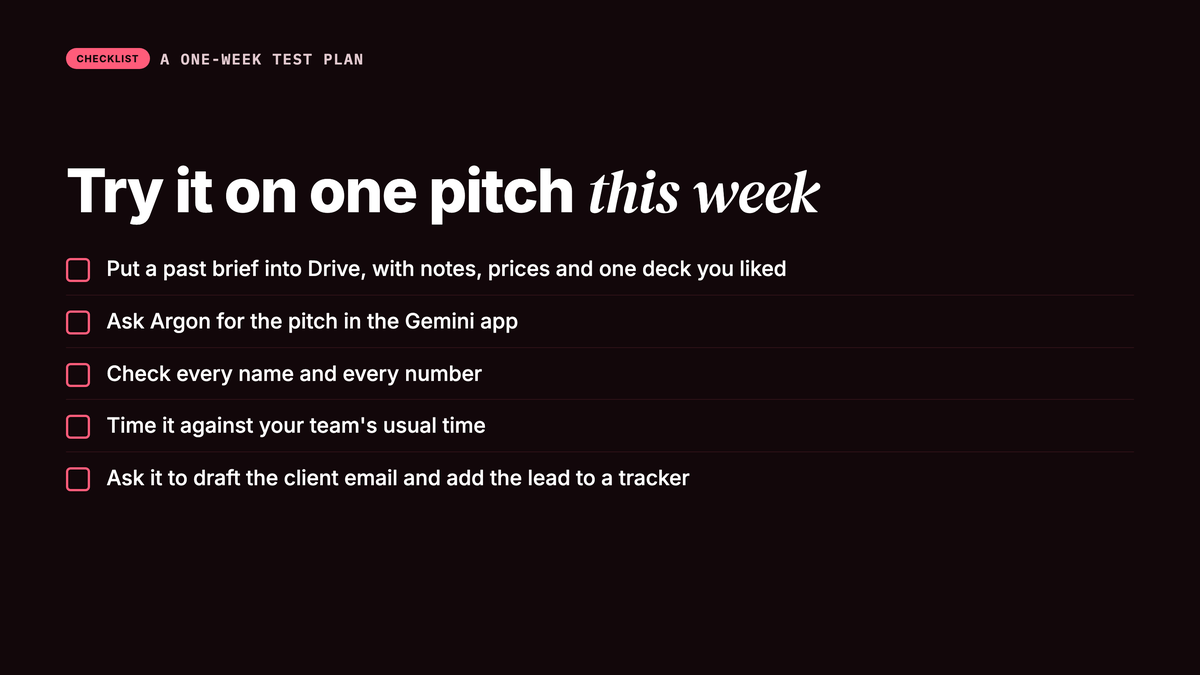
Try it on one pitch this week
Here is a test any agency can run in a week. It needs one person and one past brief.
First, put a past brief into Drive. Add the notes, the prices and one deck you liked.
Second, ask Argon for the pitch. Use the Gemini app and pick Argon in the model menu.
Third, check every name and every number. This is the step most people skip. Do not skip it.
Fourth, time it. Compare the time against your team's usual time for the same pitch.
Fifth, try the follow-up. Ask it to draft the client email and add the lead to a tracker sheet.
At the end, you will know three things. How good the deck is. How much time it saved. And how much checking it still needs.
Those three numbers are your business case. They beat any leaderboard.
What this means for your plans
Three things change after this launch.
The first is that the pitch workflow is now a fair target for AI. Not just the copy. The deck, the email and the pipeline too.
The second is that your tools matter more than the model. Argon's best demo works because it lives inside Drive, Gmail and Sheets. If your team runs on Google, that is a real edge.
The third is the price date. If you build on the API, plan for the higher rate from 1 December.
One last note on timing. Meta shipped Muse Wonder just one day before Argon. Both claim the top spot on some chart.
So run your own test. Pick the one that saves your team the most hours on real work.
FAQ
Q: What is Gemini 4 Argon?
A: It is Google's newest AI model, launched on 13 October 2026. It is the first model in the Gemini 4 family. Google built it for long, hard tasks across many steps.
Q: How can I use Gemini 4 Argon?
A: Pick Argon in the model menu in the Gemini app if you pay for Google AI Pro or Ultra. It is also in AI Mode in Search, the Gemini API and Google Antigravity.
Q: How much does Gemini 4 Argon cost?
A: For app users, it is part of the Pro and Ultra plans. For builders, it is $2 per million input tokens and $10 per million output tokens until 30 November 2026. After that it is $4 and $20.
Q: Is Gemini 4 Argon the best AI model?
A: It leads the Vals Index with 68.90%, but by under two points. On the Artificial Analysis index it scored 53, behind Claude Opus 5.5 and Muse Wonder Full.
Q: What did Gemini 4 Argon do in Google's demo?
A: It read client notes in Drive and built a pitch deck in Slides. It drafted and sent the client email. Then it set up a task to do the same for each new lead and log it in a sheet.
Q: Can Gemini 4 Argon write in my brand voice?
A: Google says it follows style rules better than earlier Gemini models, with less hedging and fewer clichés. Test it with your own tone guide before you trust it.
Q: Is it safe to let Argon read our inbox?
A: Google says it is much harder to trick with hidden instructions and pauses before steps that cannot be undone. Still keep a person on the send button for client emails.
Sources
- Google — Gemini 4 Argon: Built to solve your hardest problems (13 October 2026; availability, demo, pricing, safety and customer quotes).
- Vals AI — Vals Index (accessed 16 October 2026; ranks, component leaders, fallback note and cost per test run).
- Meta research blog — Muse Wonder (12 October 2026; carries the Artificial Analysis Intelligence Index chart cited above).
- YARD — Gemini 3.6 Flash and ChatGPT Work (earlier reads of AI launches for marketers).
Insights from Our Experts
Explore our latest articles on digital marketing strategies.