

Three model names landed in one week. Most marketing teams picked the biggest one and moved on.
That is the expensive answer.
GPT-5.6 arrived on 9 July 2026 in three tiers — Sol, Terra and Luna — (Source: Dataconomy, 2026 — dataconomy.com). They are not three products. They are one family at three price points. The number tells you the generation. The name tells you the tier.
So the real question is not "is GPT-5.6 good". It is "which of my jobs go where". This guide answers that. You get the specs, the costs, a routing rule you can copy, and a one-week test plan.
We run this decision for client accounts every quarter. The answer is almost never "use the best model". It is a split, and the split is where the savings live.
What Actually Changed in GPT-5.6
Start with the naming, because it is the part people get wrong.
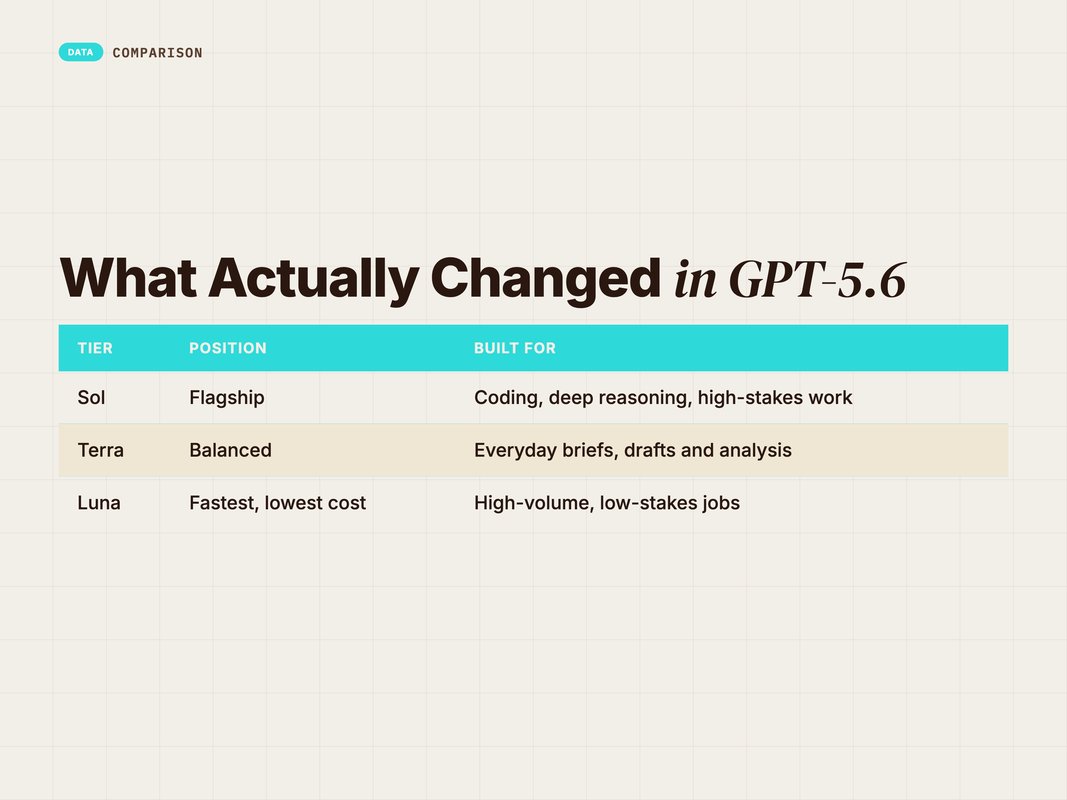
Before this release, model names mixed generation and size in one string. GPT-5.6 splits them. The number is the generation. The celestial name is the tier.
That matters more than it sounds. OpenAI says each tier can now move on its own schedule. A Luna upgrade does not force a rename of the whole family (Source: Vellum, 2026 — vellum.ai).
For you, that means one thing. Pin the tier in your stack, not the version string.
Sol is the flagship. It leads on coding, knowledge work and science. It gets there using fewer tokens than the models before it (Source: Dataconomy, 2026 — dataconomy.com).
Terra sits in the middle. It trades a little depth for speed and cost.
Luna is the cheap, fast one. It is built for volume.
There is a second change worth flagging. Token efficiency moved, not just raw capability. A model that reaches the same answer in fewer tokens costs less per job even at the same headline price.
That is why comparing tiers on the price card alone misleads you. The number that matters is cost per finished task, and it only shows up when you run your own work through both.
Q: Is GPT-5.6 a new generation or a refresh?
A: It is a point release on the GPT-5 line, not a clean-sheet generation. The bigger change is structural. One generation now ships as three named tiers, each with its own price and speed profile.
Sol, Terra and Luna: Which Tier Does What
Here is the plain-English version.
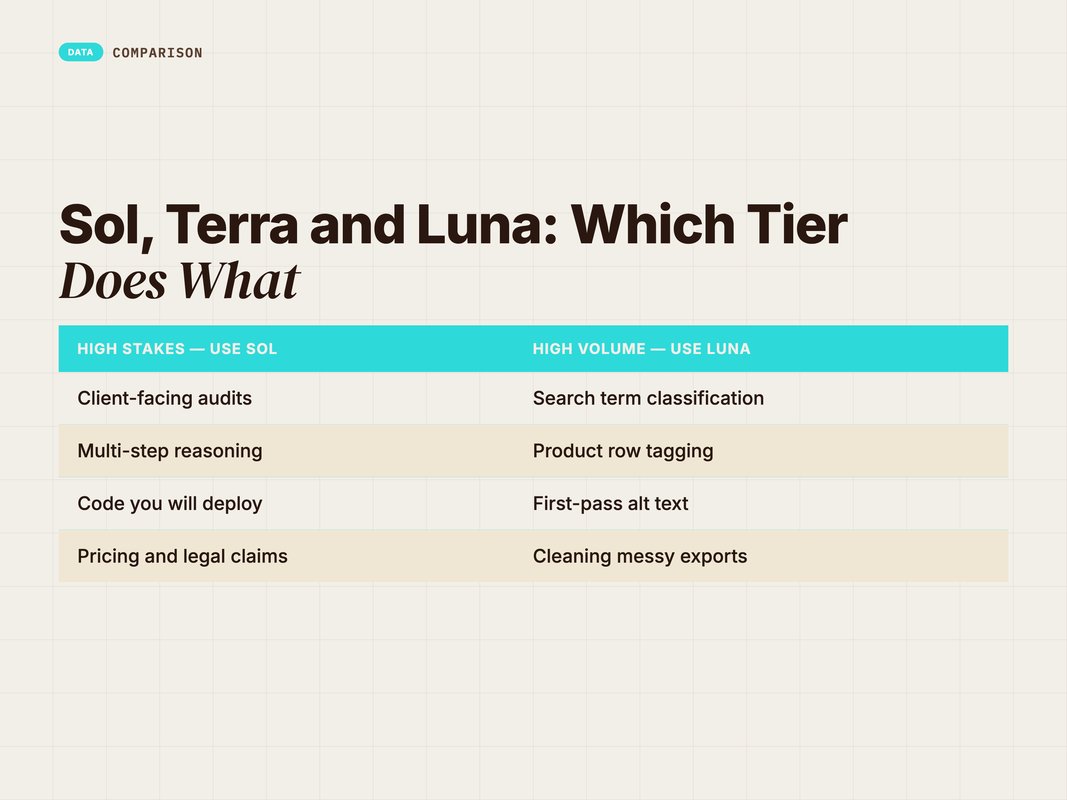
Sol is for work where being wrong is expensive. Long audits. Multi-step reasoning. Code you will deploy. Anything a client sees with your name on it.
Terra is the daily driver. Briefs, drafts, research summaries, campaign structures, analysis of a normal-sized data pull. It is the tier most marketing teams should default to.
Luna is for volume. Tagging thousands of rows. Classifying search terms. First-pass alt text. Cleaning a messy export.
The trap is treating this as a quality ladder. It is not. It is a stakes ladder.
A tagging job does not get better on Sol. It gets slower and pricier. A strategy memo does not get cheaper on Luna. It gets vaguer, and you pay for the rewrite in your own hours.
Q: Can I just use one tier for everything?
A: You can, and most teams do. It is also the most common way to overspend. Single-model defaults push cheap work onto expensive models and hard work onto weak ones.
What the Three Tiers Cost
Now the numbers. Treat these as a starting point and check the live pricing page before you commit a budget.
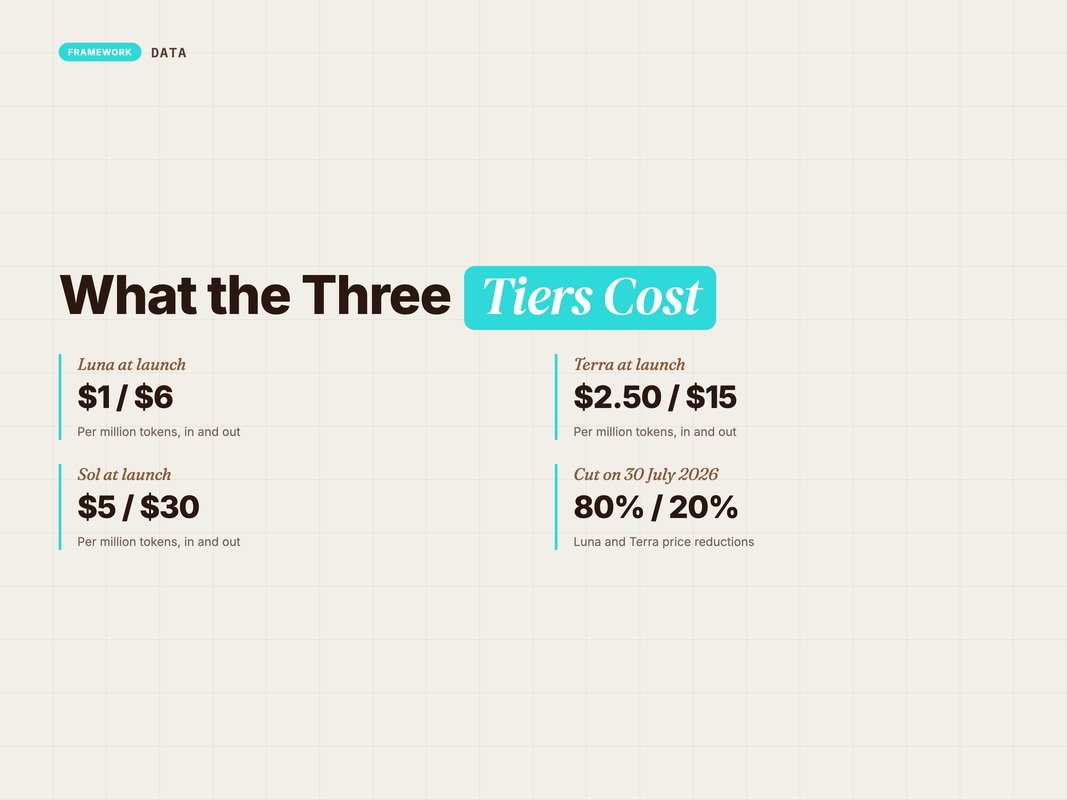
At launch, API pricing per million tokens was 1 dollar in and 6 dollars out for Luna. Terra was 2.50 and 15. Sol was 5 and 30 (Source: Vellum, 2026 — vellum.ai).
Three weeks later the floor moved. On 30 July 2026, OpenAI cut the price of Luna by 80 percent and Terra by 20 percent (Source: MindStudio, 2026 — mindstudio.ai).
Read that as a signal, not just a discount. Cheap tiers are getting cheaper faster than flagship tiers.
So the gap between "run this on everything" and "run this only when it matters" keeps widening.
One more cost note. Output tokens cost several times more than input tokens on every tier. Long, rambling answers are where budgets actually leak.
Cap your output length. Ask for a table instead of an essay.
This is the single highest-leverage change most teams can make. A prompt that returns eight rows instead of eight paragraphs can cut the output bill by more than half. The answer is usually more useful too.
Watch retries as well. Every failed or rejected output is a call you paid for and threw away. A tier with a slightly higher price but a much lower retry rate can be the cheaper option in practice.
Budget by job, not by seat. Pick your five highest-volume jobs, estimate calls per month, and price each one on two tiers. That one spreadsheet usually pays for itself in the first month.
Q: What is the cheapest way to run a big content job?
A: Split it. Do retrieval, classification and first drafts on the cheap tier. Send only the final judgement call to the flagship. You often pay a fraction of a single-model run.
The 4-Question Routing Rule We Use
We do not pick models by vibe. We ask four questions in order and stop at the first yes.
This is the whole rule. It fits on a sticky note.
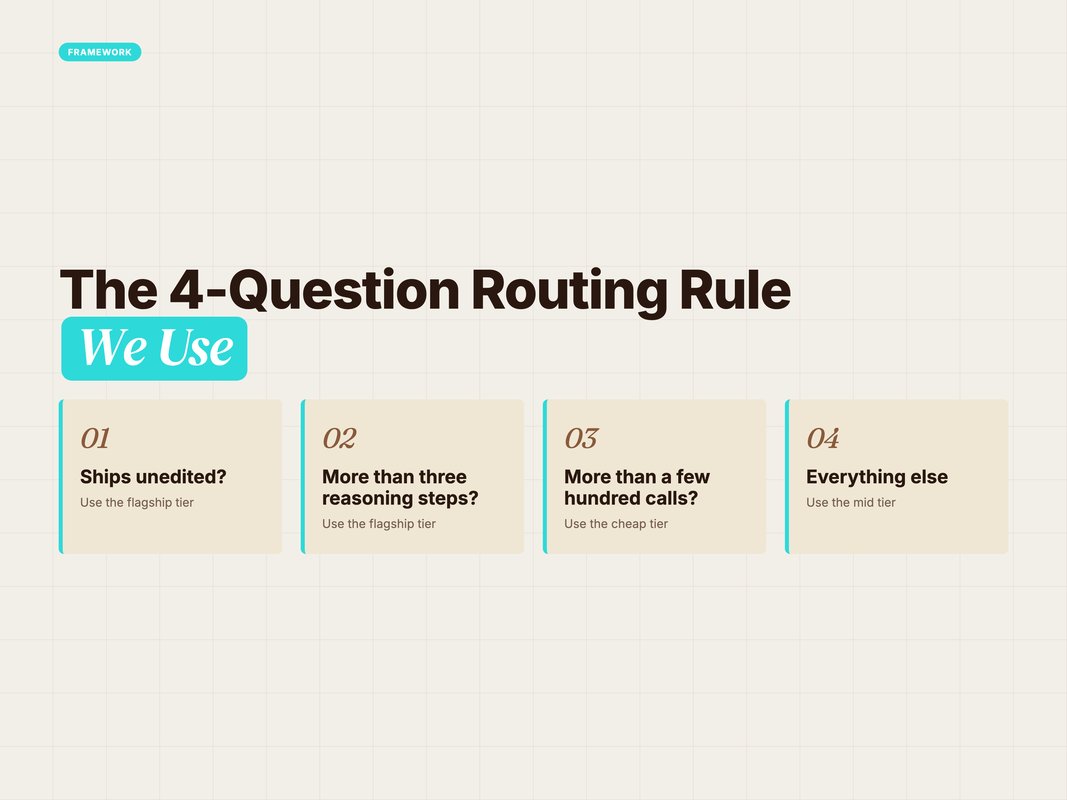
1. Does a human ship this without editing? If yes, use the flagship. Client-facing audits, pitch logic, technical builds.
2. Does it need more than three reasoning steps? If yes, use the flagship. Chained logic is where cheap tiers drift.
3. Is the volume above a few hundred calls? If yes, use the cheap tier. At that scale, price beats polish.
4. Everything else? Mid tier. This will be most of your work.
The order matters. Stakes first, then complexity, then volume. Cost is the tie-breaker, never the opening question.
Q: How often should I re-check my routing?
A: Every time a tier's price or capability changes, so roughly once a quarter right now. The July price cut alone moved several of our jobs from the mid tier down to the cheap one.
Marketing Jobs, Mapped to a Tier
Theory is easy. Here is the mapping we actually run.
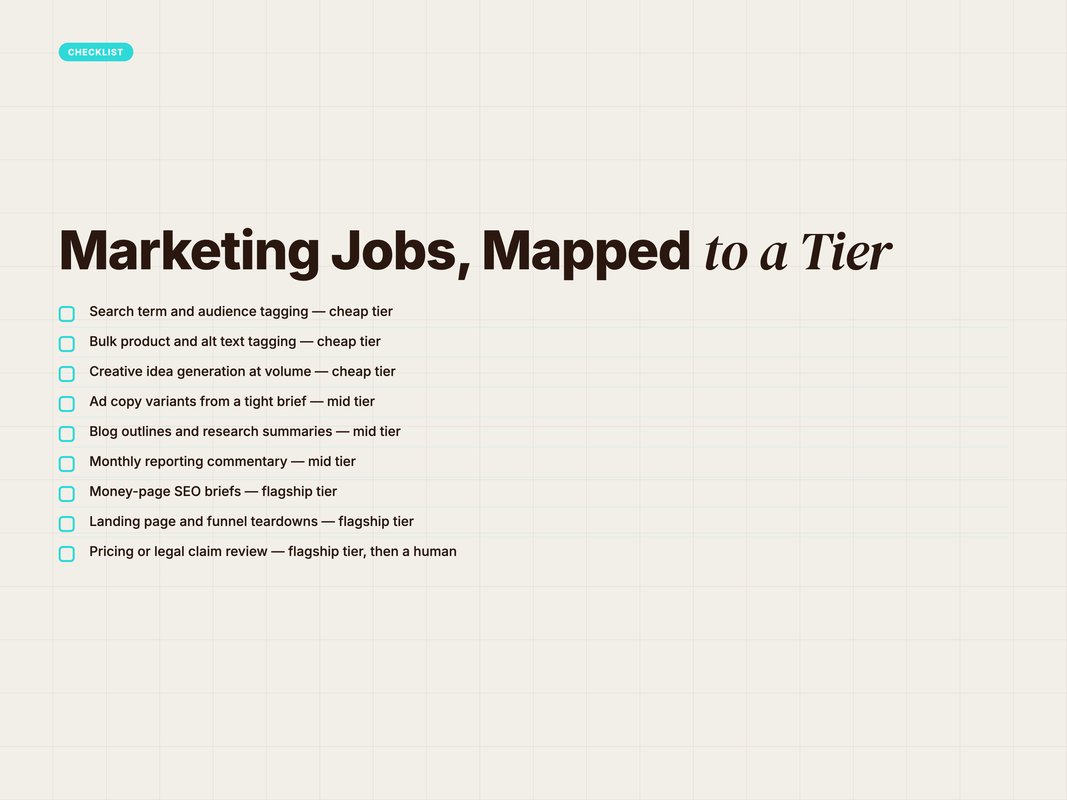
A few of these deserve a note.
Ad copy sits on the mid tier on purpose. Copy quality tracks your brief and your brand context, not model size. A tight brief on Terra beats a vague brief on Sol nearly every time.
If your copy is weak, the fix is rarely a bigger model. It is a better brief. Add the offer, the objection, the proof point and the banned words. Then run it on the tier you already pay for.
SEO briefs move up a tier when the page is a money page. A category page brief is worth the flagship. A supporting blog brief is not.
The tell is revenue exposure. If the page carries transactional intent, the reasoning has to hold. If it is a top-funnel explainer, the mid tier is fine.
Reporting commentary stays cheap. You are summarising numbers you already trust. That is a formatting job wearing an analysis costume.
Search term and audience tagging is the clearest cheap-tier win. These jobs are high volume, low stakes and easy to spot-check. Run a sample of fifty by hand once, then let the cheap tier take the rest.
Creative concepting is the odd one. It benefits from range, not depth. We often run the cheap tier at high volume for raw ideas. Then the mid tier picks and sharpens the best three.
Anything with a legal or pricing claim goes to the flagship, then to a human. No exceptions. If an AI-written headline misstates a price, that exposure is yours, not the platform's.
Q: What should never run on the cheap tier?
A: Anything a client reads unedited, anything with a price or medical or legal claim, and anything that chains more than three reasoning steps. Everything else is fair game.
A Worked Example: One Campaign, Three Tiers
Abstract rules are easy to nod at. Here is what the split looks like on a real workload.
Take a mid-size D2C brand running search, social and a blog. One month of work. The jobs break into four buckets.
Bucket one: classification. Roughly 4,000 search terms to sort into intent groups, plus 600 product rows to tag. High volume, low stakes, easy to check. This is a cheap-tier job, start to finish.
Bucket two: drafting. Around 30 ad variants, 8 blog outlines, 12 email subject lines. Mid tier. Every output gets a human edit before it ships, so a small quality gap costs minutes, not money.
Bucket three: analysis. One monthly performance read, one creative post-mortem, one landing page teardown. Mid tier for the pull, flagship for the conclusions. The numbers are simple. The judgement is not.
Bucket four: the risky one. A pricing page rewrite and a claims review. Flagship, then a named human signs off. This bucket is maybe two percent of the volume and most of the risk.
The shape repeats across accounts. Most of your calls are cheap. Most of your value is in a small slice that deserves the expensive tier and a human.
Teams that skip this exercise usually run everything through bucket four's model at bucket one's volume. That is how a modest AI budget quietly triples.
Q: What share of jobs actually need the flagship?
A: In our accounts it is usually under a tenth of total calls. The exact number varies, but the pattern holds: a small minority of work carries almost all the risk.
Where GPT-5.6 Still Falls Short
A new model is not a new strategy. Three limits still bite.
It does not know your account. No tier has seen your CRM, your margins or last quarter's creative tests. Context you do not supply is context it invents.
It is confident about fresh facts. Model knowledge has a cutoff. Prices, platform rules and ad policies move weekly. Anything time-sensitive needs a live source, every time.
Benchmarks are not your workload. A model can top a coding leaderboard and still write flat ad copy for your category. Public scores tell you very little about your specific job.
There is also a quieter risk. When a tier gets cheap, teams stop reviewing output because running it feels free. It is not free. Bad output has a downstream cost that never shows up on the API invoice.
That cost is real and measurable. A wrong product claim in an ad means a paused campaign. A hallucinated stat in a blog means a correction and a credibility hit. Neither appears on your usage dashboard.
One more limit is worth naming. Model quality is not stable across languages and regions. If you market in Hindi, Arabic or Bahasa, test in that language before you trust a tier ranking built on English benchmarks.
The fix for all four limits is the same. Supply context, cite live sources, test on your own inputs, and keep a human on anything that carries a claim.
Q: Does a higher benchmark score mean better marketing output?
A: Not reliably. Benchmarks measure reasoning and coding on fixed tasks. Marketing output depends on brief quality, brand context and your editing standard.
How to Test a New Model in One Week
You do not need a lab. You need one frozen prompt and twenty real inputs.
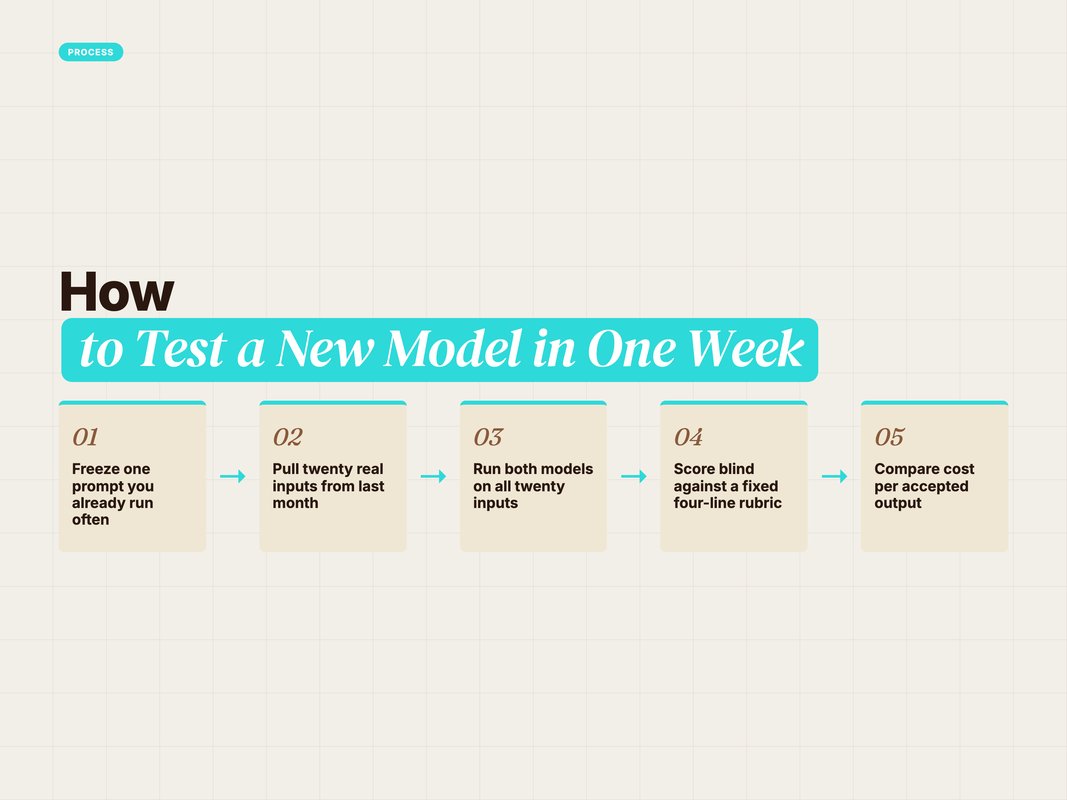
Run this and you will have a defensible answer by Friday.
Day one, pick one job you run often. Freeze the prompt exactly as it is today.
Day two, pull twenty real inputs from the last month. Not two. Twenty. Small samples flatter new models.
Day three, run both models on all twenty. Same prompt, same settings.
Day four, score blind against a fixed rubric. Ours has four lines: factually correct, on-brief, on-brand, ready to ship.
Day five, compare cost per accepted output. Not cost per call. A cheap model that fails half the time is not cheap.
Most of our tests end with a split. One tier wins for drafting. A different one wins for review. That split is the finding, and it is worth more than a single winner.
Two habits make this test far more useful.
Keep the rubric fixed across every test you ever run. If the scoring moves, you cannot compare this quarter to last quarter. A four-line rubric you never change beats a perfect one you rewrite.
And score blind. Hide which model produced which output. Reviewers reward the name on the box more than they think, and a blind pass removes that bias for free.
Log the result somewhere durable. A one-row entry per test — job, models, winner, date, cost per accepted output — becomes your routing table within a quarter.
Getting Model Strategy Right Without a Research Team
Most teams do not have a spare week to bench models. That is usually where we come in.
YARD is an AI-first growth marketing agency. We run performance marketing, LLM SEO, AI creative and AI funnels for D2C and B2B brands. Model routing is part of the plumbing underneath all of it.
In practice that means three things.
We keep a live routing table per client, so every job runs on the tier it deserves. We re-test it when prices or models move, which in 2026 is often. And we keep a human review gate on anything that carries a claim, a price or a client's name.
The result is boring and useful. Output quality goes up because hard jobs stop running on weak tiers. Spend goes down because easy jobs stop running on flagships.
If you are staring at three model names and a budget, we can map your jobs to tiers in a week. Same method as above, run on your workload. For the cross-vendor view, see [internal link: claude-vs-gpt-vs-gemini-best-ai-for-marketing].
The Short Version
GPT-5.6 is one family in three tiers. Sol for stakes. Terra for daily work. Luna for volume.
Do not pick a favourite. Pick a routing rule, write it down, and check it every quarter.
The four questions do most of the work. Would a human ship this unedited? Does it need deep reasoning? Is the volume high? If none apply, use the mid tier.
Then test on your own inputs before you migrate anything. Twenty real examples, one frozen prompt, a blind score.
New models will keep landing. A routing rule survives them. A favourite model does not.
The teams that stay calm through each launch are the ones with a rule already written down. They read the release notes, move two or three jobs, and get back to work. Nothing else changes.
Want a second opinion on your AI stack before your next planning cycle? Book a working session with the YARD team. Bring your five biggest jobs and last month's usage bill. We will map them to tiers with you, and you keep the routing table either way.
FAQ
Q: What is GPT-5.6?
A: GPT-5.6 is OpenAI's model family released on 9 July 2026. It ships in three tiers: Sol, Terra and Luna. The number tells you the generation. The celestial name tells you the capability tier.
Q: Which GPT-5.6 tier is best for marketing?
A: Most marketing work fits Terra. Use Luna for high-volume, low-stakes jobs like tagging and first-pass drafts. Save Sol for strategy, audits and code you will actually ship.
Q: How much does GPT-5.6 cost?
A: At launch Luna cost 1 dollar in and 6 out per million tokens. Terra cost 2.50 and 15. Sol cost 5 and 30. On 30 July 2026 OpenAI cut Luna by 80 percent and Terra by 20 percent. Check the live pricing page before you budget.
Q: Should I switch every workflow to GPT-5.6 Sol?
A: No. Sol is the most expensive tier and most marketing tasks do not need it. Route by stakes, not by habit. A single default model is the most common way teams waste budget.
Q: How do I test a new model without breaking things?
A: Freeze one prompt, run it on your current model and the new one, and score both against a fixed rubric. Run twenty real inputs, not two. Then check cost per accepted output, not cost per call.
Q: Does a bigger model always write better ad copy?
A: No. Copy quality tracks your brief and your brand context far more than model size. A tight brief on a mid tier beats a vague brief on a flagship almost every time.
Insights from Our Experts
Explore our latest articles on digital marketing strategies.