
Most "AI marketing tools" lists are noise. They mix every shiny launch with the things that actually move ROAS.
This one is curated. Fifteen tools we use, test, or replace clients' tools with. Each one earns its slot. Each one is mapped to the job it does. And we tell you what it costs.
87% of marketers now use generative AI in at least one workflow (Source: Salesforce State of Marketing, 2026 — salesforce.com). The question is no longer whether to use AI. It is which tools, in what order, for what spend.
This guide is the answer.
Why This List Is Different
Most lists rank tools by Twitter buzz. Or by who paid for placement. Neither maps to revenue.
We rank by time saved and ROAS lift in real client work. If a tool does not show up in our daily stack, it is not on this list. If a tool is great but only useful for content teams, we point that out and move on.
Q: Why only 15?
A: Because no one needs more. A tight stack beats a sprawling one. Each new tool is one more login, one more bill, one more onboarding. We have audited 60+ AI tools to land on these 15.
The list is grouped by job, not by hype. You will find one or two tools per category. Pick the ones that match where your team has gaps.
The Top 15 AI Tools — By Category

LLMs (the daily cockpit):
- Claude — long-form briefs, complex strategy chats, document analysis. Strongest at natural human-sounding output.
- ChatGPT (Team or Enterprise) — fast iteration, code-style automation, broad tool integration.
Paid media AI (built into the platforms):
- Meta Advantage+ Shopping — Meta's native AI campaign type. Default for D2C from $5K/mo spend up.
- Google Performance Max — Google's cross-channel AI campaign. Mandatory for shopping accounts.
- Albert.ai — third-party media buyer for $50K+/mo accounts that want full automation.
Creative + AI UGC:
- Higgsfield Soul — editorial AI photography, fashion-grade output, 60+ aesthetic presets.
- Runway Gen-4 — AI video for ad creative, strong on motion + character consistency.
- Heygen — AI presenters and avatars. Useful for global ad copy in many languages.
- Marpipe — creative testing prediction before launch. Saves test budget.
SEO + LLM SEO:
- Surfer SEO — on-page optimisation, real-time content scoring against top-ranking pages.
- Otterly.ai — GEO / AI search tracking. Tells you where ChatGPT and Perplexity cite you.
- Semrush — keyword research, competitor gap analysis, AI-powered topic clusters.
Analytics + attribution:
- Triple Whale — D2C analytics, post-iOS attribution, ad spend ROAS view.
- Northbeam — incrementality testing and media mix modelling.
Glue:
- Make.com (or n8n) — visual automation that connects every tool above.
Q: Where is Jasper?
A: Jasper is fine for short-form copy. But Claude does the same job, plus the long-form work, in one tab. We removed Jasper from our stack last quarter and gave the budget to creative tools.
That is the list. The next question is how to pick from it.
How to Pick Your Stack
You do not need all 15. You need three to start.
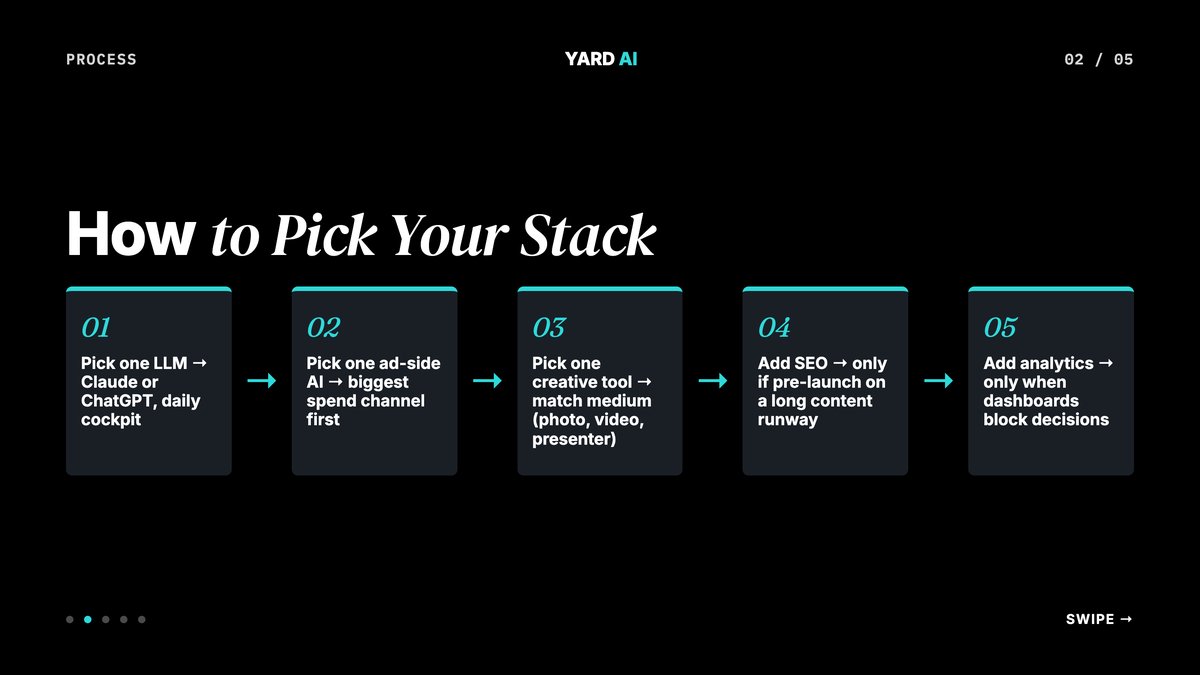
- Pick one LLM. Claude or ChatGPT. Use it daily. This is your cockpit.
- Pick one ad-side AI. Whichever platform takes the most spend. For D2C this is usually Meta Advantage+. For B2B it is usually Google Performance Max.
- Pick one creative tool. If photo-led, Higgsfield Soul. If video-led, Runway. If presenter-led, Heygen.
- Add SEO only if you are pre-launch on a long content runway. A new site benefits more than a stable one.
- Add analytics only when current dashboards are blocking decisions. Premature analytics tools become shelfware fast.
Q: How fast should I add the next tool?
A: Wait until the current stack is at full use. If your team is still typing into ChatGPT one tab over, you are not ready for tool five. Master before you stack.
The whole stack should fit in a one-tab dashboard. If it does not, your team will use a smaller mental version of it and waste the rest.
What These Tools Actually Cost
Sticker price is one thing. Total cost is another. Add seats, integrations, and the time to learn each tool.
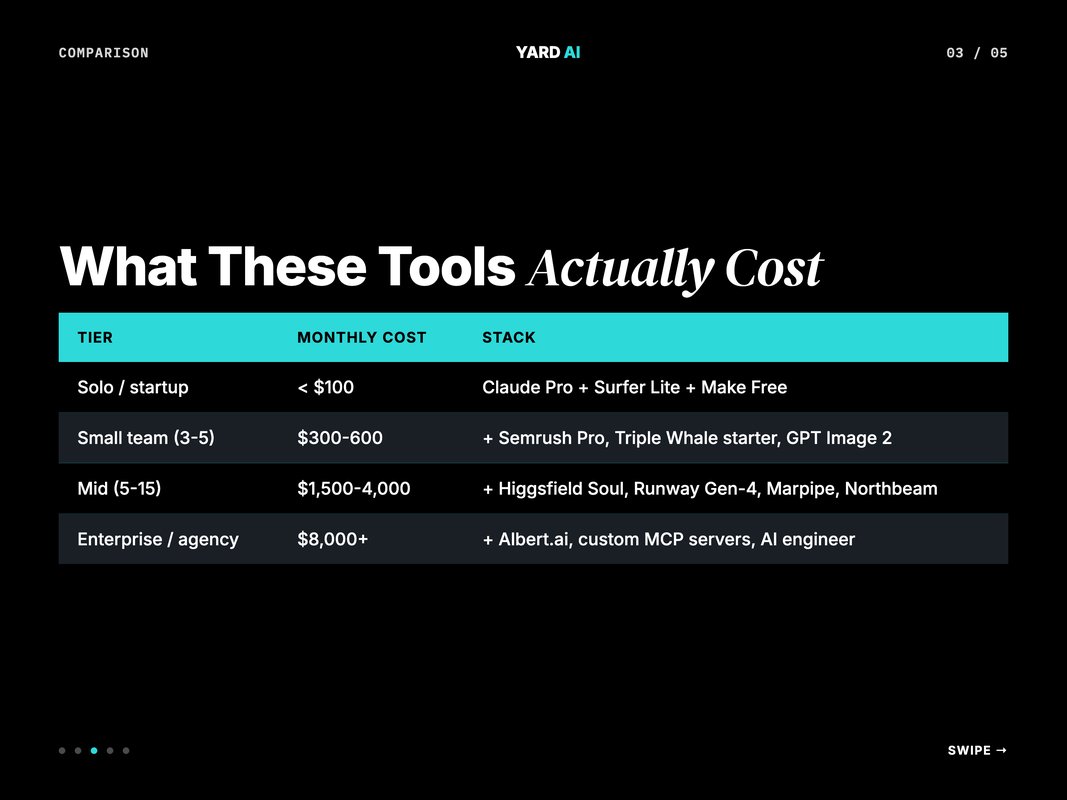
Stay one tier below where you think you "should" be. Tool sprawl is the most common waste in this category. The teams getting the most out of AI are the ones running fewer tools at higher use.
Quick Facts: AI in Marketing 2026
- 87% of marketers use generative AI in ≥1 workflow — (Source: Salesforce, 2026 — salesforce.com)
- 94% plan to use AI in content creation — (Source: HubSpot State of Marketing, 2026 — hubspot.com)
- 41% of marketers use AI daily — (Source: Content Marketing Institute, 2026 — contentmarketinginstitute.com)
- 19% of marketing budgets now go to AI, growing 28% YoY — (Source: Digital Applied, 2026 — digitalapplied.com)
The 3 Categories That Matter Most

If you only have time for three categories, make them these.
One. Daily LLM. This is the single biggest unlock. Briefs go from hours to minutes. Ad copy goes from blank page to twenty variants in one chat. Strategy gets a thinking partner. The marketers who feel "ahead" on AI all have one thing in common. They use an LLM every working day.
Two. Native ad-platform AI. Meta Advantage+ and Google Performance Max are not optional in 2026. They are now the default surface for spend. The skill is steering them. Bad inputs produce bad campaigns at speed. Good inputs scale faster than any manual structure.
Three. Creative tools. Performance plateaus on creative. The teams winning on Meta in 2026 are the ones shipping more variants. AI photo and video lets you do that without a studio team. This is where the hours come back.
Q: What about analytics?
A: Analytics matters. But fixing a broken creative pipeline returns more revenue per quarter than any new dashboard. Sequence matters.
Stack everything else after these three are running well.
Mistakes That Tank ROI on AI Tools
The fastest way to waste AI budget is to add tools faster than your team can use them.

Skip any of those and you are paying for shelfware. The shelfware bill across most marketing teams is now larger than the SaaS bill from five years ago.
Q: Should I cancel a tool that "feels useful" but cannot point to ROI?
A: Yes. Almost always yes. "Feels useful" is not a budget defence. Run a 30-day pause. If the team complains in week one, reactivate. If they do not, you have your answer.
A clean stack is faster than a wide one. Audit quarterly. Remove ruthlessly.
How YARD Picks the AI Stack for Each Brand
YARD is an AI-first growth marketing agency. We run Performance Marketing, LLM SEO, AI Creatives, and AI Funnels for multiple brands across several industries. We work with multiple D2C and B2B brands across performance, SEO, creative, and funnels
We do not run the same stack for every brand. The stack follows the funnel.
For one US luxury furniture account the unlock was Google. We rebuilt the Merchant Center. We layered Performance Max. ROAS moved from a stuck 2x to 10.6x in 10 months. Total ad revenue from $37K spend hit $400K. The AI tool that moved the needle was Google PMax. Steered by a tight Merchant Center feed. Not a third-party tool.
For Homes by Hosi, a Dubai luxury real estate personal brand, the unlock was creative. Hyper-targeted Meta campaigns plus AI multilingual voiceovers in English, German, French, and Russian. Result: 200,000 AED of spend → 130M AED in sales (650x ROAS) in four months. The AI tools that mattered were creative-side, not media-side.
Different brand, different stack. That is the work.
Subscribe to the YARD newsletter for weekly tool deep-dives and stack audits.
The Bottom Line
The right AI tool stack is small. Three to five tools, used daily, beat fifteen tools used weekly. The teams winning in 2026 are not the ones with the most logos. They are the ones with the cleanest workflow.
Pick one LLM. Pick the ad-side AI for your biggest spend channel. Pick one creative tool. Run that stack for a quarter. Then audit, cut, and add.
The cost of a tight stack is low. The cost of a sprawling one is the cost of every other thing you cannot focus on. Treat AI tools the way the best media buyers treat campaigns. Cut what does not work. Scale what does.
FAQ
Q: What is the best AI tool for performance marketing in 2026?
A: There is no single best tool. The right answer is a stack of three. One LLM (Claude or ChatGPT). One ad-side AI (Meta Advantage+ or Google Performance Max). One creative tool (Higgsfield Soul or Runway). Build from there.
Q: How much should a small team spend on AI tools per month?
A: A 1-3 person team can run a strong stack under €100 a month. Add Claude Pro or ChatGPT Team. Add one SEO tool. Add an automation tool. Skip premium creative until volume justifies it. The biggest mistake is paying for shelfware.
Q: Will AI replace performance marketers?
A: Not in 2026. AI replaces busy work. It does not replace media-buying judgement. The marketer who uses AI well will replace the marketer who does not. The role shifts toward orchestration.
Q: Which AI tool is best for ad creative?
A: Higgsfield Soul or Runway Gen-4 for editorial photo and video. Heygen for AI presenters. Marpipe for creative testing. Most teams over-invest here. Pick one and learn it well before adding a second.
Q: Are paid AI tools worth it over free ChatGPT?
A: Yes for one paid LLM, no for most others. The paid tier of an LLM you use daily pays back in week one. Specialist tools should pay back in measurable revenue or saved hours. If you cannot point to either, cancel.
Q: What AI tool should I add first as a beginner?
A: Pick one LLM, daily. Claude or ChatGPT. Use it for briefs, ad copy, and analysis chats. Keep it open while you work. The tool stack only matters once that habit is in. Start there.
Insights from Our Experts
Explore our latest articles on digital marketing strategies.