

Most marketing audits are a slide deck of things you already knew. They arrive late, list forty problems, and rank none of them.
Ours is built to do the opposite. Read everything, decide what matters, and hand you a list in the order you should fix it.
This post is the whole process. Six steps, what each one looks for, how long it takes, and the findings that come up most often.
Why Audits Are Worth Doing at All
Start with the size of the problem, because it explains the effort.
Audits of large accounts put wasted digital ad spend at about 30.6 percent. The waste sits in bad targeting, poor placements and broken tracking (Source: Improvado, 2026 — improvado.io).
Invalid traffic adds more. About 8.51 percent of all paid ad traffic is invalid. That is nearly one click in twelve with no real person behind it. It adds up to roughly 63 billion dollars of global waste (Source: MediaPost, 2026 — mediapost.com).
Media audits exist because these losses hide inside normal-looking reports (Source: Abintus Consulting, 2026 — abintus.consulting).
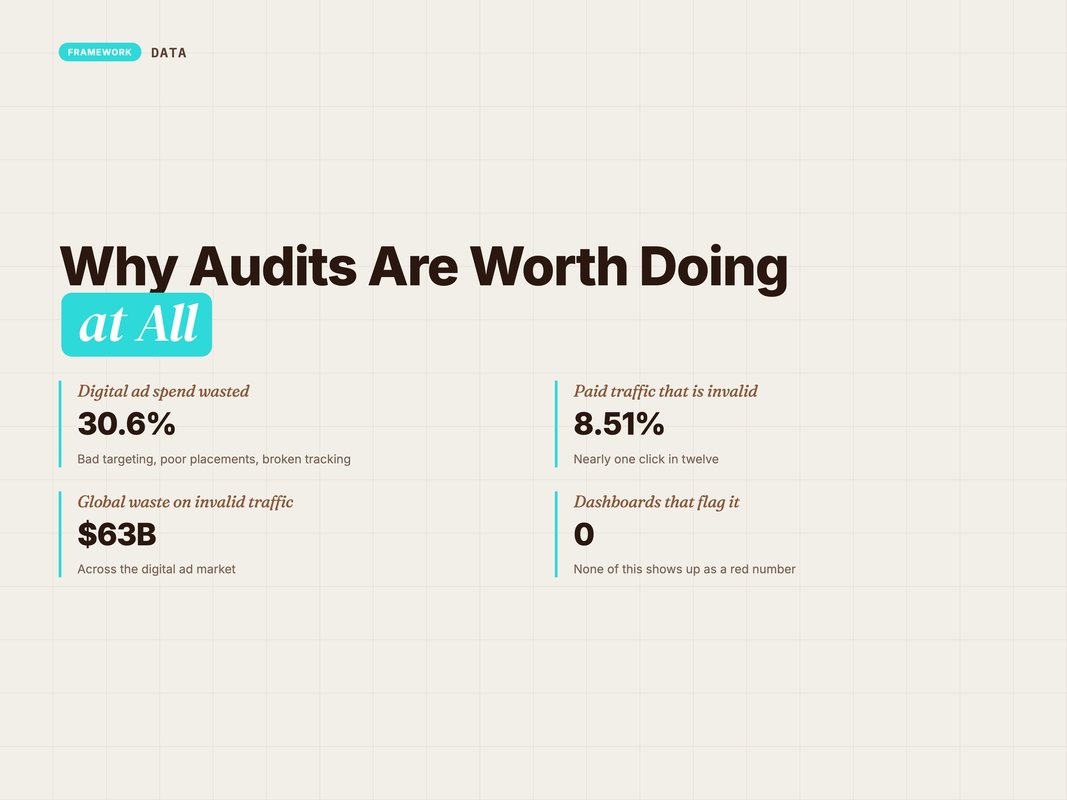
Here is the important part. Almost none of that waste shows up as a red number on a dashboard.
It looks like a slightly high cost per sale. A campaign that never quite scales. A channel everyone stopped trusting but nobody switched off.
Audits find it because they check the plumbing, not the results.
Q: How often should you audit?
A: Once a year for a stable account. Twice if you changed platforms, agencies, or your tracking setup. Also after any major platform change.
What Makes It an "AI" Audit
The AI part is not a tool that grades your account out of ten. Those exist and they are mostly noise.
The real difference is coverage.
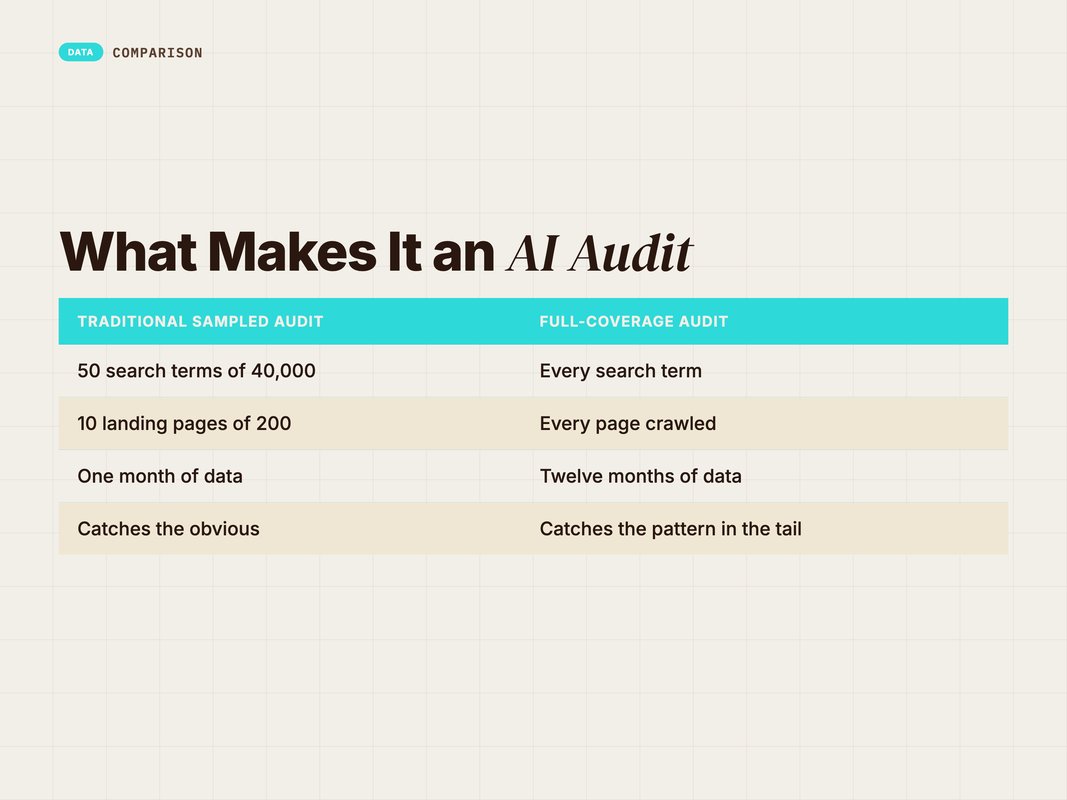
A human auditor samples. They read fifty search terms out of forty thousand, ten landing pages out of two hundred. A month of data out of a year.
With AI in the loop you read all of it. Every search term. Every ad. Every page. Every row of the conversion export.
That changes what you find. Sampling catches the obvious. Full coverage catches the pattern that only appears in the tail.
The division of labour is strict on our side.
AI reads and clusters. Volume work. Grouping, tagging, summarising, spotting anomalies.
People decide. What matters. What is risky. What order to fix things in. And what to tell the client to ignore.
We never let a model make the recommendation. A finding without a person accountable for it is just a bullet point.
Q: Does the AI touch our live accounts?
A: No. The audit is read-only. Nothing in the process changes a bid, a budget or a page.
Step One: Tracking and Measurement
Always first, because everything downstream depends on it.
We check whether the numbers can be trusted at all. Not whether they are good. Whether they are real.
That distinction saves months. A team can spend a quarter optimising toward a number that was double-counted from the start.
The work is mechanical. Fire every conversion event and watch what arrives. Compare platform-reported conversions against back-end records. Check for duplicates, missing events and events firing on the wrong page.
Then match spend to money. Platform totals against invoices, including fees that never show inside the ad manager.
The gap between those two numbers is often the first surprise of the whole audit.
What we usually find. Duplicate conversion tags counting one sale twice. Soft actions counted as conversions. A server-side setup sending thin, poorly matched events. And spend that does not tie out to the invoice.
This step takes two to three days. Skip it and the rest of the audit is built on sand.
We also check what is not being measured. Phone calls, in-store visits, WhatsApp enquiries, offline closes. A channel that drives sales you never record will always look like a bad channel.
Q: Why is this always the first finding?
A: Because tracking is set up once, by whoever built the site, and then never re-checked while the site changes around it.
Step Two: Spend and Waste
Now the money. This is the step clients expect and it is rarely the most valuable one.
We pull twelve months of spend and cut it four ways. By campaign, by placement, by geography and by audience.
Then the search term and placement review. Every query, not a sample. Every placement, including the ones automation added without asking.
What we usually find. Spend on queries with no commercial intent. Placements on low-quality inventory. Geographic spill into markets you do not serve. And brand traffic being bought and reported as new demand.
That last one is the most common expensive finding. It makes an account look efficient while adding nothing.
We check it by splitting brand from non-brand and reading them apart. If brand carries most of your conversions, your reported cost per sale is a mirage.
The other repeat offender is budget sitting in campaigns nobody has opened in six months. Not broken. Just forgotten, and quietly spending.
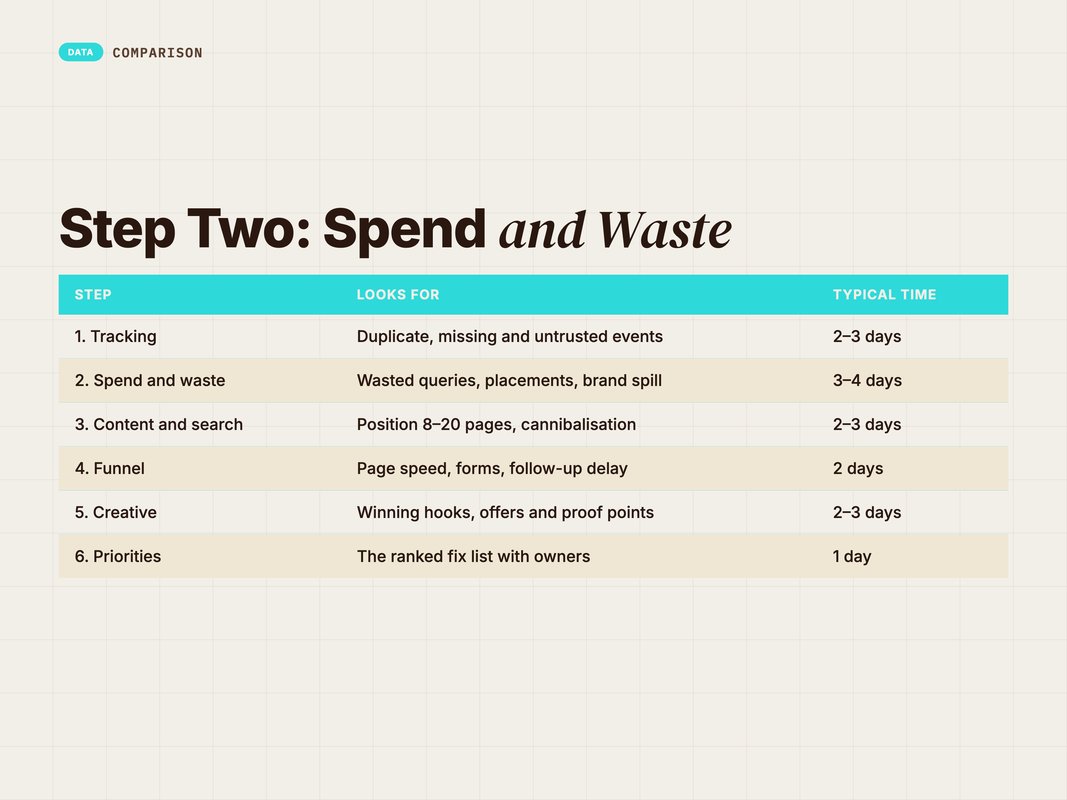
This step takes three to four days on a mid-size account. Longer if you run many markets.
The output is not a list of things to pause. It is a spend map. Where the money went, what it bought, and which parts you would not choose again.
Step Three: Content and Search Visibility
Paid and organic get audited together. They share the same landing pages and the same buyer intent.
Splitting them is how the two teams end up bidding on queries the other already owns.
We crawl the site, pull twelve months of Search Console data and map pages to queries. Then we look for four things.
Pages ranking between position 8 and 20. These are the cheapest clicks available to you and most plans ignore them entirely.
Cannibalisation. Two or more pages competing for the same query, splitting the signal and beating each other.
Thin and orphan pages. Published, indexed, linked from nowhere, doing nothing.
AI visibility. Whether assistants and AI answers cite you for the questions in your category, and which sources they cite instead.
That fourth check is newer and it is the one clients now ask about first. It is done by asking, logging and repeating. Not by a tool that guesses.
We also compare paid and organic coverage side by side. Paying for a query you already rank first for is common and rarely deliberate.
Q: Is AI visibility measurable?
A: Not precisely. It is measurable by sampling. A fixed set of questions, asked monthly, with the answers logged. Direction is reliable even when totals are not.
Step Four: Funnel and Conversion
Traffic problems get all the attention. Conversion problems cost more.
A 10 percent lift in conversion rate is worth more than a 10 percent cut in cost per click. It applies to every visitor you already paid for.
We walk the full path as a customer would. Ad, landing page, form, confirmation, follow-up. On mobile first, because that is where most of it happens.
Then we check the speed of what happens next. How long until someone replies. What that reply says. Whether it goes anywhere at all.
What we usually find. Landing pages that load slowly on mobile. Forms asking for information nobody needs at that stage. Follow-up measured in days when it should be minutes. And a lost-lead list nobody contacts twice.
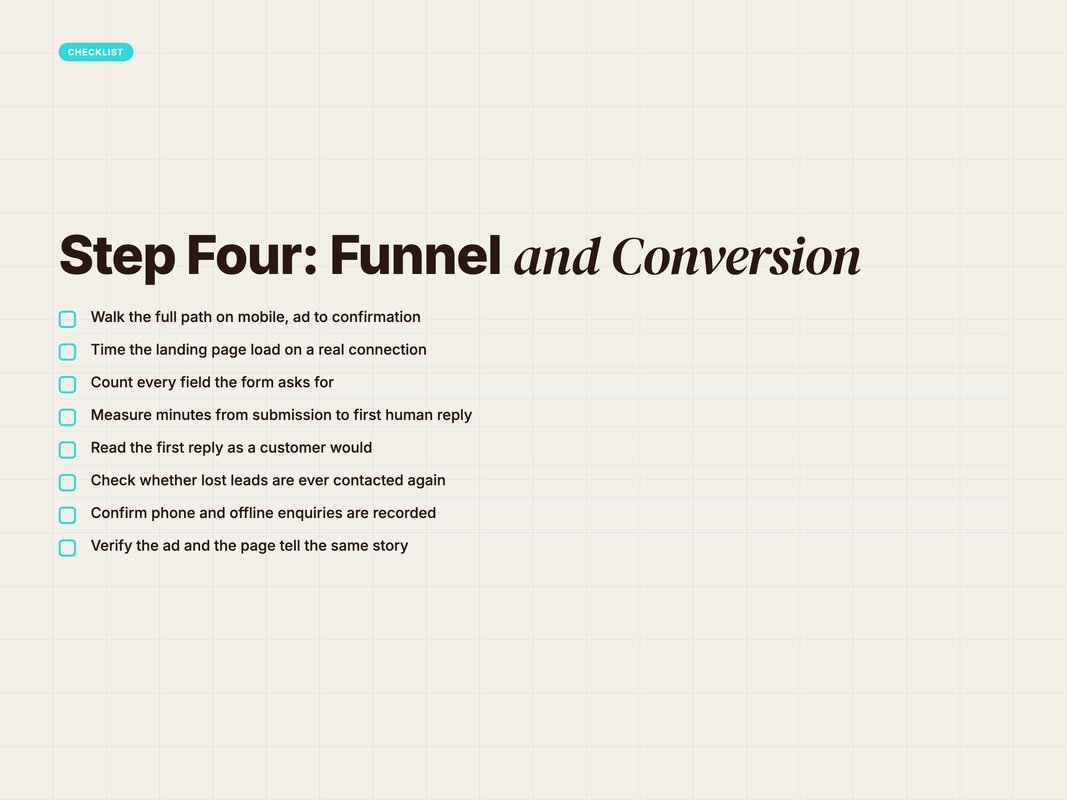
This step often produces the highest-return fix in the whole audit. It usually costs nothing to build.
Speed of reply is the clearest example. Moving first contact from hours to minutes needs a routing rule, not a project.
Q: Why audit the follow-up if it is a sales job?
A: Because the customer does not see a handover. If the reply takes two days, your ads did not fail. The funnel did.
Step Five: Creative and Message
This is the hardest step to do well. It is also the easiest to fake with opinions.
Most creative reviews are somebody senior saying which ads they like. That is not a finding. That is a preference.
We pull every asset that ran in the last year with its performance data. Then we tag each one by format, hook type, offer, proof element and length.
That tagging is the part AI makes possible. Nobody is hand-labelling nine hundred creatives.
Once tagged, the patterns show up. Which hooks earn attention in your category. Which offers convert. Which proof elements matter.
Then the useful question. What do your winners share that your losers do not?
That answer becomes a creative brief, which is the real deliverable of this step.
What we usually find. A very small number of concepts carrying most of the results. Heavy creative fatigue on the winners because nobody built variants. And a message that never states the actual offer plainly.
We also check whether the ad and the landing page tell the same story. A surprising number do not.
The mismatch is usually invisible internally. The team that wrote the ad and the team that built the page never sat in the same review.
Q: Can AI judge whether creative is good?
A: No, and it should not try. It can tell you what the winners have in common. A person still decides what to make next.
Step Six: Priorities and the Fix List
Findings without an order are just anxiety. The last step turns them into a plan.
By this point a mid-size audit has produced somewhere between forty and eighty findings. Handing that over raw would be useless.
So the scoring is deliberately blunt. Three axes, a simple score, and a hard rule that only five things can be in the top bucket.
Every finding gets scored on three axes. Impact, effort and confidence.
Impact is the revenue or cost the fix should move. Effort is how many people-days it takes. Confidence is how sure we are, given the data we have.
Then they sort into four buckets.
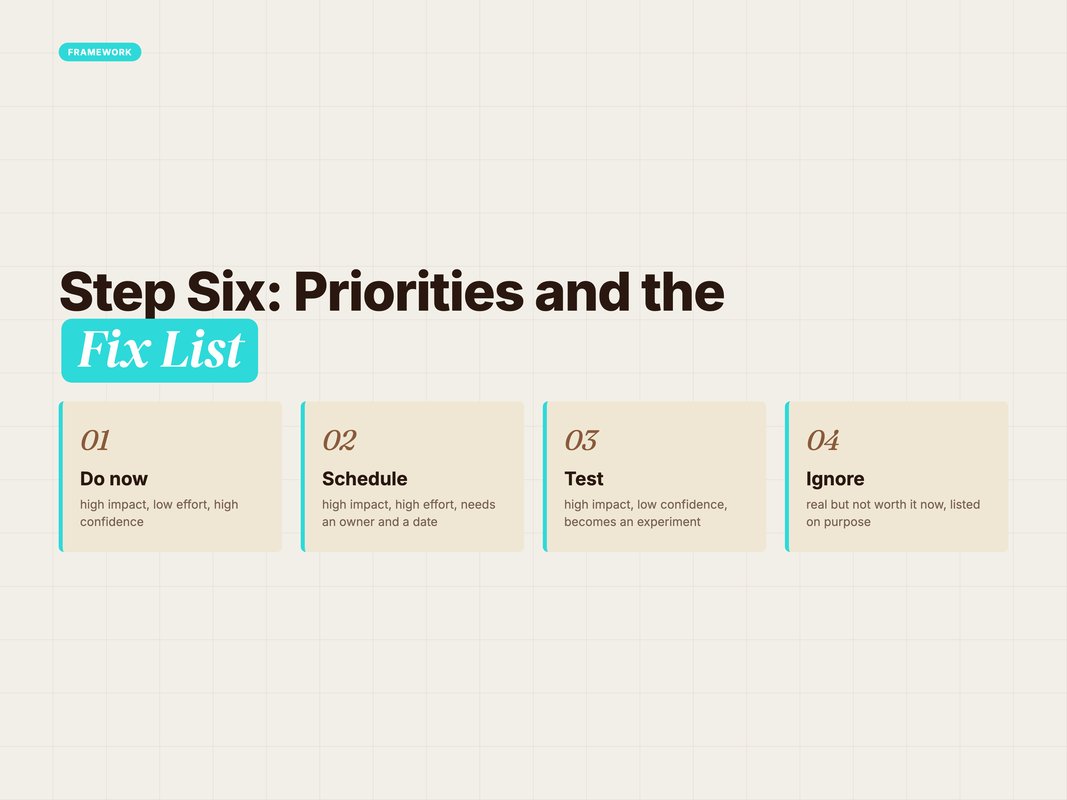
Do now. High impact, low effort, high confidence. Usually tracking fixes, negative keywords and follow-up speed.
Schedule. High impact, high effort. Site changes, funnel rebuilds, new creative systems. These need owners and dates.
Test. High impact, low confidence. Things we believe but cannot prove from the data alone. These become experiments with a defined read.
Ignore. Real but not worth the effort right now. We list these on purpose. An unlisted finding just gets rediscovered next quarter.
That last bucket is the one clients react to most. Naming what you are choosing not to do is unusual, and it makes the rest of the list credible.
It also protects the team. Somebody asks in November why nobody fixed the feed titles. The answer is already written down, with a date and a reason. Nobody has to defend a decision from memory.
Every item carries an owner, an effort estimate and the number it should move.
The owner matters most. A fix list where everything belongs to "marketing" is a fix list that will not get done.
Where a fix belongs to another team, we say so plainly. Some of the highest-impact items in an audit sit with engineering, sales or finance.
The deliverable is that list, plus every working file. Exports, tagging sheets, the crawl, the query maps. Your team should be able to rerun the analysis without us.
Q: What if we cannot do everything on the list?
A: You will not, and the list assumes that. The top five items are ordered so that stopping after five still leaves you better off.
Be realistic about your side of the effort too. That is where audits stall.
Access is the bottleneck. Ad accounts, analytics, Search Console, the CRM, the invoices. Getting all of it usually takes longer than any analysis step.
Budget one call at the start, one mid-point check and one readout. Around three hours of your team's time in total.
The whole audit runs two weeks for a single-market account. Three to four weeks for a multi-country one.
We front-load the access request for that reason. The list of logins goes out before the kickoff call, not after it.
If your team cannot grant access to something, say so early. We can usually work from exports instead, and it saves a week of chasing.
Anything sold as a two-day audit is a tool report with a cover page.
There is a version worth doing quickly, though. If you only have a week, run step one and step four. Tracking and funnel.
Those two cover most of the value and neither depends on a year of history.
How We Run This at YARD
We run this process on every new account before we touch anything, and once a year after that.
YARD is an AI-first growth marketing agency. We run performance marketing, LLM SEO, AI creative and AI funnels for D2C and B2B brands. The audit is how every one of those engagements starts.
Three things make it different from the audits people are used to.
It is read-only and it is complete. Every search term, every page, every creative. No sampling, because sampling is how the expensive problems survive.
It ends in a ranked list with owners, not a deck. If a finding has no owner and no expected impact, it does not go on the list.
And you keep the files. The exports, the tagging, the crawl and the query maps are yours at the end. That holds whether or not you work with us afterwards.
If your numbers feel fine but never quite improve, an audit is usually cheaper than another quarter of guessing. For the technical SEO half of this process, see How We Run 135-Point SEO Audits Using AI in Under 10 Minutes.
The Short Version
An AI marketing audit is a structured read of your account where AI provides coverage and a human provides judgement.
It matters because roughly 30 percent of digital ad spend leaks. Almost none of it shows up as an obvious problem on a dashboard.
Six steps, in order. Tracking, spend and waste, content and search visibility, funnel and conversion, creative and message, then priorities.
Tracking always goes first. Every number after it is worthless until it is verified. That one rule saves more audits than any clever analysis does.
The output is a ranked fix list with owners, effort and expected impact. Plus a bucket of things you are explicitly choosing not to do.
Two weeks, about three hours of your team's time, and you keep every working file.
Want to see what a full-coverage read finds in your account? Talk to the YARD team and we will scope it against your platforms.
FAQ
Q: What is an AI marketing audit?
A: It is a structured review of your tracking, spend, content and funnel. AI does the reading. A human does the judging. The output is a ranked fix list, not a tool report.
Q: How long does a marketing audit take?
A: Two weeks for a single-market account. Three to four for a multi-country one. Most of that time is data access, not analysis.
Q: What does an audit usually find first?
A: Broken or duplicated tracking. It is the most common finding and it invalidates every other number until it is fixed.
Q: How much ad spend is typically wasted?
A: Industry audits put waste around 30 percent of digital ad spend across mistargeting, poor placements and tracking errors. Roughly 8.5 percent of paid clicks are invalid traffic.
Q: Can AI run the audit on its own?
A: No. AI reads volume a human cannot and spots patterns fast. Deciding what matters, what is risky and what to do first still needs someone accountable.
Q: What do you get at the end?
A: A ranked list of fixes with owner, effort and expected impact. Plus the working files, so your team can rerun the analysis without us.
Insights from Our Experts
Explore our latest articles on digital marketing strategies.