

Every vendor deck this year shows an agent running a campaign end to end. Almost nobody is doing that.
What is actually happening is smaller, duller and more useful. Agents are quietly taking over the work nobody wanted to do on a Friday afternoon.
This post separates the two. What agents do right now. What they still cannot be trusted with. And how to pick a first project that will not embarrass you.
What "Agentic" Actually Means
The word has been stretched to cover anything with an API call in it. Here is the useful definition.
A normal AI workflow answers a prompt. You ask, it responds, you decide what happens next.
An agent works toward a goal. It plans steps, uses tools, reads the result, and decides what to do next without you at every turn.
Three properties make something agentic.
It uses tools. It can query a database, call an API, read a file, send a request.
It loops. It checks its own output and tries again when the result is wrong.
It decides. It picks the next step rather than following a fixed script.
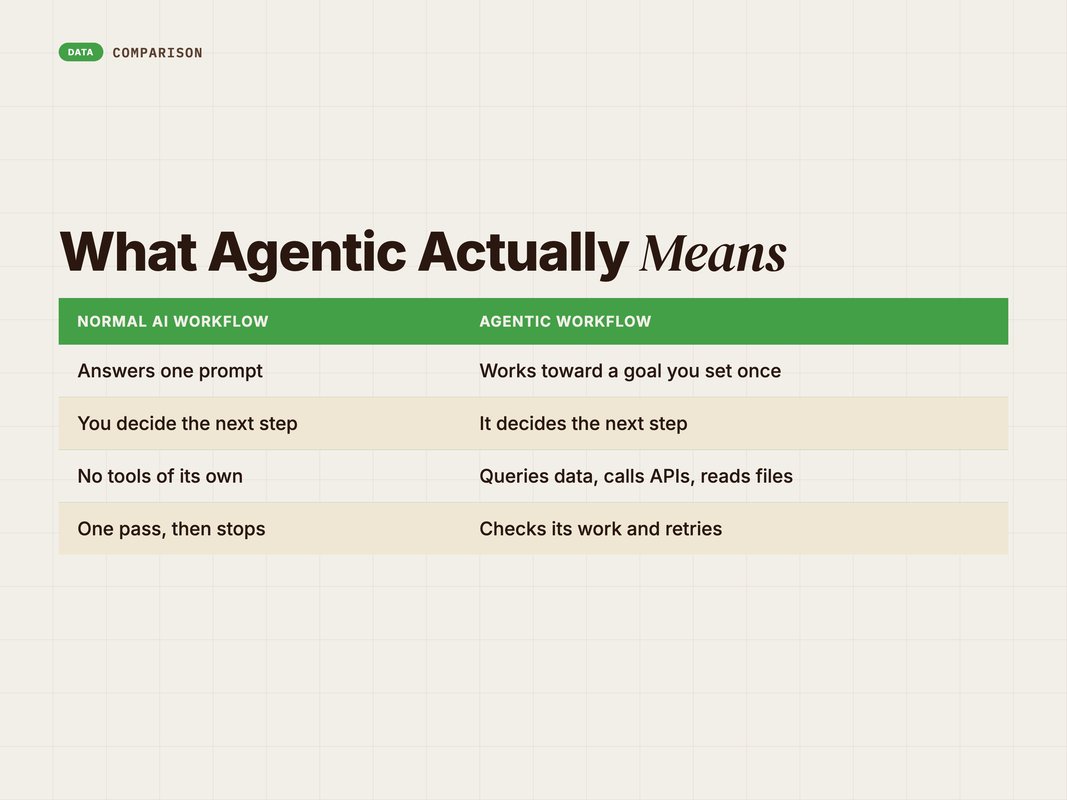
Most things marketed as agents today have the first property and not the other two. That is fine. It is just automation with a language model in it, and calling it an agent sets the wrong expectation.
Q: Is a chatbot an agent?
A: Usually not. A chatbot answers within one turn. An agent takes actions across several turns to reach a goal you set once.
Where Adoption Actually Sits
The gap between interest and deployment is the whole story of 2026.
Only about 17 percent of organisations have actually deployed AI agents so far. More than 60 percent expect to within two years, which is the most aggressive adoption-intent curve of any emerging technology (Source: Gartner, 2026 Hype Cycle for Agentic AI, via Omnibound — omnibound.ai).
Using AI, though, is already near-universal in marketing. About 91 percent of marketers report actively using AI in their work in 2026, up from 63 percent in 2025 (Source: Jasper, State of AI in Marketing 2026, n=1,400, via Omnibound — omnibound.ai).
Letting it act on its own is a different story. Only about 19 percent of marketers use AI agents for end-to-end campaign automation (Source: HubSpot, via Omnibound — omnibound.ai).
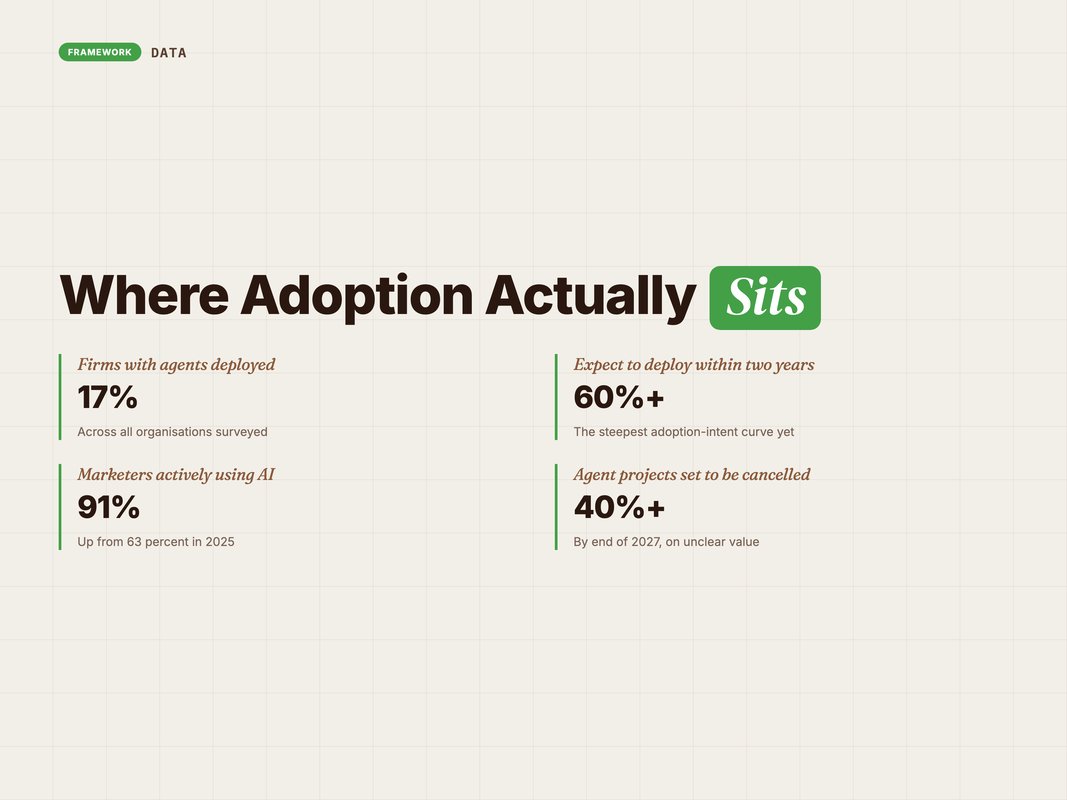
Read those three together and the shape is clear. Nearly everyone uses AI. Roughly one in five has let it run a process end to end. Almost nobody has handed over a whole function.
The forecasts cut both ways. Gartner also expects more than 40 percent of agentic AI projects to be cancelled by the end of 2027, blaming unclear value, rising costs and weak governance (Source: Gartner, June 2025, via Omnibound — omnibound.ai).
Treat forecasts as direction, not schedule. The useful question is what works this quarter.
There is a second reading of these numbers worth noting. The gap between using AI and trusting it to act is where this whole market currently sits.
That gap is not a technology problem. It is the work of finding a task worth pointing an agent at, and a way to check it afterwards.
Q: Are we late if we have not started?
A: No. Two thirds of organisations have not deployed one either. You are late if you have not run a single pilot by the end of the year.
What Agents Genuinely Do Well Today
Five jobs work reliably in production. They share a shape: repetitive, checkable, and bounded.
Weekly reports. Pull from four platforms. Line the numbers up. Flag what moved. Write the notes. This is the most common first agent and the most solid.
Account watching. Look for rule breaks. Budget pacing off. A campaign with no live creative. A landing page throwing an error. A product feed missing prices. Agents are patient in a way people are not.
Content pipeline work. Draft, run checks, route for approval, publish on approval. The agent does the moving. A human does the judging.
Sorting at volume. Tag search terms. Sort inbound leads. Group support tickets. Label creative by theme. Dull, high volume, easy to spot-check.
Research briefs. Read twenty sources. Pull out what matters. Hand back a brief with links. It saves hours, and the output is easy to check.
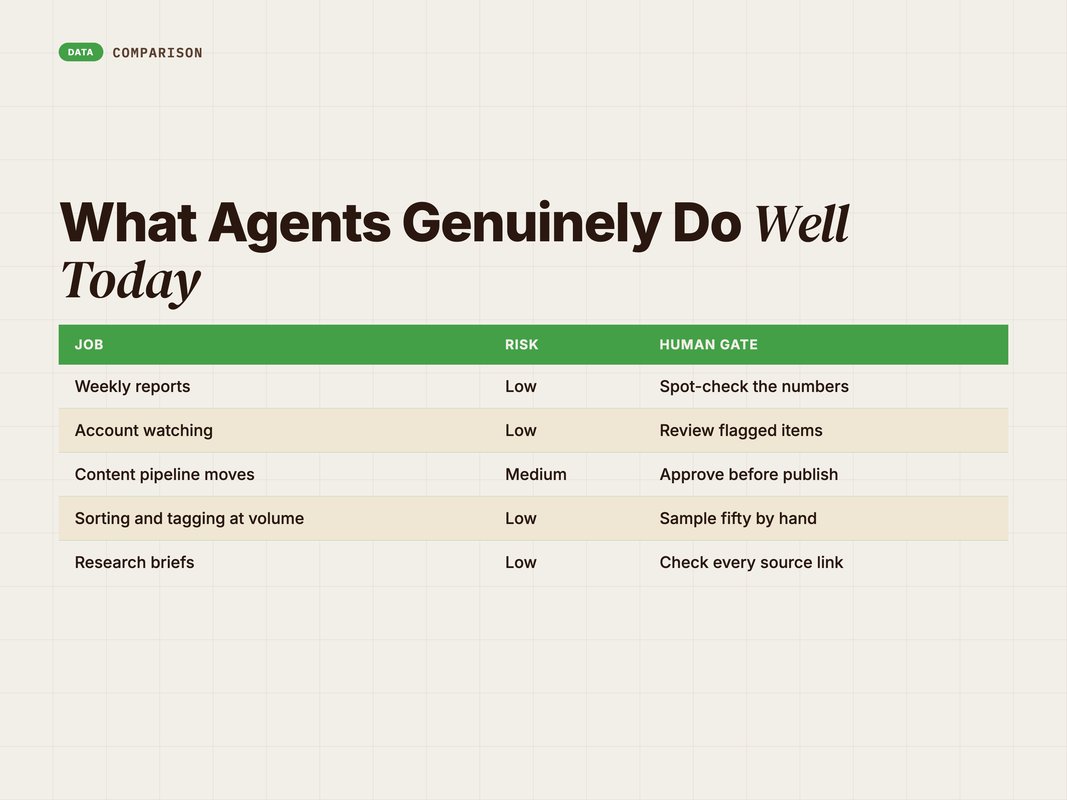
Notice what is missing from that list. None of these spend money. None of them talk to a buyer alone. None of them publish without a person pressing something.
That is not a coincidence. It is the boundary that makes them work.
Q: What is the most common first agent?
A: Weekly reporting. High frequency, low risk, and a wrong answer is obvious within a minute. It is the ideal training ground.
Where Agents Still Fail
Be specific about the failure modes, because the vendor decks will not be.
Errors that stack up. In a five-step task, a small slip at step two becomes a confident wrong answer at step five. The agent does not know it went wrong. It just keeps going.
No sense of stakes. An agent will happily pause your best campaign to hit a cost target. It has no idea that campaign funds the quarter.
Fragile tool use. A changed API. A renamed field. An expired login. Agents fail in ways that are hard to spot, because the output still looks fine.
Confidence without proof. Ask for last week's numbers and a loose agent will give you numbers. They may be made up. The layout will be perfect.
Cost drift. An agent that loops until happy can spend far more than you planned. Without a step cap and a spend cap, a stuck loop gets pricey.
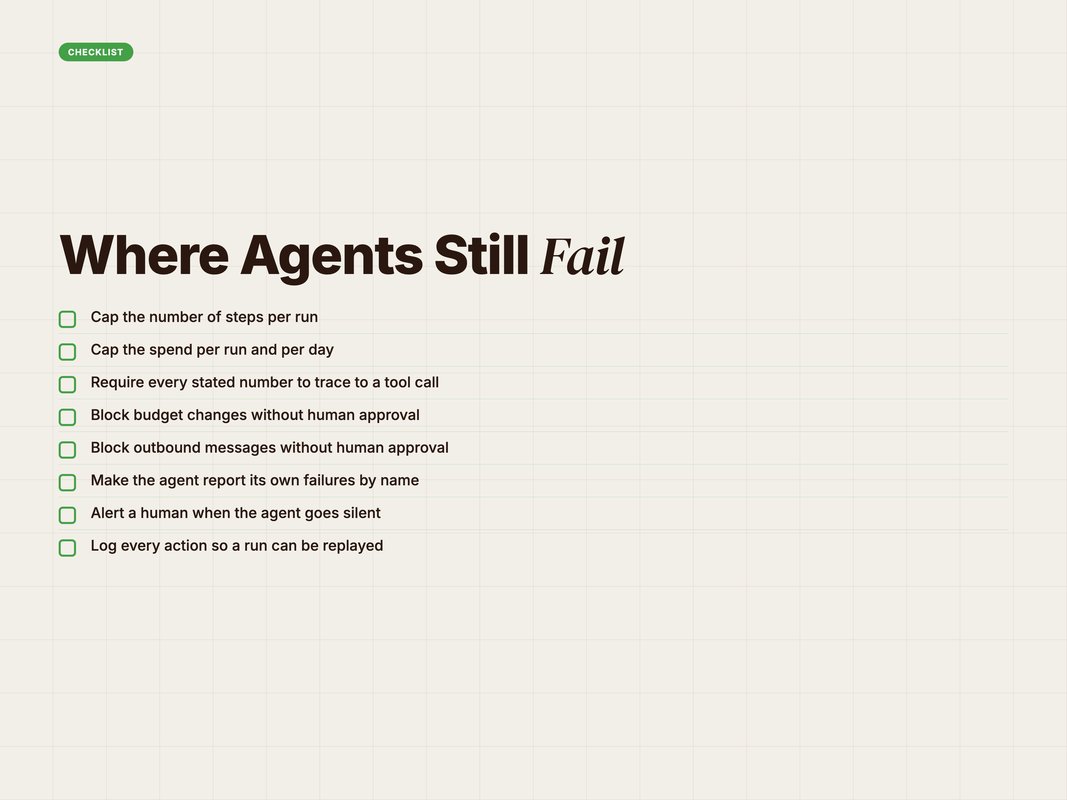
The pattern across all five is the same. Agents fail silently, not loudly.
Design for that. Every agent needs a way to admit it could not finish. And a person who sees that message when it happens.
Build the failure path first. It is the least fun part of the job and the reason the agent is still running in six months.
Q: How do I stop an agent inventing numbers?
A: Never let it recall data. Make it fetch data. If a number cannot be traced to a tool call, the agent should refuse to state it.
The Three-Question Test Before You Build One
We run every proposed agent through the same three questions. Most fail the first.
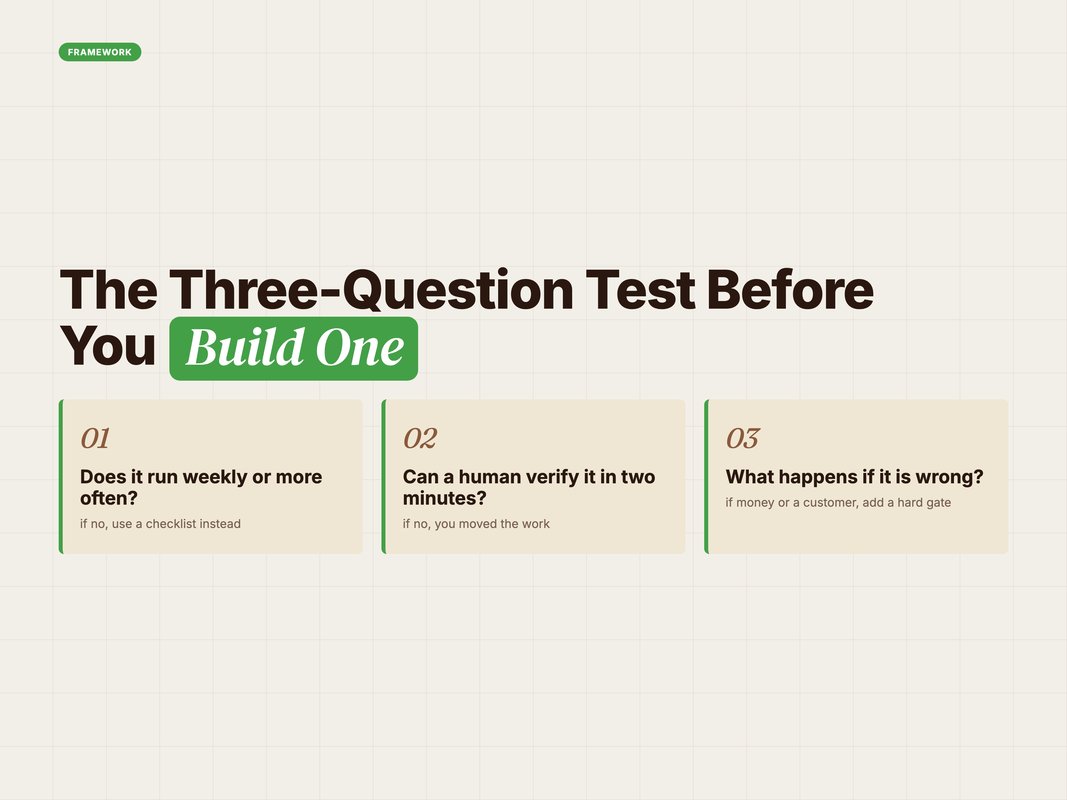
One. Does this task happen at least weekly? If it runs monthly, a checklist and a person is cheaper. Agents earn their build cost through frequency.
Two. Can a human verify the output in under two minutes? If checking takes as long as doing, you have moved the work, not removed it.
Three. What is the worst thing it can do if it is wrong? If the answer involves money leaving the business or a customer receiving something, it needs a hard human gate.
Pass all three and build it. Fail any one and either reshape the task or leave it alone.
Reshaping is usually the answer. A monthly task can often be split into a weekly one. A hard-to-check output can often be made checkable by asking for a table instead of prose.
The most common mistake we see is building an impressive agent for a task that runs twice a quarter. It works, everyone claps, and it is never used again.
Q: How long should a first agent take to build?
A: Days, not months. If the first version needs a month, the scope is too big. Cut it until it fits a week.
A First Agent, Start to Finish
Here is what a real first build looks like. No demo magic.
The task is the Monday report. Four ad platforms, one analytics tool, one spreadsheet, and an hour of someone's morning every week.
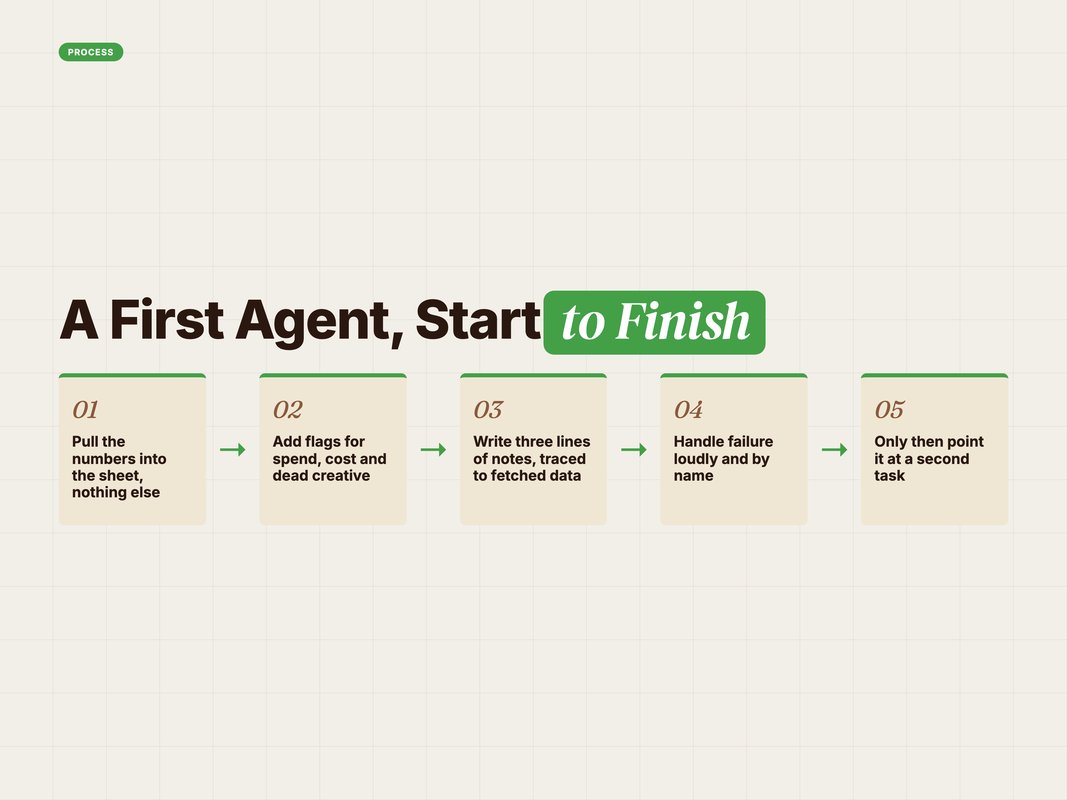
Version one does almost nothing. It pulls the numbers and writes them into the sheet. No commentary. No judgement.
That takes about two days to build. It saves forty minutes a week from the first run.
Version two adds the flags. Spend up more than 20 percent. Cost per action up more than 15 percent. A campaign with no live creative.
Now the agent is not just fetching. It is comparing against last week and telling you where to look.
Version three writes the notes. Three lines per account. What moved, by how much, and one likely reason drawn from the data it already pulled.
This is where teams get excited and where the risk enters. So the rule is strict. Every claim in the notes has to trace back to a number the agent fetched.
If it cannot point at the data, it does not get to say it.
Version four handles failure well. The platform API times out. The agent says so, in the channel, by name. It does not quietly ship a report with one account missing.
That fourth version is the one that survives. Most agents die because nobody notices they broke.
Total build time across all four versions is under two weeks of part-time work. Ongoing review is about ten minutes a week.
Then, and only then, do you point it at a second task.
Q: Why build four versions instead of one good one?
A: Because each version earns trust before it gets more freedom. A single big build gives you no way to tell which part you can rely on.
What This Costs and What It Returns
The returns are real and they are usually measured in hours, not rupees.
Proving those returns is where most teams come unstuck. About 51 percent of marketers cannot track the ROI of their AI investments at all (Source: Jasper, via Omnibound — omnibound.ai).
That says more about how teams set the work up than about the models. Pick a task with a number attached and the measurement problem mostly solves itself.
On the cost side, three things add up.
Build time. A week of someone's attention for a first agent, less after that.
Model spend. Usually modest for the jobs above, and easy to blow through without step caps.
Review time. This one never ends. Every agent adds a small review load. Teams forget to budget for it nearly every time.
The honest summary is simple. Agents shift work rather than delete it. Someone who spent Monday building a report now spends twenty minutes checking one.
That is a good trade. It is not the trade the decks promise.
How We Deploy Agents on Client Accounts
We stay cautious here on purpose. An agent that fails quietly is worse than no agent at all.
YARD is an AI-first growth marketing agency. We run performance marketing, LLM SEO, AI creative and AI funnels for D2C and B2B brands. Agents sit underneath that work, doing the parts that repeat.
Three rules govern every one we ship.
Agents read freely and write narrowly. Pulling data, checking accounts and drafting are open. Changing a budget, publishing copy or messaging a buyer goes through a person.
Every agent reports its own failures. A silent agent is assumed broken. If it has not spoken this week, someone checks why.
And every agent starts on one account before it touches ten. Scale after it has been boring for a month, not before.
If you want to start somewhere, start with reporting. It is the least glamorous project on this list and the one most likely to still be running next year. For the broader stack, see the AI marketing agency tech stack we actually use.
The Short Version
Agentic AI means software that plans, uses tools and loops toward a goal. Most things called agents today are not.
Adoption is real but early. Around a third of enterprise marketing teams run at least one agent in production, while nearly all marketers use generative AI somewhere.
Agents work well on jobs that repeat, can be checked, and have edges. Reports. Account watching. Moving content along. Sorting. Research.
They fail on long chains, on judgement calls, on fragile tool links, and on anything not grounded in real data. And they fail quietly. That is the dangerous part.
Use the three-question test. Weekly or more often, verifiable in two minutes, and harmless if wrong. Then build the smallest version that works.
Want help picking a first agent that will survive contact with your account? Talk to the YARD team and bring your three most repetitive tasks.
FAQ
Q: What is agentic AI in marketing?
A: It is AI that takes multi-step actions toward a goal, not just answers a prompt. An agent can plan, use tools, check its own work and try again without a human at each step.
Q: How many marketing teams actually use agents?
A: Fewer than the noise suggests. Only about 17 percent of organisations have deployed AI agents at all, and roughly 19 percent of marketers use them for end-to-end campaign automation. Over 60 percent expect to deploy within two years.
Q: What can a marketing agent reliably do today?
A: Repeatable work with a clear finish line. Pulling and reconciling reports, monitoring accounts for rule breaks, drafting and routing content, and tagging or classifying at volume.
Q: What should agents not be doing yet?
A: Anything that spends money, makes a public claim or touches a customer without review. Budget changes, live ad copy and outbound messages all need a human gate.
Q: Do agents save money?
A: They save hours, which is not the same thing. Most reported ROI comes from reclaimed analyst time, not from lower media costs or fewer people.
Q: Where should a team start?
A: Start with the most boring recurring task you have. Weekly reporting is the usual first win. It is high frequency, low risk, and easy to check.
Insights from Our Experts
Explore our latest articles on digital marketing strategies.