

Apple moves late and moves big. That pattern is about to hit search.
At WWDC in June 2026, Apple unveiled Siri AI. It calls this an entirely new version of Siri, more conversational and more capable than the one on your phone today (Source: Apple Newsroom, 2026 — apple.com).
It is in beta now. It ships to the public this autumn.
So should you care? Yes, but not in the way most posts will tell you. There is no Siri ranking factor to chase. There is a set of unglamorous fixes that pay off across every AI surface at once.
What Apple Actually Announced
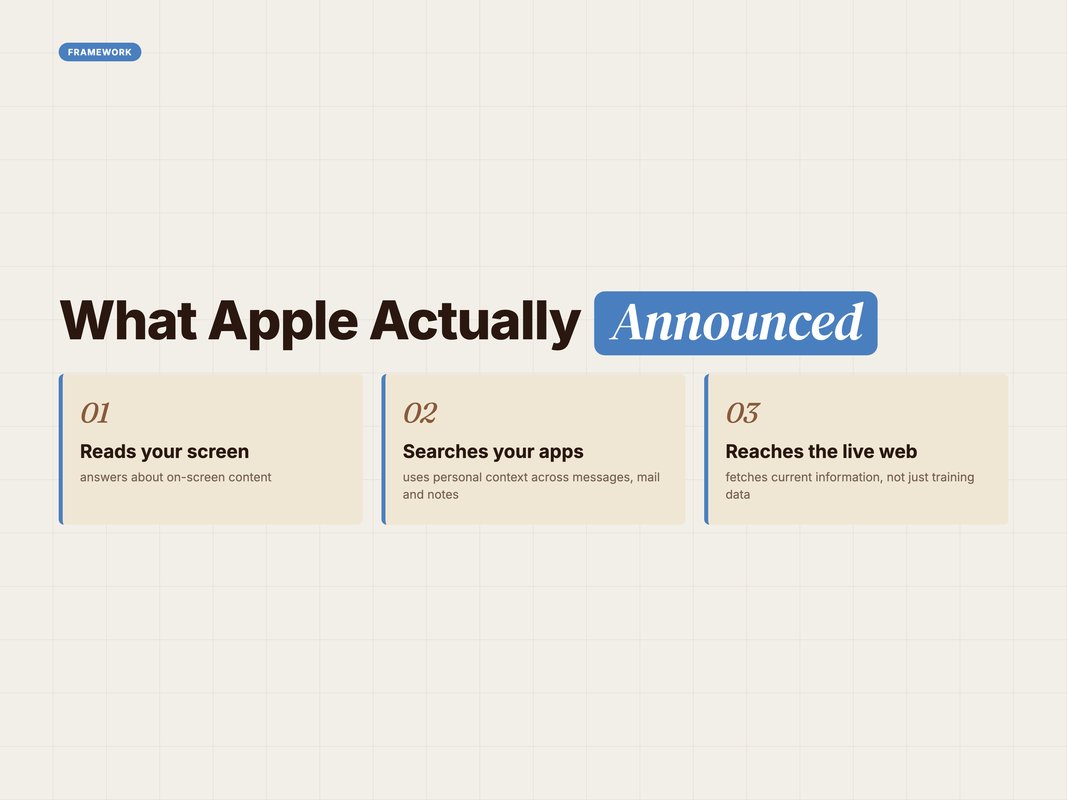
Strip the keynote language and three things stand out.
It reads your screen. Siri AI can answer questions about what is on screen right now. That turns the assistant into a layer over every app, not a separate destination.
It searches across your apps. It uses personal context to pull from things you already have. Messages, mail, notes, photos.
It goes to the web. It can fetch current information rather than relying only on what it was trained on (Source: Apple Newsroom, 2026 — apple.com).
That third point is the one that matters for brands.
An assistant that reaches the live web has to pick sources. Something decides which page answers the question. That is the surface you can influence.
There is also a model story worth knowing. Apple has worked with Google on a custom Gemini model for parts of Siri. The interface is Apple. The brain is partly not.
Q: Is this a search engine?
A: Not exactly. It is an answer layer. You ask, it replies once, and the list of options never appears. That is a bigger change than a new ranking algorithm.
Why an Assistant Is Not a Search Box
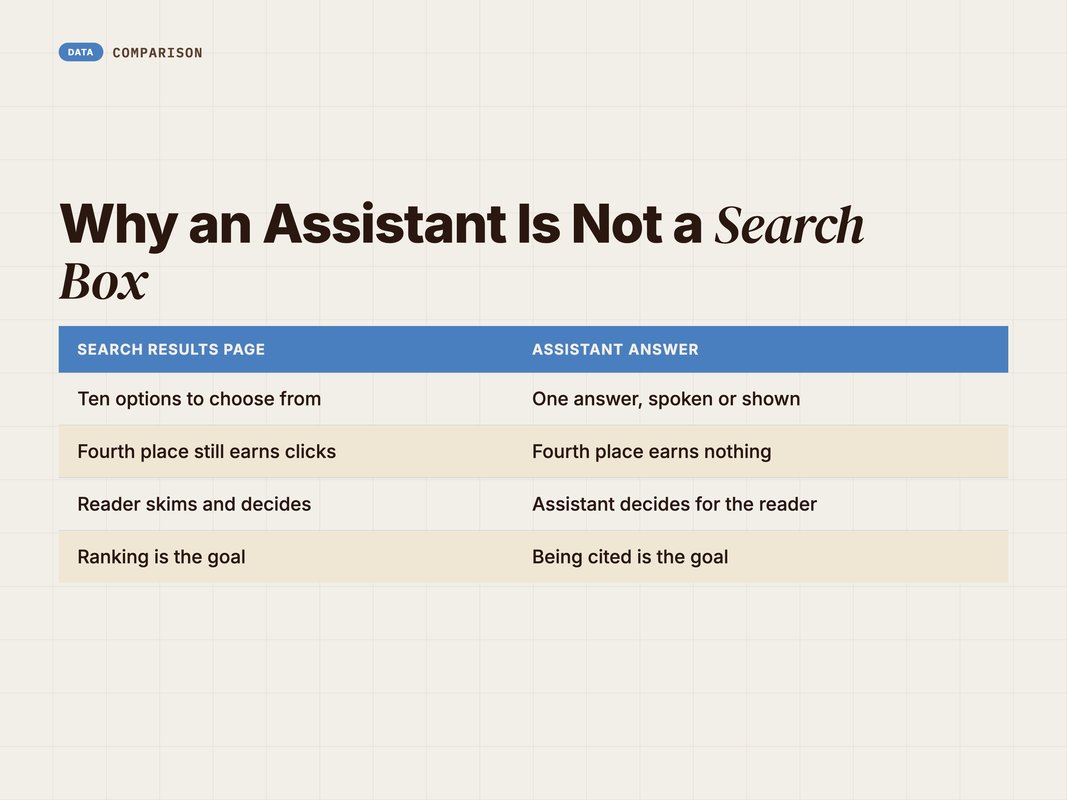
A search box gives you ten choices. An assistant gives you one answer.
That single difference reshapes the work.
On a results page, being fourth still earns clicks. In a spoken answer, being fourth earns nothing. There is no fourth.
So the goal shifts from ranking to being cited. You want to be the source the answer is built from.
The second shift is format. Assistants prefer short, direct, factual statements. A page that buries the answer under 400 words of throat-clearing is a bad source, however well it ranks.
The third shift is trust. Assistants lean on facts they can verify in more than one place. A price listed differently on your site, your listing and your marketplace page is a reason to skip you.
None of this is new advice. It is the same advice AI Overviews and chat search have been giving for two years. Apple just raises the stakes by putting it on the lock screen.
Q: Will this kill my organic traffic?
A: It will compress it for simple questions. Hours, prices, definitions. Complex and comparison queries still send clicks, because one answer is not enough for them.
The Device Limit Nobody Mentions
Here is the part that should calm your planning.
Siri AI is coming to newer Apple devices only (Source: 9to5Mac, 2026 — 9to5mac.com).
That caps the early audience by hardware, not by interest. Adoption will follow the upgrade cycle, which takes years, not months.
So the honest read is this. Year one is small. Year three is not.
That is good news, because it gives you time. It is also a trap, because "small" is how teams justify doing nothing until it is late.
The users who get it first also skew a particular way. They bought a recent flagship phone. For most consumer brands, that is not a segment you want to be invisible to.
Q: How big is the early audience really?
A: Smaller than the headlines suggest and richer than average. Treat it as a high-value slice rather than a mass channel in the first year.
What to Fix in the Next 90 Days
Skip the strategy deck. This is a maintenance list.
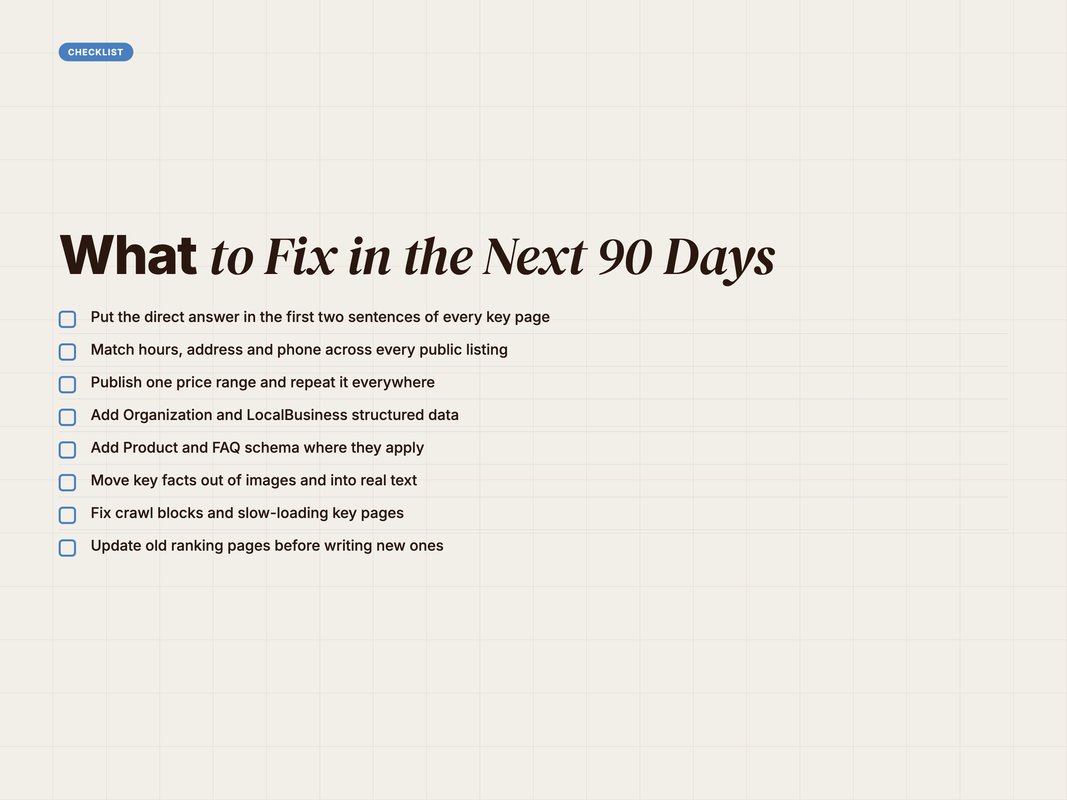
Three of these deserve a word.
Answer-first pages are the highest-leverage change. Put the direct answer in the first two sentences under the heading. Then explain. Most sites do the reverse.
Fact consistency is dull and decisive. Your hours, address, price range and service list must match everywhere. Your site, your business listing, your app store page, any marketplace. Assistants read all of them.
Structured data is how a machine reads your facts without guessing. Organization, LocalBusiness, Product, FAQ. Nothing exotic.
The rest is hygiene. Fast pages, crawlable content, no key facts locked inside images.
If a fact only exists inside a JPEG on your site, it does not exist to an assistant.
What Not to Do
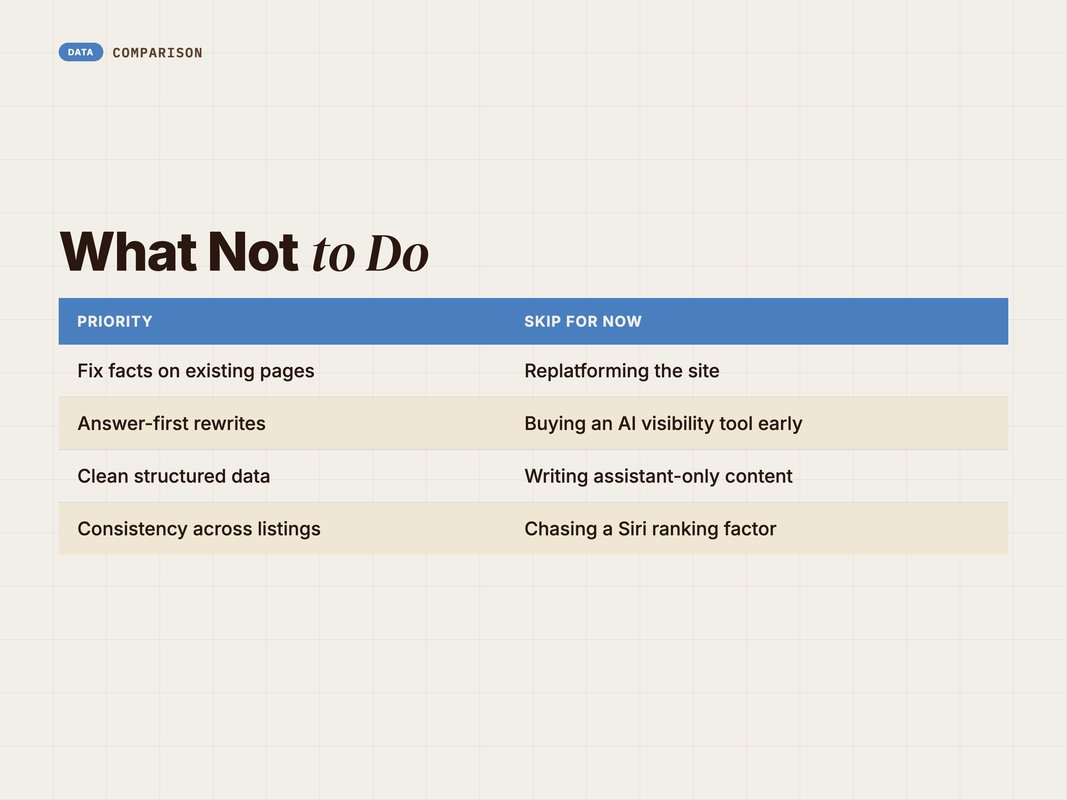
Two mistakes are already visible in the market.
Do not rebuild your site for one assistant. No assistant is worth a replatform. The work that helps Siri AI also helps Google, ChatGPT and Perplexity. Do the shared work.
Do not buy an "AI visibility" tool before you fix your facts. Tracking how often you appear is useless while your price is listed three different ways. Fix the source data first, then measure.
There is a third, quieter mistake. Teams write new content for assistants and leave the old pages alone.
Assistants pull from what is already indexed. Your old pages are the ones being read today. Fix those first.
Q: Do I need separate content for assistants?
A: No. You need clearer versions of the content you already have. A page that answers well for a person answers well for a machine.
How to Tell If It Is Working
You cannot open a dashboard for assistant visibility. So measure it by hand, on a schedule.
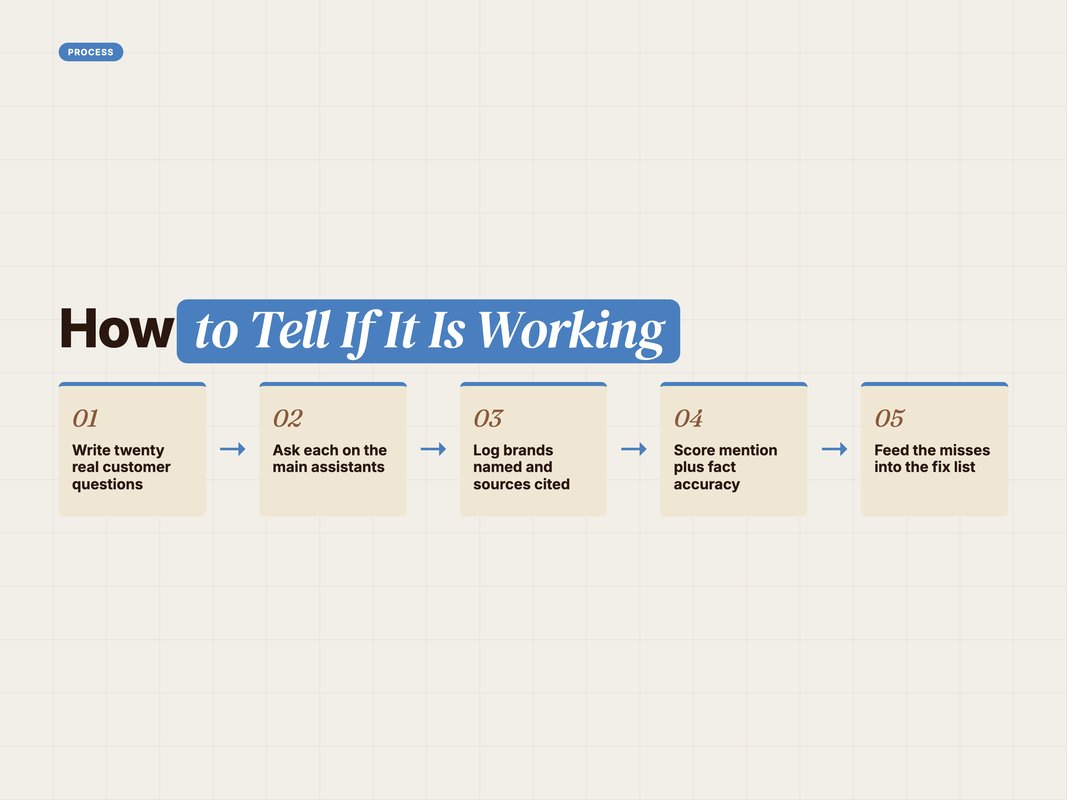
The method is simple and it takes an hour a month.
Write down twenty questions a real customer would ask out loud. Mix them. Some about your category, some about your brand, some about price and availability.
Ask each one on the main assistants. Log which brands get named and which sources get cited.
Score yourself on two things only. Were you mentioned, and was the fact correct? A wrong fact about your brand is worse than no mention at all.
Repeat the same twenty questions every month. The absolute numbers matter less than the direction.
Then feed the misses back into the fix list. If an assistant keeps naming a competitor for a question you should own, that is a content gap with an address.
Q: Can I automate this check?
A: Partly, and it is worth doing once the question set is stable. Start manual for two months so you learn what good answers look like before you script it.
How We Are Preparing Client Sites
Our approach is deliberately unexciting, because the winning work here is not creative.
YARD is an AI-first growth marketing agency. We run performance marketing, LLM SEO, AI creative and AI funnels for D2C and B2B brands. Getting brands quoted by AI systems is a core part of the SEO work now, not a side project.
The sequence we use runs in four passes.
First, a fact audit. We pull every public statement of your core facts and list the mismatches. This alone usually surfaces a dozen problems.
Second, an answer pass. We rewrite the opening of every important page so the answer comes first and the context follows.
Third, structured data. Clean schema on the pages that matter, validated, not guessed.
Fourth, a citation check. We ask the major assistants questions in your category and log which sources they use. That tells you where you actually stand, rather than where a tool estimates you stand.
The whole cycle takes a few weeks and improves normal search performance as a side effect. That is the point. Nothing in it is a bet on Apple specifically.
If you want that audit run before the autumn launch, we can scope it this month. For the wider picture, see our guide to getting your brand into AI answers.
The Short Version
Apple's new assistant is real, is shipping this autumn, and starts on newer devices only.
It reads your screen, searches your apps and reaches the live web. That last part is the one you can influence.
The work is not exotic. Answer first, keep facts identical everywhere, add clean structured data, and fix your existing pages before writing new ones.
Do not replatform for it. Do not buy tracking tools before fixing your source data. Do not wait for mass adoption to start, because the fixes take longer than the launch will.
Every hour spent here also helps AI Overviews, ChatGPT and Perplexity. That is why it is worth doing now, whatever Apple ships in October.
Want a fact and citation audit before the autumn rollout? Talk to the YARD team and we will run it against your live pages.
FAQ
Q: What is Apple's new AI assistant?
A: Apple unveiled Siri AI at WWDC in June 2026. Apple calls it an entirely new version of Siri that is more conversational and more capable. It is in beta now and launches publicly this autumn.
Q: Will Siri AI work on my current iPhone?
A: Not on every model. Siri AI is coming to newer Apple devices only. That limits the early audience, so treat the first months as a small but valuable slice of users.
Q: Does Apple's assistant use Google's models?
A: In part. Apple has been working with Google on a custom Gemini model to power parts of Siri. So the model layer is not purely Apple, even though the interface is.
Q: How does an assistant change SEO?
A: It removes the page of ten blue links. One answer gets read aloud or shown. So being the source that answer draws from matters more than ranking third.
Q: Should I change my whole SEO plan for this?
A: No. The prep work for assistants is the same work that helps AI Overviews and chat search. Clear answers, clean structured data, accurate business facts. None of it is wasted.
Q: What should a local business do first?
A: Fix the basics an assistant reads out loud. Hours, address, phone, service list and price ranges. Make them match everywhere, because an assistant will only repeat one version.
Insights from Our Experts
Explore our latest articles on digital marketing strategies.