

Your next buyer may never see your homepage.
They ask ChatGPT. They ask Perplexity. They read the answer. Then they move on. Generative engine optimization is how you get named inside that answer.
GEO is the practice of shaping content so AI engines cite your brand. It targets ChatGPT, Perplexity, Claude, Gemini, and Google AI Overviews. The win is being quoted, not just ranked.
This matters more each month. Pew Research found people clicked a result in just 8 percent of searches with an AI summary. That is down from 15 percent without one (Source: Pew Research Center, 2025 — pewresearch.org).
So the answer is the new front page. This playbook breaks GEO into a framework, real steps, and a way to measure it. Let us get into it.
What Generative Engine Optimization Actually Means
Let us define it cleanly.
Generative engine optimization is getting your brand into AI-generated answers. Not the link list. The answer itself.
Classic SEO chases a ranking. GEO chases a citation. You want the model to name you. You want it to quote you. You want it to pull your stat into the reply.
This is a real shift in how people find brands. AI Overviews already reach a big slice of search. Semrush studied ten million keywords and tracked the spread.
Coverage moved from 6.49 percent of keywords in January 2025 to a 24.61 percent peak in July. It then settled near 15.69 percent by November (Source: Semrush, 2025 — semrush.com).
That volatility is the point. AI answers are now a normal part of search. They are not a fringe feature anymore.
So GEO is not a side project. It is core to how buyers learn about you. Treat it that way.
Think about your own habits. You likely ask an AI tool before you open a tab. Your buyers do the same. The first impression now forms inside a generated reply.
That reply is built from sources. The model picks which ones to trust. GEO is how you become one of those trusted sources.
It works across every major engine. ChatGPT pulls from the open web and its index. Perplexity shows its sources right in the answer. Claude and Gemini do the same in their own way. Google AI Overviews sit on top of normal search.
Each engine has quirks. But the core need is shared. They all want clear, sourced, well-structured content they can quote with confidence.
Q: What is generative engine optimization in one sentence?
A: It is optimizing your content so AI engines cite your brand inside their answers, across ChatGPT, Perplexity, Claude, Gemini, and AI Overviews. The goal is to be named in the answer, not only ranked in a link list.
SEO vs GEO: The Shift You Cannot Ignore
Old habits do not map cleanly here.
SEO and GEO share a base. Both reward clear, useful, well-sourced pages. But the win condition changes.
SEO wins a blue link. GEO wins a line inside the answer. That is a different prize.
Here is the contrast, side by side.
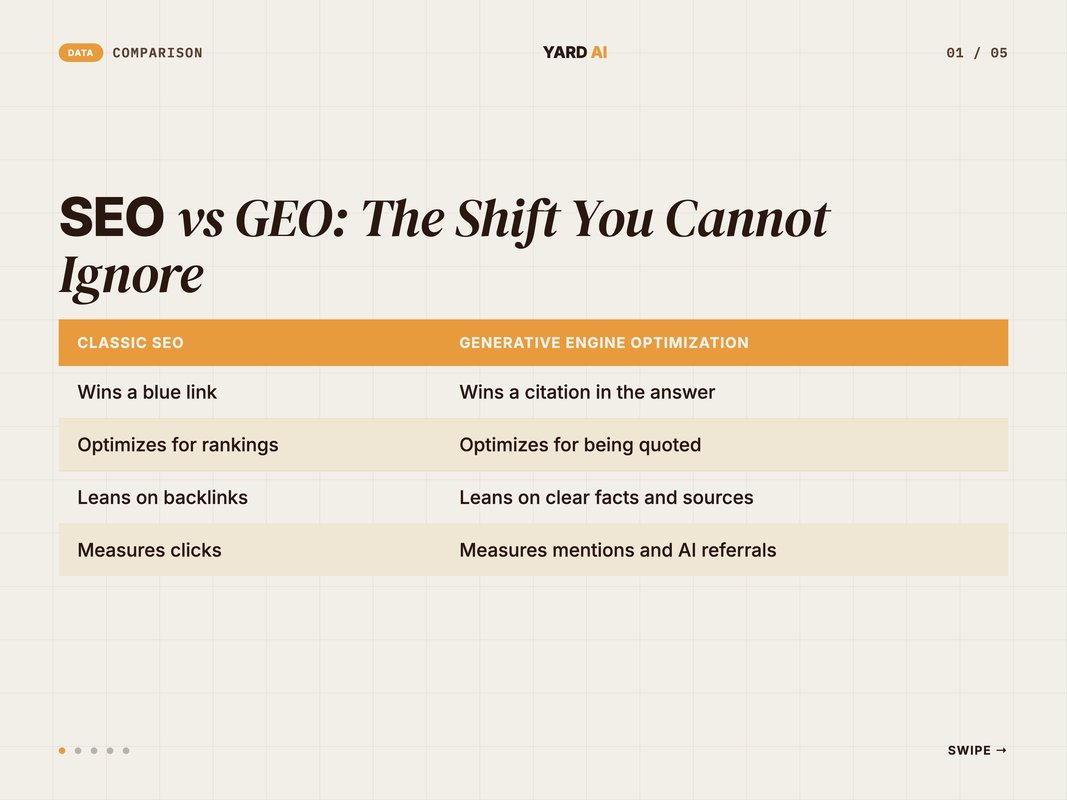
SEO vs GEO at a glance
- SEO wins a blue link. GEO wins a citation in the answer.
- SEO optimizes for rankings. GEO optimizes for being quoted.
- SEO leans on backlinks. GEO leans on clear facts and sources.
- SEO measures clicks. GEO measures mentions and AI referrals.
Read that list twice. The GEO side is where attention is moving.
You still want strong SEO. It feeds GEO. A page that ranks well is easier for an engine to find and quote.
But you must add new moves. You write to be lifted. You answer first, then explain.
You also change how you judge success. A blue link is no longer the only prize. A named mention can win the buyer with no click at all.
Here is the good news. The two efforts overlap a lot. Clean structure helps both. Clear answers help both. Strong sources help both.
So you are not starting over. You are extending what already works. Most GEO wins come from sharpening pages you already have.
Q: Is GEO replacing SEO?
A: No. GEO sits on top of SEO. You keep the rankings work, then add answer-first writing, clear sourcing, and AI-referral tracking. The two share a base of clean, useful, well-structured content.
The 4 C's of Generative Engine Optimization
You need a model you can reuse. We call ours the 4 C's.
It keeps a messy job simple. Each C is one lever. You can pull each one this week.
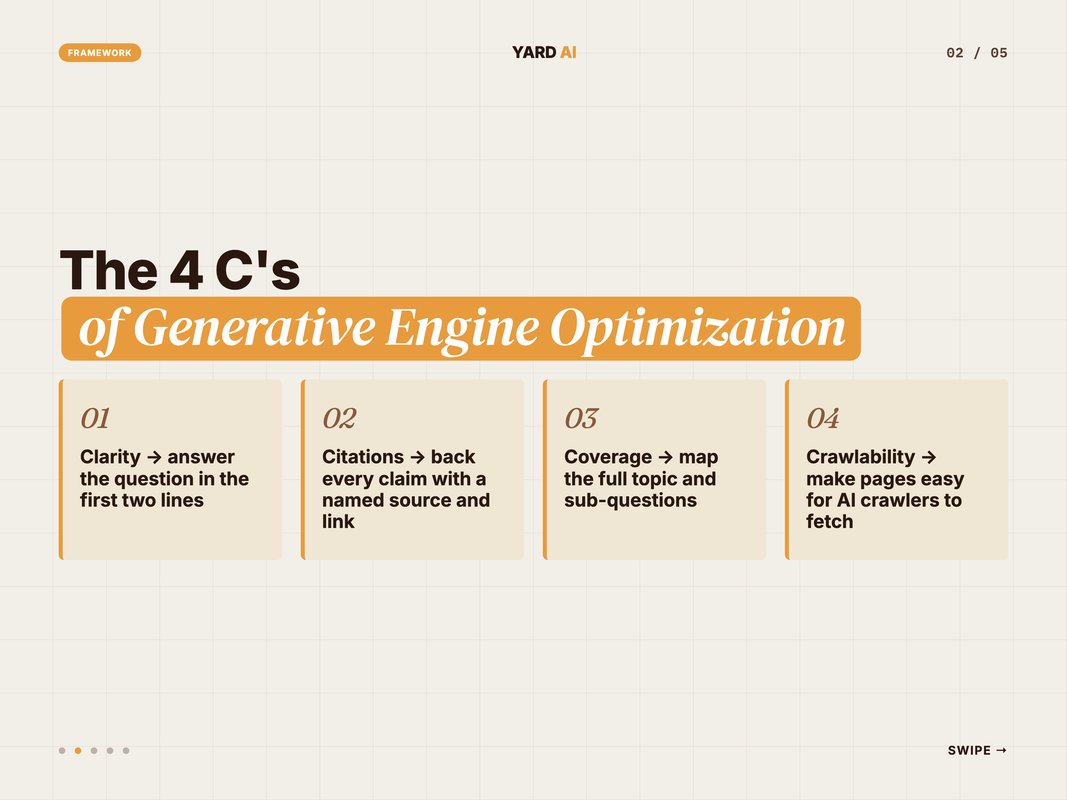
The 4 C's Framework
- Clarity — Answer the question in the first two lines of each section.
- Citations — Back every claim with a named source and live link.
- Coverage — Map the full topic, including the sub-questions buyers ask.
- Crawlability — Make pages easy for AI crawlers to fetch and parse.
Clarity comes first for a reason. Engines lift clean, direct sentences. Bury the answer and you get skipped.
Citations are not optional. They are the heart of trust. Engines favor pages that show their work.
The research backs this. The Princeton GEO study found that adding statistics and citing sources lifted source visibility by 30 to 40 percent in generated answers (Source: Aggarwal et al., Princeton / arXiv, 2024 — arxiv.org).
Coverage means depth. Answer the main question. Then answer the next five. Thin pages get passed over.
Crawlability is the plumbing. If GPTBot or ClaudeBot cannot fetch your page, none of the rest counts. Check your robots rules first.
Run all four on every key page. Clarity up top. Citations next to claims. Coverage across the topic. Crawlability under the hood.
Q: Why use a framework instead of a checklist?
A: A framework gives you a repeatable lens for every page. The 4 C's, Clarity, Citations, Coverage, and Crawlability, let your whole team apply GEO the same way. It scales better than a one-off list.
Write Content AI Engines Want to Quote
This is the heart of GEO. Most of your wins live here.
Engines quote sources that read like clean reference material. So write that way on purpose.
Start with the answer. Then add the detail. Then add the proof. That order matters.
The research is clear. In the Princeton study, "Quotation Addition" was a top method. It drove a 41 percent relative lift in visibility (Source: Aggarwal et al., Princeton / arXiv, 2024 — arxiv.org).
So quotes and stats get pulled. Give the engine clean ones to grab.
Use these moves on every key page. They are simple. They work.
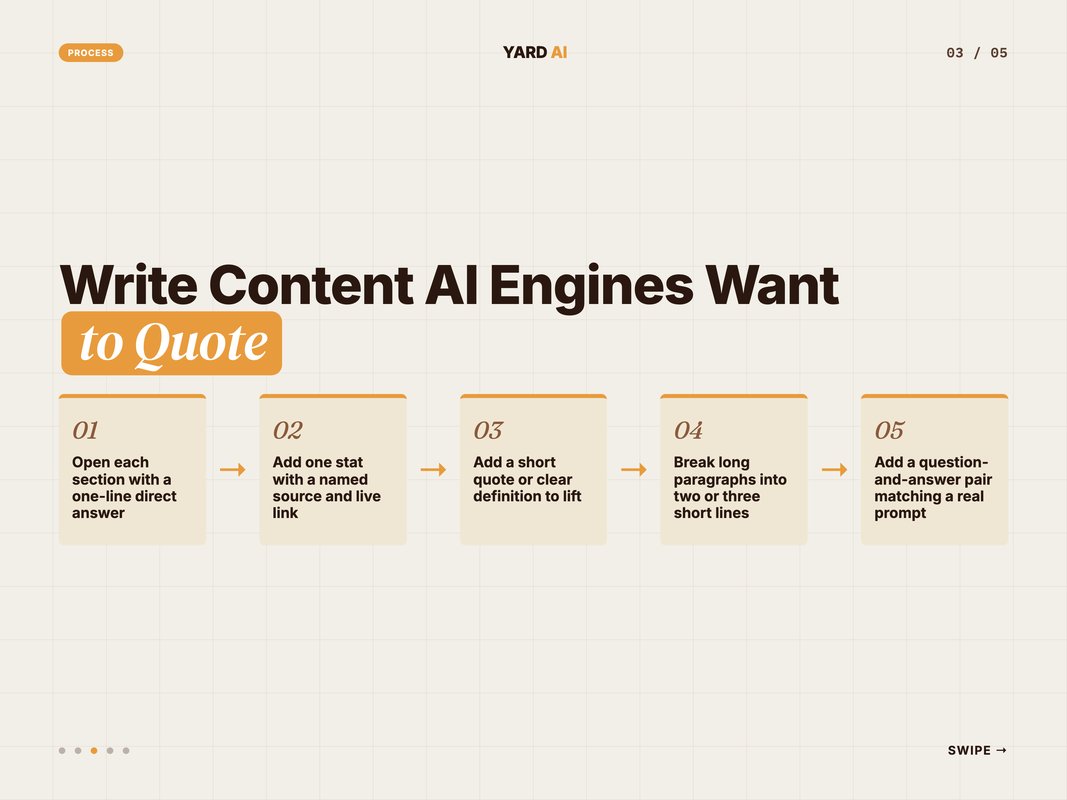
- Open each section with a one-line direct answer.
- Add one stat with a named source and live link.
- Add a short quote or clear definition the engine can lift.
- Break long paragraphs into two or three short lines.
- Add a question-and-answer pair that matches a real prompt.
Notice step three. A liftable line is gold. Make at least one per section.
Then audit your numbers. Every figure needs a source next to it. No source, no number. That rule keeps you safe.
Watch your structure too. Use short headings. Use clear lists. Use plain words. Engines parse those faster than dense prose.
Let us make this concrete. Say you sell project software. A buyer asks an AI tool for the best option for small teams.
The engine wants a clear claim. So open with one. "Our tool fits teams under ten people." Then back it with a sourced stat or a named feature.
Add a definition the model can lift. "A small team here means two to ten seats." That line reads like reference text. Engines love reference text.
Then mirror the real prompt. Add a question and answer that match a real buyer query. Use the exact words they would type. Then answer it in two clean sentences.
Do this on your top pages first. Your pricing page. Your comparison page. Your core guides. Those are the pages engines reach for most.
Q: What kind of content gets cited most by AI engines?
A: Clear, sourced, answer-first content gets cited most. Engines favor pages with named statistics, direct definitions, and quotable lines. The Princeton GEO study showed adding statistics and citations raised visibility by 30 to 40 percent.
Structured Data and llms.txt: Hype vs Reality
Let us kill two myths here.
Marketers love a switch you can flip. Schema and llms.txt look like switches. The data says: not really.
Take structured data first. It helps machines parse your page. That is genuinely useful hygiene.
But it is not a citation cheat code. The proof is blunt.
Ahrefs tracked 1,885 pages that added schema. It found no clear lift in AI citations versus a control group (Source: Ahrefs, 2026 — ahrefs.com).
So add schema for parsing, not for magic. It supports good content. It does not replace it.
Now llms.txt. It is a simple file that maps your key pages for AI crawlers. It sits at your site root.
Worth adding? Sure, it is cheap. But keep your hopes grounded. Major AI providers do not yet rely on llms.txt at scale (Source: Semrush, 2025 — semrush.com).
Here is a safe, generic llms.txt starter. Adapt it to your own site.
Brand: [Your Brand]
Summary: One line on what [Your Brand] does.

Core pages:
- About: https://yourbrand.com/about
- Product: https://yourbrand.com/product
- Blog: https://yourbrand.com/blog

Contact: hello@yourbrand.com
Keep it short. List your best pages. Update it when your site changes. That is the whole job.
So where does that leave schema? Use it, but for the right reason. Add Article schema to your posts. Add Organization schema to your site. Add FAQ schema to your answers.
That markup helps engines parse you. It clarifies what each page is. It is good hygiene, full stop.
Just do not expect it to do the heavy lifting. The lift comes from clear, sourced content. Schema supports that work. It does not replace it.
The same logic applies to llms.txt. Ship it because it is cheap and tidy. Do not bet your visibility on it. Bet on the content instead.
Q: Do schema and llms.txt guarantee AI citations?
A: No. Schema helps engines parse your page, and llms.txt maps your key URLs, but neither guarantees a citation. The Ahrefs study found no clear citation lift from schema alone. Treat both as hygiene that supports strong, sourced content.
Build Entity Authority Around Your Brand
Engines trust entities, not just pages.
An entity is a known thing. Your brand. Your founder. Your product. The clearer your entity, the more an engine trusts you.
So make your brand legible to machines. Remove the guesswork.
Use the same name everywhere. Same spelling. Same description. Same links. Mixed signals confuse the model.
Get named on sources engines already read. Think trusted directories. Think reviews. Think press.
Here is a quick entity-authority checklist. Run it this quarter.
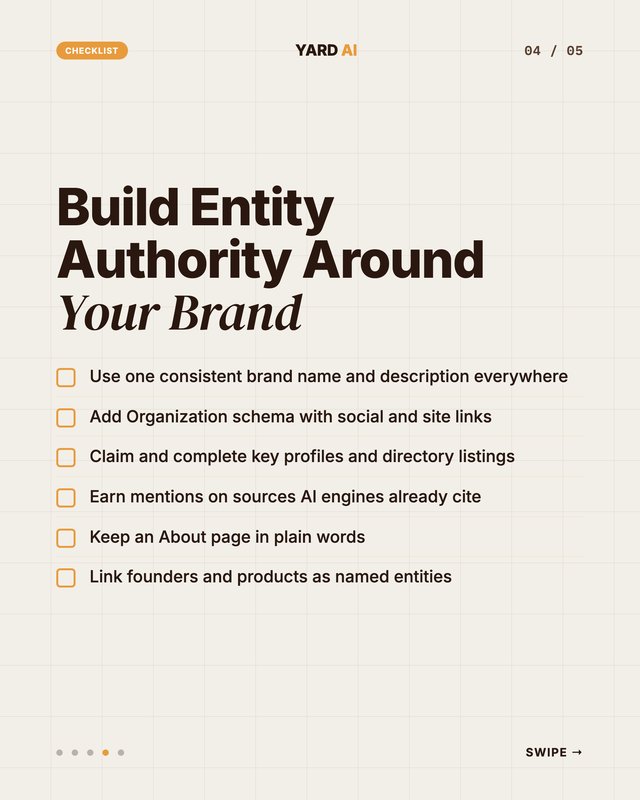
- Use one consistent brand name and description across the web.
- Add Organization schema with your social and site links.
- Claim and complete your key profiles and directory listings.
- Earn mentions on sources AI engines already cite.
- Keep an About page that states who you are in plain words.
- Link your founders and products as named entities.
None of this is exotic. It is brand hygiene done with AI in mind.
Do it once. Then maintain it. Entity trust compounds over time.
Q: What is entity authority in AI search?
A: Entity authority is how well AI engines understand and trust your brand as a known thing. It grows when your name, description, and links stay consistent everywhere. Strong entities get cited more often than scattered, inconsistent ones.
How to Measure AI-Referral Traffic
If you cannot measure it, you cannot defend it.
AI referrals are small today. But they are rising. And they convert warm, because the buyer already trusts the answer.
Start by isolating the traffic. Build a referral segment for AI hosts. That gives you a clean view.
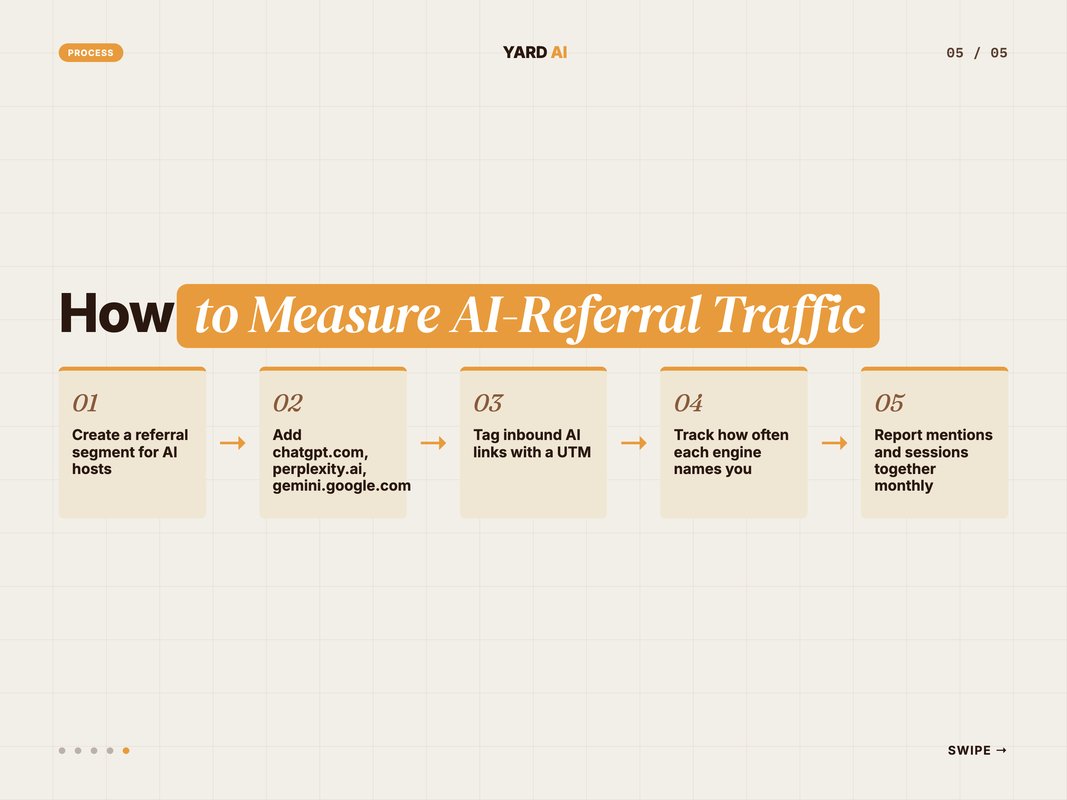
- Create a referral segment for AI hosts in your analytics tool.
- Add hosts like chatgpt.com, perplexity.ai, and gemini.google.com.
- Tag inbound AI links with a UTM where you control the source.
- Track citations: how often each engine names you for core prompts.
- Report mentions and referral sessions together each month.
Do not judge GEO on clicks alone. Influence now happens inside the answer.
Remember the Pew data. Only 1 percent of visits led to a click on a link inside the AI summary (Source: Pew Research Center, 2025 — pewresearch.org).
So count mentions, not just sessions. A brand named in the answer wins, even with no click.
Set a simple cadence too. Check your prompts monthly. Note where you appear. Note where a rival appears instead. Then fix that gap.
Pick a short list of core prompts. The ten questions your buyers ask most. Run each one through the main engines. Log who gets cited.
That log becomes your scoreboard. It shows real movement over time. It also shows which pages earn the mentions, so you can make more like them.
Watch quality, not just volume. AI referrals are smaller than search traffic today. But they tend to arrive warmer and more ready to buy. One named mention can be worth many cold clicks.
Tie it back to revenue where you can. Map AI-referral sessions to signups or sales. That number turns GEO from a nice idea into a budget line.
Quick Facts: Generative Engine Optimization at a Glance
- AI Overviews appeared on 6.49 percent of keywords in January 2025, peaking at 24.61 percent in July before settling near 15.69 percent by November — (Source: Semrush, 2025 — semrush.com).
- Users clicked a result in only 8 percent of searches with an AI summary, versus 15 percent without one — (Source: Pew Research Center, 2025 — pewresearch.org).
- Adding statistics and citing sources lifted source visibility by 30 to 40 percent in generated answers — (Source: Aggarwal et al., Princeton / arXiv, 2024 — arxiv.org).
- A study of 1,885 pages found no clear AI-citation lift from adding schema alone — (Source: Ahrefs, 2026 — ahrefs.com).Q: How do I measure AI-referral traffic?
A: Build a referral segment for AI hosts like chatgpt.com and perplexity.ai, then watch it in your analytics tool. Pair that with citation tracking: how often each engine names you for your core prompts. Report mentions and sessions together.
Common GEO Mistakes to Avoid
Most GEO failures are self-inflicted. Here are the big ones.
First, burying the answer. Long intros lose the engine. Lead with the point.
Second, naked numbers. A stat with no source is a risk. It will not get cited, and it may be wrong.
Third, chasing tactics over substance. Schema and llms.txt are fine. But they do not replace clear, sourced content.
Fourth, ignoring crawlability. Blocked bots cannot read you. Check your robots rules before anything else.
Fifth, no measurement. If you do not track AI referrals, you cannot prove the work. Build the segment early.
Sixth, writing for robots, not people. Stuffed, stiff copy reads badly. Engines and humans both skip it. Write clearly for a person, and the engine follows.
Seventh, set-and-forget. AI answers shift fast. A page cited today can drop next month. So you revisit, refresh, and re-source on a schedule.
Fix these and you are ahead of most. The bar is still low. That is the opportunity.
Q: What is the most common GEO mistake?
A: The most common mistake is burying the answer under a long intro. Engines lift clear, direct lines from near the top. Lead with the answer, then add detail and a cited source right after.
How YARD Builds GEO Into Growth Programs
We run GEO as part of every growth program. Not as a bolt-on.
YARD is an AI-first growth marketing agency. We pair performance marketing, LLM SEO, AI creatives, and AI funnels. We do this for D2C and B2B brands. The site is yardagency.ai.
Our GEO work starts with the 4 C's. We make pages answer-first. We source every claim. We map full topics, not thin posts.
Then we wire up measurement. We build AI-referral segments. We track brand citations across engines. You see where you get named and where you do not.
We also build the pipes behind it. We use Claude and MCP workflows to audit content at scale. They flag uncited claims fast. [internal link: ai-content-workflows]
The point is durable visibility. Not a one-time spike. As AI answers grow, your brand stays in them.
If your buyers ask AI before they ask you, GEO is no longer optional. It is the work. Want your brand inside more AI answers? That is exactly what we build.
The Bottom Line
Search changed shape. The answer is the new front page.
Generative engine optimization gets your brand cited inside that answer. It spans ChatGPT, Perplexity, Claude, Gemini, and AI Overviews. The win is a mention, not just a rank.
Start with the 4 C's. Clarity, Citations, Coverage, Crawlability. Write answer-first. Source every number. Build a clean entity. Then measure AI referrals and brand mentions, not clicks alone.
The data is clear. AI summaries cut clicks, yet shape what buyers believe (Source: Pew Research Center, 2025 — pewresearch.org). So your brand must live where the answer forms.
Pick one page this week. Add the answer up top. Cite your stats. That is generative engine optimization, started. [internal link: llm-seo-guide]
FAQ
Q: What is generative engine optimization? A: Generative engine optimization is the practice of shaping your content so AI engines cite your brand in their answers. It targets ChatGPT, Perplexity, Claude, Gemini, and Google AI Overviews. The goal is being named in the answer, not just ranked on a page.
Q: How is GEO different from SEO? A: SEO wins a blue link on a results page. GEO wins a mention inside a generated answer. SEO rewards rankings and clicks. GEO rewards being quoted, cited, and named. Both share a base of clear, well-sourced content.
Q: Does structured data help with AI answers? A: Structured data helps machines parse your page, but it is not a magic switch. An Ahrefs study of 1,885 pages found no clear citation lift from adding schema alone. Treat schema as good hygiene that supports strong content, not a standalone tactic.
Q: Should I add an llms.txt file? A: You can, but keep expectations low. Major AI providers do not yet rely on llms.txt at scale. It is cheap to add and may help over time. Do not treat it as the only reason you get cited.
Q: How do I measure AI-referral traffic? A: Build a referral segment for AI hosts like chatgpt.com, perplexity.ai, and gemini.google.com. Watch that segment in your analytics tool. Also track how often each engine cites or names your brand for your core prompts.
Q: Is GEO worth it if AI traffic is still small? A: Yes. AI answers already shape what buyers believe before they click. Pew found that only 8 percent of searches with an AI summary led to a result click. Influence now happens inside the answer, so your brand needs to be there.
Insights from Our Experts
Explore our latest articles on digital marketing strategies.