

Anthropic just cut the price of top-tier AI in half. Not with a discount. With a new model.
On July 24, 2026, Anthropic launched Claude Opus 5. The company's pitch is simple: near Fable 5 intelligence at Opus speed and cost. In plain terms, you get close to the best model on the market for about half the price, per Anthropic.
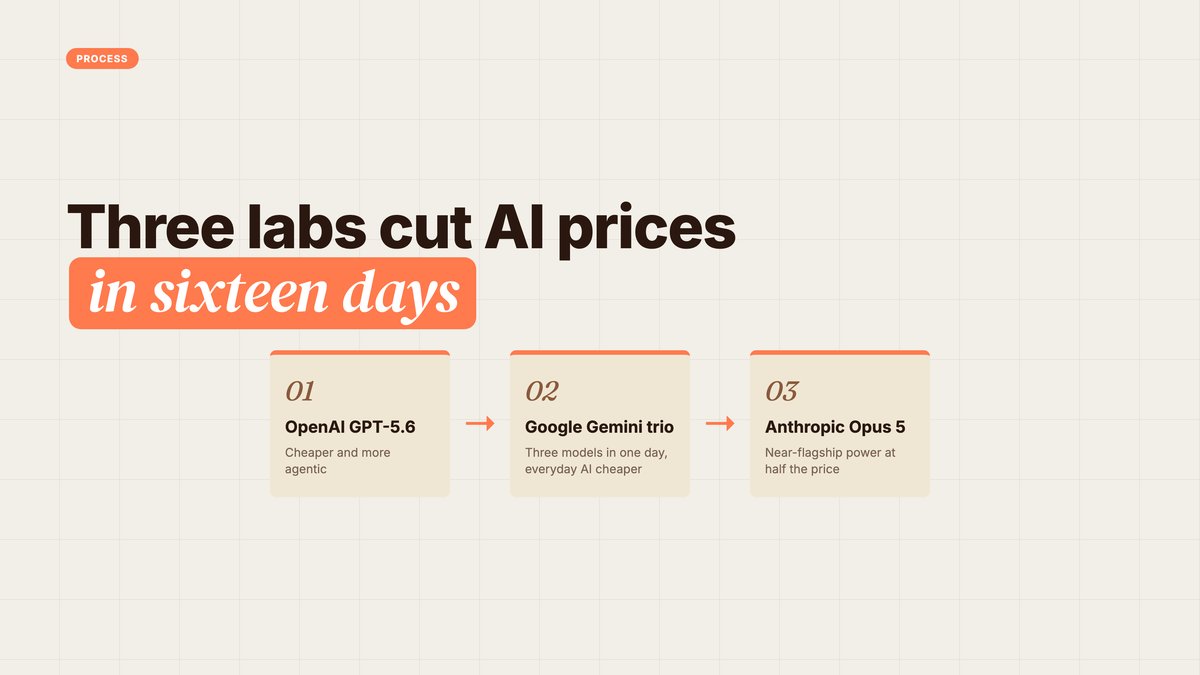
This is the third big AI price-performance move in 16 days. OpenAI shipped GPT-5.6 with lower prices on July 9. Google cut costs with three Gemini models on July 21. Now Anthropic answers, two months after Opus 4.8, per TechCrunch. The gap between launches keeps shrinking. The price of smart keeps falling.
Here is what shipped, what it costs, and the moves to make this week.
What Anthropic actually shipped
Let's keep the facts clean. One model, one speed dial, two beta tools.
The model. Opus 5 is Anthropic's new workhorse. It sits below Fable 5 in size but close to it in results. It is now the default model on Claude Max and the strongest model on Claude Pro, per TestingCatalog. Developers get it via the API as claude-opus-5.
The price. $5 per million input tokens and $25 per million output tokens, per Anthropic. That is the same sticker price as Opus 4.8. The model behind the price roughly doubled. Your effective cost per result just fell without you touching anything.
The dials. This launch is full of knobs. A Fast mode runs about 2.5 times quicker at twice the base price, per Anthropic. An adjustable effort setting trades tokens, cost, speed and quality per task, per TestingCatalog. Speed and depth are now line items you choose, not fates you accept.
The character. TechCrunch notes the model is "much stronger at verifying its work and iterating carefully until it succeeds". It checks itself and retries before handing you the result. For anyone running automations, that trait matters more than any benchmark.
The beta tools. Two API features shipped alongside. Mid-conversation tool changes let developers swap which tools Claude can use without breaking the prompt cache. And automatic fallbacks route safety-flagged requests to another model instead of returning an error, per TechCrunch. Fewer broken runs. Fewer dead ends.
The numbers that matter
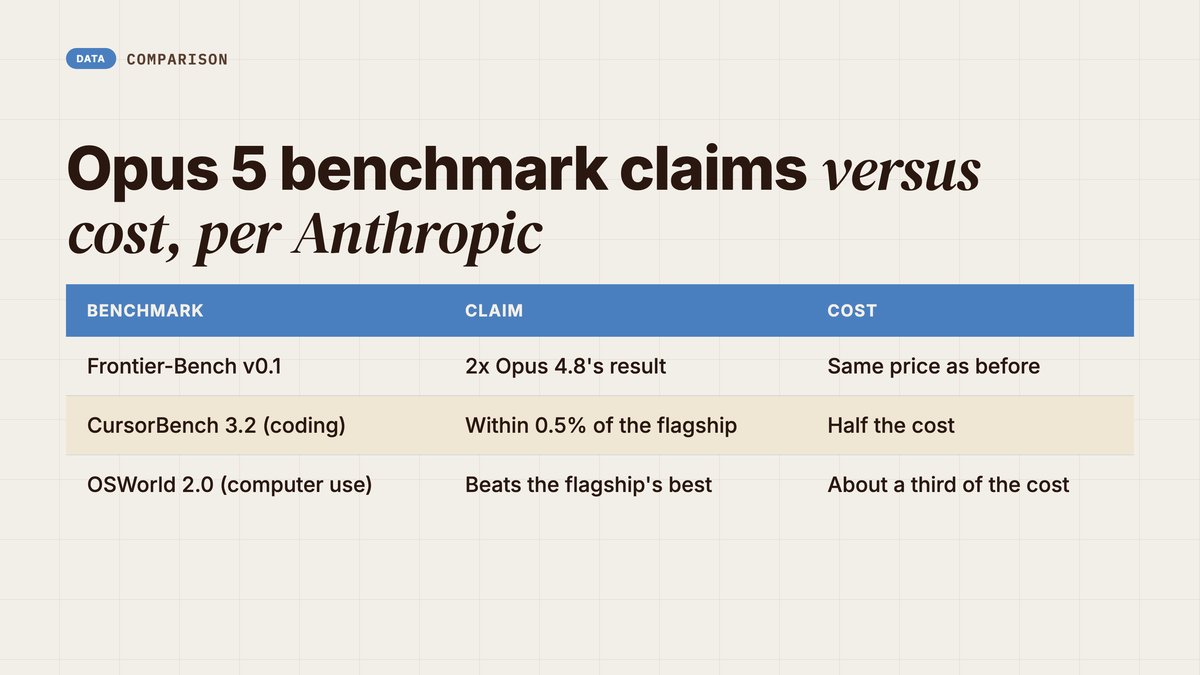
Every launch comes wrapped in benchmarks. All of these are Anthropic's own. Read them as claims. But note the shape.
Double the old Opus. On Frontier-Bench v0.1, Opus 5 more than doubles Opus 4.8's result at a lower cost per task, per Anthropic. Same price. Twice the output quality. That is the headline math.
Almost the flagship, at half price. On CursorBench 3.2, a coding test, Opus 5 lands within 0.5% of Fable 5's best at half the cost, per Anthropic.
The agent number. OSWorld 2.0 is a test of real computer use. There, Opus 5 beats Fable 5's best result at about a third of the cost, per Anthropic. Why should a marketer care? Because computer use is what agent workflows run on. Browsing, form-filling, tool-driving, report-building. That work just got roughly three times cheaper at the same quality bar.
The limits. Opus 5 stays behind Mythos 5 on offensive cybersecurity and advanced biology research, per Anthropic. Those are restricted lanes for approved organizations. Not your marketing stack. Two more notes, per TechCrunch. Safety classifiers are expected to step in about 85% less often than on Fable 5. And Fable's 30-day data retention rule does not apply here.
The real story: the dial replaces the upgrade
Zoom out. Three labs, three launches, 16 days.
We covered the first move when OpenAI shipped GPT-5.6 — cheaper and more agentic. We covered the second when Google shipped three Gemini models in one day and cut the cost of everyday AI again. Opus 5 is the third beat of the same drum. The frontier is not just moving up. It is moving down-market, fast.
But there is a new wrinkle this time, and it changes how you buy. Opus 5 does not just have a price. It has dials. Effort settings. A Fast mode at a defined premium. A fallback path when a request gets flagged. The question is no longer "which model do we use?" It is "which setting does this task deserve?"
That is procurement thinking, and it favors teams that know their workloads. A draft blog outline does not need maximum effort. A contract summary might. A live chat agent is worth paying the Fast premium for. A nightly report is not. Teams that route tasks to the right dial will quietly pay half of what their competitors pay for the same output.
One more signal. The model that checks its own work is a model built for running unattended. Pair that with automatic fallbacks — flagged requests get an answer instead of an error — and the message is clear. These models are being hardened for automation, not chat. The labs are competing on "runs your workflow without babysitting." That is exactly the buying criterion marketers should use.
A worked example: the dial math
Numbers land better than claims. Let's run one.
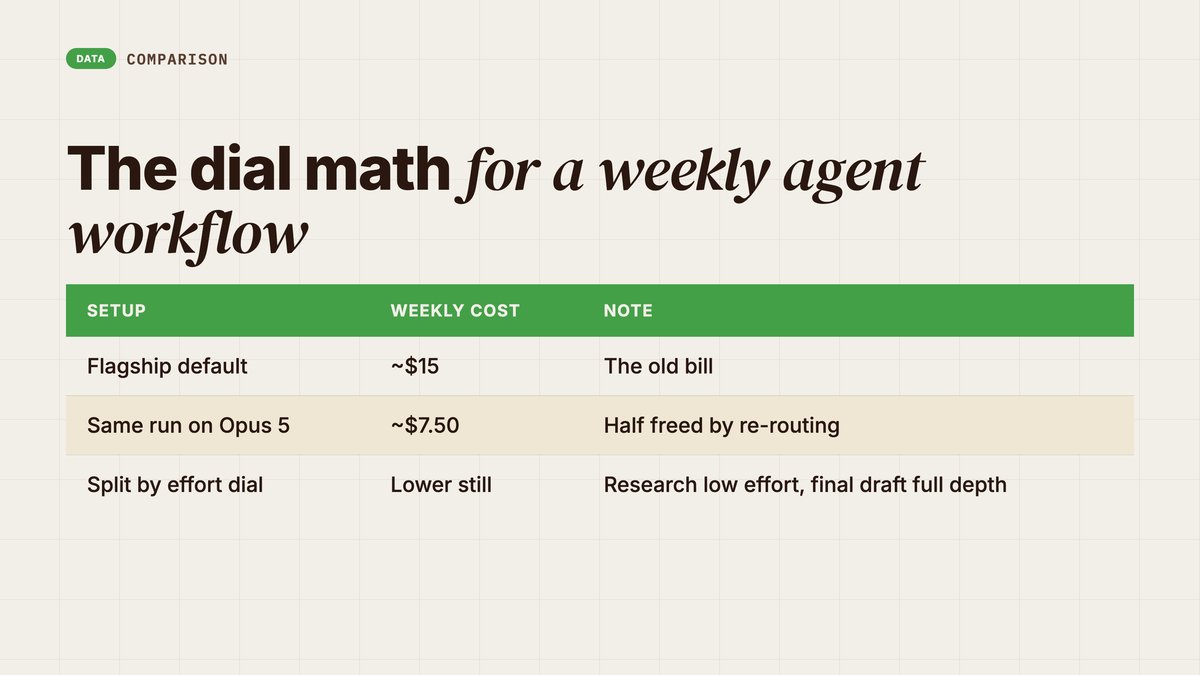
Say your team runs an agent workflow that researches competitors and drafts a weekly teardown. Assume it burns about 500,000 input tokens and 200,000 output tokens a week on a flagship model at Fable-class prices.
On Opus 5's pricing, that same weekly run costs about $2.50 on input and $5 on output. Around $7.50 a week. If the flagship version cost you roughly double, you just freed half the budget. Not by cutting the workflow. By re-routing it.
Now add the dial. Suppose the research half of the run works fine at a lower effort setting, and only the final draft needs full depth. Split the run and the bill drops again. The exact cents will differ for your stack. The shape will not: routing plus dials beats loyalty every time.
The bigger point sits underneath. At these prices, the model bill stops being the reason to say no to an automation idea. What is left is setup time and review time. Budget for those instead.
What this changes for your marketing stack
Here is the practical read, by workload.
Agent workflows. The OSWorld number is the one to act on. Computer-use agents at a third of flagship cost, per Anthropic's own testing, reprices every browsing, scraping, monitoring and reporting automation you shelved. Re-scope the one you wanted most.
Content operations. Drafting, repurposing, tagging and summarizing get the double-the-quality-same-price gain. If your pipeline runs on a mid-tier model to save money, re-test it. The cheap tier just got smarter than your old expensive tier.
Real-time uses. Fast mode puts a price on speed: 2.5x quicker for 2x cost, per Anthropic. That trade makes sense for live chat, on-call agents and anything a human is waiting on. It makes no sense for batch jobs. Decide per lane, not per company.
Reliability work. Automatic fallbacks and self-verification target the least glamorous problem in AI operations: runs that die halfway. If your automations break weekly, this launch is aimed at you.
Vendor pressure. Every AI tool you pay for can now run on a cheaper, better engine. Ask which model powers your plan and whether your price reflects the new floor. Silence is an answer too.
Where this fits the bigger 2026 picture
Step back one more level. July 2026 will read, in hindsight, as the month AI pricing broke.
Three labs cut the effective cost of strong AI in under three weeks. Each cut lands the same way. Work that was too costly to automate last quarter becomes routine. Work that was routine becomes cheap enough to run more often. Weekly reports become daily. One draft becomes five drafts to pick from. The winners are not the teams with the biggest budgets. They are the teams that re-check their math every time the floor moves.
There is a compounding effect here that most teams miss. Cheaper models mean more tests. More tests mean faster lessons. Faster lessons mean better prompts, better routing, better automations. A team running ten experiments a week at these prices learns more in a month. A cautious team needs a quarter for the same lessons. The cost of being wrong just fell. So the cost of not trying just rose.
That is the real takeaway of this launch month. Not any single model. The habit of re-pricing your ambitions every time the bill shrinks.
Do this now
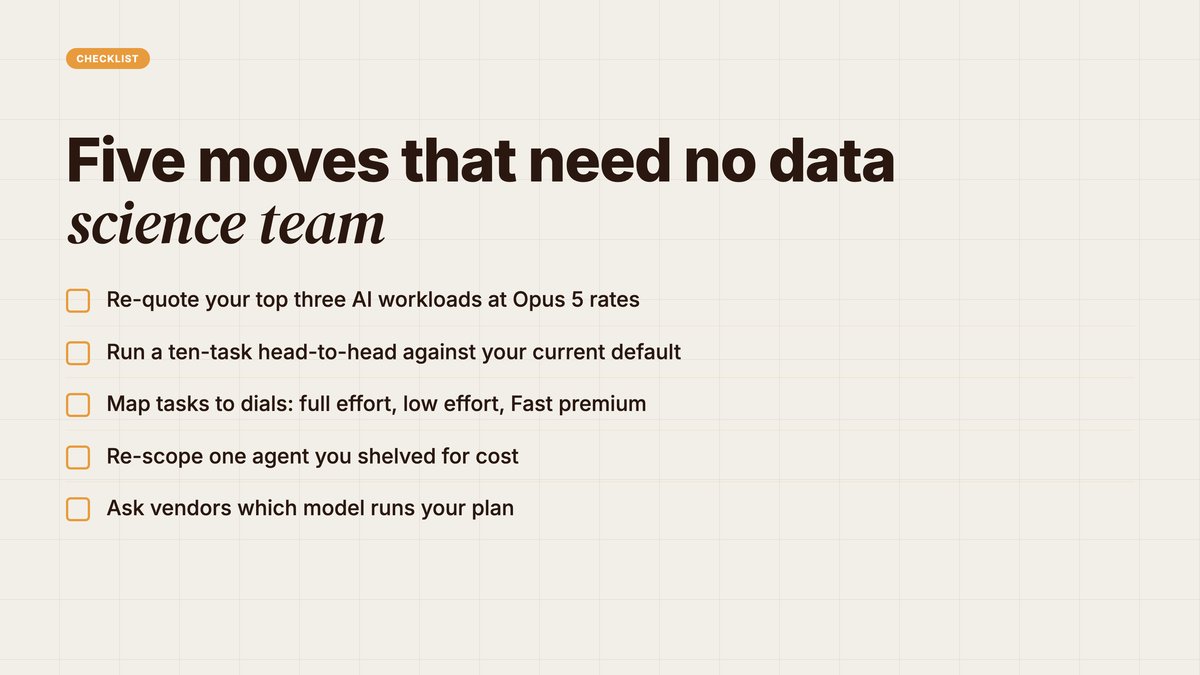
Five moves, none of which need a data science team.
- Re-quote your top three AI workloads. Price them on Opus 5's rates. The effective floor moved three times this month.
- Run a ten-task head-to-head. Real tasks from last week, current default versus Opus 5. Judge quality, speed and token use. Switch what wins.
- Map your tasks to dials. One list, three columns: needs full effort, fine on low effort, worth the Fast premium. This list is your new cost plan.
- Re-scope one shelved agent. The automation you dropped for cost. Re-price it at a third of flagship computer-use rates.
- Ask your vendors the model question. Which model runs your plan, and did the new pricing reach your invoice?
What to watch next
The rival counter. OpenAI and Google can read a price sheet. A response inside weeks would fit the pattern this month set. Keep workloads portable so you can take the best offer.
The effort-setting playbooks. Teams will start publishing what works at which dial. Early routing knowledge compounds into a real cost edge.
Haiku 5. TechCrunch notes the small model in Anthropic's lineup still awaits its 5-series upgrade. When it lands, the bottom tier reprices too.
Independent benchmarks. Every number above is Anthropic grading its own model. Community evals over the next two weeks will confirm or trim the claims. Let them land before you migrate anything critical.
The caveat
Do not switch your stack on launch-day claims. The benchmarks come from Anthropic's own announcement, and vendors always show their best angles. Real workloads are messier than test sets. Run your own ten-task comparison before you move anything that matters. And remember what this model is not. Anthropic itself says Opus 5 trails Fable 5 at the very top end. It also trails Mythos 5 in restricted research lanes. If your work lives on the absolute frontier, the flagship still earns its price. For everything else, the burden of proof just flipped.
FAQ
What did Anthropic launch on July 24, 2026?
Claude Opus 5, a model that approaches Fable 5's intelligence at about half the price, per Anthropic. It is the default on Claude Max, the strongest model on Claude Pro, and available via the API.
How much does Claude Opus 5 cost?
$5 per million input tokens and $25 per million output tokens, the same sticker price as Opus 4.8, per Anthropic. A Fast mode runs about 2.5x quicker at double the base price.
Is Opus 5 better than Opus 4.8?
On Anthropic's own tests, yes — it more than doubles Opus 4.8's Frontier-Bench result at a lower cost per task. Verify on your own workloads before switching.
How does Opus 5 compare to Fable 5?
Close behind at half the price, per Anthropic — within 0.5% on CursorBench 3.2 — and ahead on OSWorld 2.0 computer use at about a third of the cost. Fable 5 keeps the edge at the absolute top end.
What are the new beta features?
Two. Mid-conversation tool changes let developers swap tools without breaking the prompt cache. Automatic fallbacks route safety-flagged requests to another model instead of failing, per TechCrunch.
Are the benchmark numbers trustworthy?
They are Anthropic's own launch-day figures. Treat them as vendor claims until independent evals land, and run a ten-task head-to-head on your real work.
What should marketers do first?
Re-quote your top AI workloads on the new pricing, then map tasks to effort and speed dials. The savings come from routing, not from loyalty to one model.
Sources: Anthropic — Introducing Claude Opus 5. TechCrunch — Anthropic launches Opus 5. TestingCatalog — Claude Opus 5 launches across all platforms.
Insights from Our Experts
Explore our latest articles on digital marketing strategies.