

The phrase "AI-first agency" usually means somebody bought a lot of subscriptions.
Here is what it means for us. A machine does the first pass. A person does the judgement. That rule decides who does what all day.
This is an honest hour-by-hour view of that. What runs before anyone arrives, what people actually spend their time on, and the parts that did not get easier.
What Runs Before Anyone Logs In
By the time the team opens a laptop, three jobs have already finished.
The reports are built. Overnight, spend and performance data from every client account lands in one place. Numbers pulled, compared against last week, flagged where something moved.
The accounts have been checked. Budget pacing, dead creative, broken landing pages, feed errors. Anything that breaks a rule gets raised.
The index check has run. Every published page checked against search, with anything stuck surfaced in a list.
None of that is glamorous. All of it used to be someone's morning.
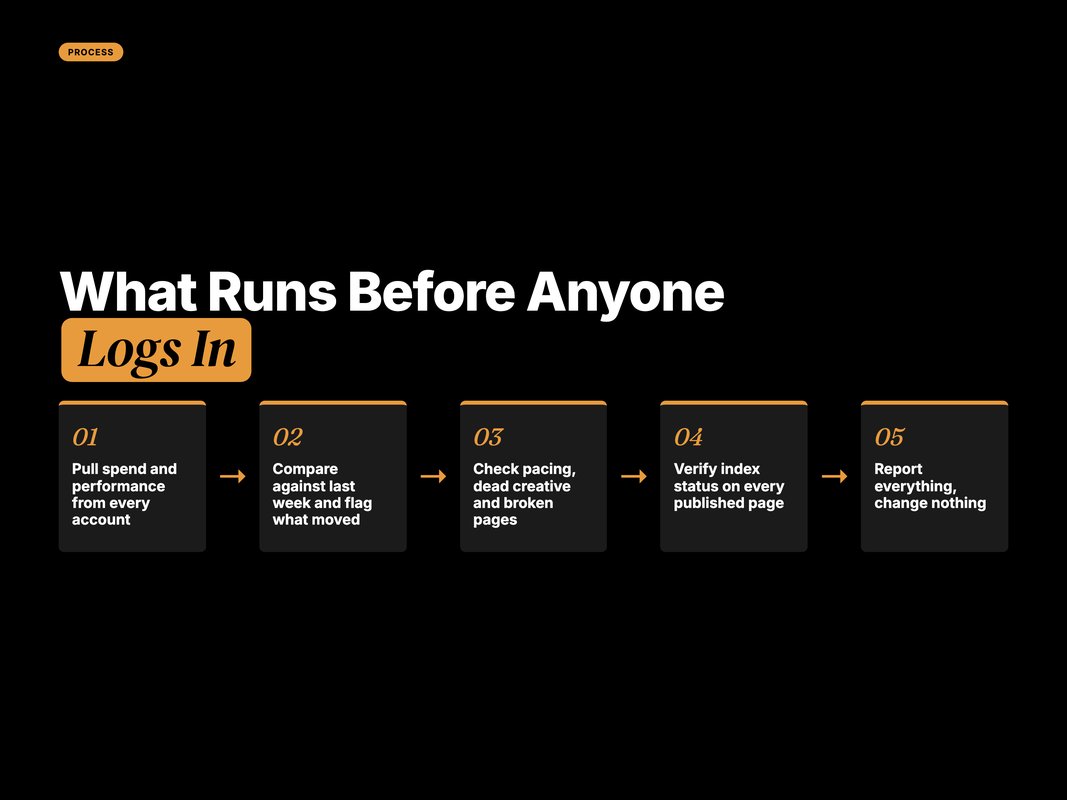
The important design choice is what these jobs do not do. They do not fix anything. They do not change a budget, pause a campaign or publish a page.
They read, compare and report. Every action stays with a person.
Q: What happens when an overnight job fails?
A: It says so, by name, in the channel. A silent failure is treated as a bug. If a job has not spoken, someone checks it.
The Morning: Judgement, Not Production
Nine to twelve is the part of the day that changed most.
Nobody starts by building a report, because the report exists. They start by reading it.
That sounds like a small shift. It is the whole shift.
The first hour is spent deciding what the numbers mean and what to do about them. Which flags are real. Which are noise. What changes today and what waits for more data.
The second and third hours go to the work those decisions produce. Rewriting a landing page. Restructuring a campaign. Rebuilding an audience.
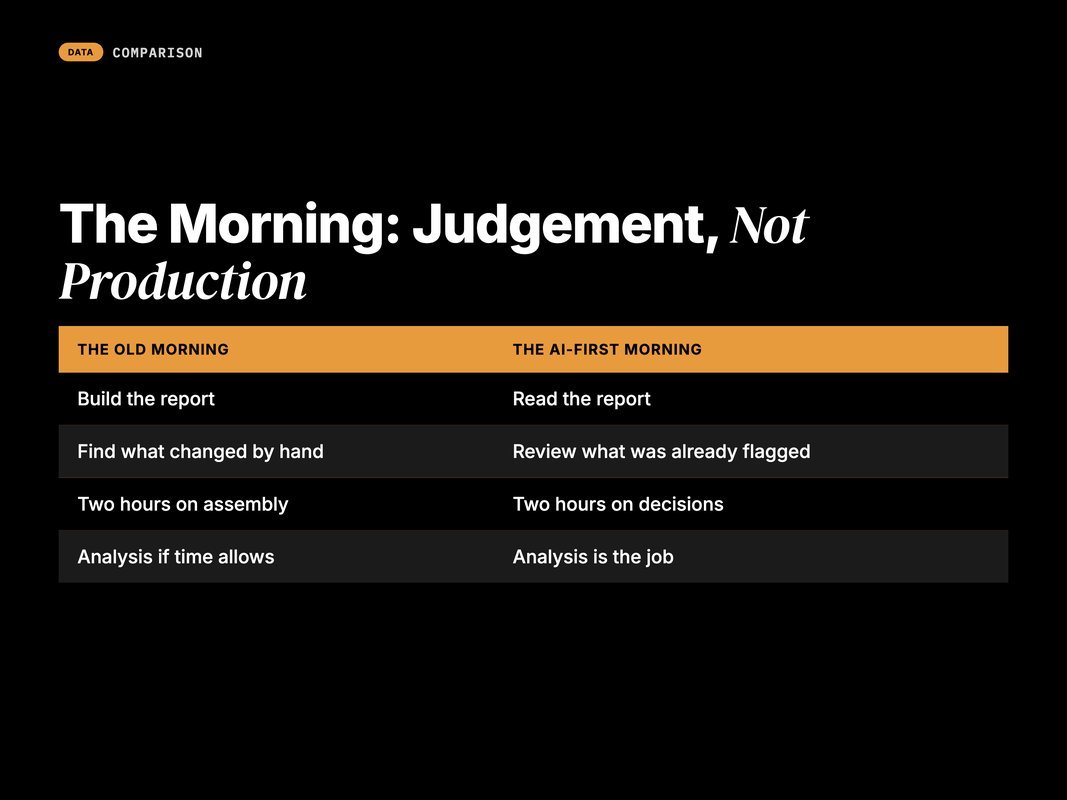
The output looks similar from outside. The distribution of effort inside it is completely different.
Less time producing the thing that tells you what happened. More time on what to do next.
Q: Does this make the work harder?
A: For most people, yes, and they prefer it. The easy hours got automated. What is left is the part that needs a brain.
Afternoon: Making Things
Afternoons are for building. Creative, content, landing pages, decks.
The pattern is consistent across all of them. The first version arrives fast and it is never the version that ships.
For creative, that means dozens of variants generated against a brief, then a hard human cut down to three or four. The cut is where the value is.
For content, a validated draft exists before anyone edits. Then a person checks every fact, every source link, and rewrites whatever sounds like nobody wrote it.
For decks and reports, the structure and first-draft commentary are automatic. The narrative and the recommendation are not.
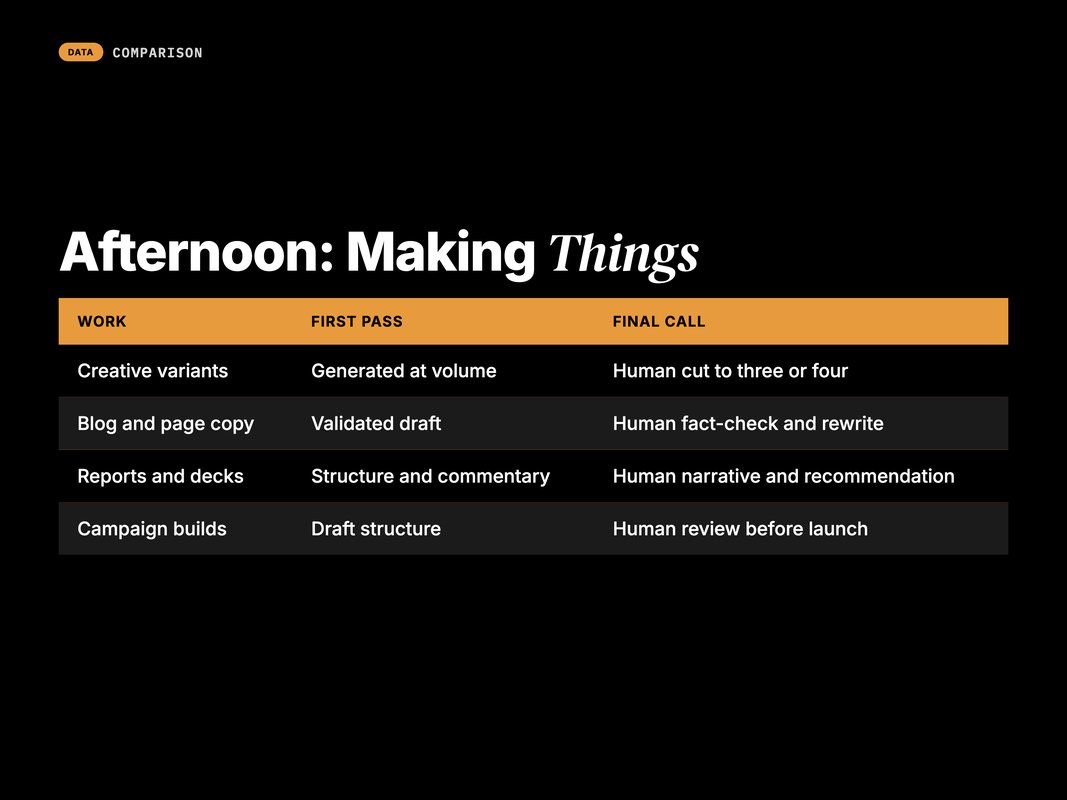
There is one rule that governs all of it. Nothing goes to a client with a number in it that a person has not traced back to its source.
That rule slows the work down. It has also saved us more than once.
There is a rhythm to the afternoon that took a while to find. Generate wide early, cut hard late.
Teams that do it the other way round, narrowing the brief before generating, end up with fewer options and worse ones. The cheap step is generation. Spend it.
Q: Is AI-made creative actually good?
A: The tenth version usually is. The first is not. The value is in volume plus a ruthless edit, not in a lucky first attempt.
What Never Gets Automated
The list is short and firm.
Client conversations. Every call, every difficult email, every renewal. No exceptions.
Strategic calls. What to do with a budget, which market to enter, when to stop something. Analysis can inform it. A person decides it.
Anything with a price or a legal claim. Every one gets human sign-off before it goes live.
Final creative selection. A model can rank variants. It cannot tell you what your brand should sound like this quarter.
Apologies. When something goes wrong, a person writes it and a person sends it.
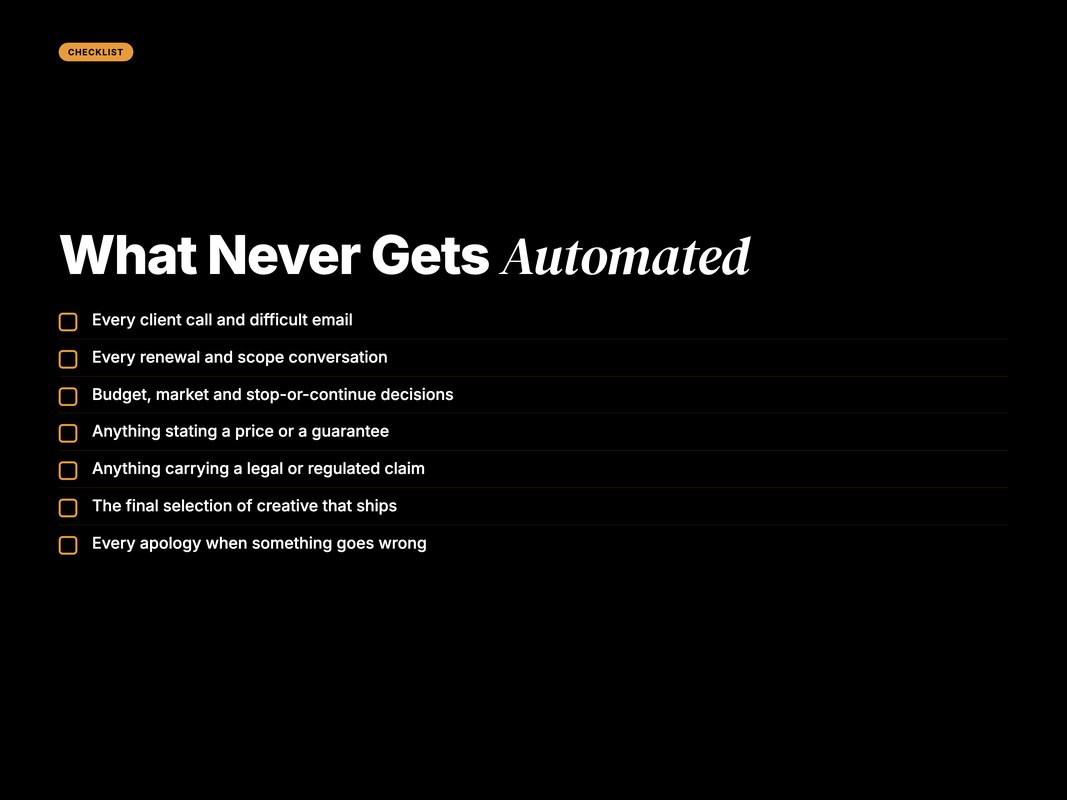
That last one matters more than it looks. The moments where trust is won or lost are almost never the efficient ones.
Q: Do clients know which parts are AI-assisted?
A: Yes, we tell them. It is in the scope conversation. Nobody has ever objected once they understand where the human review sits.
The Numbers on Time Saved
Industry data gives useful context here, and it is more modest than the headlines suggest.
Marketers recover an average of about 6.1 hours a week using AI. Senior practitioners save 8 to 10 hours. Junior staff save 3 to 4 (Source: Digital Applied, 2026 — digitalapplied.com).
A broader read is more sober still. Most employees using AI save less than half a workday a week (Source: eMarketer, 2026 — emarketer.com).
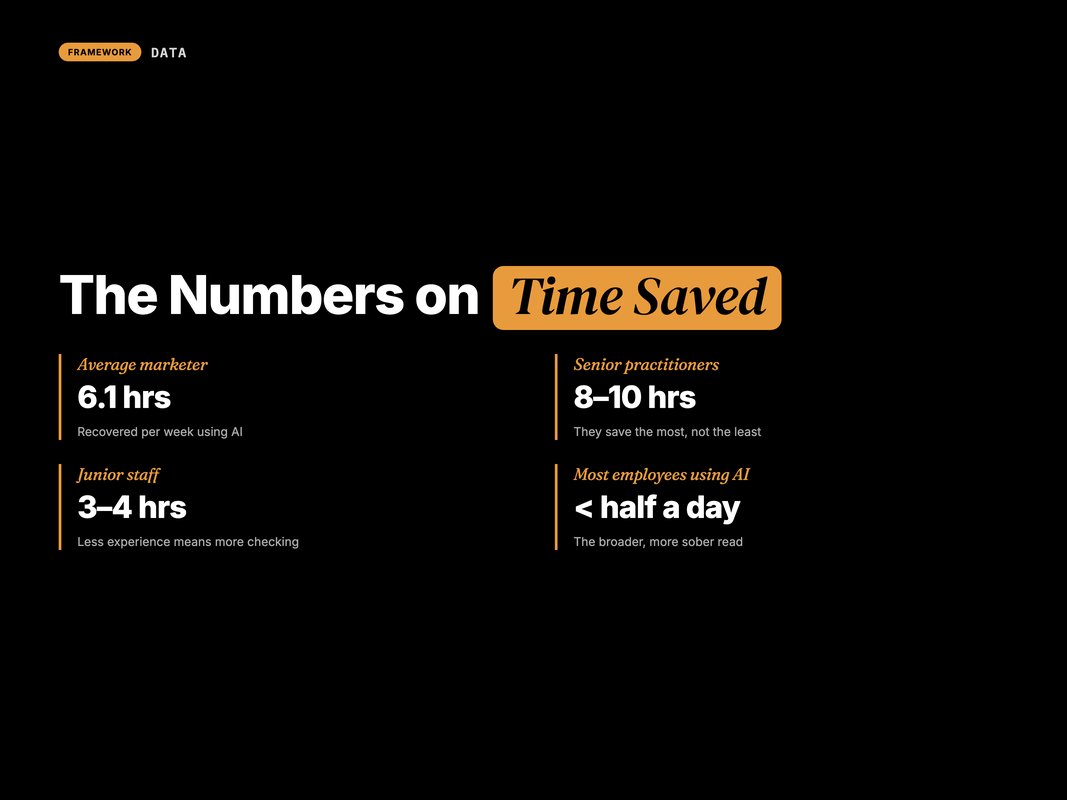
Notice the direction of that split. Senior people save more.
That runs against the common assumption that AI mainly replaces junior work. In practice, the people who save most are the ones who already knew what good looked like.
They can tell in seconds whether an output is usable. A junior person cannot, so they spend the saved time checking.
That has a real implication for how you build a team. AI raises the value of judgement, and judgement is the slowest thing to train.
So the hiring question changed. It is no longer how fast someone produces. It is how quickly they can tell whether something is right.
Those are different skills, and the second one is much harder to interview for.
What Got Harder
An honest account has to include this part.
Review load grew. More output means more checking. The bottleneck moved rather than disappeared, and it landed on the most experienced people.
Silent failures. An automation that quietly stops running is worse than no automation, because everyone assumes it is fine. We design for loud failure now.
Learning by doing got scarcer. Juniors used to learn by building reports badly and then better. That path is thinner now, so we make people do some tasks by hand on purpose.
Sameness. Left alone, AI-assisted work drifts toward an average. Fighting that is a constant, deliberate effort in creative and in writing.
None of these are reasons to go back. They are the costs of the trade. Pretending they do not exist is how teams get surprised in month four.
We track two of them deliberately. Review hours per person per week, and the number of automations that failed silently in a month.
Both should be visible. Neither improves on its own.
Q: How do you keep the work from feeling generic?
A: Strong briefs, a hard human edit, and rotating who does the final pass. Sameness comes from an unedited first draft, not from the tool.
How This Shapes What We Sell
The way we work changed what clients get, so it is worth being direct about it.
YARD is an AI-first growth marketing agency. We run performance marketing, LLM SEO, AI creative and AI funnels for D2C and B2B brands.
Three things follow from the operating model.
Reporting is not a deliverable, it is a given. Nobody should pay for a monthly deck that a machine assembles. They should pay for what we decide because of it.
Volume is cheap and judgement is not. So the pricing conversation is about the thinking, the review and the accountability, not about how many assets get produced.
And the systems stay with the client. The automations, the tables, the checks. If an engagement ends, the plumbing does not leave with us.
The stack that runs underneath all of this is in The AI Marketing Agency Tech Stack — Everything We Use.
The Short Version
AI-first is a rule, not a toolkit. The machine takes the first pass. A person makes the judgement.
Overnight, reports build themselves, accounts get checked and indexing gets verified. None of those jobs change anything on their own.
Mornings are for deciding, not producing. Afternoons are for building, with volume from the machine and a hard human cut.
Client conversations, strategy, claims, final creative and apologies stay entirely human.
Expect about six hours a week back, not a transformed workweek. Senior people gain most, which is the opposite of the common assumption.
And plan for what gets harder. Review load, silent failures, thinner learning paths and a drift toward sameness.
Curious what this looks like applied to your account? Talk to the YARD team.
FAQ
Q: What makes an agency AI-first?
A: The default is that a machine does the first pass and a person does the judgement. It is a rule about where work starts, not a list of tools the team owns.
Q: How much time does AI actually save?
A: Around 6.1 hours a week on average for marketers, with senior people saving 8 to 10 and junior staff 3 to 4. Most employees using AI save less than half a workday a week.
Q: Does AI mean smaller teams?
A: Not in our experience. It changes what people do rather than how many you need. Review and judgement work grows as production work shrinks.
Q: What work stays entirely human?
A: Client conversations, strategic calls, anything with a price or a legal claim, and the final decision on creative. Also every apology.
Q: How do junior people learn in this setup?
A: By reviewing rather than producing. It is faster in some ways and riskier in others, so we deliberately make juniors do some tasks by hand first.
Q: What breaks most often?
A: Silent failures. An automation that stops running without telling anyone is the most common problem, and the one worth designing against first.
Insights from Our Experts
Explore our latest articles on digital marketing strategies.