

Nobody read it. That is the point of a terms update that applies automatically.
On 1 July 2026, Google put a rewritten Ads Terms of Service into effect. It was the first big rewrite in about eight years. It applied to every account with no need to re-accept (Source: Common Thread Collective, 2026 — commonthreadco.com).
The headline change is straightforward. Google can use more of your inputs to build your ads.
The part that matters more is what did not change. The liability is still yours.
What the Terms Actually Say
Two things moved, in opposite directions.
Google's rights widened. The new terms let it use more of your inputs to build ad assets. That covers landing page URLs. Prompts typed into Gemini. And the content of your own site (Source: Common Thread Collective, 2026 — commonthreadco.com).
Your duty did not shrink. The new terms say it plainly. You must still review, approve, edit or remove campaigns and ad assets. That covers the ones Google's own tools wrote (Source: Digital Applied, 2026 — digitalapplied.com).
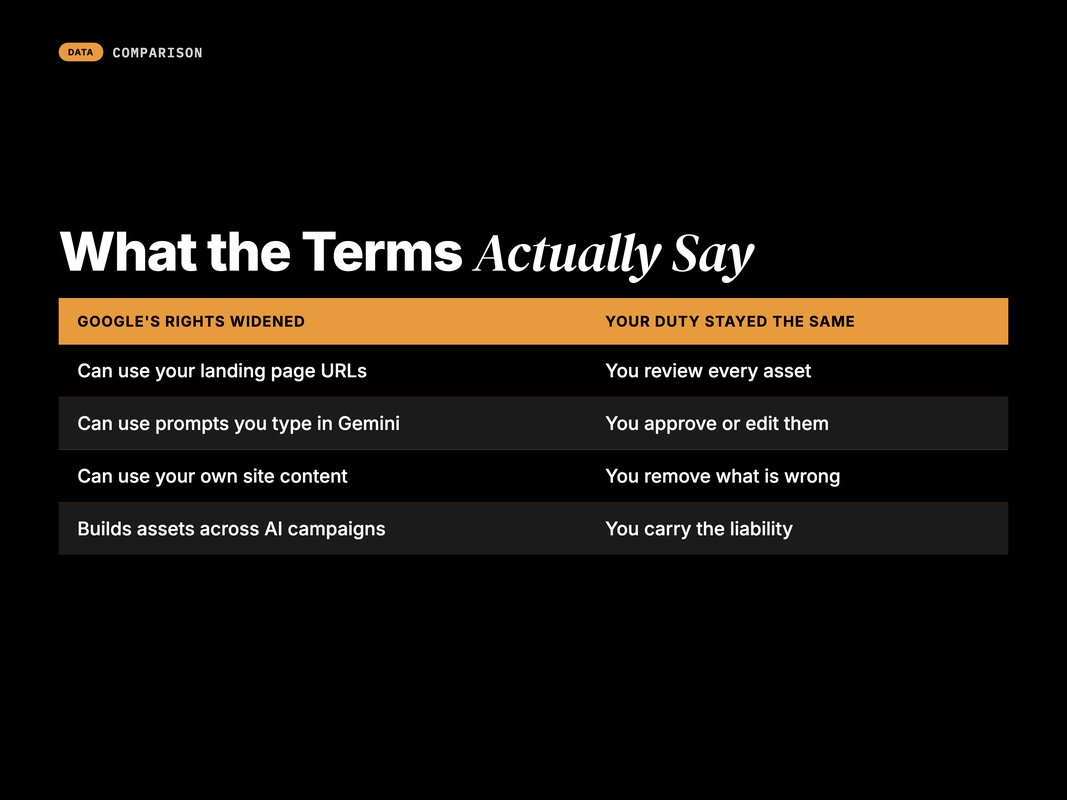
Read those together and the shape is clear.
More of your ad can be written by a system you do not control. All of it is still your problem if it is wrong.
A third change came with a date. From 13 July 2026, Google began to require labels on AI-built ad creative. If AI made any image or text part of a display or video ad, that ad needs a label (Source: Common Thread Collective, 2026 — commonthreadco.com).
Q: Did I agree to this?
A: Yes, by keeping the account running. The terms applied on their own. There was no click-to-accept step. That is why so few teams noticed.
Why This Is Not Just Legal Housekeeping
It is tempting to file this under paperwork. Three real effects say otherwise.
Your site is now ad copy. Google can build assets from your landing pages. So every stale price, old offer and dated claim is a possible headline.
Claims you never wrote can run under your brand. A built line can join two true facts into one false one. In a regulated market, that is a real risk.
The label rule adds a job. Someone has to know which display and video assets AI helped make. And check the labels are right.
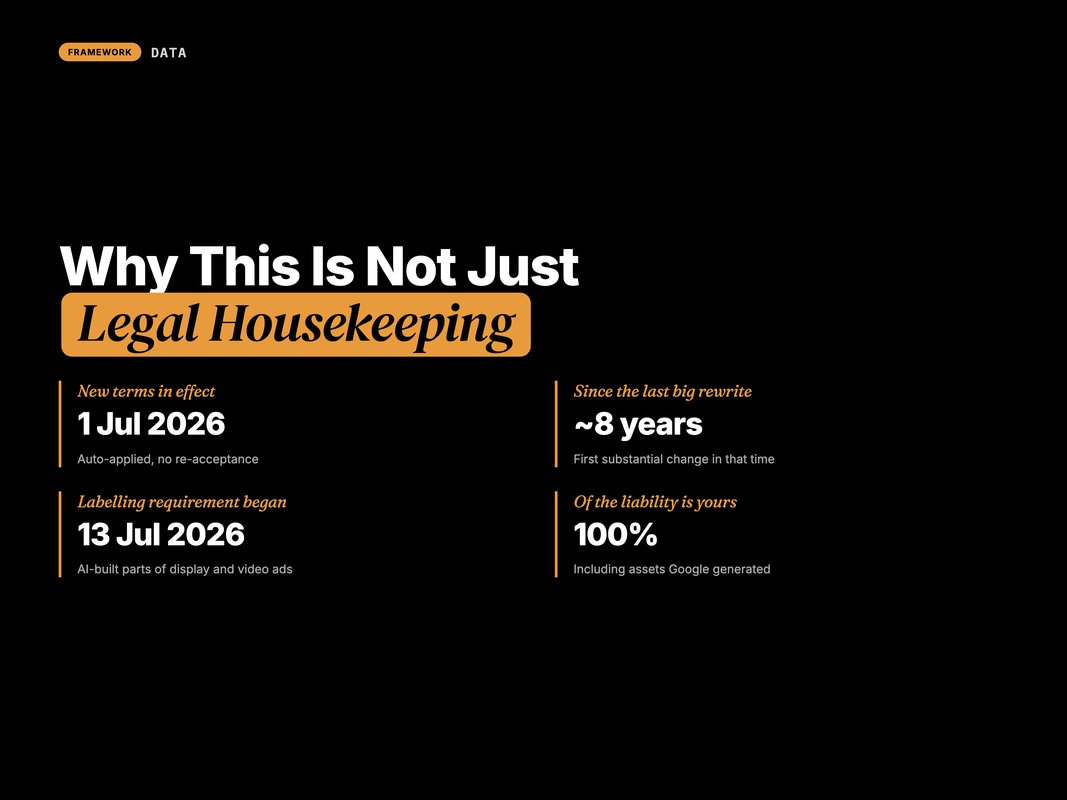
The risk is concrete. A built headline may get a price wrong. It may use a rival's trademark. It may make a claim you cannot back. That sits with the account holder (Source: Digital Applied, 2026 — digitalapplied.com).
Not with the platform that generated it.
Q: Is this different from what already happened with automated assets?
A: It is wider and it is now spelled out. Auto-built assets existed before. What changed is the range of inputs, and the clear line that the duty to check is yours.
The Four Controls That Still Work
You cannot opt out of the terms. You can control a lot of what the system does.
Four levers do most of the work.
One. Asset control. Read the auto-built assets in your campaigns. Remove any you would not have written. This is a weekly job now, not a quarterly one.
Two. Page rules. Decide which pages the system may draw from. Old campaign landers, sold-out pages and stale price pages should be shut out.
Three. Brand exclusions and negatives. These stop the system reaching places you do not want it. Same care as any broad-match setup.
Four. Your website. This is the one people skip. Clean your live pages and the built assets get better. The source got better.
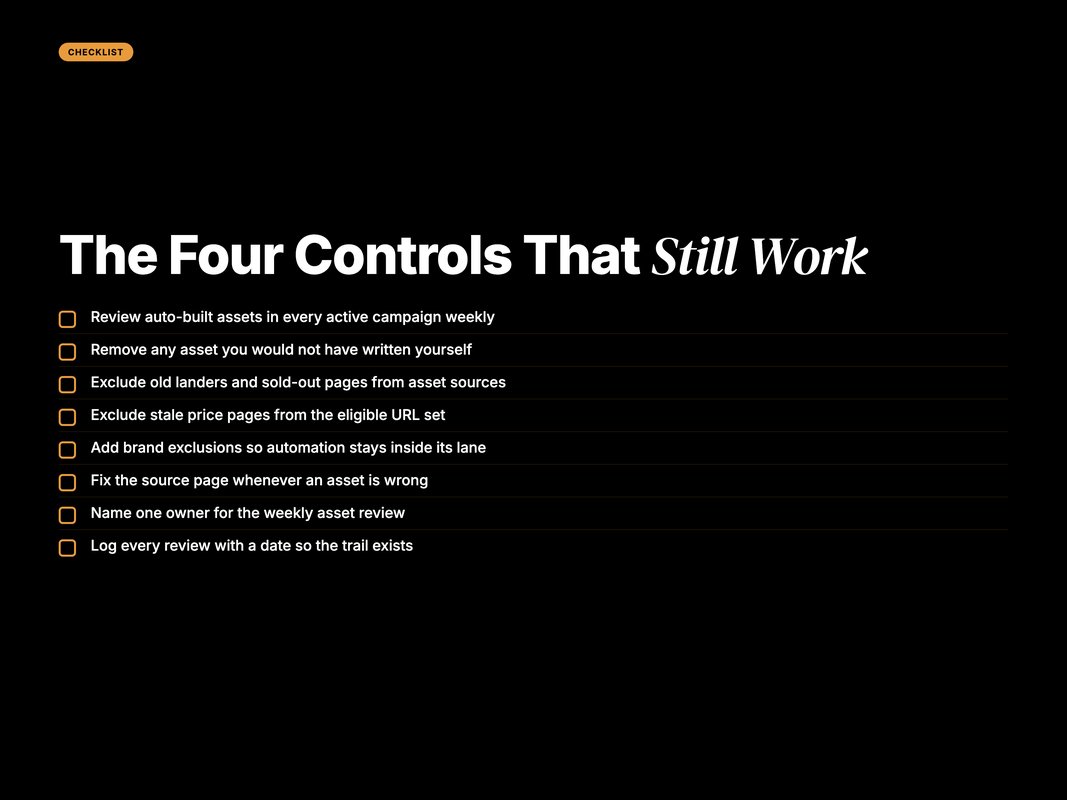
That fourth lever is the quickest win for most teams. A price page wrong since March is now a live risk. Not just a bad look.
Q: How often should we review generated assets?
A: Weekly for active accounts. Monthly is the bare minimum. And monthly is how a wrong price runs for four weeks.
A One-Hour Audit You Can Run Today
You do not need a project for this. You need an hour and a checklist.
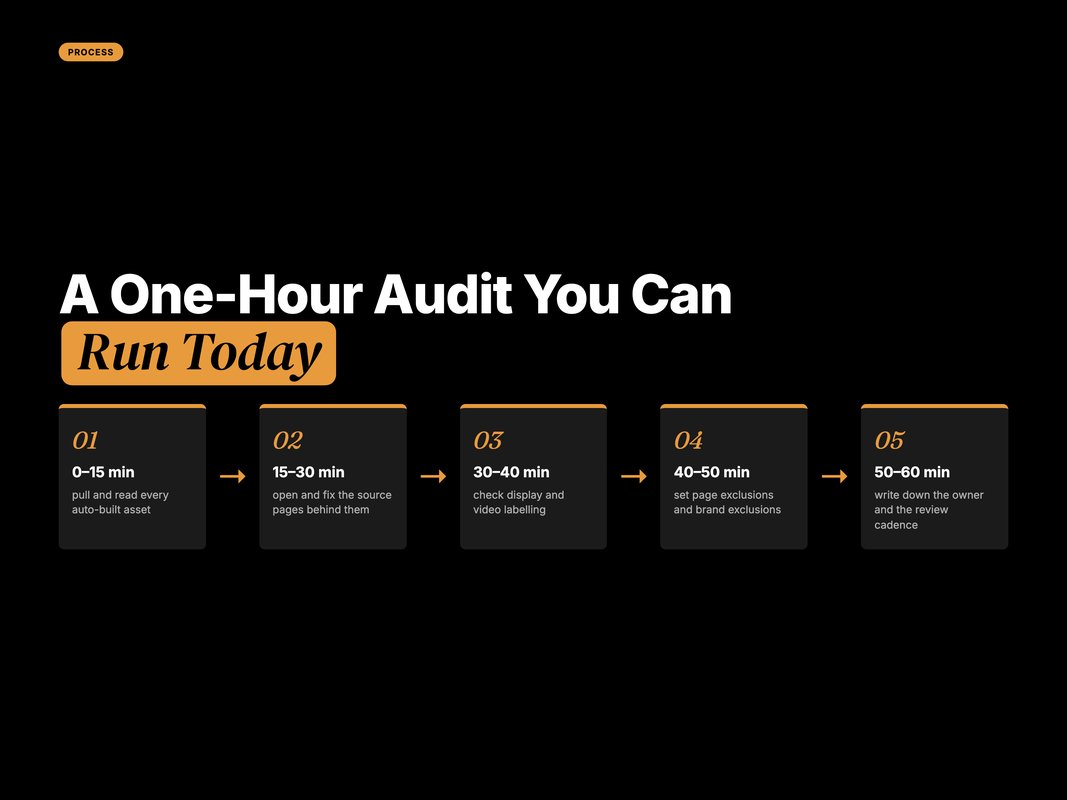
Minute 0 to 15. Pull every auto-built asset. Read them as a buyer would. Flag anything that states a price, a promise, a best-in-class claim or a rival comparison.
Minute 15 to 30. Check the source pages. For each flagged asset, open the page it came from. If the page is wrong, fix the page. Not just the asset.
Minute 30 to 40. Check display and video. Work out which used AI-built parts. Confirm the labels are right.
Minute 40 to 50. Set the exclusions. Lock out pages that should never feed an asset. Add brand exclusions if they are missing.
Minute 50 to 60. Write it down. Who reviews generated assets, how often, and where the log lives.
That last step is the one that makes the other fifty minutes stick.
Q: What if we use an agency?
A: The duty still sits with the account holder. Agree in writing who checks built assets, and how often. Assume nothing.
What a Clean Source Page Looks Like
If your site is now feedstock, it is worth saying what good looks like.
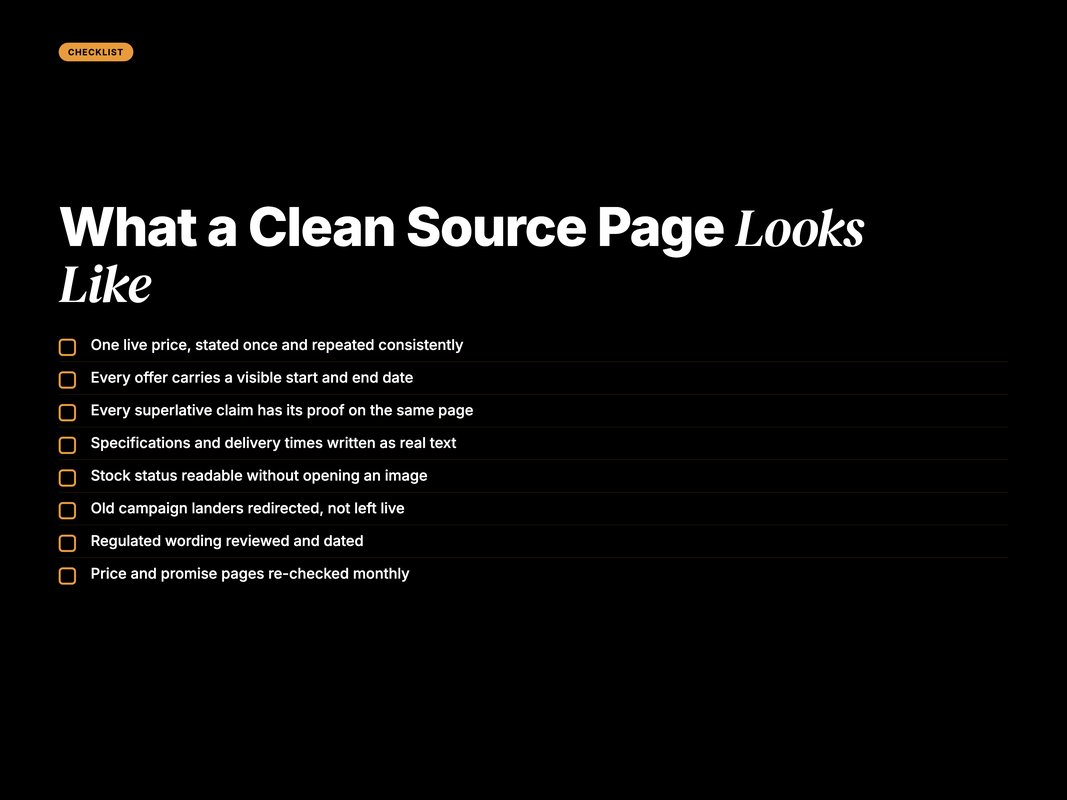
Five things do most of the work.
One live price, stated once. Not a price in the hero, a different one in a table. A third in an old banner. Pick one and repeat it.
A dated offer. Every promotion should carry a start and end date in the page content. An expired offer with no date is a headline waiting to happen.
Claims you can back. If you say fastest, cheapest or number one, keep the proof on the same page. If you cannot prove it, cut it.
Clean product data. Specifications, delivery times and stock status in real text. Not baked into an image.
No stale campaign pages. Old landers should be redirected or excluded, not left live and forgotten.
None of this is new advice. What changed is the cost of ignoring it.
A wrong page used to be a poor experience for whoever found it. Now it can become a headline shown to thousands of people who never visit the page at all.
Q: How often should source pages be checked?
A: Quarterly for most pages. Monthly for anything carrying a price, a promise or a date.
What This Signals About Where Ads Are Going
Zoom out and this fits a very consistent pattern.
Platforms take more of the creative and targeting calls. Brands keep the blame. The controls you still hold are about inputs now, not outputs.
That has one clear implication for how you spend your time.
Your leverage moves upstream. You cannot hand-write every headline now. You can decide what the machine reads before it writes.
So the best work now is the source material. Correct pages. Clear offers. Clean product data. A fact sheet that is current.
That is a duller job than writing ads. It has a bigger effect on what your ads say.
The second effect is about review. As more assets get built for you, review work grows. It does not shrink.
Some teams cut review time because the AI writes it now. They have the trade exactly backwards.
How We Handle This on Client Accounts
Terms changes are easy to ignore because nothing breaks on the day they land.
YARD is an AI-first growth marketing agency. We run performance marketing, LLM SEO, AI creative and AI funnels for D2C and B2B brands. Keeping accounts clean under changing platform rules is part of the standing work.
Our routine after this change has three parts.
We audit source pages first, not assets. A wrong asset is a symptom. A wrong page is the cause. Fix the page and a whole class of problems goes away.
We put asset review on a weekly calendar with a named owner. Not a shared duty. One name.
And we keep a claims list per client. Prices, promises, delivery times and any regulated wording, each with a date. If a built asset says something outside that list, it comes down.
Can anyone at your company say who checked your auto-built ads last week? If not, that is the gap to close first. For the wider automation shift, see Google AI Max: Complete Guide for Advertisers.
The Short Version
Google rewrote its Ads terms with effect from 1 July 2026. They applied automatically, with no re-acceptance.
The terms widen Google's right to use your inputs. Landing pages, prompts and site content can all feed an ad asset.
Your duty did not change. You must still review, approve, edit and remove assets. That includes the ones built for you.
From 13 July 2026, AI-built parts of display and video ads need a label.
So do four things. Review built assets weekly. Control which pages can feed them. Set brand exclusions. And clean the source pages.
Then accept the bigger shift. Your leverage is upstream now. What the machine reads decides what your ads say.
Want an hour of your account checked against the new terms? Talk to the YARD team.
FAQ
Q: What changed in the Google Ads terms?
A: Google rewrote its Ads Terms of Service with effect from 1 July 2026. It was the first substantial rewrite in about eight years and it applied automatically, with no re-acceptance needed.
Q: Can Google now generate ads from my website?
A: Yes. The terms extend Google's right to use advertiser inputs. Landing page URLs, prompts you type, and your own site content can all feed an ad asset.
Q: Who is responsible if an AI-generated ad is wrong?
A: You are. The terms state that advertisers remain responsible for reviewing, approving, editing or removing campaigns and assets, including ones generated automatically.
Q: Do AI-generated ads need a label?
A: Yes for display and video. From 13 July 2026 Google began requiring disclosure labelling where AI generated visual or text elements in those formats.
Q: Can I turn the automation off?
A: You can control much of it at campaign level through asset settings, URL rules and exclusions. You cannot opt out of the terms themselves. So the control work matters more than it used to.
Q: What is the biggest practical risk?
A: A generated headline stating a wrong price, an unsupportable claim or a competitor's trademark. That exposure sits with the account holder, not with Google.
Insights from Our Experts
Explore our latest articles on digital marketing strategies.