

Google AI Max went GA on April 15, 2026.
Eleven months of beta. Now the default. By September 30, 2026, every DSA, every Auto-Created Asset campaign. Every campaign-level broad match in your account will flip to AI Max. Opt-in or not.
That window is the gap. Smart accounts move first. This is the YARD playbook.
You have four months to get ahead of the forced flip. Use them well. The teams that opt in this week will own the data. The teams that wait will eat the volatility in September.
Quick Facts: AI Max rollout timeline
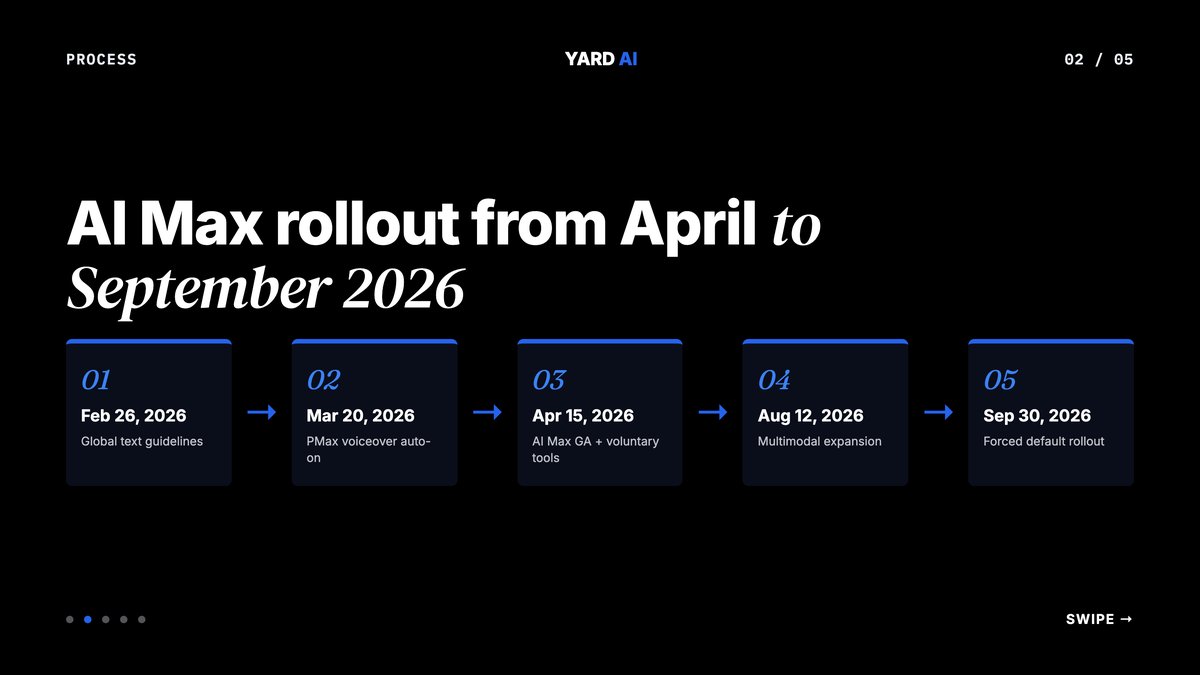
- April 15, 2026 — AI Max GA (general availability).
- April 15, 2026 — Voluntary upgrade tools open.
- February 26, 2026 — Global text guidelines went live.
- March 20, 2026 — AI voiceover auto-on for silent PMax video assets.
- August 12, 2026 — Multimodal expansion ships.
- September 30, 2026 — Forced default rollout. (Source: Google blog, 2026 — blog.google).
What AI Max Actually Is
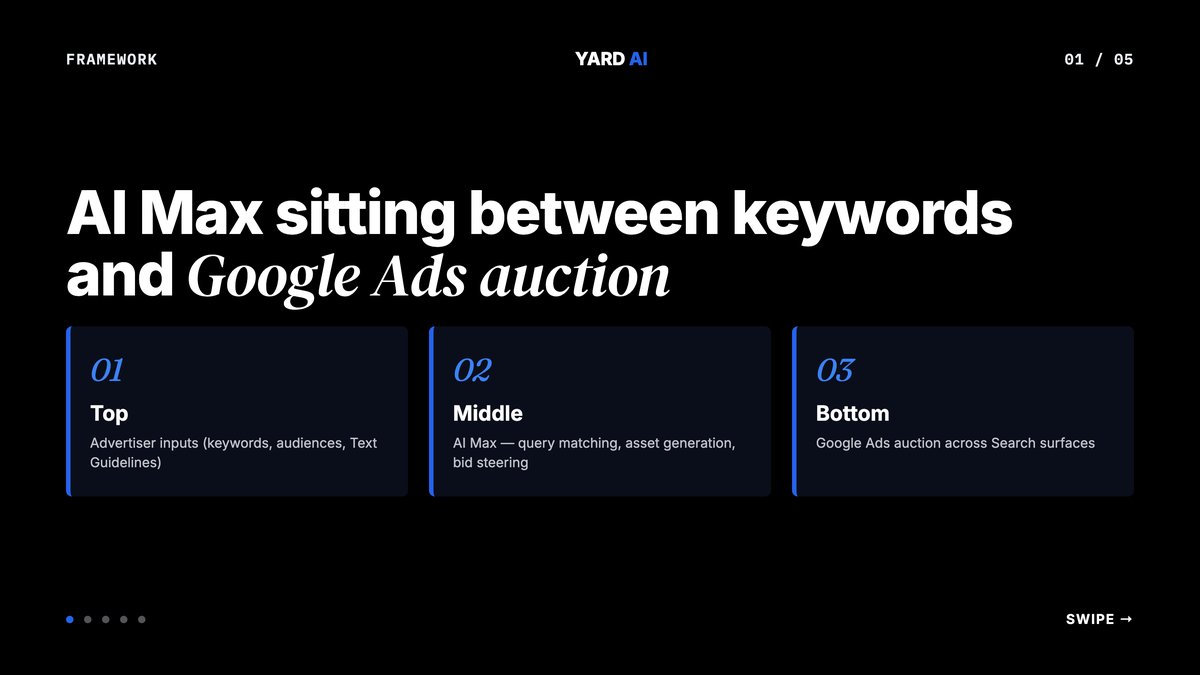
AI Max is a search campaign type. It hands three jobs to Google's AI. Query matching. Asset generation. Bid steering. All inside one campaign-level toggle. (Source: Google Ads & Commerce blog, 2026 — blog.google)
It is not a new ad format. It is a new control layer.
Think of it as the natural endpoint. Google has spent five years pushing away from advertiser-managed keywords. They want AI-driven matching against intent. AI Max is where Search joins the same engine that runs Performance Max.
The shift is real. The old model gave you tight control over which queries you matched. The new model gives Google more room. Your job changes too. Less keyword grooming. More signal hygiene.
That is why this guide exists. AI Max rewards clean accounts. It punishes broken ones.
The clean account has three things in place. Enhanced Conversions live. Negative lists active. Search terms reviewed weekly. Without those three, AI Max scales the noise. With them, AI Max scales the signal.
The choice is binary. Clean up first. Then opt in. Or opt in dirty and fight fires for two months.
Q: What is Google AI Max in one sentence?
A: A GA search campaign type that lets Google's AI handle query matching, asset writing, and bidding. All inside one toggle. It went live April 15, 2026. It becomes the forced default on September 30, 2026.
What AI Max Replaces (And When)
Three legacy products retire into AI Max. All three sunset on September 30, 2026.
- Dynamic Search Ads (DSA).
- Automatically Created Assets.
- Campaign-level broad match.
Voluntary upgrade tools shipped the week of April 15, 2026. Use that window. Forced migrations rarely go smoothly. (Source: Search Engine Land, 2026 — searchengineland.com)
According to Google, every account running those three legacy surfaces will auto-flip in September. You have roughly four months of voluntary control left.
What does the flip mean in practice? Your DSA campaigns become AI Max campaigns overnight. Your auto-created asset settings get rolled into the same control layer. Your old broad match toggle disappears. The new toggle is AI Max.
If you do nothing, Google does the work for you. That is the risk. You lose the chance to tune negatives, write Text Guidelines, and watch the data while volume is still light.
The auto-flip is one event. The opt-in is a process. Process beats event. Every time. Pick a campaign. Run the playbook. Build the muscle now.
The Three Things AI Max Does Differently
Three real changes. Each one matters. Each one shifts how you run the account.
1. Query expansion goes wider. Your existing keywords still trigger. AI Max layers on broad-match-style matching. It uses semantic intent, not just tokens. Wider than DSA. Narrower than pure broad match. Tuned by AI against your conversion signal.
2. Asset generation gets continuous. Headlines and descriptions auto-generate in real time. You set the tone via Text Guidelines. Those went global on February 26, 2026. AI Max writes variants. Bad variants die. Good ones get more impressions.
3. Reporting splits AI vs original. A new AI Max attribution column shows which conversions came from AI matching. Versus your original keywords. DSA never gave you this view. Now you can isolate the AI lift.
A study found double-digit conversion lifts on clean accounts. AI-driven matching helps when Enhanced Conversions are full and rich. The lift is real. So is the risk on accounts with broken tracking.
(Source: Semrush, 2026 — semrush.com/blog)
Q: Will AI Max replace my keyword targeting?
A: No. It expands it. Your keywords stay live. AI Max layers AI query expansion on top. Plus auto-written headlines. You still control negatives and brand exclusions. Same control surface. Wider matching.
How to Opt In Voluntarily This Week
This is the sequence we run on YARD client accounts. Three steps. About 30 minutes per account. Keep the campaign small first. Scale only after parity.

Step 1 — Pre-flight checklist. Before you opt in, confirm:
- Enhanced Conversions installed and validated.
- No missing user_data fields in conversion events.
- Account-level negative keyword list for brand-irrelevant terms.
- Search terms report exported for the last 90 days.
If any of these is missing, fix it first. AI Max amplifies whatever signal it sees. Broken signal scales poorly.
Step 2 — Run the voluntary upgrade tool. Go to Google Ads. Click Tools & Settings. Open the Upgrades tab. Find the AI Max migration assistant. Pick one campaign first. Not all of them.
Step 3 — Set Text Guidelines. Inside campaign settings, write 2 or 3 short sentences. Describe your brand voice. AI Max uses this to constrain auto-written copy.
Examples that work:
- "Direct, premium, no superlatives. Avoid 'best', 'top', 'leading'.".
- "Professional medical tone. No urgency claims. Always reference licensed practitioners.".
The Text Guidelines field is your single biggest brand-safety lever. Treat it like a brand book. Edit it weekly during the first month.
You can also seed the matching surface using a GAQL query. Pull recent search terms first:
SELECT search_term_view.search_term, metrics.conversions, metrics.cost_micros
FROM search_term_view
WHERE segments.date DURING LAST_90_DAYS
ORDER BY metrics.cost_micros DESC
Use the output to seed your negative list before flipping the switch.
The negative list is your firewall. AI Max will match wider than your keywords. Negatives keep the wider match clean. Build the list before you flip. Review it weekly after.
One more tip from our migration runs: name your AI Max test campaign with a clear tag. Use a prefix like "AIMAX-TEST". This makes the post-flip data review fast. You can filter, sort, and compare in one click.
What Stays Under Your Control
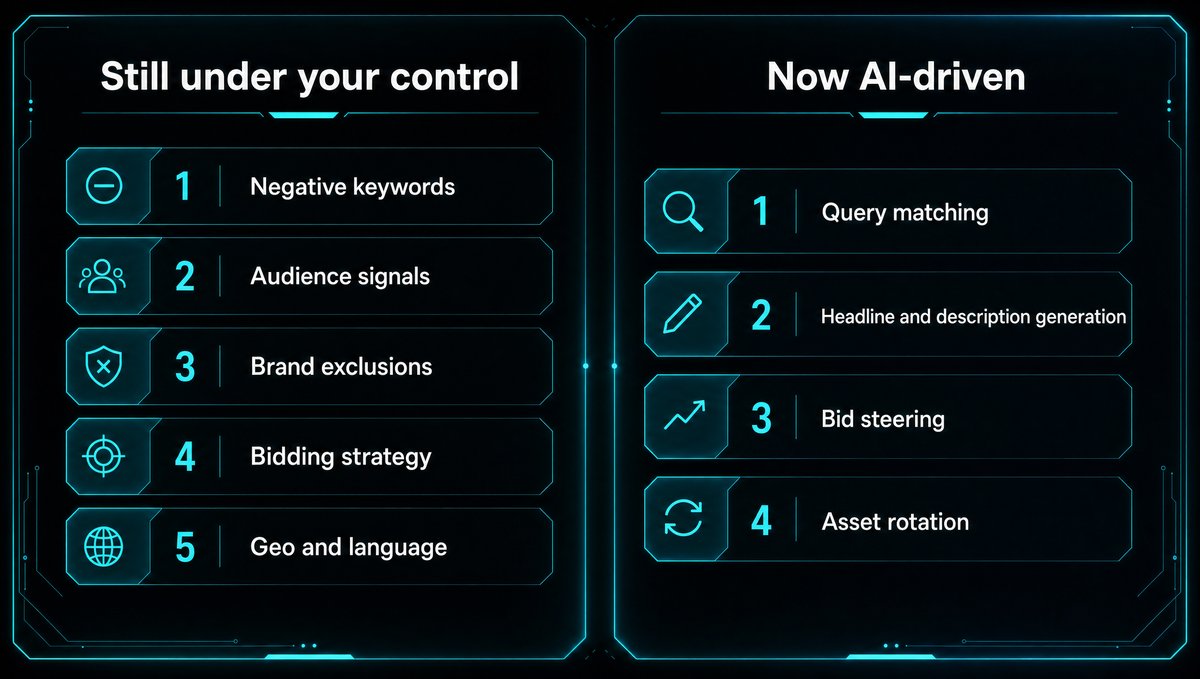
AI Max gives Google more matching freedom. It does not strip these levers. You still run the account.
- Negative keywords still work. Add them aggressively after Day 7.
- Audience signals still steer. First-party data integrates more tightly than DSA ever allowed.
- Brand exclusion lists stay live. Competitor names stay blocked.
- Bidding strategy stays as-is. Your tROAS or tCPA target carries over.
- Geo and language settings do not change.
The Day 1 mistake teams make is simple. Opt in. Walk away. Come back two weeks later wondering why CPC tripled. Research shows new broad-match-adjacent surfaces need active negative-keyword pruning. Especially in the first 30 days. (Source: Semrush, 2026 — semrush.com/blog)
Pull the search terms report weekly. Add negatives. Build the habit. The accounts that win are the ones that treat AI Max like a new broad-match build. Not like a set-and-forget toggle.
Audience signals are the second lever. AI Max reads first-party data more deeply than DSA ever did. If you have a customer match list, upload it. If you have a converters audience, attach it. If you have a high-LTV segment, signal it. The AI uses these signals to weight the auction.
Brand exclusion lists are the third lever. List every competitor name. List every off-brand variant. List every term you do not want to bid on. AI Max respects the list. Use it.
How AI Max Compares to Performance Max
Both are AI-driven. They serve different jobs. They are not rivals.
PMax delivers across every Google surface. Search. YouTube. Display. Discover. Maps. Gmail. Shopping. Use it for maximum reach.
AI Max stays inside Search. Use it for the high-intent conversions that used to come from your DSA and broad-match keyword campaigns.
According to the Google Ads team, AI Max and PMax share the same engine. The split is by surface. Not by engine. PMax goes wide. AI Max stays focused.
(Source: Google Ads & Commerce blog, 2026 — blog.google)
Most performance accounts run both. Our 6-Campaign Google Ads Architecture stacks them like this:
- Brand Search — exact match, manual control.
- Generic Search — phrase match, manual control.
- Competition Search — exact and phrase, manual.
- Category PMax — full Google surface, AI-driven.
- Product PMax — AI-driven asset placement.
- Demand Gen — top of funnel.
AI Max slots into position 5. Alongside Product PMax. The two complement each other. One tunes Search query matching. The other tunes asset placement across surfaces.
Q: Will AI Max replace Performance Max?
A: No. AI Max augments Search. PMax handles Shopping plus cross-channel reach. They run side by side. Most YARD-managed accounts use both.
For a US luxury account this multi-surface stack drove 10.6x ROAS over 10 months. The starting point was 2x ROAS. The lift came from a 3-phase playbook. Phase one: Foundation. Merchant Center rebuild. Enhanced Conversions install. CRO sticky-ATC.
Phase two: Google Architecture. Brand Search. Product Shopping. Segmented PMax. Phase three: Meta Activation. The full stack ran in concert.
BFCM peaked at 32x ROAS. One BFCM week pulled $122K from 123 orders on $2,498 spend. Total spend March to December 2025 was $37,871. Total revenue was $400K. The numbers held all year.
Same brand. Same stack. Different week. The AI Max layer would have slotted right into position 5. That is the architecture pattern.
What to Watch For in the First 14 Days
Three failure modes. We have seen all three on early opt-in accounts. Each has a known fix.

Failure mode 1 — CPC spike on irrelevant queries. AI Max matches semantically. Say your account is a "premium senior care" service. Your keyword set has the word "care". AI Max may match "skin care", "pet care", "child care". Pull the search terms report on Day 7 and Day 14. Add negatives.
Failure mode 2 — Brand voice drift. Auto-written headlines drift toward generic "Best deals on X" patterns. Unless Text Guidelines actively constrain them. Review auto-generated assets on Day 3. If anything sounds off-brand, tighten the guidelines. Then check again on Day 7.
Failure mode 3 — Conversion volume drops without CPL gain. AI Max sometimes prunes its own matching. This happens when conversion signal is weak. The symptom is clear. Impressions stay flat. Clicks drop. CPA holds. The fix: improve Enhanced Conversions coverage. Tighten conversion event quality. AI Max needs rich signal to lean in.
The Day 7 review ritual. Block 30 minutes. Pull the search terms report. Sort by cost. Add negatives for the top 10 irrelevant terms. Review the auto-written headlines. Flag any that miss your tone. Update Text Guidelines if needed.
The Day 14 review ritual. Same pull. Same sort. Compare the AI Max attribution column to your original keyword column. If AI Max is pulling 30% or more of conversions, you have a green light. Migrate the next campaign.
If AI Max is pulling under 10%, pause. Check Enhanced Conversions. Check Text Guidelines. Check the negative list. The signal is the lever. Fix the signal first.
Q: How do I measure if AI Max is actually working?
A: Check the new AI Max attribution column in Search reports. It splits AI-driven conversions from your original keyword conversions. Run the upgrade for 14 days minimum before you judge. AI Max needs the learning window like any auction-side change.
The Performance Max Voiceover Trap
You probably already missed this one. On March 20, 2026, Google enabled AI voiceover auto-on. On every silent PMax video asset. Unless you opted out. (Source: Search Engine Land, 2026 — searchengineland.com)
If your campaigns had silent video and you did not opt out, Google now narrates them.
To check and disable:
- Open each PMax campaign. Go to Settings.
- Find Asset enhancements.
- Locate the Video enhancement toggle.
- Disable it for any campaign with brand-controlled video.
We disabled this by default across every YARD-managed PMax account. AI voiceover is fine for raw-stock product videos. It is brand-risk for premium D2C, healthcare, real estate, or any account where voice tone matters.
Run a Clean AI Max Migration with YARD
Internally we run a 4-step migration playbook. On every YARD-managed account.
- Pre-flight audit. Enhanced Conversions, negative list, search-term baseline, ROAS by campaign.
- Single-campaign opt-in. Pick one mid-volume campaign. Not the highest spender.
- 14-day learning watch. Daily search-term review. Weekly Text Guidelines tune.
- Account-wide rollout. Once one campaign hits parity ROAS, migrate the rest in waves.
This is the same workflow we use across our 6-Campaign Google Ads Architecture. The architecture that took a D2C food brand from ₹5L per month to ₹19L per month in 3 months. A 3.8x revenue lift on a D2C food brand. AI Max now slots cleanly into position 5 of that stack.
For a B2B enterprise tech client, a US B2B enterprise tech account, we ran a Google-Ads-only build. Cost per qualified lead dropped from $739 to $183. A 75% cut over 7 months. Lead-to-qualified rate climbed from 9% to 47%. AI-driven query matching was a real contributor on the matching efficiency side.
YARD runs Performance Marketing across multiple brands. The AI Max migration is part of every account's Q2 2026 plan.
If you want a clean migration without losing performance, YARD can run yours in two weeks. Pre-flight audit. Single-campaign opt-in. 14-day watch. Account-wide rollout. Same playbook. Built around your conversion signal.
Our team handles Google Ads, Meta, and conversion tracking under one roof. Performance Marketing. CRO. Analytics. Creative. The AI Max migration is one part of the full stack we run.
The AI Max window closes on September 30, 2026. Forced flips are coming. Your call: opt in now with full data, or wait and eat the volatility. The choice is the playbook.
The Bottom Line
AI Max is Google's new default for AI-driven Search. It is not optional. DSA, Auto-Created Assets, and campaign-level broad match all auto-upgrade on September 30, 2026.
Use the voluntary window. Opt in one campaign this week. Watch search terms daily for 14 days. Add negatives. Tune Text Guidelines. Then roll out account-wide.
Done well, you keep the conversions you have. You add AI matching efficiency on top. Done poorly, you watch CPC spike and brand voice drift. While you wait for the forced flip.
The accounts that win this year move first. The ones that wait will spend Q3 cleaning up. The choice is yours. The clock is real. The window is open. The playbook is on the page. Pick a campaign. Run the steps. Watch the data. Tune the levers. Win the quarter.
FAQ
Q: What is Google AI Max?
A: AI Max is Google's GA search campaign type. It went live on April 15, 2026. It replaces DSA, Auto-Created Assets, and campaign-level broad match. All three auto-upgrade in September 2026.
Q: How is AI Max different from Performance Max?
A: PMax serves all Google surfaces. AI Max stays inside Search. PMax handles Shopping and cross-channel. Most accounts run both side by side.
Q: Should I opt in now or wait for September?
A: Opt in now if your tracking is clean. The voluntary window gives you weeks of data. If tracking is broken, fix it first. AI Max amplifies whatever signal it sees.
Q: Will AI Max replace my keyword targeting?
A: No. It expands it. Your keywords stay live. AI Max layers AI query expansion on top. You still control negatives and brand exclusions.
Q: What about PMax video voiceovers?
A: Google auto-generates AI voiceovers on silent PMax video assets unless you opted out before March 20, 2026. Disable it in campaign Settings under Asset enhancements.
Q: How do I measure if AI Max is working?
A: Check the new AI Max attribution column in Search reports. It splits AI-driven conversions from your original keywords. Run for at least 14 days before judging.
Q: What breaks if I leave my account on DSA?
A: Nothing breaks until September 30, 2026. Then DSA auto-migrates anyway. The risk: zero learning data and no chance to tune negatives in advance.
Insights from Our Experts
Explore our latest articles on digital marketing strategies.