

Your next support call might be answered by an OpenAI agent. Not a startup's wrapper. OpenAI itself, installed in the building.
On July 22, 2026, OpenAI launched Presence. It is a platform for running AI agents inside real business workflows. Voice and chat. The named lanes are customer support, sales development, IT, HR and procurement, per industry coverage. The agents answer questions and reach into company systems. They take approved actions. They hand off to humans when needed.
One number carries the launch. OpenAI says Presence runs its own English phone support line. It resolves 75% of inbound issues without human help. That is a vendor stat about the vendor's own line. Treat it that way. But it is also the number your CFO will quote at your next budget meeting.
Here is what launched, how it works, and what to do about it. Even if you never buy it.
What OpenAI actually launched
Let's keep the facts clean. One platform, a strict sales model, and a very clear target buyer.
The product. Presence deploys AI agents for front-office and internal work. The lanes: customer support, sales development, procurement, IT and HR, per the launch coverage. Agents work by voice and chat. They run under company-set policies and permissions.
The guardrails. This is the part built for big buyers. Presence wraps agents in policies, approved actions, simulations and grading tools, per Help Net Security. Before launch, teams test agents against common requests and edge cases. They test high-risk cases too. Graders check rule-following, tool use and handoff behavior.
The upgrade loop. After launch, a Codex-powered process reviews live sessions and suggests fixes. OpenAI claims this loop cut human handoffs on its own line by 15 points in 10 days. Again: vendor number, vendor's own rollout. But the mechanism matters. The agent gets better from real traffic. No code rewrites.
The sales model. This is the twist. Presence is not self-serve. It ships through a limited access program. OpenAI's own field engineers and select partners install it. Pricing is not public. Each deal is scoped one by one, per an OpenAI spokesperson quoted by The Register.
In plain terms: OpenAI is selling installed outcomes, not tokens. The Register calls it the consulting path. At boots-on-the-ground prices.
The numbers that matter
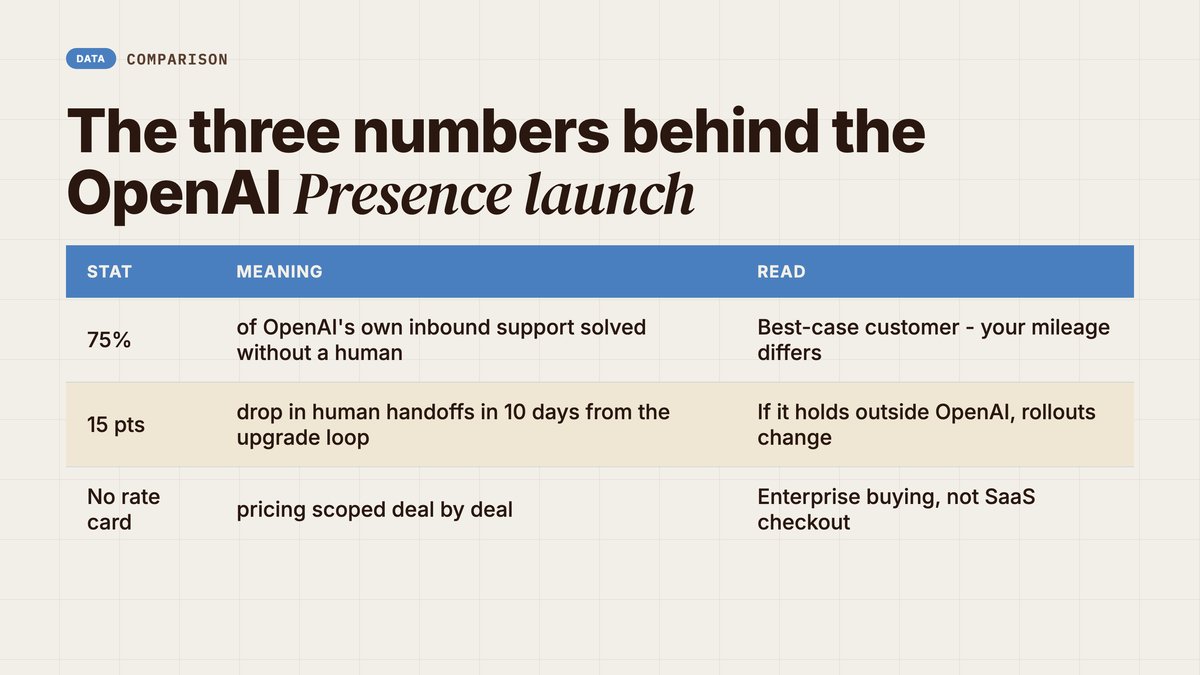
Three figures define this launch. All deserve a skeptical read.
75% self-resolution. OpenAI's English phone support runs on Presence. It solves three of four inbound issues without a human, per the company. Remember the context. OpenAI is the best-case customer. Clean docs. Tech-savvy users. Full control of the stack. Your mileage will differ. But this number just became the bar every support vendor gets measured against.
15 points in 10 days. The claimed drop in human handoffs from the upgrade loop. If it holds outside OpenAI's walls, it changes the rollout story. An agent that improves weekly is a different purchase than one you tune once.
Pricing: not public. No rate card. Deals are scoped one by one. Wider pricing comes later, per The Register. When a vendor prices by deal, the invoice is large. This is big-company buying territory. Not a SaaS checkout.
The real story: the front office is turning into a product
Zoom out. This launch closes a loop we have tracked all year.
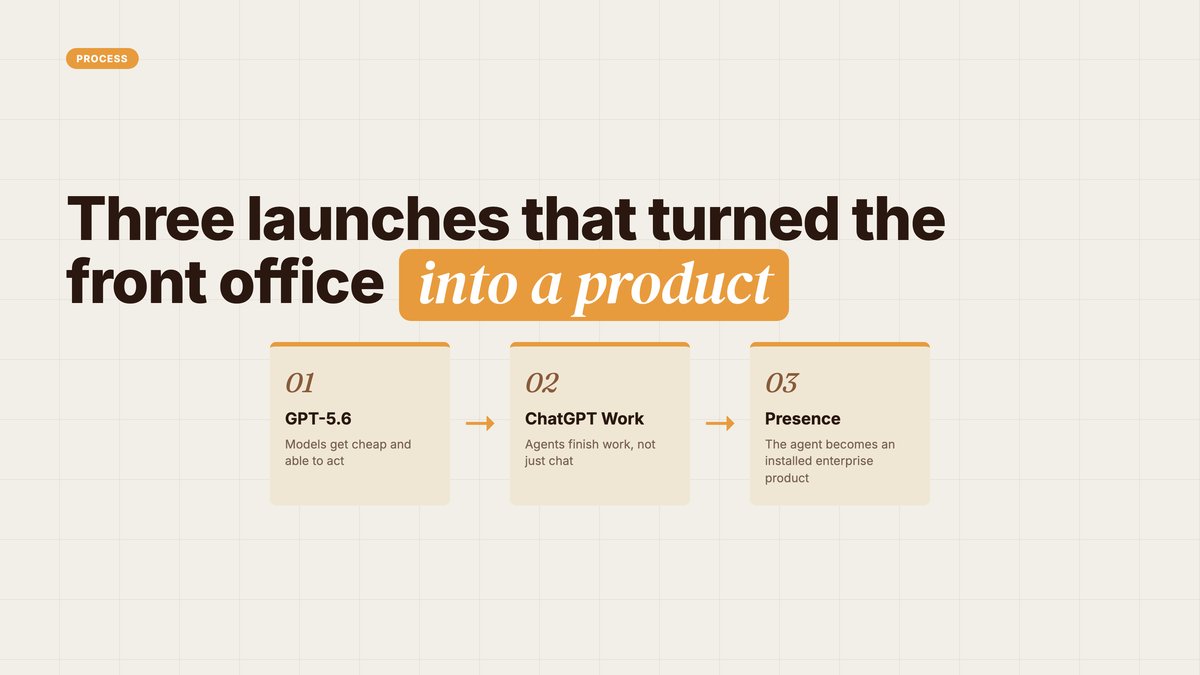
First, the models got cheap and able to act. We covered that when OpenAI shipped GPT-5.6. Then the agents learned to finish work, not just chat. We covered that when ChatGPT Work launched. Presence is the third act. The agent is now a boxed product for big firms. The model maker installs it. The rules come built in.
Look at what OpenAI chose to automate first. Not creative work. Not strategy. The talking jobs at the front of the house. Support calls. Sales touches. Service requests. High volume. Clear intent. Easy to score. That is where AI meets the money fastest.
Now look at how they sell it. OpenAI bought a consulting firm. It built a team of field engineers. It prices each deal by hand, per The Register. The world's biggest AI lab decided that agents do not sell themselves. Someone has to install them. Someone has to set the rules and tune them. That is a loud signal about what works in the real world. And it backs every agency building those skills right now.
The counterweight: do not fire the support team
Hold the hype for a moment. There is a strong bear case. It comes from Gartner.
Gartner predicts half of companies will drop plans to cut support jobs with AI by 2027, as cited by The Register. The reason is simple. People still want people when the issue is messy or high stakes. Early AI support rollouts still hand off to humans all the time.
Both things can be true. Agents can absorb 75% of routine calls at OpenAI. Half the market can still walk back its job cuts. The gap is the work behind the launch. Clean answers. Clear rules. Tested edge cases. Real paths to a human. Presence sells exactly that work as a product. Which tells you the work is the hard part, not the model.
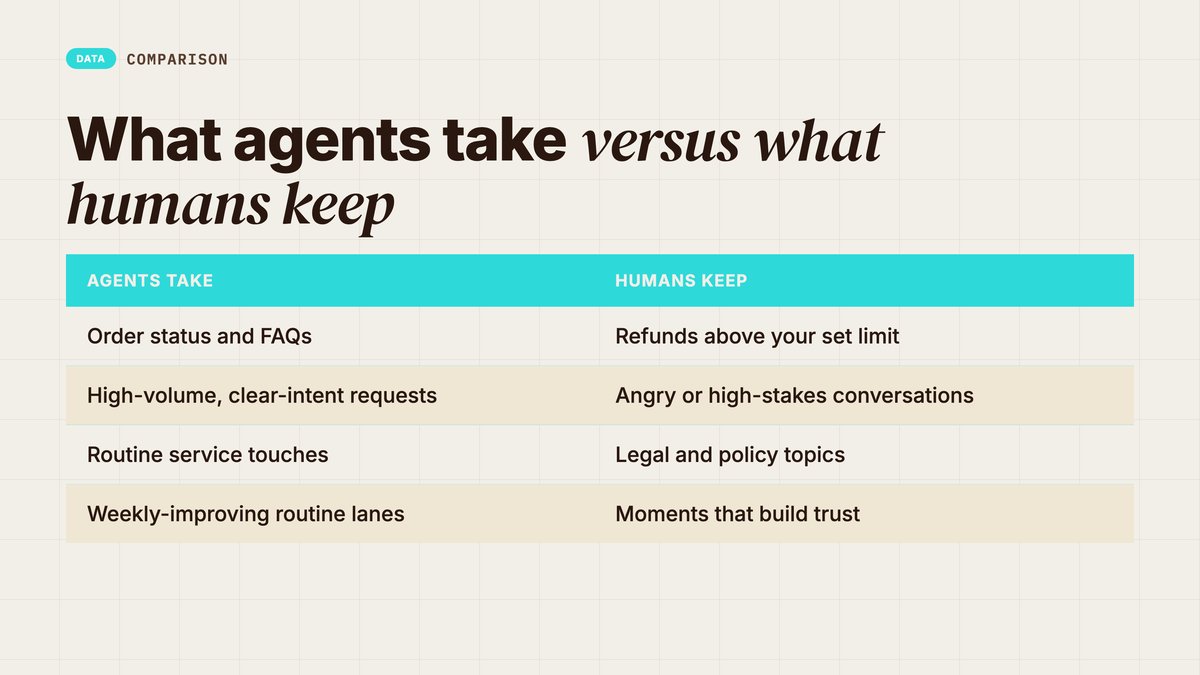
So the move is not "replace the team." The move is: let agents eat the routine calls, so humans own the ones that build trust. Frame it that way and you keep quality while wait times fall. Frame it as job cuts and you end up in Gartner's stat.
A worked example: run the readiness audit
You probably cannot buy Presence this quarter. You can still find out if you are ready for anything like it. One afternoon. One sheet.
List your top 10 inbound intents. Pull them from your ticket system, call logs or WhatsApp inbox. "Where is my order." "Does this plan include X." "I need a refund." Rank them by volume. Keep the real phrasing.
Ask four questions per intent. Is the correct answer written down anywhere? Is the policy clear enough for a smart temp to apply? What system access does the fix need? What should trigger a human handoff?
Score it honestly. Green: written answer, clear policy, defined handoff. Yellow: the answer lives in someone's head. Red: no policy exists, or the policy is "it depends."
Count your greens. That is your automatable share. Most teams find the blocker is not AI skill. It is that half their answers were never written down. That gap blocks a Presence rollout at any price. It also blocks the cheaper tools you can buy today.
This audit costs nothing and pays either way. Fix the reds and yellows. Every support tool you own gets better. Including the humans.
What this changes, by function
Support and CX teams. The 75% talk is coming. When your leadership quotes that number, answer with your readiness audit, not a shrug. Push for the routine-vs-trust split. Track the quality of solved chats, not just the count. A wrong answer served fast is not a win.
Sales and demand teams. Sales development is a named Presence lane, per the launch coverage. Voice agents doing lead checks at scale will change the math on outbound. List which touches truly need a human. The rest just got a price ceiling.
Marketing teams. Every chat an agent handles is data you never had. Intents. Objections. Exact phrasing. Drop-off points. That is a gold mine for content and positioning. Decide now who owns agent-chat insights in your team.
Agency owners. OpenAI just backed your business model. The biggest AI lab chose hands-on rollout over self-serve, per The Register. Mid-market clients cannot afford OpenAI's field engineers. They will need someone to do the same job with tools they can buy. That someone should be you.
The mid-market angle: you are not locked out
Here is the part the headlines skip. You do not need Presence to act on Presence.
The hard work behind a good agent is not the model. It is the prep. Written answers. Clear rules. A tested list of when to hand off to a human. That work costs time, not money. And it pays off with every tool, at every price point.
Think of it like this. OpenAI charges big firms to do three things. Write down the policies. Wire up the systems. Test the edge cases. A small team can do a scrappy version of the same three things in a week. The gap is polish, not magic.
There is a second edge for small teams: speed. A five-person brand can rewrite its help docs in days. A bank cannot. Cheap agent tools will catch up to Presence within quarters, on 2026 form. The prepared small team switches them on and wins. The unprepared one starts from zero.
The lesson from every AI cycle this year is the same. The tech gets cheap fast. The prep stays valuable forever. Do the prep.
Do this now
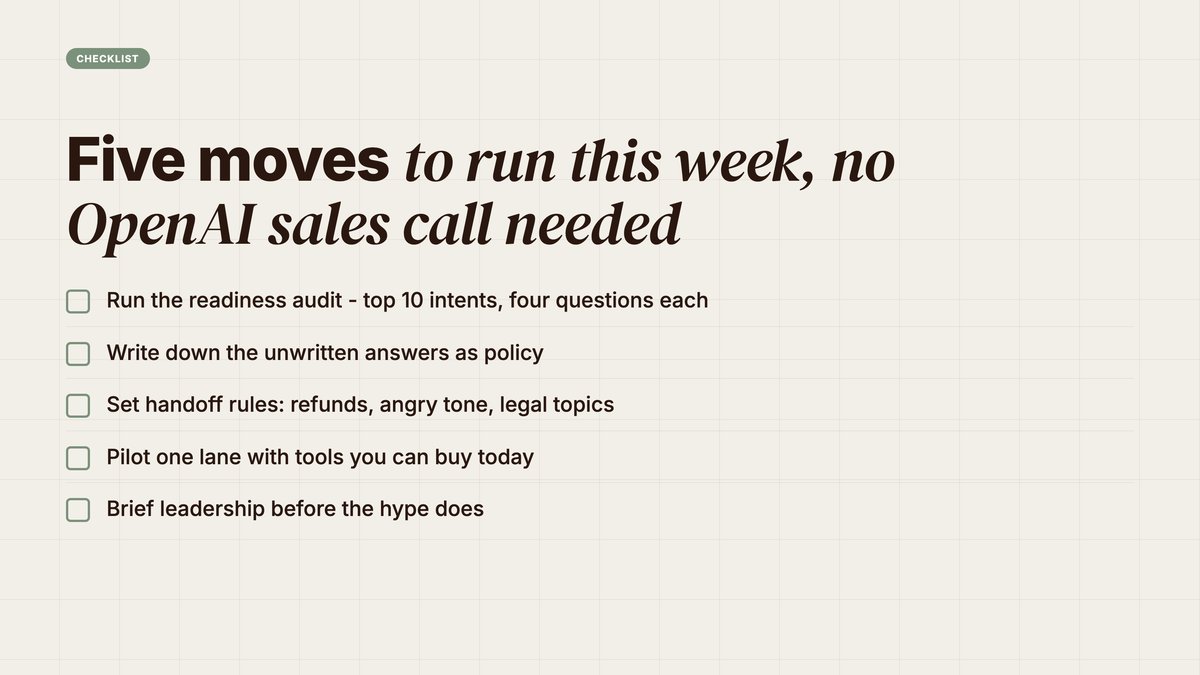
Five moves this week. None require an OpenAI sales call.
- Run the readiness audit. Top 10 intents. Four questions each. Green, yellow, red. Know your automatable share before anyone asks.
- Write down the unwritten answers. Every yellow becomes a written policy. This is the highest-ROI AI prep there is.
- Set handoff rules. Decide today which chats must reach a human. Refunds above X. Angry tone. Legal topics. Write the list.
- Pilot with what you can buy. Agent tools exist at every price point. Run one lane, like order status or FAQs. Measure honestly.
- Set the story inside. Brief leadership before the hype does. Agents take the routine volume. Humans take the moments that matter.
What to watch next
A public price. OpenAI says wider pricing comes as access expands. When a rate card appears, the mid-market clock starts.
Outside proof. Every number so far comes from OpenAI's own rollout. The first named outside customer with checked results will tell us what this really does.
The rival response. Anthropic, Google and the CX incumbents all have agent plays. Think Zendesk, Salesforce, Intercom. A price war in front-office agents lowers the entry cost for everyone else.
New rules. Voice agents that sound human and hold personal data will draw disclosure rules. Watch for laws that make AI callers say they are AI. They will shape scripts and flows.
The caveat
Every number in this story is OpenAI grading its own homework. The 75% fix rate comes from OpenAI's own support line. So does the 15-point gain. That is the friendliest test bed there is. No outside customer results are public yet. The price is hidden and the door is gated. Gartner's warning about walked-back job cuts comes from real rollouts that fell short. So do the prep work. Pilot small. Buy nothing on a launch-day stat.
FAQ
What is OpenAI Presence?
A platform for deploying AI voice and chat agents into big-company workflows. Lanes include support, sales development, IT and HR. It launched July 22, 2026. Agents follow company policies and escalate to humans.
Can my company buy Presence today?
Only if you are a large enterprise. It ships through a limited access program. OpenAI's field engineers and select partners install it. It is not self-serve, per The Register.
How much does it cost?
OpenAI has not published pricing. Each deal is scoped one by one during the limited access phase.
Is the 75% resolution claim reliable?
It is OpenAI's own number, measured on OpenAI's own support line, per Help Net Security. Treat it as a best-case ceiling. Not a promise for your business.
Will AI agents replace support teams?
Be careful here. Gartner predicts half of companies will drop AI-driven job cuts in support by 2027. The winning split: agents take routine volume. Humans take high-stakes moments.
What should smaller businesses do about this?
Do the prep. Write down your top support answers. Set handoff rules. Pilot a buyable agent tool on one lane. The prep transfers to any platform, at any price.
What should marketers do first?
Run the 10-intent readiness audit this week. Then claim ownership of agent-chat data. The intents and objections agents capture are next quarter's positioning research.
Sources: OpenAI — Introducing OpenAI Presence. The Register — OpenAI tries the consulting path with Presence. Help Net Security — Presence connects AI agents to enterprise data. No Jitter — OpenAI makes its Presence felt in CX.
Insights from Our Experts
Explore our latest articles on digital marketing strategies.