Kisaansay — How a 6-Campaign Google Ads Stack Broke a D2C Food Brand's Meta-Only Plateau
Project Breakdown
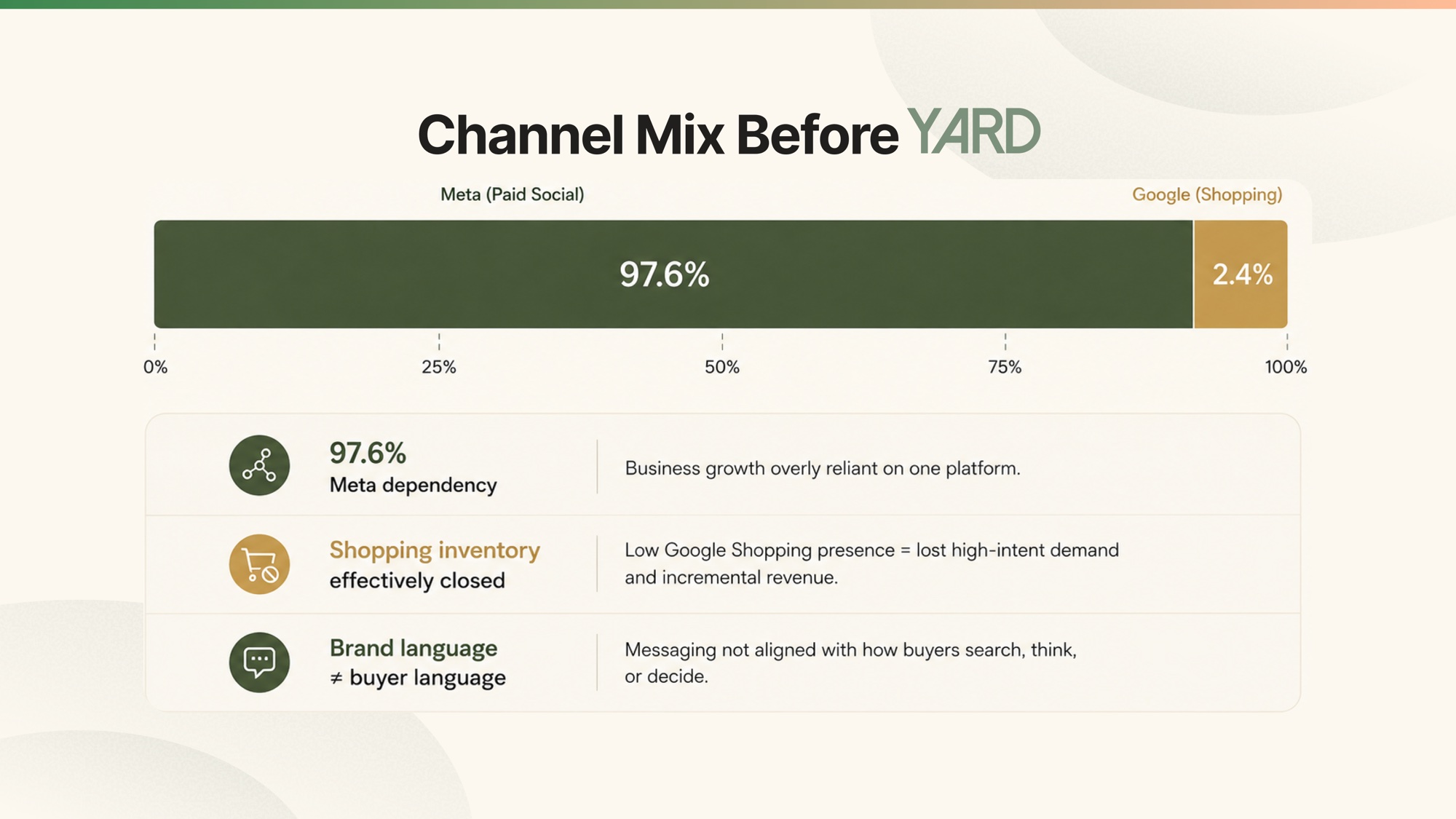
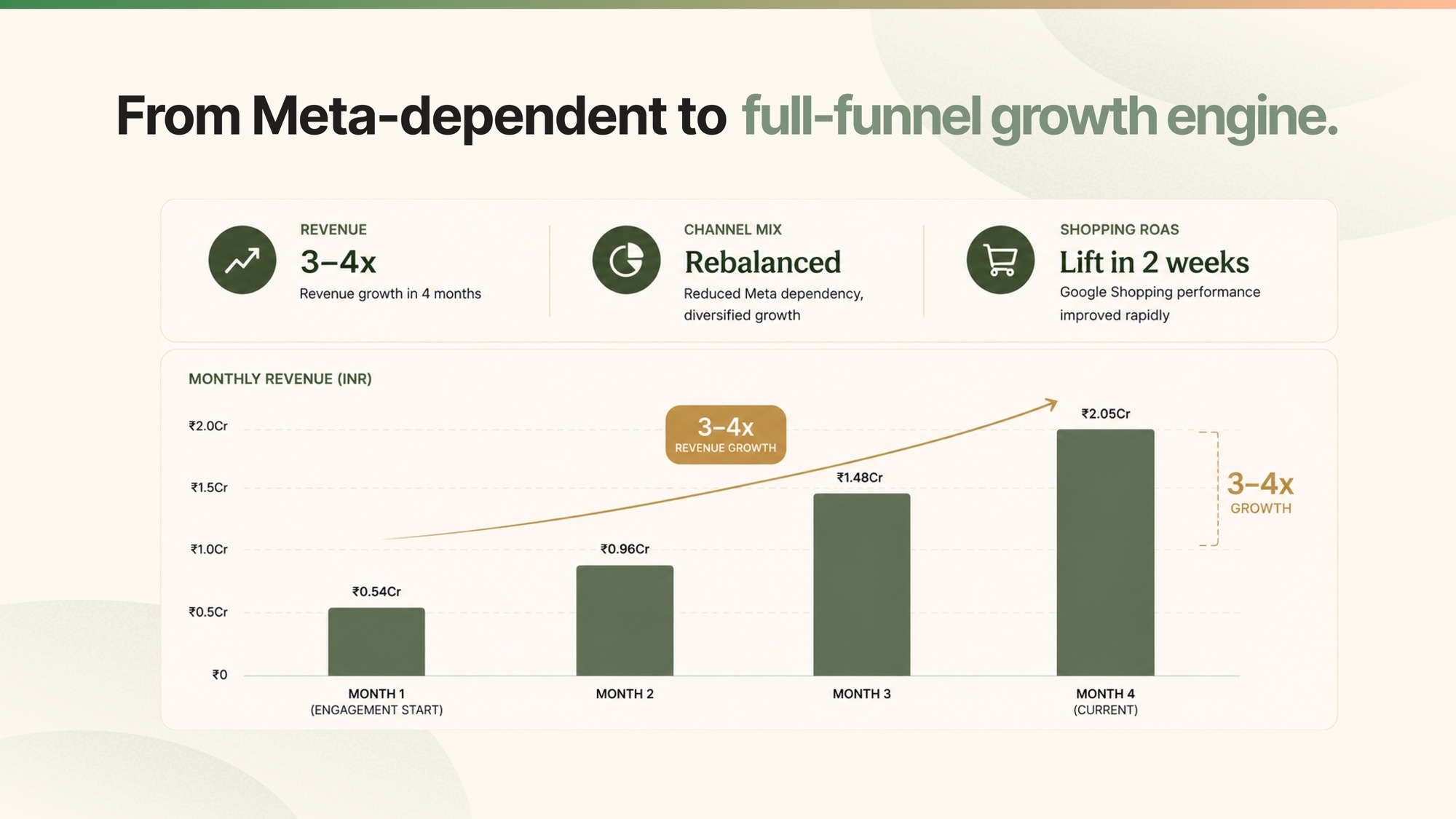
Kisaansay had built a great D2C food brand on Meta — and hit the ceiling that every Meta-only brand eventually hits. 97.6% of spend was in one channel. The growth was real, but it was also fragile. YARD built out the missing Google Ads stack and tripled monthly revenue inside the first quarter.
| Client | Kisaansay |
|---|---|
| Industry | D2C Food (India) |
| Region | India · Pan-India shipping |
| Channels | Meta (97.6% pre-engagement) → Meta + Google Ads (Search, Shopping, PMax, Demand Gen) |
| Engagement | Performance Marketing |
| Timeline | 3–4 months to 3–4x monthly revenue |
The Client
Kisaansay is a digitally-native D2C food brand built around freshness, farmer sourcing, and the Indian household's weekly repeat-purchase categories — ghee, jaggery, hand-milled atta, single-origin spices, regional pickles. The best customer doesn't buy once. They buy weekly, then they buy for their parents, then they buy for the cousin who lives abroad.
The product story is unusually strong. Most D2C food in India is either heavily processed or heavily commoditised. Kisaansay sits in a defensible middle — farm-traced, premium-but-affordable, regionally-rooted. Customers who try it generally come back; the issue was never retention. It was discovery.
The Problem
Kisaansay walked in with what looked, at first glance, like a "scale our ads" brief. The diagnosis underneath was different.
The 97.6% problem
97.6% of paid spend was in Meta. Google was being used as a brand-search defence campaign and almost nothing else. The category has enormous high-intent generic and Shopping demand on Google — "fresh atta delivery online," "buy single-origin ghee India," "kashmir saffron 1g online" — and Kisaansay was capturing essentially none of it.
A Meta-only brand isn't just a brand with one channel. It's a brand whose entire growth engine is dependent on the same audience cohort being shown the same ad pool over and over. Past a certain spend level, the algorithm starts re-serving warmer audiences instead of finding new ones, blended CAC climbs, and ROAS halves.
The feed problem
Underneath the channel issue was a Merchant Center problem. Product titles read like inventory labels — "KSY-SF-001 · Saffron 1g" — and matched almost none of the actual search-language buyers used.
The Strategy
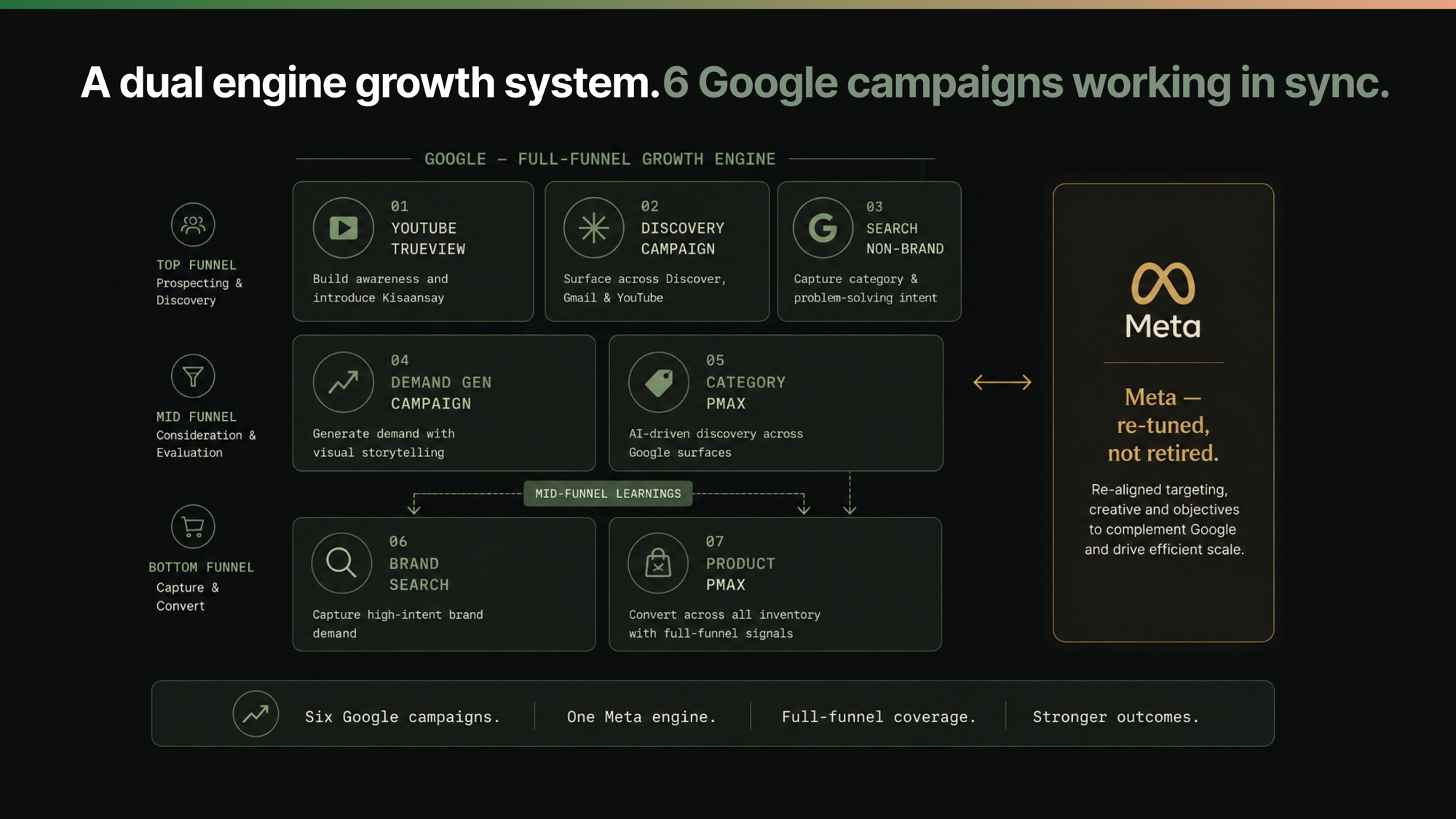
The 6-Campaign Google Ads Architecture — the same playbook deployed across our retail and food roster.
| # | Campaign | Job |
|---|---|---|
| 1 | Brand Search | Defend brand queries from competitor bidding |
| 2 | Generic Search | Capture category demand |
| 3 | Competition Search | Controlled bidding on adjacent D2C food brand queries |
| 4 | Category PMax | Segmented asset groups by buyer outcome |
| 5 | Product PMax | Bottom-funnel Shopping coverage tuned to ROAS targets |
| 6 | Demand Gen | Top-of-funnel category storytelling on YouTube, Discover, Gmail |
Six campaigns. Each with one job. Each tunable independently.
Merchant Center rebuild
Product titles were re-cut to lead with search-language — "Kashmir Saffron 1g – Single-Origin Stigma Strands" before "KSY-SF-001." Custom labels for household-staple-vs-festival-item and single-purchase-vs-subscription-eligible were added.
Subscription/repeat-purchase as a creative lever
The category's economic engine is repeat purchase, not first purchase. We built a creative pool specifically for the subscription / repeat-purchase narrative.
Meta did not disappear
Meta stayed live as a core channel. The strategic shift was that Meta was no longer doing all the work.
The Execution
The first 30 days were architecture and feed. Google Ads stack stood up. Merchant Center rebuilt. Demand Gen creative produced.
Days 30–60: budget rebalancing. Spend that had been over-indexed on Meta was shifted into the missing layers of the Google stack — Generic Search and Category PMax first, then Product PMax once Shopping inventory was warm.
Days 60–120: scaling. Once each campaign showed it could absorb budget without efficiency collapse, the architecture absorbed the ramp cleanly.
"The 97.6% wasn't a Meta failure. It was a Google absence. We didn't fix Meta — we filled in the gap next to it."
The Results
| Metric | Outcome |
|---|---|
| Monthly revenue | 3–4x vs pre-engagement baseline, within 3–4 months |
| Channel mix | From 97.6% Meta to a balanced Meta + Google split |
| Google Shopping ROAS | Immediate lift within 2 weeks of Merchant Center rebuild |
| Generic Search impression share | Built from near-zero baseline to consistent presence inside 60 days |
| CAC trajectory | Reversed — declining instead of climbing |
The headline is 3–4x revenue. The structural win underneath is that the brand is no longer single-channel-fragile.
Why It Worked
- The architecture wasn't built for Meta replacement — it was built for the gap Meta couldn't fill.
- Feed-language matched buyer-language.
- Six campaigns each doing one job beat the legacy structure on every measurable axis.
- Demand Gen and Category PMax fed each other.
Closing Thought
The brand that buys ghee from Kisaansay one week and remembers to re-order it three weeks later is the unit economic that makes the business work. Every architectural decision in this engagement was made in service of that one customer.

Stealth REIT — Building a Regulated PropTech's Martech Stack From Zero, and Cutting CPL 67%

Manvar — How a Heritage Thar Desert Brand Broke Its OTA Dependency and Grew Direct Room Nights 56%