

REP — Building a Premium Fitness E-Commerce Engine in the UAE
Project Breakdown
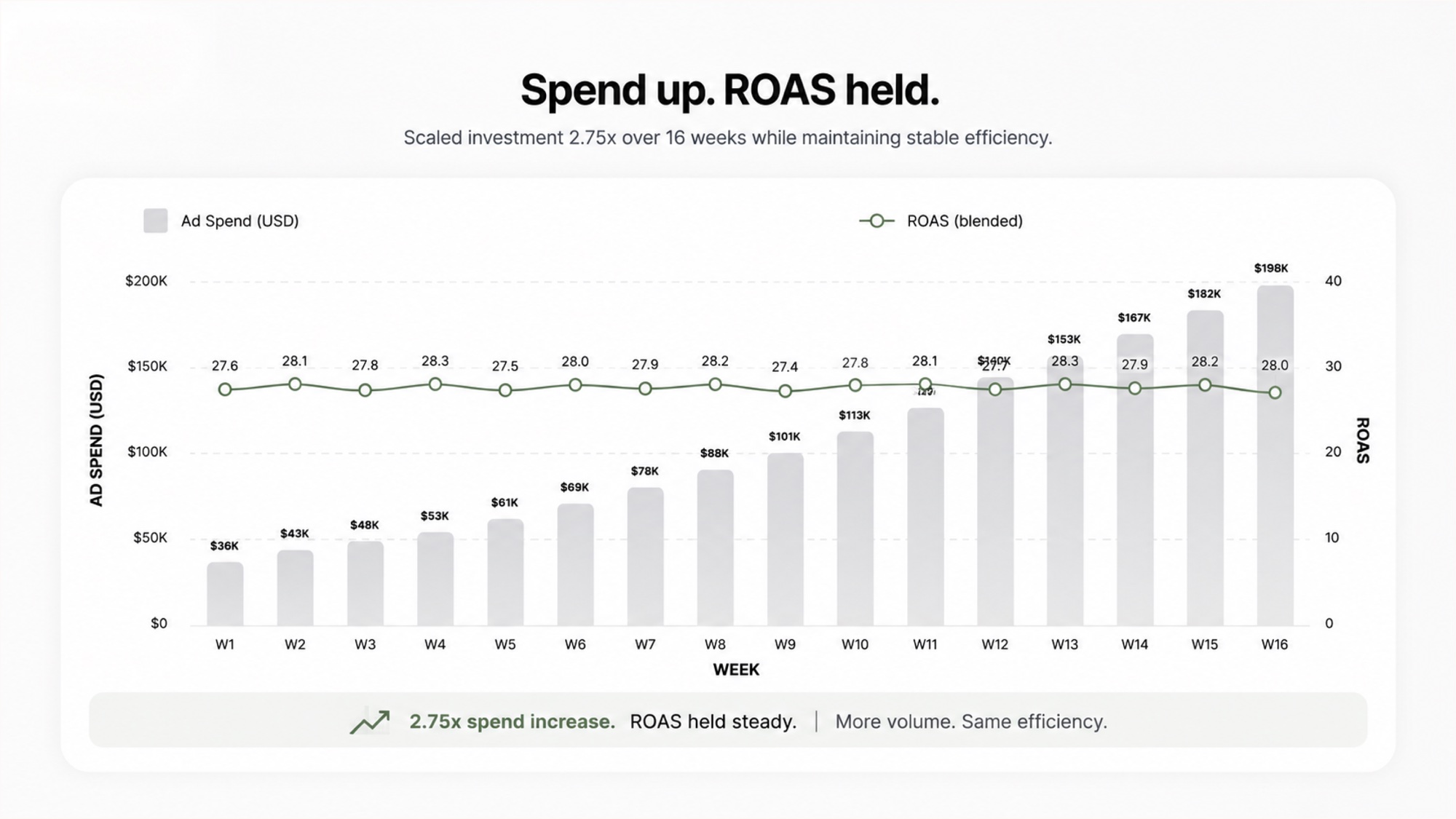
REP had the product. Premium powerlifting gear, racks, plates, benches — the kind of equipment serious lifters in the UAE actively want. What it didn't have was an account architecture that could scale. In four months, YARD pushed spend 2.75x without giving up margin.
| Client | REP UAE |
|---|---|
| Industry | Premium Fitness E-Commerce |
| Region | UAE |
| Channels | Meta, Google Shopping, Merchant Center |
| Engagement | Performance Marketing |
| Timeline | 4 months (active scale window) |
The Client
REP is one of the most respected premium home and commercial gym equipment brands globally. The UAE arm services serious lifters, garage-gym builders, and high-end commercial gym fit-outs — average order values that are large, considered, and price-elastic.
The category is structurally interesting. A premium power rack is not an impulse purchase; it is a decision the buyer has been quietly researching for weeks or months. Many of the highest-AOV orders are accompanied by complementary purchases — plates, bench, accessories — and there is a strong "complete the home gym" buying pattern that, if surfaced correctly, can pull AOV up materially.
The UAE market adds further nuance. Home-gym culture in the region has grown sharply since 2020 and has not retreated to pre-pandemic levels. Buyers are willing to spend, but supply chain confidence (will it arrive, will it be the right spec, will warranty actually work) is a bigger objection than price for most premium decisions.
The Problem
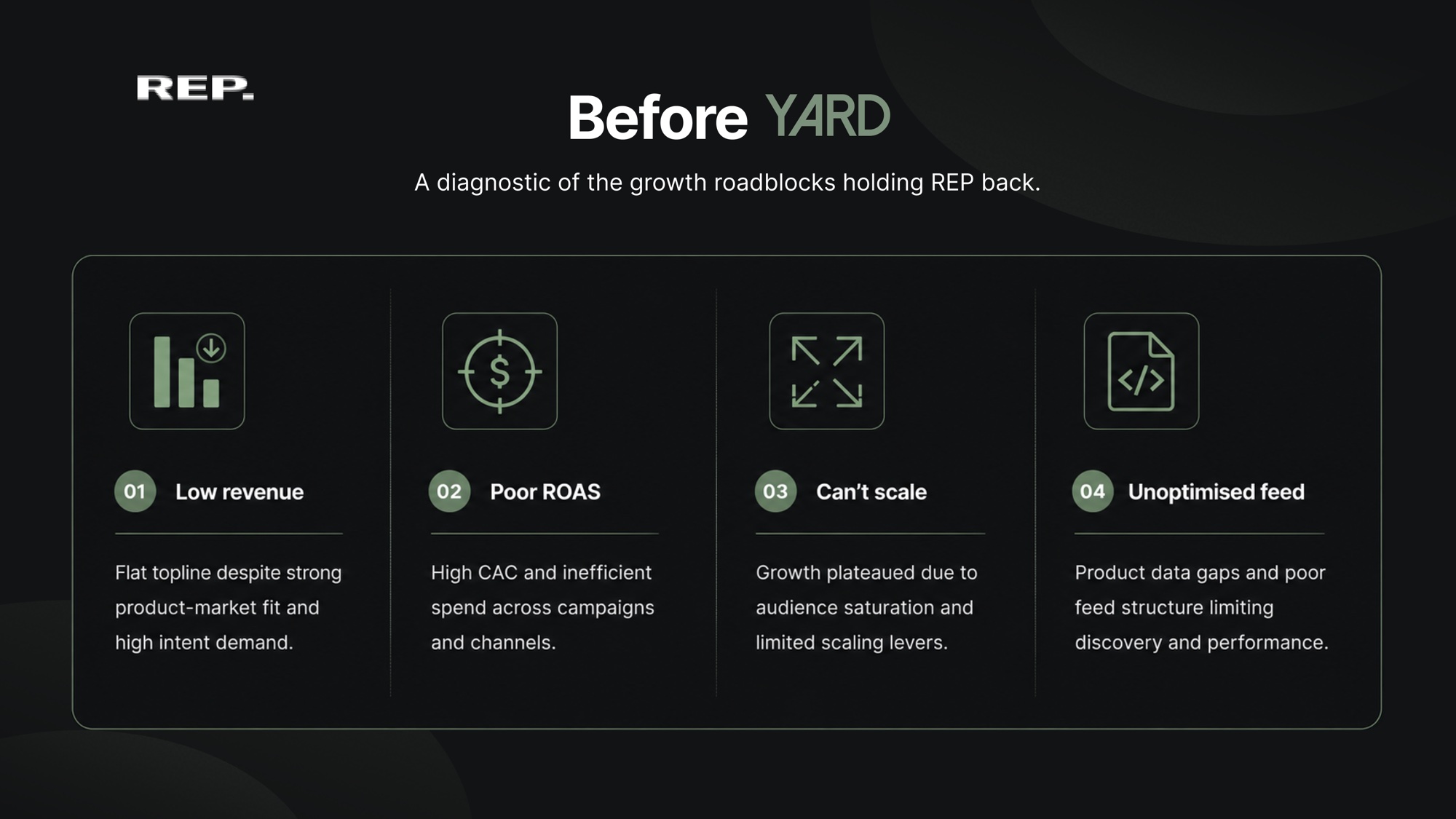
The brief, in the team's own words: "Low revenue, poor ROAS, can't scale, unoptimised feed."
Specifically:
- Merchant Center feed had not been re-cut for search-language. Long product names like "Adjustable Bench AB-3000" weren't matching how lifters search.
- Meta account was running a single all-in-one campaign that was trying to do prospecting, retargeting, and conversion in the same ad set.
- Spend ceiling had been hit at a level the brand could afford to triple — but every attempt to push past it collapsed ROAS within a week.
- No coordinated Shopping presence on Google.
The product was correct. The account was wrong.
The Strategy
The same architectural playbook we'd validated on Vivobarefoot and SoleTherapy — applied to a heavier-AOV, more considered-purchase category.
1. Merchant Center rebuild
Product titles rewritten to lead with the category query ("Powerlifting Bench" before model number). Structured attributes filled out across the entire SKU range. GTINs and product type taxonomy aligned to Google's expected categories. Custom labels for equipment category (rack, bench, plates, accessories) and home-vs-commercial tier were added.
2. Dual-funnel Meta architecture
Two campaigns. Clean separation.
- Campaign 1 — ATC: mid-funnel prospecting against lifter / home-gym-builder interest stacks, optimised for Add-to-Cart events.
- Campaign 2 — Advantage+ Shopping for Sales: bottom-funnel, fed by the ATC audience, optimised for purchase value.
Premium fitness has a longer consideration cycle than fashion or food — the dual-funnel suits that perfectly.
3. Google Shopping running in parallel
Brand and Generic Search plus a Product PMax campaign caught the high-intent bottom-of-funnel queries that Meta wasn't going to reach as efficiently. Coordinated bidding and budget allocation between the two channels — not run in silos.
4. Creative built for the considered-purchase buyer
We commissioned new creative built around three buyer archetypes: the home-gym serious-lifter, the commercial gym buyer, and the gift-purchase buyer (spouse buying for their partner — a real and underserved segment in this market).

The Execution
The first 30 days were architecture and feed. Every legacy campaign was paused once the new structure was live.
Days 30–60: spend was held at baseline while the new structure learned. ROAS recovered to baseline by week 4 and started climbing through week 6.
Days 60–120: with the architecture proven stable, spend was scaled up steadily. The dual-funnel held — Campaign 1 fed Campaign 2 fast enough that bid efficiency kept improving as we pushed budget through.
"The hardest part of any rebuild is week two — the architecture is live, the legacy campaigns are off, the new numbers haven't yet stabilised, and the temptation to revert is enormous."
The Results
| Metric | Outcome |
|---|---|
| Ad spend | Scaled 2.75x vs baseline |
| ROAS | Stable at scale — no collapse across the ramp |
| Merchant Center feed | Quality Score and impression share both lifted within 2 weeks |
| Architecture | Same dual-funnel + Shopping coordination running today |
| AOV | Lifted on the back of gift-purchase creative entering the mix |
The win to underline: this wasn't a peak — it was a ramp. The brand can keep pushing spend through the same architecture without forcing a re-platform.

Why It Worked
- Architecture before activity. We didn't try to optimise the legacy stack — we replaced it.
- Premium AOV rewards the dual-funnel. Long consideration cycles need a campaign whose only job is to generate hand-raisers.
- Feed-language matches buyer-language. Powerlifters search like powerlifters.
- Creative archetypes uncovered hidden audience segments.
Closing Thought
The headline of this case study is 2.75x spend at stable ROAS. The real takeaway is that the architecture that made it possible is the same one running underneath three other YARD footwear and fitness accounts.

Ageasy — How a Senior-Care Brand Scaled 3–4x by Pairing Google Search With a Real Demand-Gen Engine

Stealth REIT — Building a Regulated PropTech's Martech Stack From Zero, and Cutting CPL 67%