How Martin & MacArthur Hit a 32x ROAS Peak — Scaling a Heritage Hawaiian Luxury Brand on Google Ads
Project Breakdown
A heritage Hawaiian luxury brand was sitting on world-class product and underwhelming digital revenue. In seven months, YARD turned Google Ads into a 10.6x average ROAS engine — peaking at 32x and pulling $122K through in a single BFCM week.
- Client: Martin & MacArthur
- Industry: Heritage Luxury Retail · Koa wood furniture, fine art, watches, jewelry
- Region: Hawaii, USA
- Channels: Google Ads, Meta, Merchant Center
- Engagement: Performance Marketing
- Timeline: 7 months (active scale window)
The Client
Martin & MacArthur is Hawaii's most established Koa wood luxury house. Eight-plus gallery stores across the islands, four-plus decades of craftsmanship, and the world's first Koa wood watches — a brand sitting on genuinely rare provenance. Koa is one of the slowest-growing hardwoods in the world. A piece of Martin & MacArthur furniture is not just a product; it is a finite cut from a finite forest, carved by craftsmen whose grandparents trained the previous generation of the workshop.
Their physical retail presence was extraordinary. Their digital revenue was not.
By the time they approached YARD, the e-commerce engine had stalled. Ad spend was flat, ROAS was inconsistent, and the team had no confidence that scaling would do anything but burn through margin. Worse, the brand had real seasonal commercial pressure — gifting holidays, returning Hawaiian residents, and inbound luxury tourism all collide in Q4 — and BFCM was being treated like just another month.
"Heritage brand. World-class product. And a media account that didn't know how to sell it."
The brief that landed on our desk wasn't about clever creative or a new channel. It was about scale. Specifically: could a properly engineered Google Ads stack absorb three to four times the brand's existing media budget without ROAS collapsing?
The Problem
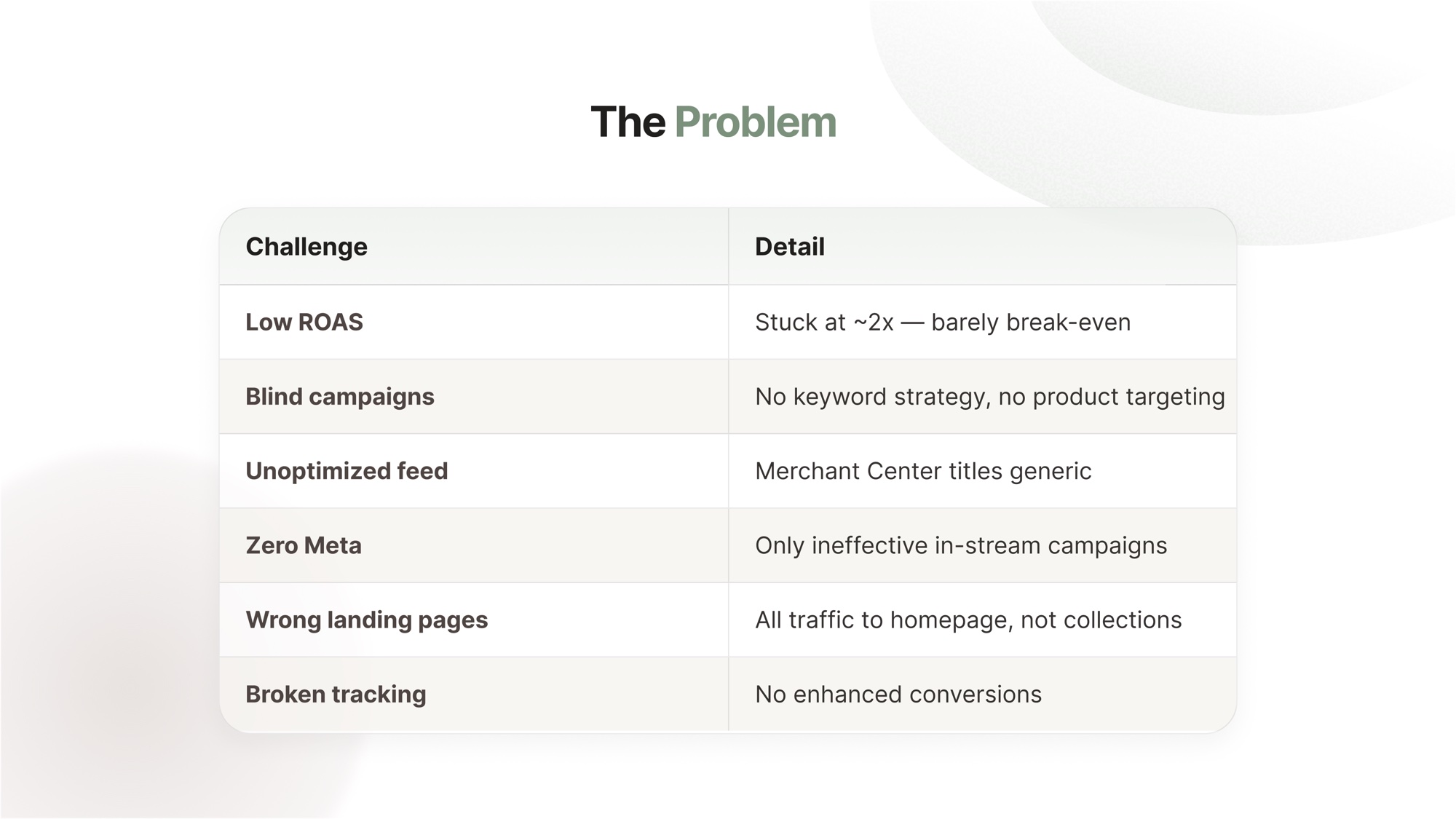
1. A Merchant Center feed built for SKUs, not search
Product titles read like catalogue entries — "MM-KOA-7842 · Bowl · Large" — and matched almost none of the long-tail buyer queries actually typed into Google. "Hawaiian Koa salad bowl," "handcrafted Koa wood watch," "premium Hawaiian wedding gift" — none of those queries found a match in the feed.
The compounding effect was severe. Google's Quality Score depends on relevance, and the feed was telling the algorithm the products were less relevant than they actually were. Bids had to push up to compensate. Margin took the hit.
2. A Google Ads structure full of inheritance, not strategy
Seven legacy campaigns running in parallel, no clear funnel separation between brand, generic, competitor, and shopping. Spend was leaking across non-converting placements. Several campaigns were active simply because nobody remembered why they were turned on.
This is one of the most common patterns we see on inherited accounts. The structure isn't wrong in any individual campaign — it's wrong in its aggregate.
3. No coordinated BFCM playbook
The brand's single biggest commercial window each year was being treated like any other month — same creatives, same budget shape, same bidding logic. BFCM in luxury retail is not a one-weekend event; it's a 90-day commercial arc, with priming starting in mid-October and tail orders coming in well into December.
The underlying diagnosis was simple: this account had scale potential, not optimisation potential. Tweaking it would change nothing. It needed a rebuild.
The Strategy
Three concurrent workstreams over the first 30 days. We deliberately resisted the urge to sequence them — every day spent waiting for the feed rebuild was a day the structure was still leaking, and vice versa.
1. Merchant Center rebuild
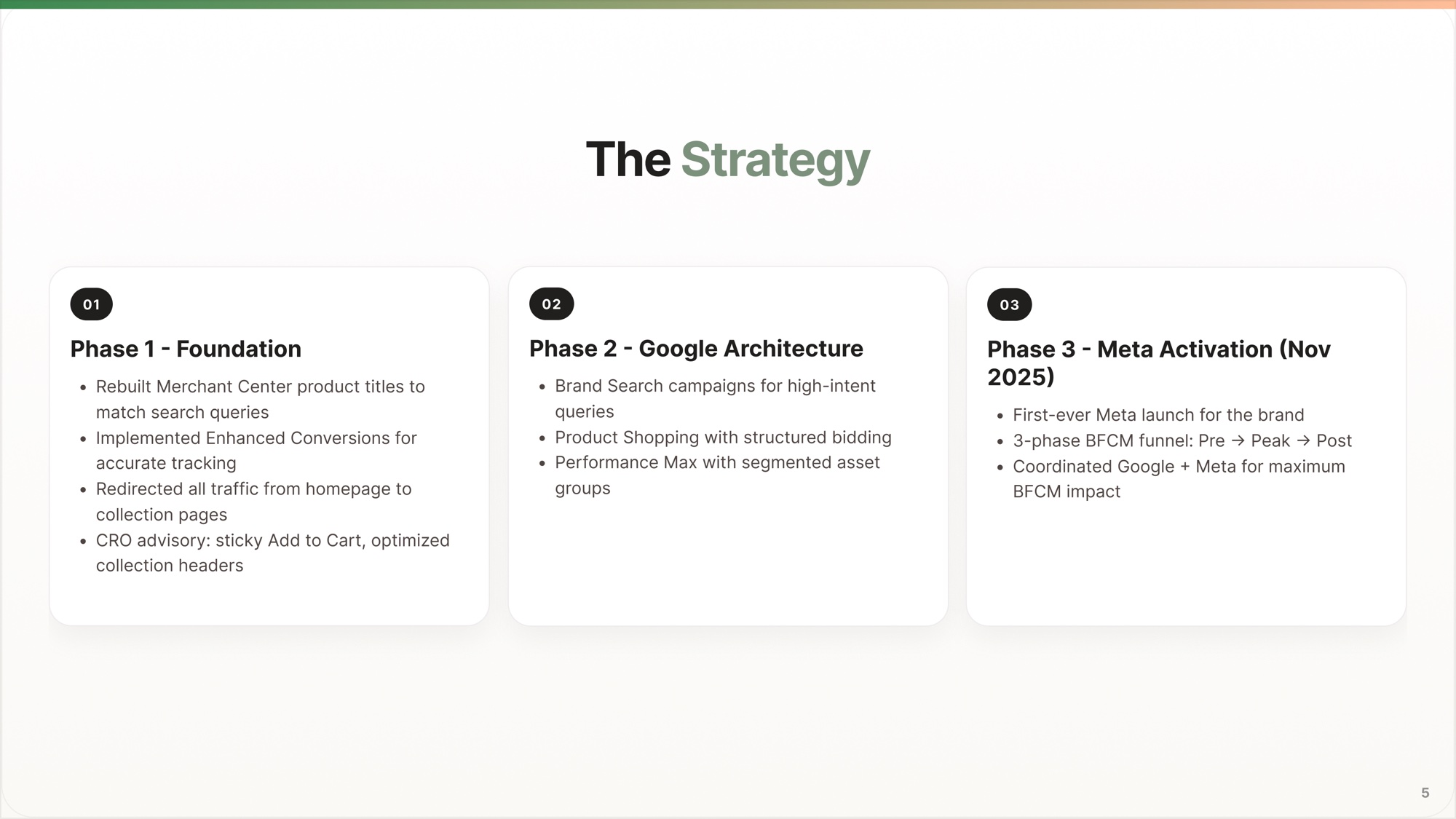
Every product title was rewritten to lead with the search query, not the SKU. "Koa Wood Watch" before "Model 7842." "Hawaiian Koa Salad Bowl" before "MM-KOA-Large." Structured attributes, GTINs, and material tags were standardised across the feed. Custom labels were added for margin tier, BFCM eligibility, and gift-price-band so that bidding could be tuned to commercial reality rather than blunt SKU-by-SKU averages.
The lift was almost immediate — impression share on commercial-intent shopping queries climbed inside the first two weeks, and CPCs fell as Quality Score caught up.
2. Google Ads architecture rebuild
We collapsed the legacy account into a clean 6-campaign architecture, the same playbook we now use across our retail roster:
- Brand Search — for high-intent navigational queries
- Generic Search — category-level queries ("hawaiian koa watches," "handcrafted wood bowl")
- Competition — controlled bidding against adjacent luxury Hawaiian brands
- Category PMax — segmented asset groups by product category, not by SKU
- Product PMax — bottom-funnel shopping coverage tuned to ROAS targets
- Demand Gen — top-of-funnel visual storytelling on YouTube, Discover, and Gmail
Each campaign had a single, defensible role. No campaign was allowed to do two jobs.
3. BFCM playbook — Pre / Peak / Post
The biggest single bet was a 3-phase BFCM funnel running on Google + Meta in coordination:
- Pre-BFCM (Oct → mid-Nov): Warm-up audiences, restocking signal, gift-finder positioning. Bidding stayed conservative; the goal was to feed bottom-of-funnel audiences for the peak window.
- Peak-BFCM (Black Friday → Cyber Monday): Aggressive bidding on hand-raisers, dynamic price callouts, retargeting layered on top of fresh prospecting. Budget caps were lifted for the four-day window with a daily monitoring cadence.
- Post-BFCM (Dec): Last-mile shipping urgency, gift-completion creative, holiday-luxury bundle pushes. Many luxury buyers convert after Cyber Monday — they need the price signal during the window, but the decision lands later.
The Execution
Once the architecture was live, the campaigns spoke to each other rather than competing.
- Search captured intent at the bottom of the funnel.
- Shopping caught visual research behaviour as buyers compared craftsmanship.
- PMax filled in the gaps Google's first-party signals identified.
- Demand Gen seeded the next wave of buyers with cinematic Koa-wood storytelling so the bottom of the funnel never starved.
Inside Meta, we ran a parallel dual-funnel: a dedicated ATC (Add-to-Cart) campaign feeding an Advantage+ Shopping campaign optimised for purchases.
What didn't work first
Two specific things had to be corrected after the first BFCM rehearsal in early November. First, our initial Category PMax asset groups were segmented too narrowly — by sub-category rather than by outcome. Second, our Demand Gen creative initially leaned product-first; we rebuilt it around the craftsman — the hands, the workshop, the Koa cut itself — and CPM dropped while view-through behaviour improved.
"The win wasn't the rebuild. The win was the discipline to leave the rebuild alone long enough for it to work. Two weeks of flat ROAS during learning, then everything moved."
The Results
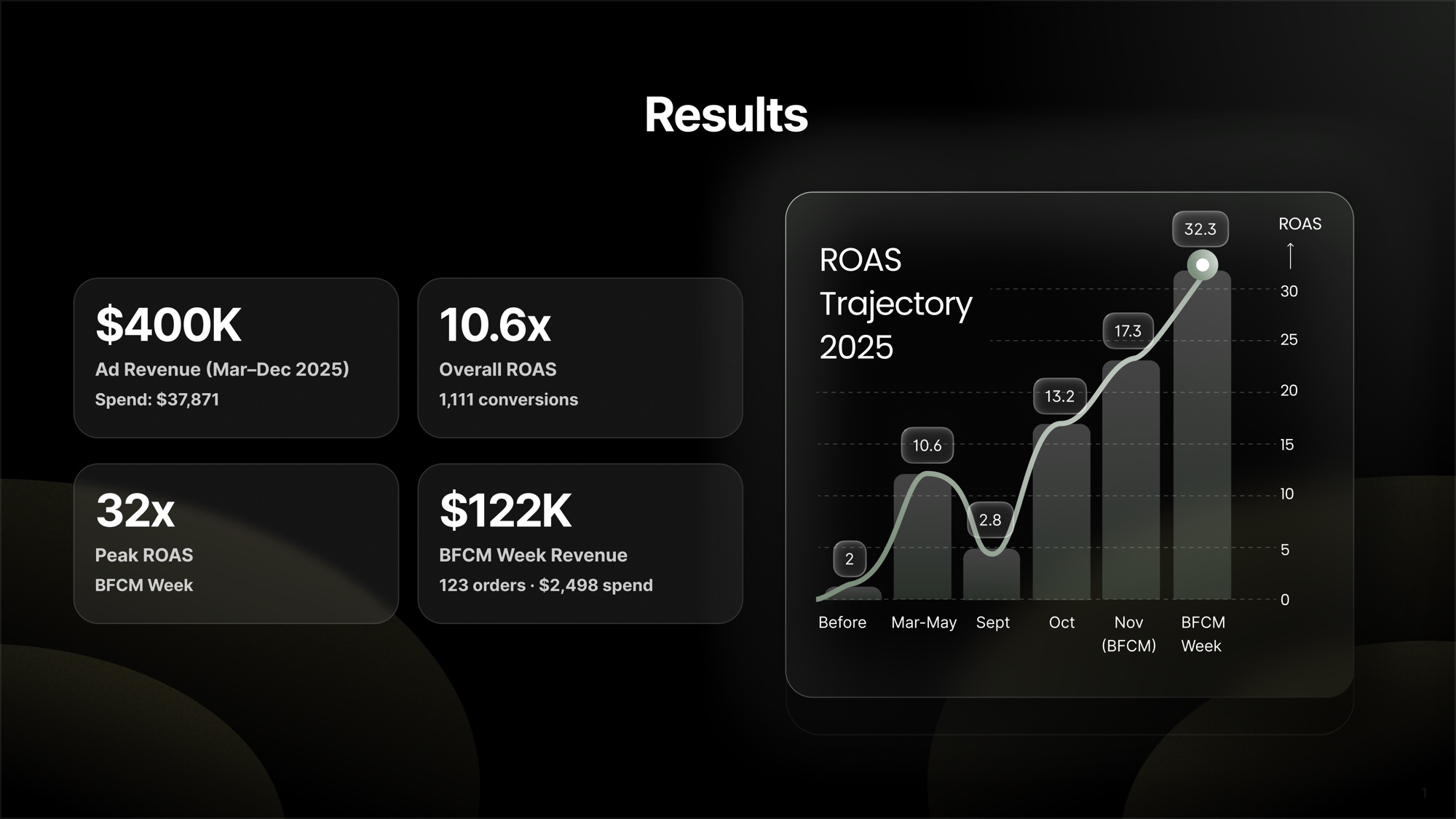
Across the seven-month active window, the rebuilt stack delivered:
- Average ROAS: 10.6x
- Peak ROAS (BFCM week): 32x
- BFCM single-week revenue: $122K
- Active ad spend managed: ~$400K
- Account structure: 7 → 6 campaigns, every one with a defensible role
- Shopping impression share: recovered from depressed baseline within 14 days of feed rebuild
- Quality Score (Generic Search): lifted across the top-20 commercial keywords inside 30 days
The BFCM peak wasn't an outlier — it was the natural ceiling of an account that had finally been built correctly. Average ROAS held above 10x for the rest of the active window.
Why It Worked
- The feed was the bottleneck — not the bidding. Most agencies tune bids on a feed that's actively fighting them. We rewrote the feed first, and the rest of the work became easier.
- Architecture beats optimisation. Six campaigns each doing one job clearly will out-deliver fifteen campaigns doing each other's jobs badly.
- BFCM is a 90-day event, not a 4-day one. Treating Pre-BFCM and Post-BFCM as part of the same campaign — not afterthoughts — is what unlocks the 32x peak.
Lessons for Heritage Luxury Retailers
- Provenance is a search asset, not just a brand asset. Words like "handcrafted," "Koa," "Hawaiian-made," and "heirloom" carry real commercial intent in the feed.
- Gift-search is a different buyer than self-purchase. Build at least one creative pool and one Category PMax asset group that speaks directly to the gifter.
- Demand Gen pays Brand Search. Top-of-funnel video lifts branded queries 7–14 days later.
- Q4 is a separate planning cycle. Build the BFCM stack as if it's a launch — separate creative, separate budget envelope, separate dashboards.
Closing Thought
The most quotable number is $122K in a single BFCM week. The most useful number is 10.6x across seven months. Peak ROAS is a screenshot. Sustained ROAS is a business — and the architecture that produced both is now sitting underneath every retail engagement on the roster.

Stealth REIT — Building a Regulated PropTech's Martech Stack From Zero, and Cutting CPL 67%

Manvar — How a Heritage Thar Desert Brand Broke Its OTA Dependency and Grew Direct Room Nights 56%