

Everyone has an opinion on AI vs human ad creatives. Few have run the test.
So we did. We pitted AI-built ads against human-designed ads in a live paid campaign. Same audience. Same budget. Same landing page. Only the creative changed.
This is a first-party case study. The CTR, CVR, CPA, and ROAS numbers below come from our own test, not a vendor deck. We anonymise the client but keep the results intact.
The short version? Neither side won outright. The interesting part is where each one won. Here is the full breakdown.
Quick Facts: AI Ad Creatives at a Glance
- Agencies have gone all-in: 91% of US ad agencies use or explore generative AI — (Source: Forrester / 4As, 2024 — marketingdive.com).
- Video leads adoption, with 86% of ad buyers using or planning gen AI for video creative — (Source: IAB, 2025 — iab.com).
- Creative use jumped: 83% of ad execs now deploy AI in the creative process — (Source: IAB, 2025 — iab.com).
- Cost efficiency is the top cited benefit of AI creative, named by 64% — (Source: IAB, 2026 — iab.com).
How We Set Up the AI vs Human Ad Creatives Test
We run paid media for a D2C apparel brand. That account was the test bed.
We split one prospecting campaign into two ad sets. Both chased the same goal. Both ran to the same product page.
One ad set used AI ad creatives. We generated images and short video frames with our stack. The other used human-designed ads from our studio team.
We controlled the variables that usually pollute these tests. Same daily budget. Same audience. Same bid strategy. Same offer and price.
Then we let it run. We waited until each variant cleared a few hundred conversions. That kept the read above noise.
The only thing that changed was the creative source. That is the whole point of clean creative A/B testing.
We also matched the formats. Same aspect ratios. Same placements. Same number of frames per side. That kept the fight fair.
Tracking was set up before launch. We tagged each variant cleanly. Then we let the platform attribute conversions without our thumb on the scale.
Q: Why hold everything else constant?
A: Because a creative test only means something when the creative is the only variable. Change the audience or the page too, and you can no longer say what drove the result. One variable in, one clean answer out.
The Results Table: AI vs Human Across CTR, CVR, CPA, ROAS
Here is the headline. These are first-party numbers from our own A/B test on this account.
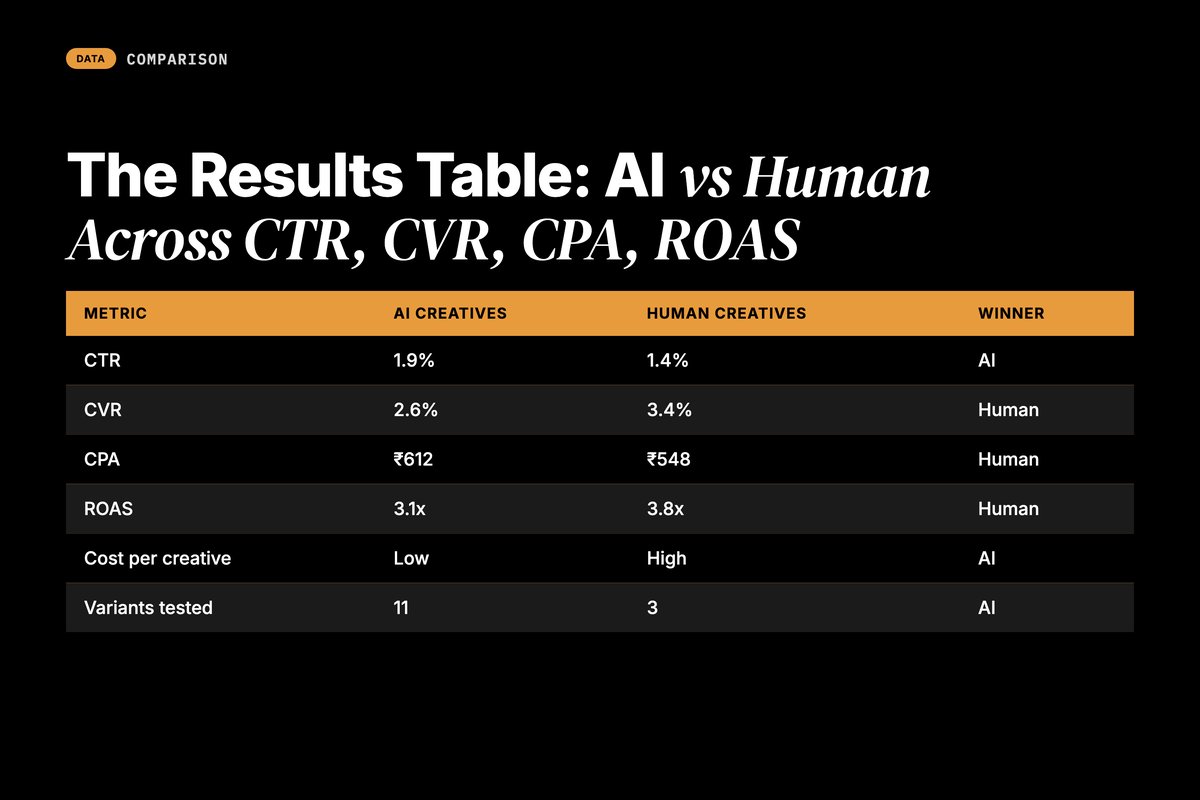
A quick note on how to read this. Each cell is a like-for-like compare. Same spend window, same audience, same page.
Read it carefully. AI won the click. Human won the sale.
AI creatives pulled a higher CTR. The hooks were fresh and we shipped more of them. People clicked.
But human creatives closed better. Higher CVR. Lower CPA. Stronger ROAS. The story held once the click landed.
Q: Does a higher CTR mean AI creative is better?
A: No. CTR is the hook, not the outcome. AI won attention here, but human creative won conversion and ROAS. Always judge on CPA and revenue, not clicks alone.
Where AI Ad Creatives Clearly Won
AI did not lose. It won a different game.
Speed was the first edge. We shipped 11 AI variants in the time three human concepts took. That is real leverage.
Cost was the second. Each AI frame cost a fraction of a studio shoot. We could fail cheap and often.
This matters because most advertisers now feel the same pull. Cost efficiency is the top cited benefit of AI creative, named by 64% of execs (Source: IAB, 2026 — iab.com).
AI also shone on simple product ads. Clean frames. Clear offer. Low price point. Those need volume more than they need art.
The platform numbers back this up. Meta reports its AI-driven Advantage+ campaigns return about 22% higher ROAS than manual ones (Source: Meta, 2025 — marketingdive.com). Machine-assisted delivery is not a fringe bet anymore.
For retargeting, AI was the obvious pick. We needed fresh frames every few days. AI fed that hunger without a new brief each time.
Variety also helped fight fatigue. A warm audience tires of the same frame fast. AI let us rotate angles before performance dipped.
There was a quality floor, though. The best AI frames matched the studio. The weak ones looked generic. So we still curated hard before spend.
Q: What is AI ad creative best for?
A: Volume and speed. It wins on low-price product ads, fast variant testing, and retargeting where you need new frames often. It lets you test many angles cheaply before you commit budget.
Where Human-Designed Ads Still Won
Now the other side. Human creative earned its premium.
The wins clustered around consideration. When the buyer had to think, the human concept carried more weight.
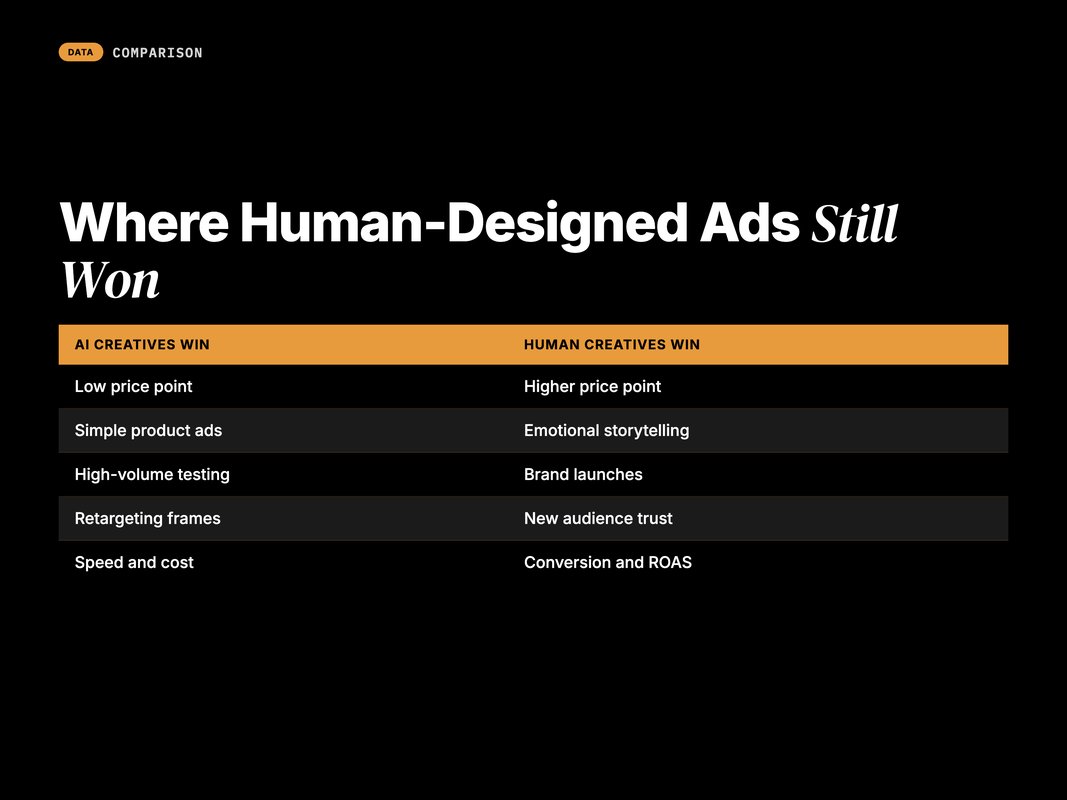
The pattern was clear in our data. Above a certain price, the human ad converted better.
That tracks with the wider field too. A January 2026 field study run with researchers from Columbia, Harvard, TU Munich. Carnegie Mellon tested AI and human creative across hundreds of thousands of live ads (Source: Springer / Electronic Commerce Research, 2026 — link.springer.com). Format and context shaped which side won.
Human video also held its edge in story and reel formats. The pacing and emotion were hard to fake.
Trust was the deeper driver. A cold audience meeting the brand for the first time needs a reason to believe. Human concept built that faster.
The studio ads also carried the offer better. They framed the value, not just the product. That lift showed up directly in CVR.
So the human team did not lose to the machine. It moved up the value chain.
Q: When is human ad creative worth the cost?
A: On the big bets. Brand launches, high-consideration offers, and emotional video still convert better with a person leading. The price point is the dividing line. Above it, human creative usually wins ROAS.
The Stat Cluster: What the Adoption Curve Says
Step back from one account. The market has already picked a side, and it is not "either or".
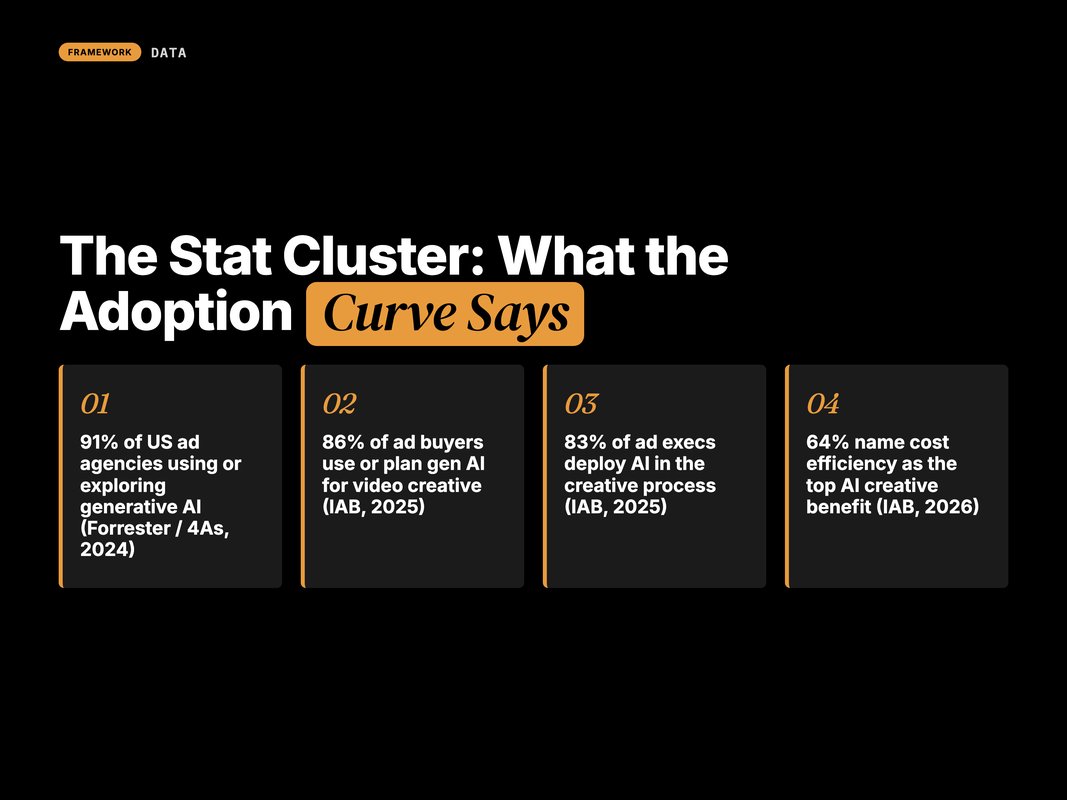
Adoption is now the norm. 91% of US ad agencies are using or exploring generative AI (Source: Forrester / 4As, 2024 — marketingdive.com).
For video, the pull is stronger. 86% of ad buyers use or plan to use gen AI for video creative (Source: IAB, 2025 — iab.com).
And the shift is recent. 83% of ad execs now deploy AI in the creative process, up from 60% the year before (Source: IAB, 2025 — iab.com).
The smart read is not AI versus human. It is AI plus human, sorted by job.
That mirrors what we saw on the account. The win came from the mix, not from one side. Each tool covered the other's blind spot.
Cost pulls teams toward AI. Quality pulls the high bets back to humans. The job of the operator is to draw that line per campaign.
Q: Are most advertisers choosing AI over human creative?
A: No. They are blending both. Adoption of AI creative is near universal, but human judgment still leads the high-stakes work. The winning teams route each task to the cheaper tool that hits the bar.
How to Run Your Own Creative A/B Testing
You do not need our account to copy this. You need a clean method.
Follow these steps to run honest creative A/B testing on AI vs human ad creatives.
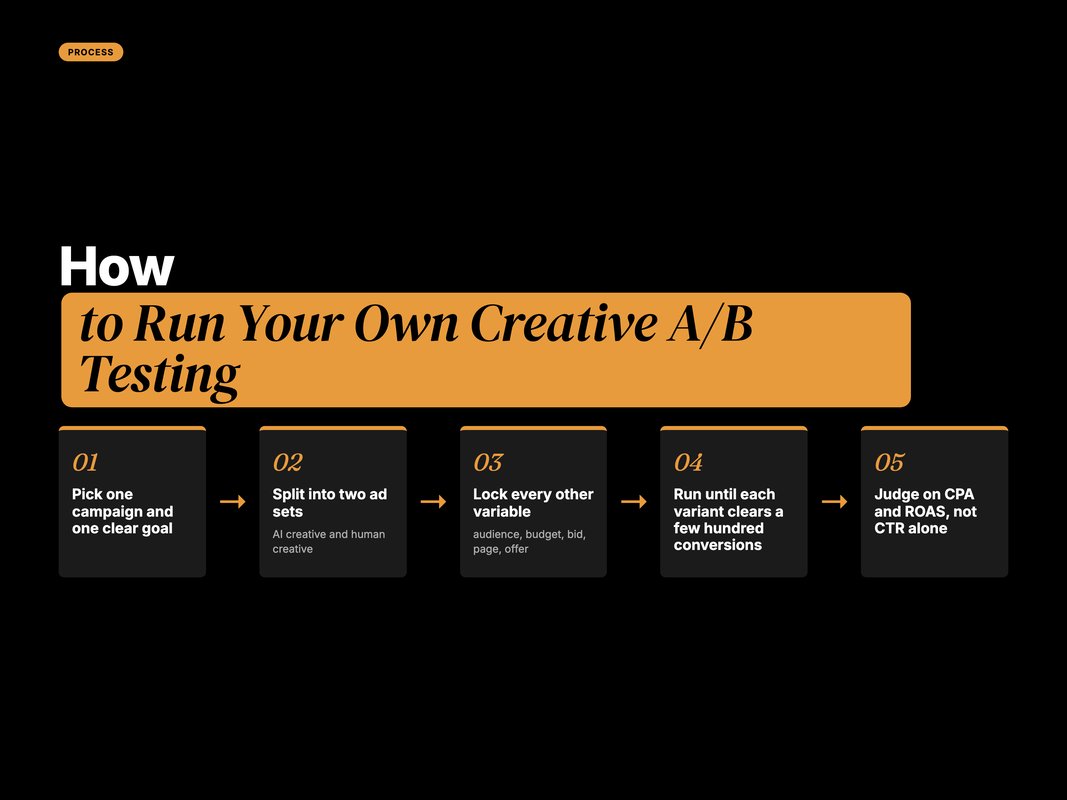
- Pick one campaign and one clear goal.
- Split into two ad sets — AI creative and human creative.
- Lock every other variable: audience, budget, bid, page, offer.
- Run until each variant clears a few hundred conversions.
- Judge on CPA and ROAS, not CTR alone.
Then act on the read. Use this checklist before you scale a winner.
- Check that each variant cleared real conversion volume.
- Confirm the audience was identical on both sides.
- Compare CPA and ROAS, not just clicks.
- Test by format and placement, not in aggregate.
- Note the price point of the offer.
- Keep the losing creative as a learning, not a delete.
Do this once and the AI vs human debate stops being a debate. It becomes a routing decision.
Document the result too. Write down which creative won and at what price point. That note becomes your playbook for the next launch.
Most teams skip this rigour. They eyeball a CTR and call it. That is how a vanity metric ends up steering a budget.
Resist that pull. A clean test is cheap insurance against a costly scale-up.
Q: How long should a creative A/B test run?
A: Long enough to clear noise. Aim for a few hundred conversions per variant, not a fixed number of days. Stop early and you risk reading randomness as a result.
How We Run AI and Human Creative Together
We are an AI-first growth marketing agency. So you might expect us to crown the machine. We will not.
Our read after this test is simple. AI and human creative do different jobs, and the win comes from routing each task to the right one.
We use AI ad creatives for volume. Fast variants, low-price product ads, retargeting frames. The stack ships them cheaply, so we test more angles per rupee.
We use our studio team for the big swings. Brand launches, high-consideration offers, emotional video. That is where human concept still pays back.
The glue is the test itself. Every creative earns its budget through clean creative A/B testing, not through opinion.
That is the YARD approach across paid, SEO, and content. AI for scale. Humans for judgment. Data to settle every call.
Want to see how this plays out on your account? See our work and the results behind it.
Conclusion
AI vs human ad creatives is the wrong fight. The right question is which job each one should own.
In our test, AI won clicks, speed, and cost. Human creative won conversion, CPA, and ROAS. Both were right — for different work.
So stop picking a team. Build a system that routes each task to the tool that clears the bar cheapest.
Run the test on your own account. Lock the variables, judge on ROAS, and let the data decide. That is how the AI vs human question finally gets a real answer.
One test will not settle it forever. Models improve. Audiences shift. So treat this as a habit, not a one-off.
Keep testing. Keep routing. Let the cheaper winner take each job.
FAQ
Q: Do AI ad creatives beat human ones?
A: Not always. In our first-party A/B test, AI creatives won on cost and speed for simple product ads. Human creatives won on conversion rate and ROAS for higher-consideration offers. The right answer depends on the funnel stage and the price point.
Q: How do you run a fair AI vs human creative test?
A: Hold everything else constant. Same audience, same budget, same landing page, same offer. Change only the creative source. Run until each variant clears a few hundred conversions so the result is not noise.
Q: Which metric matters most in creative A/B testing?
A: CTR tells you about the hook. CVR and CPA tell you about the sale. ROAS ties it to revenue. Judge a creative on CPA and ROAS, not on clicks alone. A high CTR with weak conversion is a vanity win.
Q: When should I use AI ad creatives?
A: Use AI for volume. It is strong for low-price product ads, rapid variant testing, and retargeting where you need fresh frames fast. It cuts production cost and lets you test ten angles in the time one human concept takes.
Q: When should I use human ad creatives?
A: Use human creative for the big bets. Brand launches, high-consideration offers, and emotional storytelling still convert better when a person leads the concept. The cost is higher, but so is the payoff above a certain price point.
Q: Is the AI vs human result the same on every platform?
A: No. AI image creatives did well in feed placements in our test. Human-led video held its edge in story and reel formats. Treat platform and format as part of the test, not an afterthought.
Insights from Our Experts
Explore our latest articles on digital marketing strategies.