

Most B2B buyers now choose a shortlist before they speak to a single vendor.
That one fact explains why cold email feels harder every quarter. You are writing to people who have already decided who they will call. And mostly, it is not you.
This is not a moral argument against outbound. It is a timing argument. The decision moved earlier, into places a cold email never reaches.
This playbook covers what the 2026 data says about how B2B buyers buy. Then it covers the five channels that replace cold outreach. It ends with a 90-day plan, and a way to measure demand that never clicks.
We use it with B2B and SaaS clients who want pipeline without burning their domain.
Quick Facts: B2B Buying in 2026 at a Glance
- Gartner found 61% of B2B buyers prefer a rep-free buying experience — (Source: Gartner, 2025 — gartner.com).
- Gartner also found 73% actively avoid suppliers who send irrelevant outreach — (Source: Gartner, 2025 — gartner.com).
- Buyers make first contact 61% of the way through their journey — (Source: 6sense, 2025 — 6sense.com).
- A typical purchase involves 13 internal stakeholders and nine external influencers — (Source: Forrester, 2026 — forrester.com).
- Half of B2B software buyers now start research in an AI chatbot more often than in Google — (Source: G2, 2026 — prnewswire.com).
Why cold email stopped being the default
Start with what buyers say they want.
Gartner surveyed 632 B2B buyers. It found 61% prefer an overall rep-free buying experience (Source: Gartner, 2025 — gartner.com).
The same study found something sharper. Some 73% of buyers actively avoid suppliers who send irrelevant outreach.
Read that twice. A bad cold email does not just get ignored. It can take you off the list.
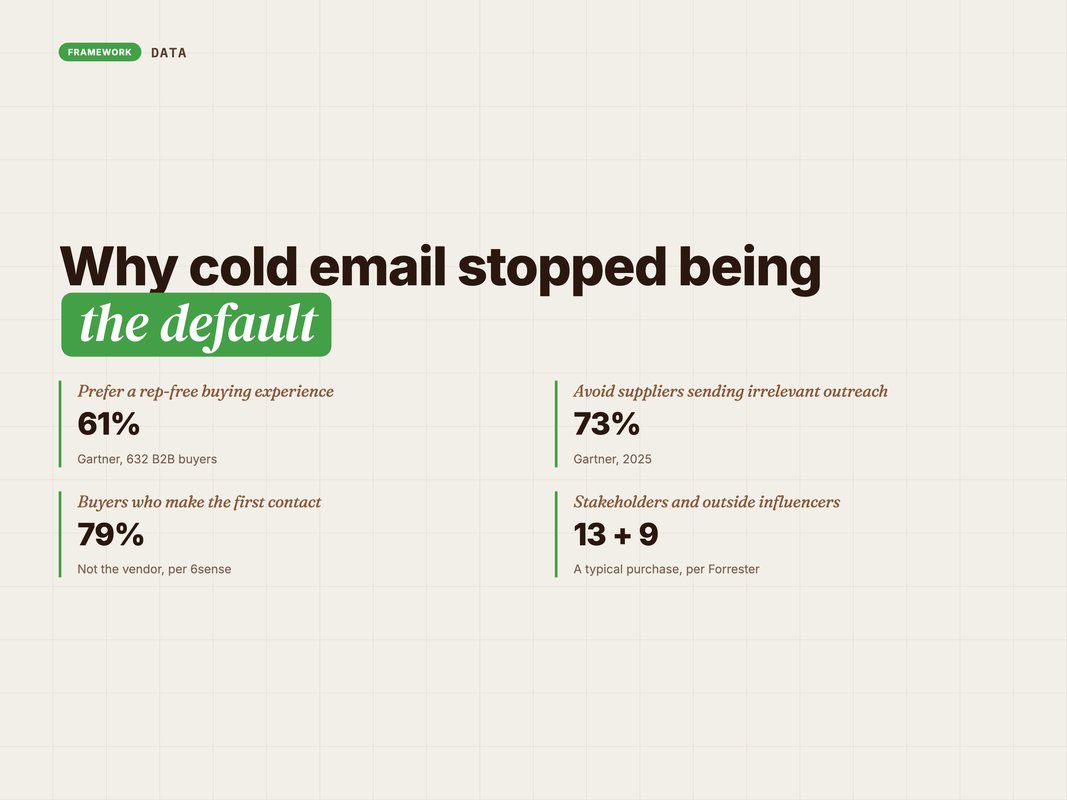
Now add the timing. In its 2025 buyer research, 6sense found buyers first contact a seller 61% of the way through their journey. That was down from 69% the year before (Source: 6sense, 2025 — 6sense.com).
And buyers start the conversation themselves. The same study found 79% of buyers made the first contact, not the vendor.
So the picture is clear. The buyer researches alone, builds a list, and then reaches out. Your cold email lands in the middle of a process that is already running without you.
Q: Is outbound dead for B2B?
A: No. Targeted outbound to a named account list, with a reason to write, still works. What stopped working is volume outbound that treats every inbox as a lead.
The inbox rules changed too
There is a second, more practical problem. The big inbox providers tightened their rules for bulk senders.
Here is what each one now asks for, from their own pages.
| Provider | Who it applies to | What it requires |
|---|---|---|
| Gmail | Senders of 5,000+ messages a day to personal Gmail | Spam rate below 0.10%, never 0.30% or higher, one-click unsubscribe |
| Yahoo | Bulk senders | Spam rate below 0.3%, honour unsubscribes within 2 days |
| Outlook.com | Domains sending 5,000+ emails a day | SPF, DKIM and DMARC, enforced from May 2025 |
Gmail's figures come from its sender guidelines (Source: Google, 2026 — support.google.com). Yahoo's come from its sender best practices (Source: Yahoo, 2026 — senders.yahooinc.com). Outlook's come from Microsoft's announcement (Source: Microsoft, 2025 — techcommunity.microsoft.com).
Be precise about what this means. Gmail says its sender rules apply only to mail sent to personal Gmail accounts (Source: Google, 2026 — support.google.com). So they do not directly block email to a company's work inbox.
But they show where every provider is heading. Authenticate your domain. Keep complaints near zero. Make leaving easy.
Volume cold email breaks all three. A few annoyed recipients can push a small sender over a 0.3% complaint line fast.
That is why we treat cold email as a precision tool now. Small lists, real reasons, clean domains. Never the main engine.
How B2B buying actually works in 2026
Cold email assumes one buyer who reads an email and books a call. The real process looks nothing like that.
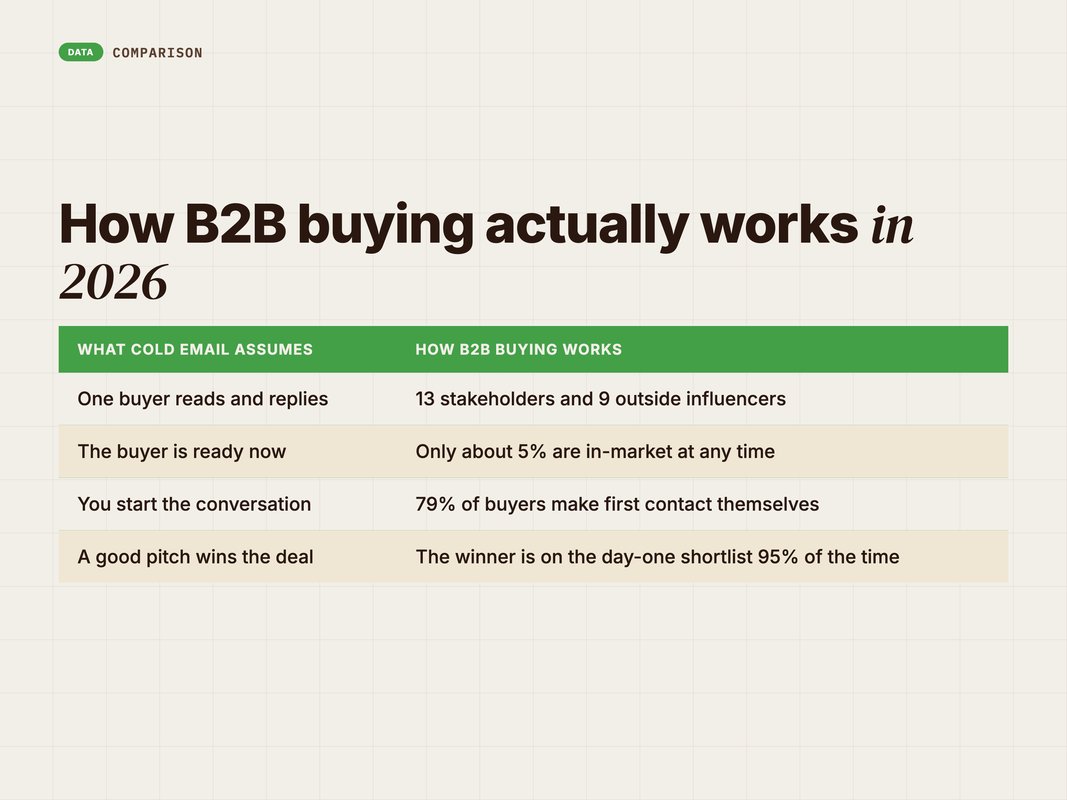
The group is large. Forrester found the typical buying decision now includes 13 internal stakeholders and nine external influencers (Source: Forrester, 2026 — forrester.com). You are not selling to one inbox. You are selling to a committee, most of whom you will never email.
Most of the market is not buying. The LinkedIn B2B Institute's 95-5 rule says only about 5% of buyers are in-market at any time. It advises running lead generation for that 5%. It also advises investing far more in brand for the other 95% (Source: LinkedIn B2B Institute, 2022 — business.linkedin.com).
The winner is picked early. In the 6sense research, the winning vendor was already on the day-one shortlist 95% of the time. Four out of five deals still went to the favourite a buyer had before contacting anyone (Source: 6sense, 2025 — 6sense.com).
Put those together and the job changes. Lead gen is no longer about finding the 5% and chasing them. It is about being the name the whole committee already knows when the 5% moment arrives.
That is a brand problem wearing a lead-gen label.
It also changes who you are writing for. The person who signs is rarely the person who first finds you. A finance lead, an IT reviewer and an end user may all shape the shortlist.
Each of them reads different things. The end user reads peer posts and reviews. The IT reviewer reads documentation and security pages. Finance reads pricing and case studies.
Cold email reaches, at best, one of those people. Demand generation has to reach all of them, mostly without their knowing a vendor is trying.
Q: What is a day-one shortlist?
A: It is the list of vendors a buyer has in mind before they start formal research. The 6sense research found the eventual winner is on that list almost every time.
The five channels that replace cold outreach
None of these are new. What changed is the order of importance.
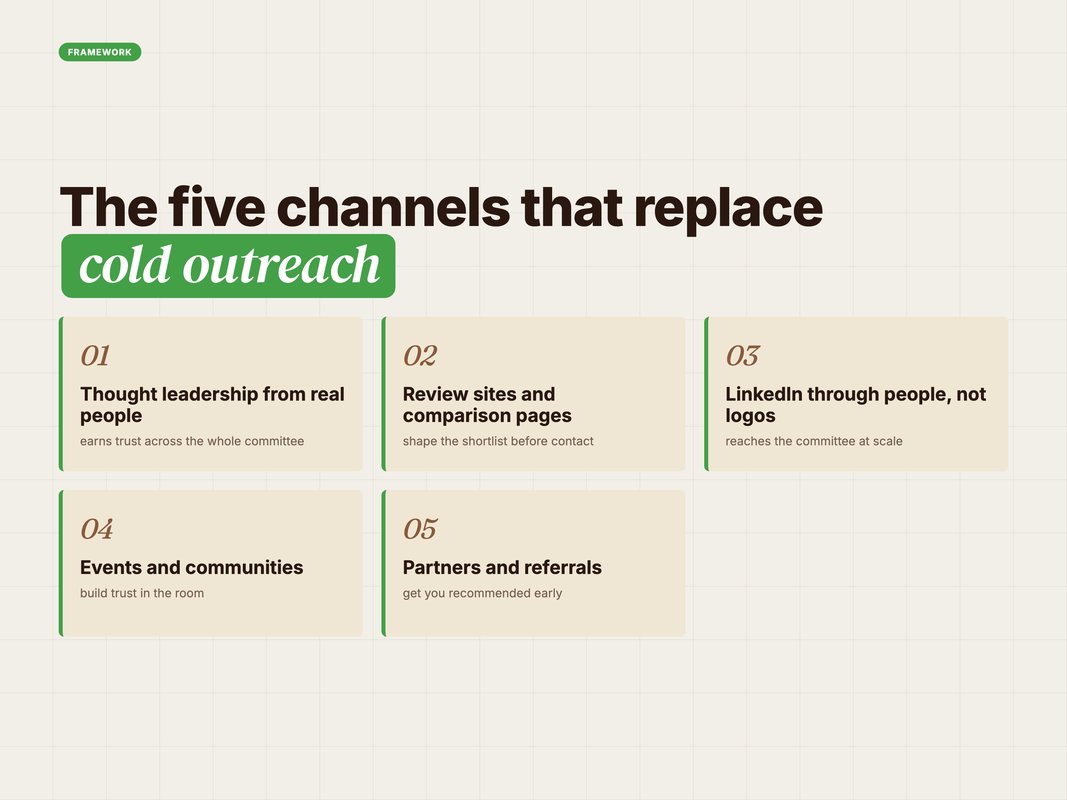
1. Thought leadership from real people. Buyers read expert content, and so do the people who quietly influence the deal. LinkedIn reported 64% of target buyers spend more than an hour a week on thought leadership. Some 63% of hidden buyers do the same (Source: LinkedIn, 2025 — linkedin.com).
That same research found 95% of those stakeholders say strong thought leadership makes them more open to outreach (Source: LinkedIn, 2026 — linkedin.com). Notice the order. Content first, outreach second.
The practical move is to pick people, not topics. Choose two experts inside your company who have a real point of view. A founder and a head of product is a common pair.
Give each one a clear position they can defend. Not "AI is changing everything". Something a peer could disagree with, backed by what they see in their own work.
Then publish on their profiles, not the company page. People follow people. A company page post reaches followers of the company, which is usually a small and mostly internal crowd.
2. Review sites and comparison pages. G2's July 2026 research found review sites were the top source shaping shortlists, at 38%. AI chatbots came second at 37% (Source: G2, 2026 — company.g2.com).
3. LinkedIn, run through people rather than logos. Thought Leader Ads let you promote a person's post, not a company page. In a 2023 pilot, LinkedIn found they got a 1.7x higher click-through rate than single-image ads (Source: LinkedIn, 2023 — business.linkedin.com). LinkedIn calls the result directional, so test it rather than bank on it.
4. Events and communities. In-person is back. LinkedIn reported 57% of B2B event organisers say attendance at their in-person events grew in the past year (Source: LinkedIn, 2025 — news.linkedin.com). A small, well-run room of the right people beats a large webinar list.
5. Partners and referrals. Buyers trust peers more than brands. LinkedIn found 70% of B2B marketers say buyers rely more on peer voices and experts than on brand content (Source: LinkedIn, 2026 — news.linkedin.com). A partner who recommends you is the warmest intro there is.
Partners work best when the exchange is clear. An agency that implements your product, a consultant who advises your buyers, a tool that integrates with yours. Each has a reason to recommend you, and a reputation to protect if you let their clients down.
Start with three partners, not thirty. Give them a named contact, a simple referral process and a reason to bring you in early. Early is the whole point, because early is when the shortlist forms.
The platform side is covered in our LinkedIn algorithm guide for B2B.
Getting onto the AI shortlist
There is a sixth channel, and it is growing faster than all of them. The shortlist now gets built inside AI chatbots.
G2 surveyed 1,076 software buyers in March 2026. It found 51% now begin their research with an AI chatbot more often than with Google. That was up from 29% in April 2025 (Source: G2, 2026 — prnewswire.com).
The same survey found 69% of buyers chose a different vendor than they first planned, based on chatbot guidance.
That is the number that should worry a sales team. A chatbot is changing the shortlist, and no rep was in the room.
And it is not limited to software. According to 6sense, 94% of buyers use large language models during their buying process (Source: 6sense, 2025 — 6sense.com).
So how do you show up? Chatbots summarise what the web already says about you. That points to four jobs.
- Earn reviews on the sites buyers in your category already trust.
- Publish plain comparison pages that name alternatives honestly.
- Put pricing, or at least a price range, on your own site in text.
- Get your experts quoted by credible third parties, not just your own blog.
Start with reviews, because they are the fastest to move. Ask your ten happiest customers this month. Make it easy: one link, one line on what to write about, and a follow-up a week later.
Do not offer anything in return. Paid or incentivised reviews break most review sites' rules, and buyers can usually tell.
Then look at what the reviews say. The phrases customers use are the phrases a chatbot will repeat. Maybe nobody mentions the thing you most want to be known for. That is a positioning problem, and it comes before any campaign.
India follows the same trend. Over the next 12 months, 69% of Indian B2B marketers expect to raise investment in AI search optimisation (Source: MediaNews4U, 2026 — medianews4u.com).
Our wider method for this is in Generative Engine Optimization: Getting Your Brand in AI Answers.
A 90-day plan to switch off cold email
You do not have to stop outbound on Monday. You replace it in stages, and you keep what the data says still works.
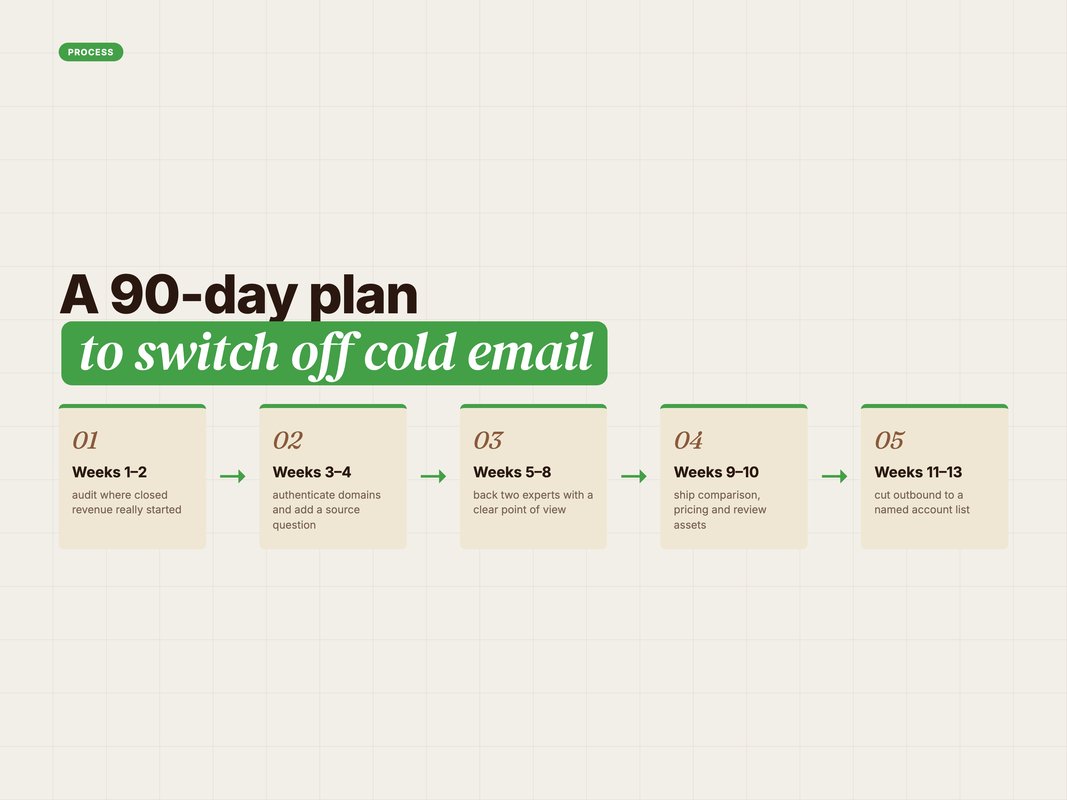
Weeks 1 to 2: audit what you have. Pull the last six months of closed deals. Ask sales where each one really started. You will usually find referrals and inbound carry more revenue than the outbound dashboard suggests.
Weeks 3 to 4: fix the foundations. Authenticate every sending domain with SPF, DKIM and DMARC. Add a required free-text field to every form asking how the buyer heard about you.
Weeks 5 to 8: pick two people, not ten topics. Choose two subject experts from your company. Give them one clear point of view each. Help them post on LinkedIn every week, and put a small Thought Leader Ads budget behind their best posts.
Weeks 9 to 10: build the shortlist assets. Ship one honest comparison page and one pricing page. Start a review drive with your happiest customers.
Weeks 11 to 13: narrow outbound, do not kill it. Cut the cold list to a named set of target accounts. Every message must reference something specific the account did. If there is nothing specific to say, do not send.
Keep the outbound message short and specific. Name the thing the account did. Say why it matters to them. Ask one small question. If you cannot fill in the first line with something real, the account is not ready for outreach yet.
At the end of 90 days you will not have replaced all your pipeline. But you will know which channel is earning it, which is more than most B2B teams can say today.
How to measure demand you cannot click
The hardest part of this shift is reporting. Most of the new channels do not produce a clean click.
A buyer reads your founder's post, hears your name on a podcast, asks a chatbot, and then types your URL directly. Your analytics files that as direct traffic. The channel that did the work gets no credit.
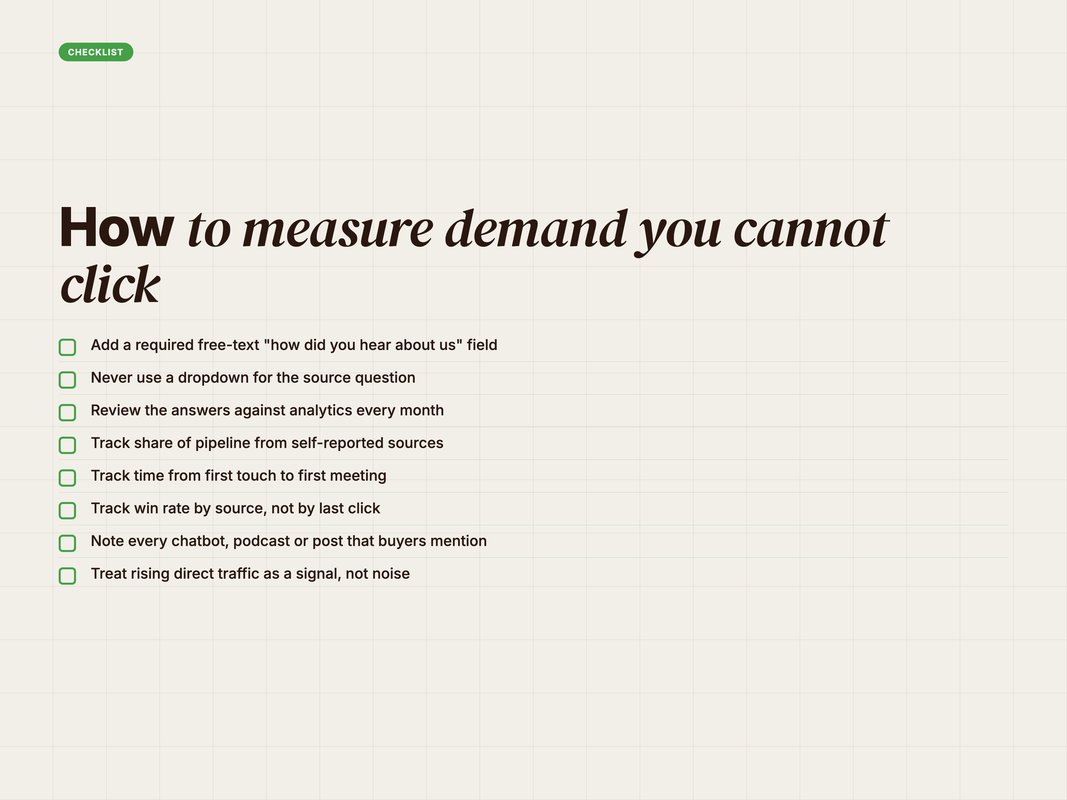
The fix is simple and a little old-fashioned. Ask the buyer.
Put a required free-text field on your demo form that asks how the buyer heard about you. It will tell you more than your attribution model. Do not use a dropdown. Dropdowns only confirm the options you already thought of.
Then compare the answers with your analytics every month. Buyers may keep naming LinkedIn, a podcast or a chatbot while your dashboard says direct. If so, you have found your real channel mix.
Track three numbers alongside it. Share of pipeline from self-reported sources. Time from first touch to meeting. And win rate by source. Those three tell you whether demand generation is working long before a quarter closes.
Buyers are also getting harder to reach with brand messages. In LinkedIn research reported by MediaNews4U, four in five Indian B2B marketers say buyers are more sceptical than before (Source: MediaNews4U, 2026 — medianews4u.com). That is one more reason to measure trust signals, not just clicks.
What we do at YARD
We are an AI-first growth marketing agency. We run performance marketing, LLM SEO, AI creative and AI funnels for D2C and B2B brands.
For B2B clients, we usually start where this playbook starts. We audit where closed revenue really came from, and we fix the sending domains before anything else.
Then we build the demand side. We help two or three internal experts find a clear point of view and publish it consistently. We run paid distribution behind their best work. We build the comparison, pricing and review assets that feed both Google and AI chatbots.
We keep outbound, but we shrink it. A named account list, a real reason to write, and a hard rule that nothing generic goes out.
The part clients find most useful is the reporting. Self-reported attribution sitting next to analytics, reviewed every month. It ends the argument about whether brand work produces pipeline, because the buyers answer it themselves.
For early-stage budget splits, see our ₹5L SaaS budget guide.
The takeaway
B2B lead gen did not die. It moved earlier, into places cold email cannot reach.
Buyers research alone, build a shortlist, and then reach out. The shortlist is increasingly shaped by review sites and AI chatbots. And the decision is made by a committee you will mostly never email.
So the job is to be known before the buyer is ready. Put your experts in front of the whole committee. Earn the reviews. Publish the honest comparison. Make your pricing readable. Keep outbound small and specific.
Then ask every buyer how they found you, and believe the answer over the dashboard.
You can book a call with our team if you want help building the plan for your pipeline.
FAQ
Q: Does cold email still work for B2B in 2026?
A: It still works in narrow cases, but it should not be your main engine. Gartner found 73% of B2B buyers actively avoid suppliers who send irrelevant outreach. Most buyers also pick a shortlist before contacting anyone.
Q: When do B2B buyers first contact a vendor?
A: About 61% of the way through their buying journey, according to 6sense. That is earlier than the 69% it measured before. Most of the research still happens before a seller hears from them.
Q: Do Gmail's sender rules block B2B cold email?
A: Not directly. Gmail's bulk sender rules apply to mail sent to personal Gmail accounts. But they show where every inbox provider is heading. Authenticate your domain, keep complaints very low, and make unsubscribing easy.
Q: What is the 95-5 rule in B2B marketing?
A: The LinkedIn B2B Institute found only about 5% of buyers are in the market at any one time. The advice is to run lead generation for that 5% and invest far more in brand for the other 95%.
Q: How do I get my company onto AI chatbot shortlists?
A: Earn reviews on the sites buyers trust. Publish clear comparison and pricing pages. Get your experts quoted by credible third parties. Chatbots summarise what the web already says about you.
Q: How do I measure leads that come from dark social?
A: Add a required free-text field asking how the buyer heard about you. Compare those answers with your analytics every month. The gap between the two is the demand your dashboard cannot see.
Insights from Our Experts
Explore our latest articles on digital marketing strategies.