The LinkedIn algorithm 2026 B2B feed is not what it was last year.
Reach is down. Likes count for less. The platform now reads your profile to decide if you are a credible voice on a topic. Then it scores each post on dwell time and comment depth in a 90-minute window.
If your B2B reach dropped this year, this is why. And it is fixable.
Here is what we have learned from the latest research, the LinkedIn engineering posts, and the data behind 1.3 million tracked posts (Source: Socialinsider Benchmarks 2026 — socialinsider.io/social-media-benchmarks/linkedin). We will cover how ranking works now, the dwell-time shift, what content formats win, the employee advocacy edge. The myths to stop chasing.
How LinkedIn Actually Ranks Posts Now
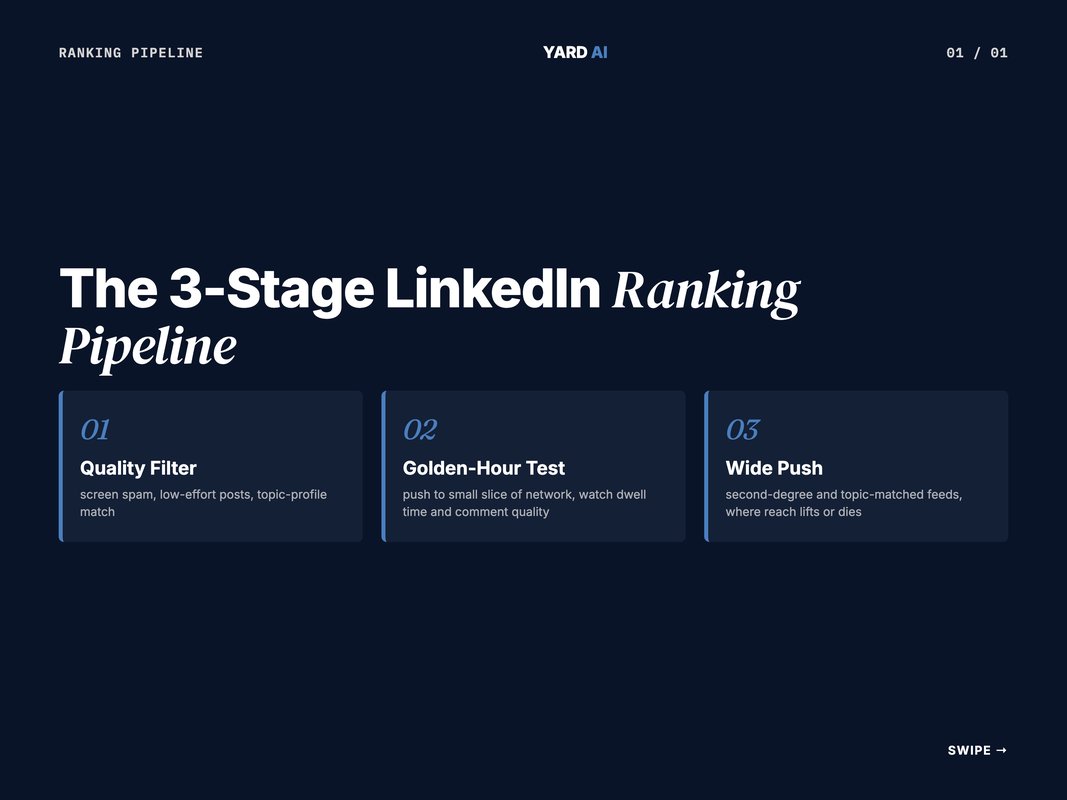
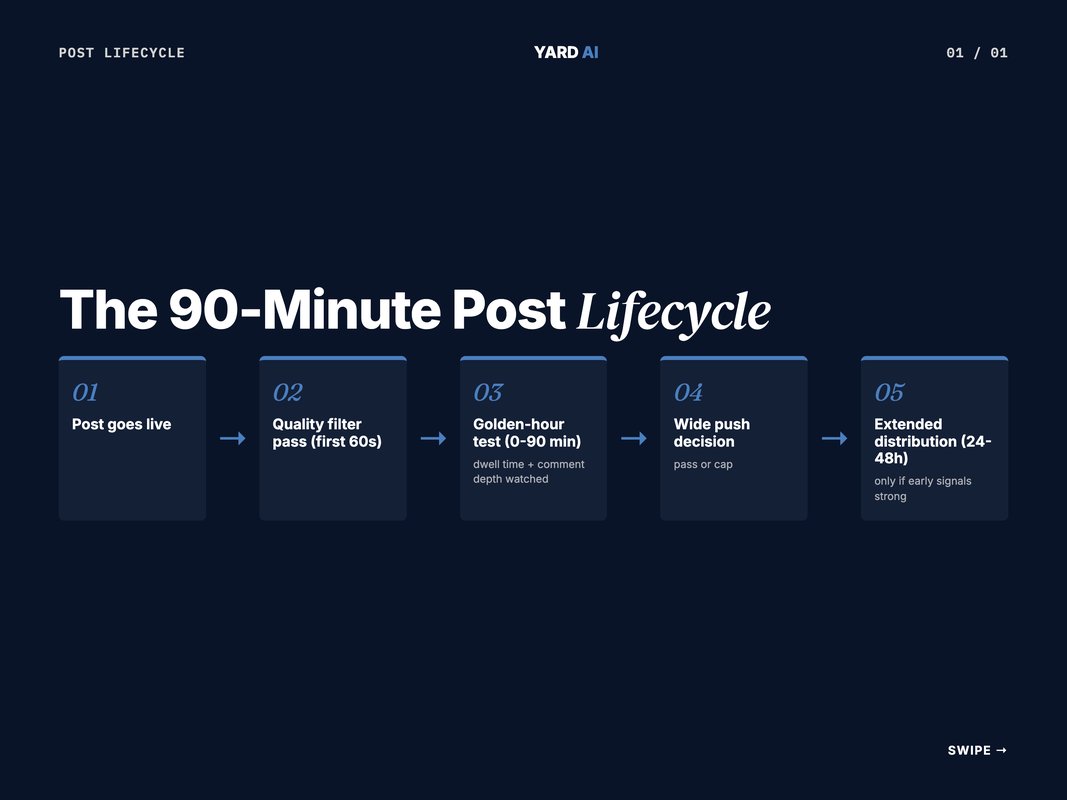
LinkedIn ranking is a three-stage pipeline. Every post moves through it. Most posts fail at stage one or two.
Stage one is a quality filter. The model checks for spam, low-effort prompts, and content that looks copied from a chatbot. It also checks if the topic fits your profile. If you post about supply chain one week and crypto the next, the model gets confused.
Stage two is the golden-hour test. The post goes to a small slice of your first-degree network. The model watches dwell time, comment quality, and saves. Likes barely register here.
Stage three is the wide push. If your post passed the golden hour, it goes into the feeds of second-degree and topic-matched users. This is where reach explodes or dies.
Quick Facts: LinkedIn Algorithm 2026 at a Glance
- LinkedIn's ranking model is 360Brew, a 150-billion-parameter LLM that replaced signal-based ranking â (Source: Teract.ai, 2026 â teract.ai/resources/linkedin-algorithm-2026).
- Comments carry roughly 15x the weight of a like in the ranking model â (Source: Stackmatix, 2026 â stackmatix.com/blog).
- Posts with three or more commenters in the first 60 minutes get about 5.2x amplified reach â (Source: ExpertLinked, 2026 â expertlinked.in/posts).
- One external link in the post body cuts median reach by about 19 percent across 1.3M posts â (Source: Just Connecting Algorithm Report 2025 â richardvanderblom.com).
- Document posts average 7 percent engagement, the top format â (Source: Socialinsider Benchmarks 2026 â socialinsider.io/social-media-benchmarks/linkedin).Q: How does the LinkedIn algorithm 2026 B2B feed actually rank posts?
A: It runs a three-stage pipeline. First quality filter, then golden-hour test, then wide push. The wider you go, the more your topic match and dwell time decide your fate.
The Dwell-Time Shift That Changed Everything
Likes used to drive reach. Not anymore.
LinkedIn's ranking model now treats dwell time as the primary quality signal. Dwell time is the number of seconds a reader spends on your post before scrolling past it.
A post that holds eyes for 12 seconds beats a post that gets 30 quick taps.
Why does this matter for B2B? Because it kills lazy content. Short, generic, hook-bait posts get fast scrolls. Substantive posts hold attention.
Here is what lifts dwell time:
- Longer captions with real specifics, not slogans.
- Document carousels that need swiping.
- A question that makes the reader stop and think.
- A line break pattern that pulls the eye down the post.
And here is what kills it:
- One-liners pretending to be deep.
- AI-generated openers like "In today's fast-paced world".
- Hooks that promise a story and deliver a recap.
The shift is brutal for marketers who built a feed of one-line motivational posts. It is great news for operators who can write with substance.
The next signal is comments. And the math changed there too.
The old game was "tag five people, get 50 comments". That is dead. LinkedIn's model now reads the comments.
A two-word "great post" comment barely moves the post. A four-sentence reply from a topic-relevant peer, with a counter-point or a follow-up question, is gold. Multi-reply threads are the strongest signal of all.
Three rules apply.
- Comments from people who match your topic graph weigh more than random ones.
- Comments that get a reply from you weigh more than orphan comments.
- Comment threads with three or more turns weigh the most.
Stop chasing comment volume. Start writing posts that invite a real reply. Then show up in your own thread for the first 90 minutes to keep it alive.
This is the part most B2B brands skip. Their team posts and walks away. Then they complain about reach.
Q: What is dwell time and why does it matter for B2B reach?
A: It is the seconds a reader spends on your post before scrolling. It is the strongest quality signal in 2026. Long captions, carousels, and real questions all lift it.
The 90-Minute Window vs the Old 24-Hour Cycle
The old advice was: post in the morning, the algorithm gives you a 24-hour boost.
The new advice is: the first 90 minutes decide most of your final reach.
LinkedIn's 2026 model uses early engagement to choose whether to push your post wider. If dwell time and comments look weak in the first 90 minutes, the post is capped. It never recovers.
If the early signals look strong, the post gets pushed wide for 24 to 48 hours. The boost is not granted upfront. It is earned in the first window.
What this means in practice:
- Post when your network is awake and online, not just on a fixed schedule.
- Be at your desk for the first 90 minutes after posting.
- Reply to every early comment fast. Speed signals quality.
- Do not post twice in the same day. Each post fights the last one.
A few B2B teams now run a "1 hour rule". They block the first hour after every post for thread tending. Reach lifts every time.
Q: What is the 90-minute window on LinkedIn?
A: It is the time after you post when LinkedIn decides if your post deserves wider reach. Strong dwell time and real comments in that window push the post wide. Weak signals cap it forever.
Document Posts vs Video vs Polls vs Text
Format choice matters more than ever. The 2026 benchmarks are clear.
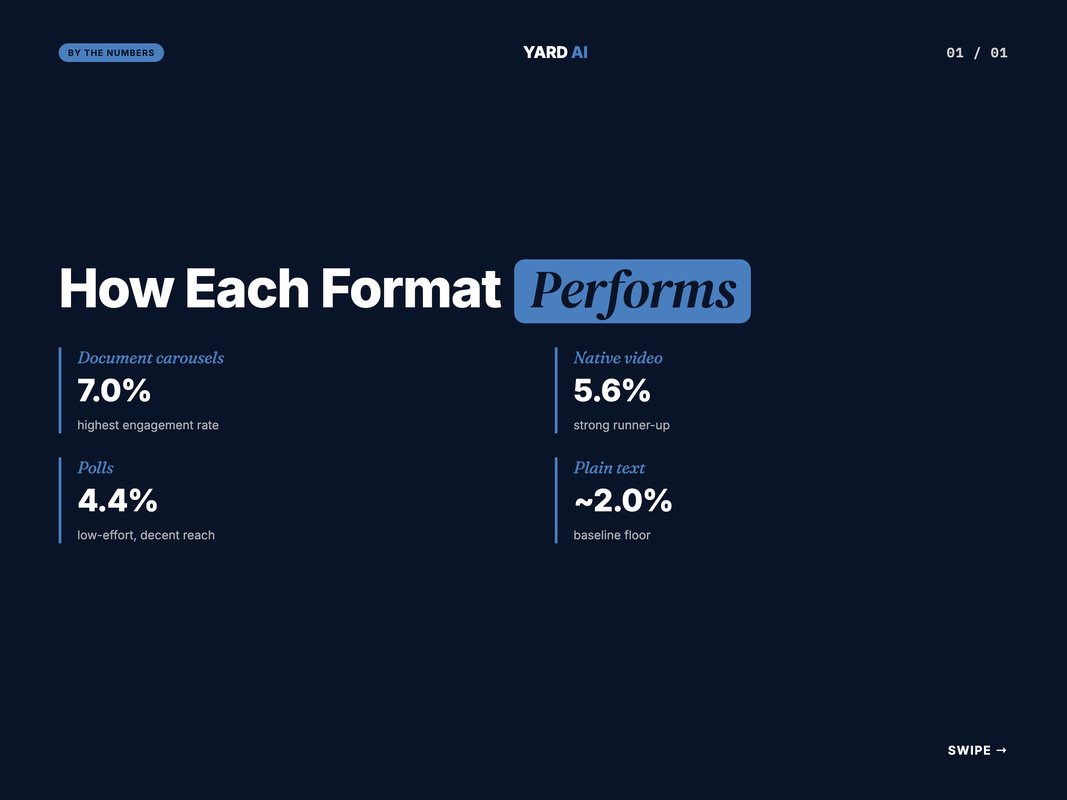
Document carousels lead the pack. They average about 7 percent engagement, the top of any LinkedIn format (Source: Socialinsider Benchmarks 2026 — socialinsider.io/social-media-benchmarks/linkedin). They hold readers on the post for 30 to 60 seconds while they swipe. That is high dwell time and a clean signal of value.
Native video sits at about 5.6 percent engagement (Source: Socialinsider Benchmarks 2026 — socialinsider.io/social-media-benchmarks/linkedin). Short-form video under 60 seconds gets 1.4x more reach than longer videos. But video reach is down 36 percent year-over-year, so do not over-index on it (Source: State of Brand, 2026 — thestateofbrand.com).
Polls get about 4.4 percent engagement (Source: meet-LEA / Hootsuite benchmark, 2026 — meet-lea.com/linkedin-poll-engagement). They drive reach but rarely drive real comments. Useful for testing a hypothesis, not for building authority.
Plain text posts struggle to break out as a format on their own. They still work for thought-leadership from named accounts with strong topic authority, but the bar is high.
What works for B2B in practice:
- Lead with document carousels for frameworks, breakdowns, and case studies.
- Use short native video for founder POV and behind-the-scenes.
- Use polls sparingly to surface audience opinion you can write about next.
- Use plain text for short opinion drops where the take itself is the asset.
The trap is treating all four as equal. They are not.
Q: Do document posts still win on LinkedIn in 2026?
A: Yes. They lead the platform at about 7 percent engagement (Source: Socialinsider Benchmarks 2026 — socialinsider.io/social-media-benchmarks/linkedin). They lift dwell time, hold readers on the post, and avoid the external-link penalty. Polls drive reach but not pipeline.
Why External Links Are Quietly Killing Your Reach
LinkedIn does not want you leaving the platform. The model knows.
Research on 1.3 million posts found that one external link in the post body cuts median reach by about 19 percent (Source: Just Connecting Algorithm Report 2025 — richardvanderblom.com). Two links can cut it by more. The post still publishes. It just goes to a fraction of your network.
This is the single biggest unforced error in B2B content. Marketing teams attach a link to every post because their lead gen tracker needs it.
The workarounds work:
- Drop the link in the first comment, not the post body.
- Host the asset natively as a document carousel.
- Write the post as a standalone insight, then add the link as a P.S. in a follow-up comment.
- For high-priority launches, accept the reach hit and use paid amplification.
A few B2B teams report a clean reach lift just from moving links to the comments.
Q: Do external links hurt LinkedIn reach in 2026?
A: Yes. One link in the body cuts median reach by about 19 percent (Source: Just Connecting Algorithm Report 2025 — richardvanderblom.com). Put the link in the first comment, or host the asset natively as a document carousel.
Personal Profiles, Company Pages, and the Employee Advocacy Edge
Company pages are losing the feed. Personal profiles own it.
The 2026 benchmarks show personal profiles get five to eight times more engagement than company pages. Company page reach dropped 60 to 66 percent from 2024 to 2026. Company pages now get about 5 percent of feed allocation. Personal profiles get about 65 percent (Source: Ordinal, 2026 — tryordinal.com/the-declining-reach-of-linkedin-company-pages).
This is not a bug. LinkedIn wants people, not brands, in the feed.
So why do most B2B brands still post from the company page? Habit and risk aversion. Both cost reach.
The play for 2026 is to flip the ratio.
- Use the company page for product news, hiring, and trust signals.
- Use named employees for opinion, expertise, and most of the volume.
- Pick two to four "Top Voices" inside the company and back them up.
A coordinated group of employee profiles is the highest-leverage channel a B2B brand has.
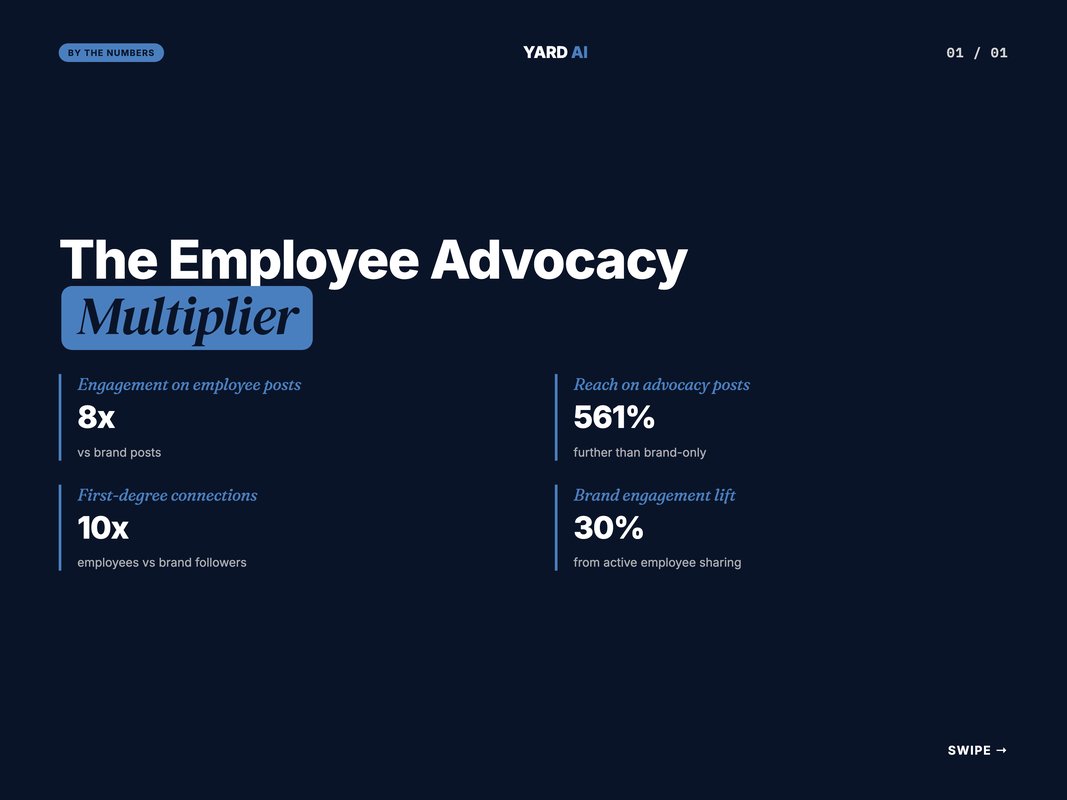
The numbers are blunt. Employee-shared content gets about 8x more engagement than the same content shared by the brand (Source: LinkedIn Marketing Solutions — linkedin.com/business/marketing/prove-power-employee-advocacy-statistics). The average employee advocacy post reaches 561 percent further than a brand post (Source: ExpertLinked, 2025 — expertlinked.in/employee-advocacy-multiplier). Employees collectively hold 10x more first-degree connections than the brand has followers (Source: LinkedIn Marketing Solutions — linkedin.com/business/marketing/prove-power-employee-advocacy-statistics).
Only about 3 percent of employees share company content. That tiny share lifts total brand engagement by about 30 percent (Source: LinkedIn Marketing Solutions — linkedin.com/business/marketing/prove-power-employee-advocacy-statistics).
The math is one-sided. The execution is where most brands fail.
A working employee advocacy playbook for B2B looks like this.
- Pick 5 to 10 employees who already post or will post weekly.
- Train each on their own topic, not the brand's topic.
- Ship a weekly content kit with hooks, angles, and carousel templates.
- Give them first-comment language and a 90-minute reply window.
- Measure dwell time and comments, not likes and shares.
- Refresh the topic ladder every 90 days based on what is winning.
The trap is forcing employees to repost canned brand content. The model spots copy-paste. Reach collapses.
Q: Does employee advocacy still work for B2B in 2026?
A: It is one of the highest-leverage levers left. Employee posts get 8x the engagement of brand posts (Source: LinkedIn Marketing Solutions — linkedin.com/business/marketing/prove-power-employee-advocacy-statistics) and reach 561 percent further (Source: ExpertLinked, 2025 — expertlinked.in/employee-advocacy-multiplier). Run it as a real program, not a one-off campaign.
The B2B Content Patterns That Actually Win
Pattern matters more than topic in 2026. The same idea, written in two different shapes, gets two different reach numbers.
Here is the YARD-tested pattern set for B2B operators:
The named framework. A repeatable model with a name. "The 3-stage LinkedIn ranking pipeline" beats "How LinkedIn ranks posts". Names get saved. Saves lift dwell time.
The counter-take. Pick a piece of accepted wisdom in your space and disagree with it, with evidence. "Most teams optimise the wrong metric". This pulls comments because people defend their priors.
The receipt drop. A single specific number, then the story behind it. "We cut CAC by a third in a quarter. Here is what we changed." Specificity beats generality.
The mistake post-mortem. "We launched X and it flopped. Here is why." LinkedIn rewards honest failure stories with strong dwell time because they are rare.
The behind-the-curtain. Walk readers through how you actually run a thing. Screenshots, steps, the unglamorous bits. These are saved heavily.
The document carousel teardown. Take one big idea and unpack it across 8 to 12 slides. This is the format LinkedIn rewards hardest.
The thread continuation. Post once, then drop a follow-up in the comments. The model reads the thread as one signal cluster.
Mix three to four of these patterns across a week. Avoid running the same shape twice in a row.
Q: What B2B content patterns get the most LinkedIn reach in 2026?
A: Named frameworks, counter-takes, specific receipts, mistake post-mortems, and document carousels. The shape of the post matters more than the topic. Mix three or four patterns each week.
Posting Cadence, Timing, and the Frequency Sweet Spot
More posts do not equal more reach. The opposite is often true.
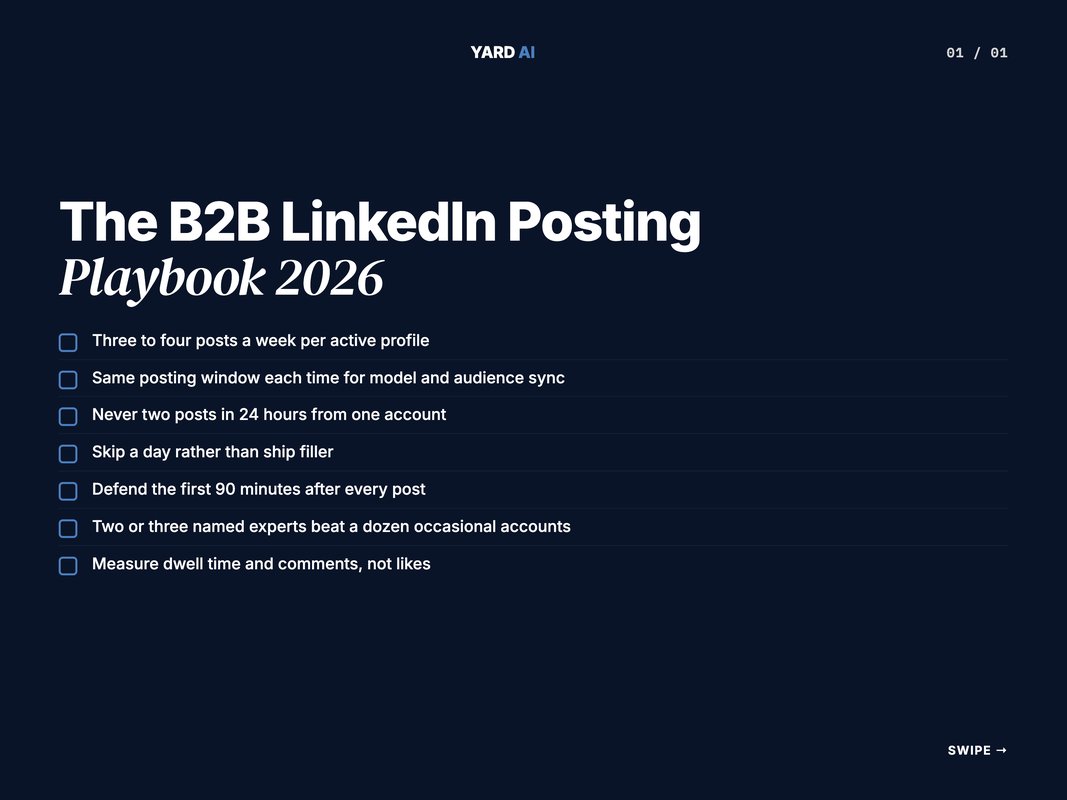
The 2026 research is clear on this. Two or three named experts posting consistently will outperform a dozen accounts posting occasionally. The model needs frequency to learn what topic you own.
But there is a ceiling. Post twice in one day and each post fights the other for early engagement. The second post almost always loses.
The cadence that works for B2B:
- Three to four posts a week per active profile.
- Same posting window each time, so the model and your audience sync.
- Never two posts in 24 hours from the same account.
- Skip a day rather than ship filler.
Timing is less important than people think. The first 90 minutes matter more than the hour of day. Pick a slot when you can sit and reply, then defend that slot.
For a B2B brand with five active profiles, that is roughly 15 to 20 posts a week across the team. Plenty of surface area without cannibalisation.
Q: How often should a B2B brand post on LinkedIn in 2026?
A: Three to four times a week per active profile. Never twice in 24 hours. Two or three experts posting weekly beat a dozen accounts posting once a month.
How YARD Runs LinkedIn as a System
Some 2024 advice is now actively hurting reach. Kill it first.
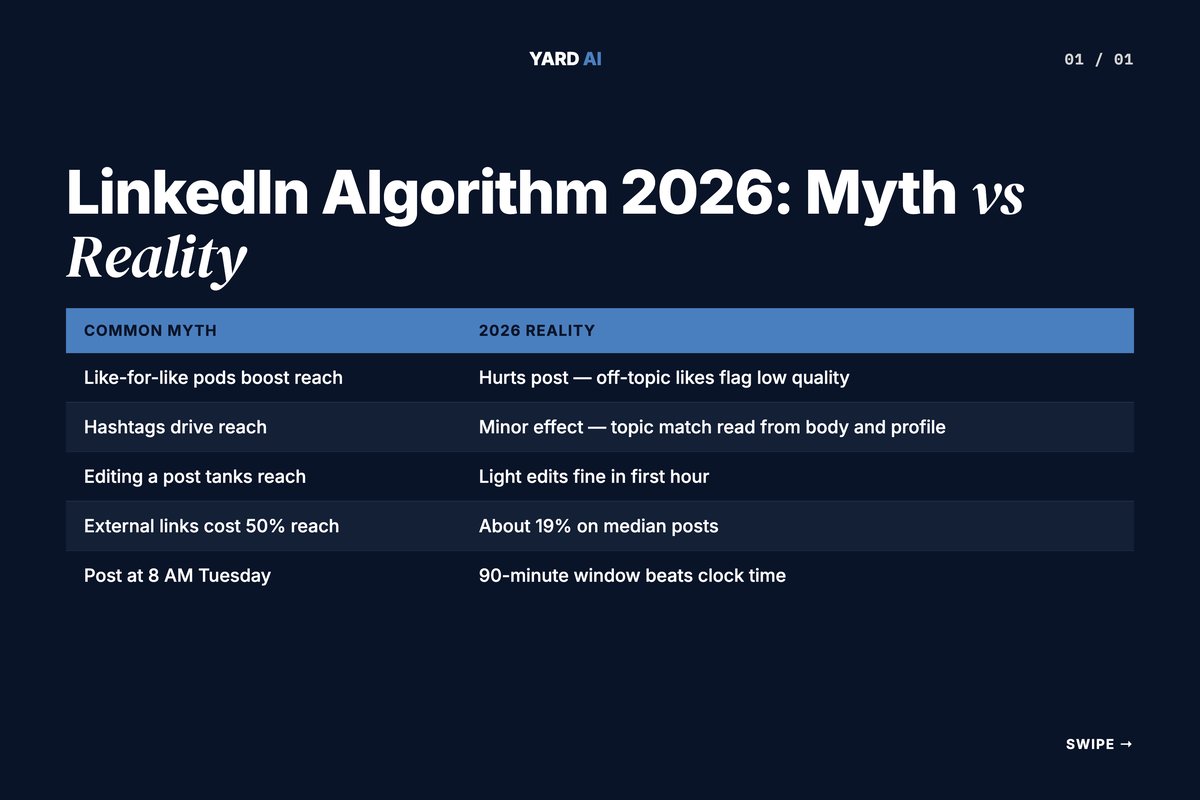
Myth one: "Like-for-like pods boost reach." False. The model reads engagement quality and topic match. Generic likes from off-topic pod members signal low quality and can hurt the post.
Myth two: "Hashtags drive reach." Mostly false. Hashtags have minor effect at best. Topic match is read from the post body and your profile.
Myth three: "Edit a post and you lose reach." Mostly false. Light edits in the first hour are fine. The model does not penalise typo fixes.
Myth four: "External links always tank reach by half." Half true. The hit is about 19 percent on median posts, not 50 (Source: Just Connecting Algorithm Report 2025 — richardvanderblom.com).
Myth five: "Post at 8 AM Tuesday for max reach." False as a universal rule. The 90-minute window matters more than the clock.
Drop the myths. Keep the levers.
LinkedIn in 2026 is not a posting channel. It is a system with three inputs. Profile authority, content format, and early-engagement orchestration.
At YARD, we run LinkedIn for B2B clients as a core piece of an AI-first growth stack. Content is built from a topic graph mapped to the buyer journey, formatted for what LinkedIn rewards.
We also run document carousels through programmatic templates. That means the team is not wrestling with Figma every week. More posts in the format LinkedIn rewards, with less production drag.
The brands that move first on this stack pull ahead on share of voice. Everyone else is still posting from the company page and wondering why nobody is reading.
If you are reworking your LinkedIn motion, start with cadence and the format mix. Profile authority builds on top of that.
Conclusion: Run the Lever, Not the Hack
The LinkedIn algorithm 2026 B2B feed rewards real expertise and real attention. Likes, hashtags, and posting at 8 AM Tuesday are not the levers anymore.
The levers are dwell time, comment depth, the 90-minute window, document carousels, and named experts over brand pages. Pull those and reach lifts. Skip them and no amount of frequency saves you.
Pick two changes from this guide and ship them this week. Move external links to the first comment. Switch one weekly post to a document carousel. Then defend the first 90 minutes after every post.
That alone will move reach more than another quarter of "best practice" advice ever will.
Want to see how we run LinkedIn for B2B brands? Take a look at [internal link: yard-services]. Or follow our team's posts to see the patterns in action.
FAQ
Q: How does the LinkedIn algorithm 2026 B2B feed actually rank posts?
A: LinkedIn runs a three-stage pipeline. First, a quality filter screens spam and low-effort posts. Second, a golden-hour test pushes the post to a small slice of your network. Third, a 150-billion-parameter ranking model called 360Brew scores topic match, dwell time, and comment depth before pushing the post wider (Source: Firooz et al., LinkedIn FAIT, arXiv 2501.16450, 2025 — arxiv.org/abs/2501.16450).
Q: What is dwell time and why does it matter for B2B reach?
A: Dwell time is the seconds a reader spends on your post before scrolling. It is the strongest single quality signal on LinkedIn in 2026. Long captions, document carousels, and posts that ask a real question all lift dwell time. Likes alone no longer move the needle.
Q: Do external links hurt LinkedIn reach in 2026?
A: Yes. Research on 1.3 million posts found that one external link in the post body cuts median reach by about 19 percent (Source: Just Connecting Algorithm Report 2025 — richardvanderblom.com). The fix is to put the link in the first comment, or to host the asset natively as a document carousel.
Q: Should B2B brands post from the company page or from people?
A: Personal profiles get five to eight times more engagement than company pages in 2026 (Source: Ordinal, 2026 — tryordinal.com/the-declining-reach-of-linkedin-company-pages). Use the company page for proof, hiring, and product news. Use named employees for opinion, expertise, and the bulk of organic reach.
Q: What is the 90-minute window on LinkedIn?
A: The first 90 minutes after you post decide most of your final reach. Strong dwell time and substantive comments in that window push the post into the wider ranking stage. Weak signals cap the post at a tiny audience. The old 24-hour boost cycle is dead.
Q: Do document posts and PDF carousels still win in 2026?
A: Yes. Document posts hit about 7 percent engagement, the top format on LinkedIn (Source: Socialinsider Benchmarks 2026 — socialinsider.io/social-media-benchmarks/linkedin). They hold readers on the post, lift dwell time, and avoid the external-link penalty. Polls still get reach but rarely drive comments or pipeline.
Q: How often should a B2B brand post on LinkedIn in 2026?
A: Three to four times a week per active profile is the sweet spot. Two or three named experts posting weekly will outperform a dozen accounts posting once a month. The model needs frequency to learn what topic you own.
Insights from Our Experts
Explore our latest articles on digital marketing strategies.