

On 23 October 2026, Moonshot AI released Kimi K3.1 Pro. Vals AI, an outside testing firm, now ranks it as the top open-weights model on its Vals Index (Source: Vals AI, 2026 — Kimi K3.1 Pro).
The key phrase here is "open weights". It means the model itself will be shared, so you can run it on your own machines. Moonshot says the full weights will be out by 4 November 2026 (Source: Moonshot AI, 2026 — Introducing Kimi K3.1 Pro).
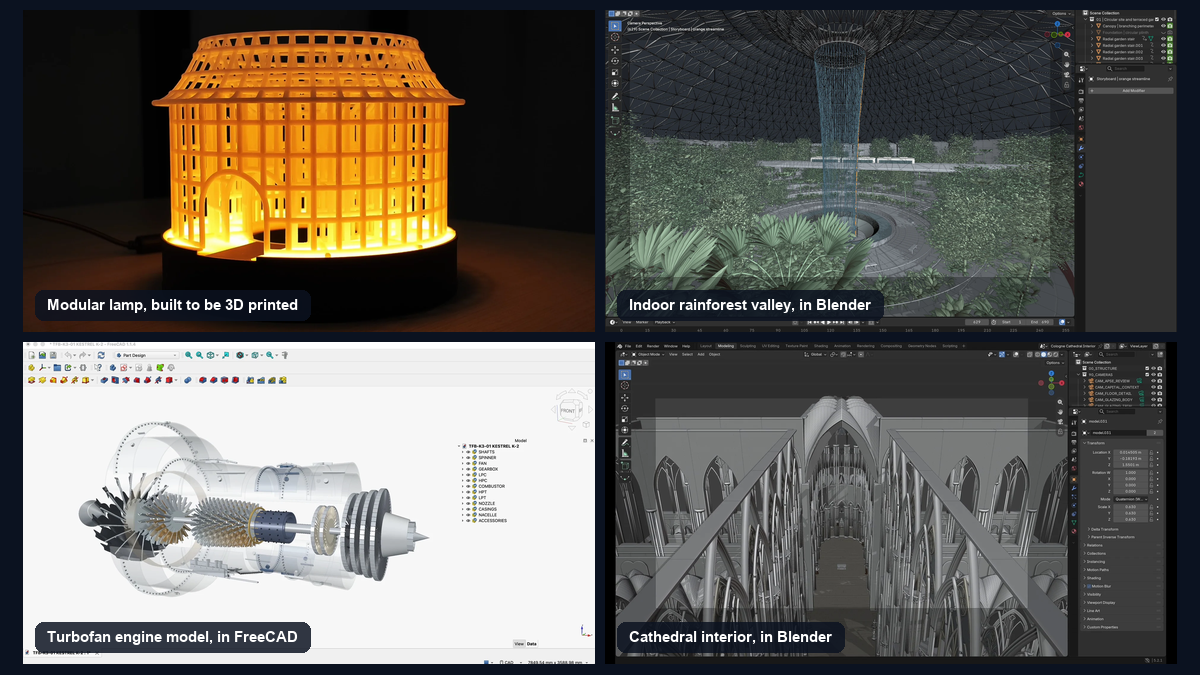
Moonshot shows 3D assets the model made "for brand films, games, and interactive web experiences". One is a short robot film. Another is a lamp built to be 3D printed (Source: Moonshot AI, 2026 — launch post).
And a tool called 3D Make is live in the Kimi app today.
So there are two stories. An open model now sits close to the best paid ones. And it makes 3D work, not just text.
This piece is a read of Moonshot's launch post, its price page and one outside leaderboard. Where a number is Moonshot's own, we say so.
What Moonshot actually shipped
Moonshot shipped two models. Kimi K3.1 Pro is the main one. Kimi K3.1 Pro Highspeed is the faster version, at two to three times the speed (Source: Moonshot AI, 2026 — launch post).
Moonshot calls K3.1 Pro "our most capable 3T-class open-weight model to date". It is an upgrade of its older model, Kimi K3, with much more training on top (Source: Moonshot AI, 2026 — launch post).
Here is where you can use it now.
- On kimi.ai and in the Kimi phone apps.
- In the Kimi Work desktop app.
- In Kimi Code, the tool for developers.
- Through the Kimi API, for teams that build their own tools.
Companies on Kimi Enterprise will find it switched off at first. An admin has to turn it on.
It can also read a lot at once. Its working memory holds one million tokens (Source: Moonshot AI, 2026 — launch post). In plain words, it can take in a large stack of brand files in one go.
API customers can also ask for Zero Data Retention. In plain words, the service should not keep what you send it. Read the terms before you rely on that.
What open weights mean for a brand
A model's weights are what it learned in training. They are the model itself, saved as files.
Most top models keep those files private. You can only reach them through the maker's app or API. So your prompts travel to the maker's servers.
Open weights change that. Once the files are out, a company can run the model on its own servers or a cloud it picks. Prompts, product plans and customer data can stay in-house.
You can also tune an open model on your own material. Think past campaigns, tone guides and product specs.
But there are three catches, and they matter.
First, the weights are not out yet. Moonshot says they will land by 4 November 2026 (Source: Moonshot AI, 2026 — launch post). Until then, you can only use Moonshot's own apps and API.
Second, Moonshot's post does not name a license. The license decides what a business may do with the model. Wait for it, and have someone read it, before you plan around it.
Third, this is a very large model. Moonshot calls it "3T-class" (Source: Moonshot AI, 2026 — launch post). A model that big needs serious server hardware or a paid cloud host. It is not a laptop model.
We have covered smaller open models before, like Meta Muse Glimmer and Inkling. K3.1 Pro is in a different, much bigger class.
Moonshot held back its hacking skills on purpose
Once weights are public, the maker cannot control who uses them. So Moonshot says it removed hacking-related data from training for the open release.
On its internal hacking test, a version without those cuts solved 90.5% of tasks. The final model solved 81.0% (Source: Moonshot AI, 2026 — launch post).
Moonshot adds that its cyber skills stay behind top paid models. That is a useful line for your security review.
How close it really is to the best
Moonshot says K3.1 Pro matches or comes close to the strongest paid models. Here is how that claim holds up.
The coding score that got the attention
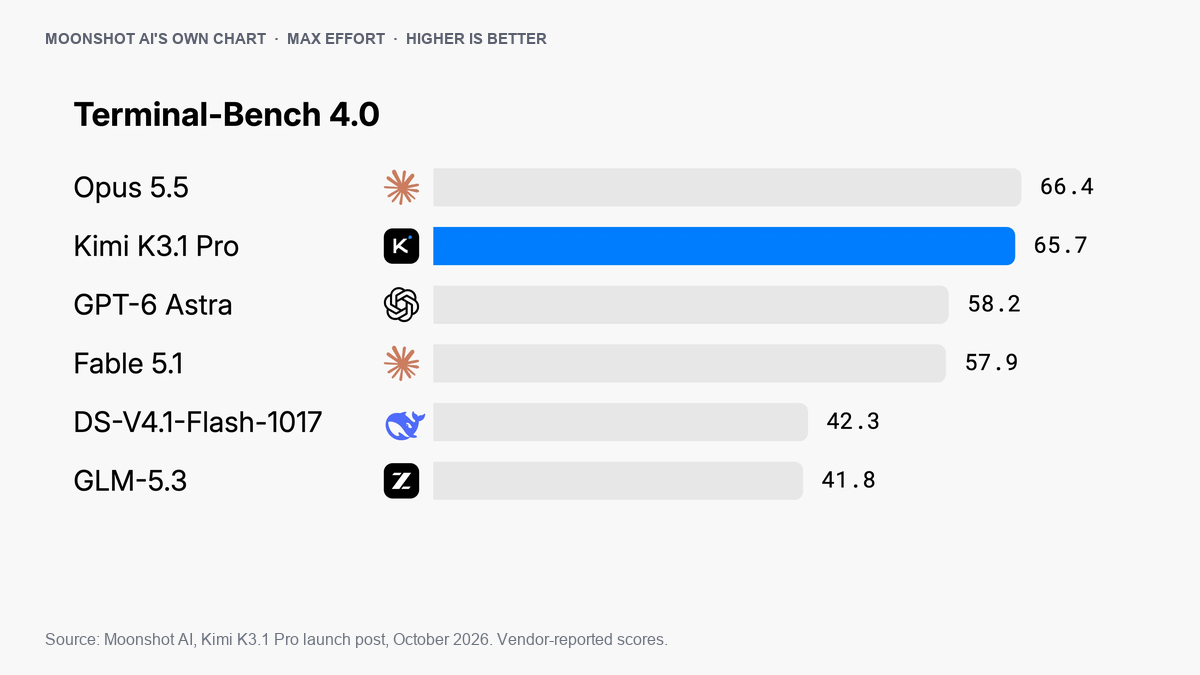
Terminal-Bench 4.0 tests AI agents on real tasks in a command line. Think of it as a test of whether the AI can finish a job, not just talk about it.
On Moonshot's own chart, K3.1 Pro scored 65.7%. Claude Opus 5.5 scored 66.4%, and GPT-6 Astra scored 58.2%. That puts K3.1 Pro less than one point behind Opus 5.5. It is more than seven points ahead of GPT-6 Astra (Source: Moonshot AI, 2026 — launch post).
Note how Moonshot got there. It ran its own model at maximum effort. It took most rival scores from their makers' posts or the public leaderboard.
So we checked an outside run. Vals AI ran the same test. On Vals' run, K3.1 Pro scored 63.64% and Claude Opus 5.5 scored 65.15%. That is still within two points (Source: Vals AI, 2026 — Kimi K3.1 Pro).
So the coding claim broadly holds up.
The wider picture is less rosy
The Vals Index is a broader test than coding alone. It scores models on finance, coding, legal and tax work.
On it, K3.1 Pro scores 62.52%. That makes it the top open-weights model, just ahead of DeepSeek V4.1 Flash at 61.26% (Source: Vals AI, 2026 — Kimi K3.1 Pro).
The leaders are still paid models. Claude Sonnet 5.5 is first with 70.85%. Claude Opus 5.5 is next with 70.18%, and Gemini 4 Argon has 69.24% (Source: Vals AI, 2026 — Vals Index).
So on broad business work, the gap is about eight points, not one (Source: Vals AI, 2026 — Vals Index). We wrote about Gemini 4 Argon when it took the top spot on this same index.
Vals also found a dip. K3.1 Pro scored lower than Kimi K3 on legal research and on tax work (Source: Vals AI, 2026 — Kimi K3.1 Pro). If your work is heavy on legal or tax, test it with care.
Here is the fair summary. On coding, it is a hair behind the best. On wide business tasks, it is the best open model, and a clear step behind the leaders.
The 3D part, built for brand films
Moonshot says K3.1 Pro can build 3D models from a text brief, a sketch or a reference image. It works out the shape, size and how parts fit together.
It can also write scripts for tools like Blender and CAD software. That is how it builds objects, edits materials and lays out scenes. It works with game engines such as Unity, Unreal Engine and Godot.
The post then shows five 3D examples. Moonshot says it made them "for brand films, games, and interactive web experiences" (Source: Moonshot AI, 2026 — launch post).
- A short 3D film of a small robot.
- A modular lamp, built to be 3D printed.
- A rainforest valley inside an airport.
- A jet engine model that is put together and then spins.
- The inside of Cologne Cathedral, built up piece by piece.
The coding part of the post adds games. One is a palace battle game in Unreal Engine. Another is an adventure game in Godot. Moonshot says its examples were made "end to end" by K3.1 Pro.
There is a score for this too. BenchCAD tests how well a model rebuilds 3D objects as design code. With tools, K3.1 Pro scored 92.7%, Claude Opus 5.5 scored 96.2% and GPT-6 Astra scored 95.9% (Source: Moonshot AI, 2026 — launch post). Again, close but not first.
Now read that as a marketer. A product launch film needs a clean 3D model of the product. A launch page might want a 3D viewer. A brand might want a small browser game.
Today, each of those usually means a 3D artist or a vendor. If a model can draft the first pass, the artist starts from a draft, not a blank file.
These are Moonshot's own demos, picked to look good. Treat them as a sign of what is possible, not a promise of what you will get.
3D Make, the part you can try today
Most of this launch needs a developer. One part does not.
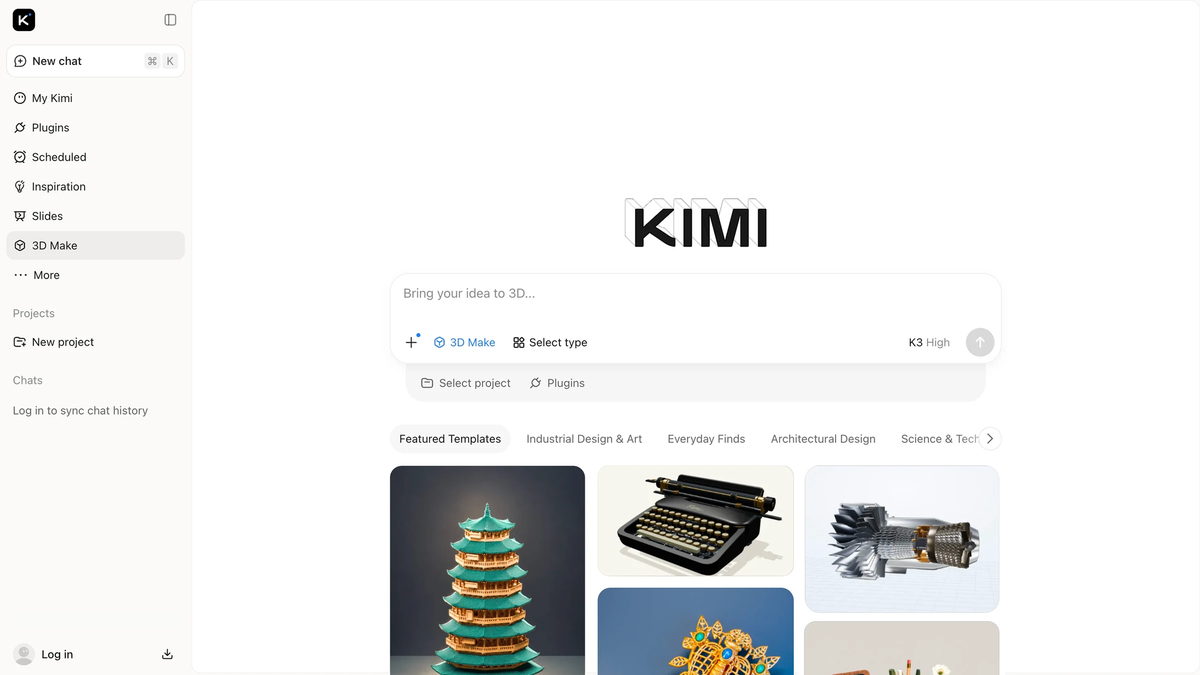
Moonshot says 3D Make is "now live on kimi.ai and the Kimi app". You can preview and edit 3D models online. You can download them, ready for 3D printing. Or you can export them as videos or Live Photos to share (Source: Moonshot AI, 2026 — launch post).
The screen in Moonshot's post is simple. A prompt box says "Bring your idea to 3D". Below it sit sample models, like a pagoda, a typewriter and a jet engine.
That last export option is the one to notice. A spinning product video can be a social post. A Live Photo can be a story frame.
Moonshot does not say which plans include 3D Make, or how many models you can make. Check that in the app before you plan a project around it.
Two more upgrades, on facts and finance
Two other changes in the post matter for brand work. One is about facts. The other is about numbers.
Fewer made-up facts, Moonshot says
Every brand that uses AI has seen it invent a fact. A wrong price. A made-up stat. A quote nobody said.
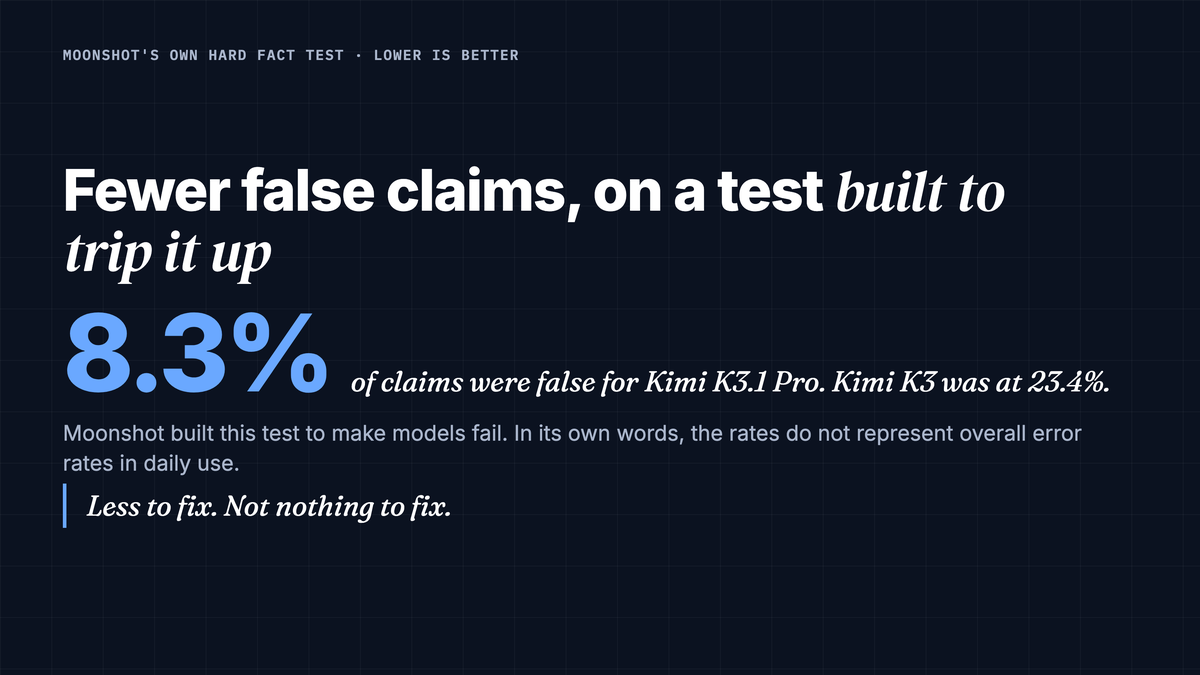
Moonshot says K3.1 Pro does this far less often. On its hard factual test, false claims fell from 23.4% for K3 to 8.3% for K3.1 Pro (Source: Moonshot AI, 2026 — launch post).
Read the small print, though. Moonshot built that test to make models fail. In its own words, the rates "do not represent overall error rates in daily use".
So the score shows the direction, not your daily risk.
On the same chart, GPT-6 Astra had a lower rate still, at 5.5%. Claude Opus 5.5 scored 15.0 on that scale. Lower is better here (Source: Moonshot AI, 2026 — launch post).
The lesson for content teams has not changed. Check every number, name and claim before it goes out. A better model means less to fix, not nothing to fix.
Better at spreadsheets and finance work
On OfficeQA Pro v2, K3.1 Pro scored 64.4. That test asks models to dig numbers out of real financial documents. Moonshot calls it a state-of-the-art result (Source: Moonshot AI, 2026 — launch post).
Its internal tests show three gains over K3. Financial modelling rose 7.2 points. Financial research rose 11.6 points. A test of running a pretend business rose from 8.9 to 37, about 4.2 times K3's score (Source: Moonshot AI, 2026 — launch post).
One demo shows it building a valuation model for NVIDIA inside Kimi Work.
For a marketer, swap the valuation model for a media plan or a budget sheet. The same skills apply. Formulas must link. Sources must check out. Numbers must match across tabs.
These are Moonshot's own tests again. On Vals' outside finance agent test, K3.1 Pro scored 61.49%. That put it mid-table, not on top (Source: Vals AI, 2026 — Kimi K3.1 Pro).
What it costs
There are two ways to pay. The Kimi apps have their own plans. Through the API, you pay per use, by the token.
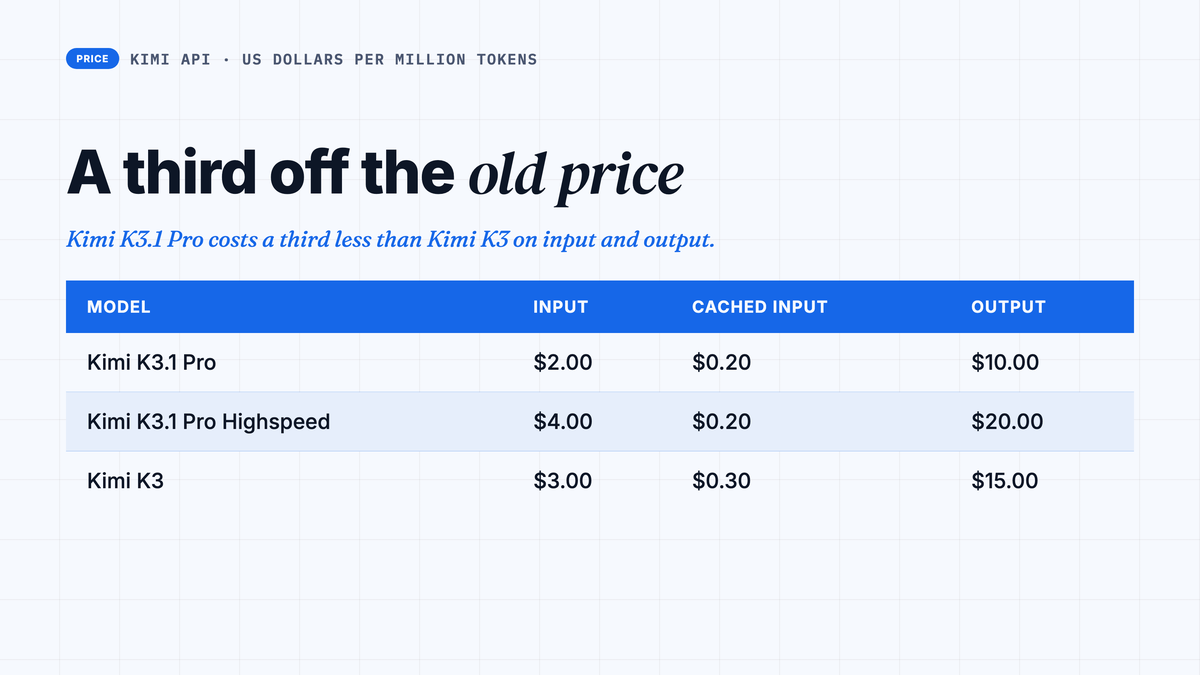
Here are the API prices per million tokens. Cached input means text you send again and again, like a long brand guide (Source: Kimi API Platform, 2026 — Model Pricing).
| Model | Input | Cached input | Output |
|---|---|---|---|
| Kimi K3.1 Pro | $2.00 | $0.20 | $10.00 |
| Kimi K3.1 Pro Highspeed | $4.00 | $0.20 | $20.00 |
| Kimi K3 | $3.00 | $0.30 | $15.00 |
So the new model is cheaper than the old one. Input drops from $3 to $2, and output drops from $15 to $10. That is a third off both (Source: Kimi API Platform, 2026 — Model Pricing).
The fast version costs twice as much for input and output, in return for the speed. Cached input costs a tenth of the normal input price (Source: Kimi API Platform, 2026 — Model Pricing).
If your team reuses the same long brand guide in every prompt, that adds up.
Once the weights are out, there is a third way to pay. You can pay for your own servers instead of paying per token. For most brands, the API will still be simpler. For brands with strict data rules, owning the setup may be worth it.
For a wider view of tool costs, see our guide to AI marketing cost in 2026.
Try 3D Make on one product this week
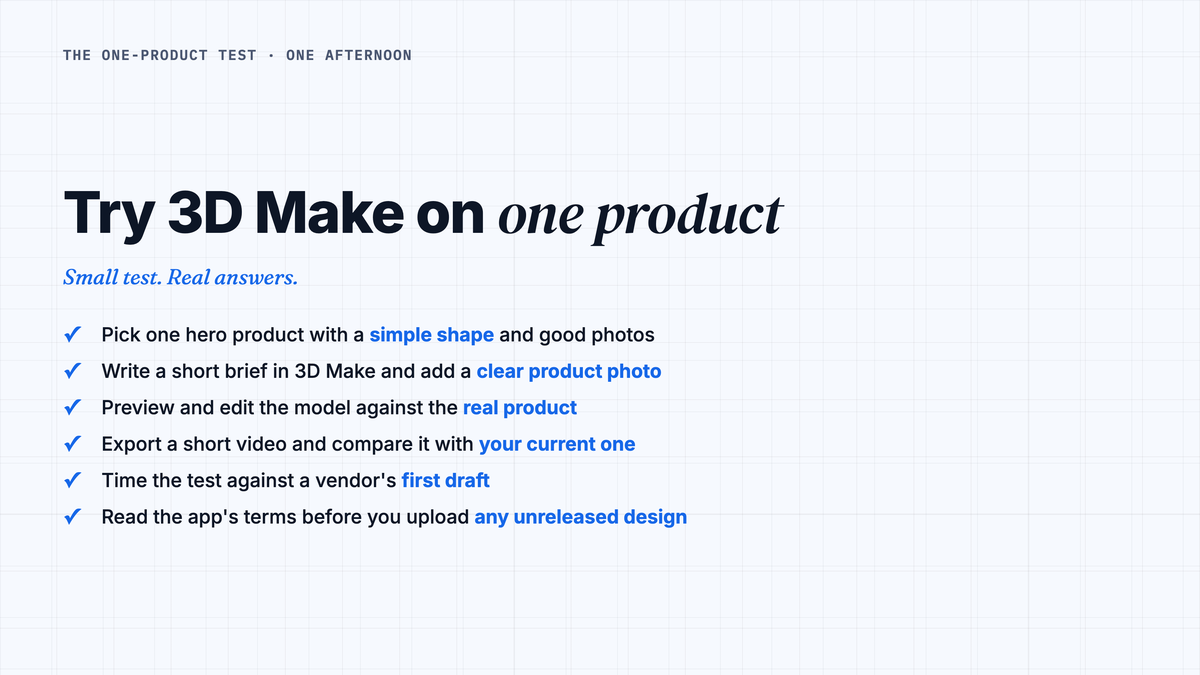
Here is a test any brand team can run in one afternoon. It needs one person and one product.
First, pick one hero product. Choose one with a simple shape and good photos.
Second, open 3D Make on kimi.ai. Write a short brief, and add a clear product photo as a reference.
Third, preview the model and edit it. Check the shape, the size and the details against the real thing.
Fourth, export a short video. Put it next to your current product video and ask your team which works better.
Fifth, time the whole thing. Compare it with what a 3D artist or a vendor needs for a first draft.
Before you start, read the app's terms. Do not upload an unreleased product design until you know where it goes.
At the end, you will know three things. How close the model gets. How long it took. And how much fixing it needs.
What this means for your plans
Three things change after this launch.
The first is price pressure. An open model now sits close to the paid leaders on coding. That makes it harder for paid models to charge a lot more for the same work.
The second is 3D. Making 3D product assets is starting to move from a specialist job to a prompt and a check. Creative teams should start testing now.
The third is control. The weights are due by 4 November 2026 (Source: Moonshot AI, 2026 — launch post). After that, brands with strict data rules get a near-top model they can run themselves. Wait for the license first.
So run one 3D test this week. And set a reminder for when the weights and the license arrive.
FAQ
Q: What is Kimi K3.1 Pro?
A: It is a large AI model from Moonshot AI, released on 23 October 2026. It is an open-weights model. Moonshot says the full model files will be released by 4 November 2026.
Q: Is Kimi K3.1 Pro better than Claude Opus 5.5?
A: Not overall. On Moonshot's Terminal-Bench chart it scored 65.7% to Opus 5.5's 66.4%. On the broader Vals Index it scored 62.52%, against 70.18% for Opus 5.5.
Q: What does open weights mean for my brand?
A: Once the files are out, you can run the model on your own servers, so your data can stay in-house. Moonshot has not named a license yet. Check it before any business use.
Q: How much does the Kimi K3.1 Pro API cost?
A: It costs $2 per million input tokens and $10 per million output tokens. Cached input is $0.20. The faster Highspeed version costs $4 and $20.
Q: What is Kimi 3D Make?
A: It is a tool on kimi.ai and in the Kimi app. You can preview and edit 3D models, download them for 3D printing, or export them as videos or Live Photos.
Q: Does Kimi K3.1 Pro still make mistakes?
A: Yes. Moonshot says false claims fell from 23.4% to 8.3% on its hard stress test. It also says that is not the error rate in daily use. Check every fact.
Sources
- Moonshot AI — Introducing Kimi K3.1 Pro (launch post, scores, 3D Make and availability).
- Kimi API Platform — Model Pricing (token prices, checked 27 October 2026).
- Vals AI — Kimi K3.1 Pro and Vals Index (outside results, checked 27 October 2026).
- YARD — Inkling and Gemini 4 Argon (earlier reads).
Insights from Our Experts
Explore our latest articles on digital marketing strategies.