
On August 10, 2026, Meta Superintelligence Labs released Muse Glimmer. It is a 30-billion-parameter model built for one job: running agents on the machine in front of you.
The weights are already on Hugging Face. The licence is Apache 2.0.
Read that second line again, because it is the part with commercial consequences.
Most model launches this year have been about a bigger number in a data centre. This one is about a smaller number on a desk. And for any marketing team that has ever been told "compliance will not approve that", it is the more useful story.
What Meta actually shipped
Muse Glimmer is a 30-billion-parameter multimodal model. It is small enough to run on a Mac or a PC with a single consumer GPU.
Meta is direct about the target. It says the model is "optimized for always-on local agent workflows". Four use cases are named: local agents, function calling, local coding, and using the model as a judge to grade other outputs.
The framing in the launch post is worth quoting, because it describes a product most people have not used yet. Meta describes an agent that "manages your schedule, drafts your messages, organizes your files, and learns how you work." Such an agent, it says, "needs deep access to personal context."
That is the pitch. Not a chat window. A resident assistant with the keys to your desktop.
Eight capabilities are called out. End-to-end agentic task completion. Reliable tool use with precise schemas. Multi-step reasoning over long horizons. Failure recovery, so a bad tool call gets diagnosed and retried rather than halting the run. Multimodal input through a dedicated perception encoder, which means it reads screenshots, charts and documents. Scaffold compatibility. Controllable effort. And more than 100 languages.
Failure recovery is the quiet one. Most agent demos break the first time a tool returns something unexpected. Training for the retry is what turns a demo into a tool.
Why "runs on your laptop" is the whole story
Here is the constraint Meta had to beat.
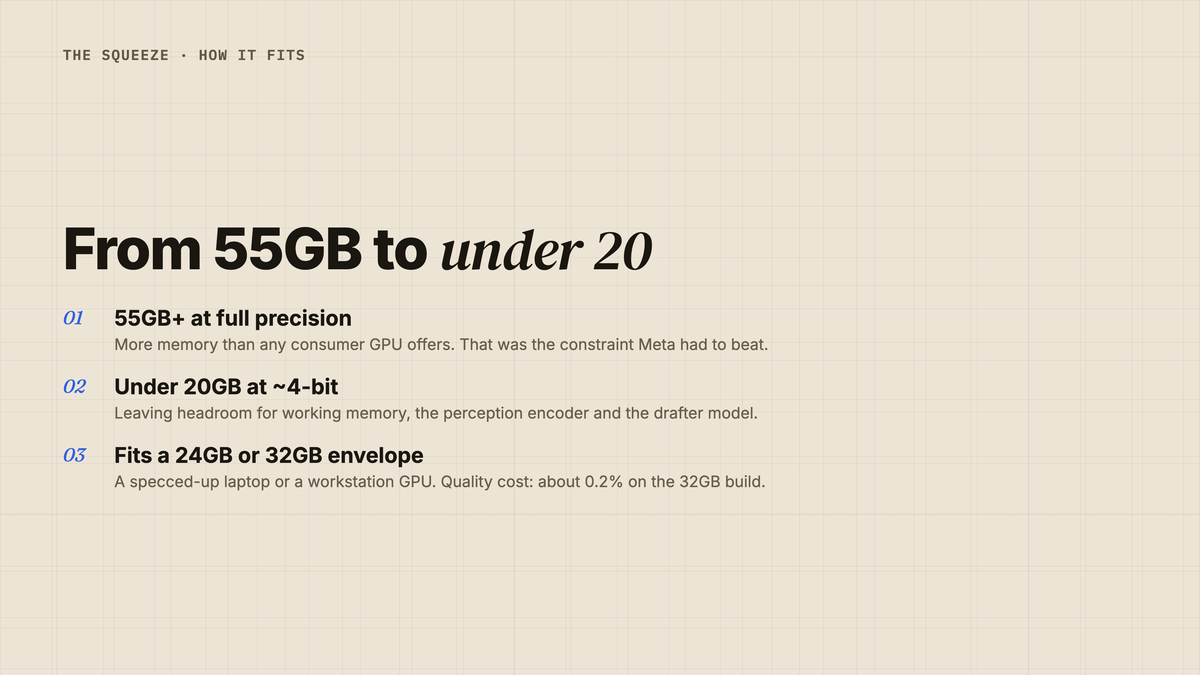
At full precision, a 30-billion-parameter model needs over 55 GB of memory. No consumer GPU has that.
So Meta compressed the weights to roughly 4-bit precision. That shrinks the language model to under 20 GB. What is left fits the working memory, the perception encoder and the speed helper inside a 24 GB or 32 GB envelope.
The cost of that squeeze is small. MarkTechPost reports about 0.2% average degradation on the 32 GB build, and about 1.0% on the leaner 24 GB build.
So the price of running an agent privately is now roughly one percent of quality. That is a very different trade from a year ago.
Quick Facts: Muse Glimmer at a Glance
- 30 billion parameters, released August 10, 2026 under Apache 2.0 — (Source: Meta Superintelligence Labs, 2026 — launch post)
- Full precision would need over 55 GB; 4-bit brings the model under 20 GB — (Source: Meta Superintelligence Labs, 2026 — launch post)
- Scores 75.5 on MCP Atlas against 62.5 and 54.2 for two rivals in its size class — (Source: MarkTechPost, Aug 10 2026 — benchmark roundup)
- Runs at 233.4 tokens per second on an RTX 5090 with speculative decoding — (Source: MarkTechPost, Aug 10 2026 — benchmark roundup)
- Weights and docs are public today — (Source: Meta — Hugging Face and developer docs)
The numbers, including the ones Meta lost
Meta compares Muse Glimmer with two models in its size class: Gemma4-31B and Qwen3.6-27B. Not with frontier models. That framing is honest, and you should keep it.
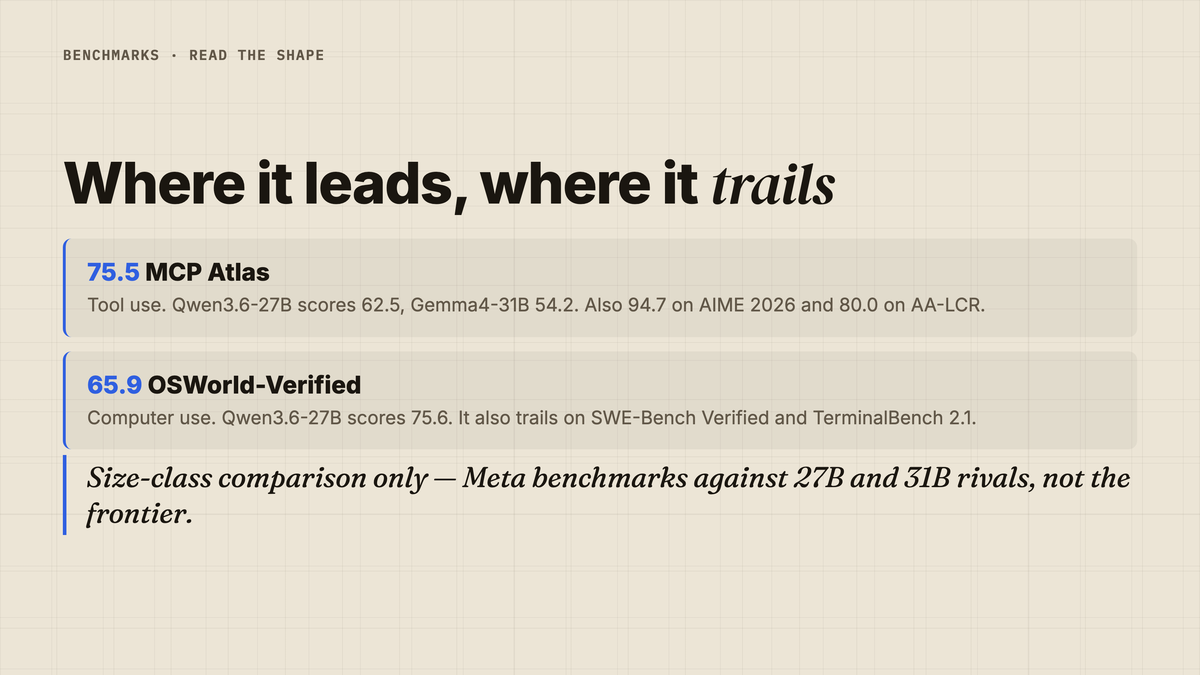
The wins are real. On MCP Atlas, an agentic tool-use benchmark, MarkTechPost reports a score of 75.5. The same table puts Qwen3.6-27B at 62.5 and Gemma4-31B at 54.2. That is a wide margin on exactly the skill the model was built for.
Other reported results include 74.6 on DeepSearch QA, 94.7 on AIME 2026, 77.0 on IFBench and 80.0 on AA-LCR.
Now the losses, which matter more.
On OSWorld-Verified, a computer-use benchmark, it scores 65.9. Qwen3.6-27B scores 75.6. That is a clear loss on driving a desktop.
It also trails Qwen3.6-27B on SWE-Bench Verified, where it scores 77.2, and on TerminalBench 2.1.
So read the shape, not the headline. This model is strong at calling tools and weaker at operating a screen. If your use case is "watch my desktop and do things", test it hard before you believe it.
The speed problem, and how they solved it
A local agent is only useful if it feels fast. Meta says as much: an agent that takes minutes to plan its next step "breaks the flow of real work".
Models normally write one token at a time. Muse Glimmer ships with a small companion model, a drafter, that proposes whole blocks of tokens at once. The main model then checks those blocks in parallel and fixes what is wrong.
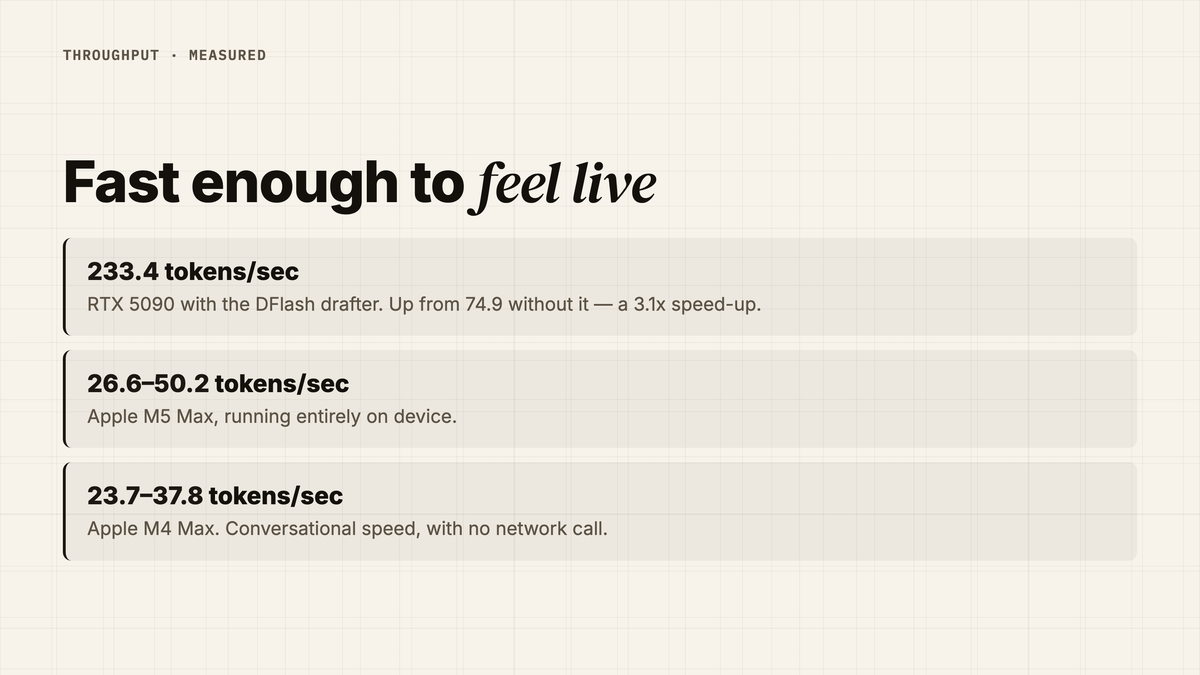
The gain is large. On an RTX 5090, generation goes from 74.9 tokens per second to 233.4 with the drafter switched on. That is a 3.1 times speed-up, according to the same benchmark roundup.
On Apple silicon the numbers are lower but usable. A MacBook M5 Max runs between 26.6 and 50.2 tokens per second. An M4 Max runs between 23.7 and 37.8.
Those Mac figures deserve a moment. A laptop many creative teams already own can now run an agentic model at conversational speed, with no network call.
What changes for marketing teams
Four things change, and none of them are about writing captions faster.
The compliance objection loses its main leg. Every agency has a client who will not let data touch a third-party API. Legal, healthcare, finance, anything under an NDA. If the model runs on the machine, the data never leaves. That is a different conversation than a data-processing addendum.
The licence lets you ship it. Apache 2.0 is permissive. You can build it into a product, modify it, and use it commercially without asking. Compare that with a model you rent by the token. We made a related point when Alibaba promised open weights for Qwen3.8-Max, but those weights were still pending. These are live today.
Cost stops scaling with usage. A hosted model bills per token. A local model bills once, in hardware. If you run high-volume repetitive work, that maths changes fast. Compare the token price of a hosted flagship such as Claude Opus 5 against a fixed machine cost.
Hardware becomes a line item again. You need 24 GB to 32 GB of memory. That is a specced-up laptop or a workstation GPU. For years the answer to "what do we need to run AI?" was "a login". Now it is a purchase order.
Local or cloud: how to actually choose
You do not have to pick one. Most teams will run both. The useful question is which jobs move.
Move a job local when the data is the problem. Client files under NDA. Anything with personal data in it. Internal documents you would not paste into a browser. These are the jobs that never got automated, because the approval never came.
Move a job local when the volume is boring and constant. Tagging. Sorting. Renaming. Extracting fields from the same document type, all day. Per-token billing punishes exactly this kind of work, and a fixed machine cost does not.
Keep a job in the cloud when you need the best possible answer. Strategy, positioning, hard reasoning, anything where quality beats cost. A size-class model is not the tool for that.
Keep it in the cloud when the work needs to be current. The knowledge cutoff here is January 4, 2026.
And keep it in the cloud when nobody on the team owns the machine. Local means someone maintains it. That is a real cost, and it is a person, not a licence.
The honest summary is simple. Local wins on privacy and repetition. Cloud wins on quality and freshness. Sort your task list into those two piles before you buy anything.
The security catch nobody is headlining
Here is the part to read twice.
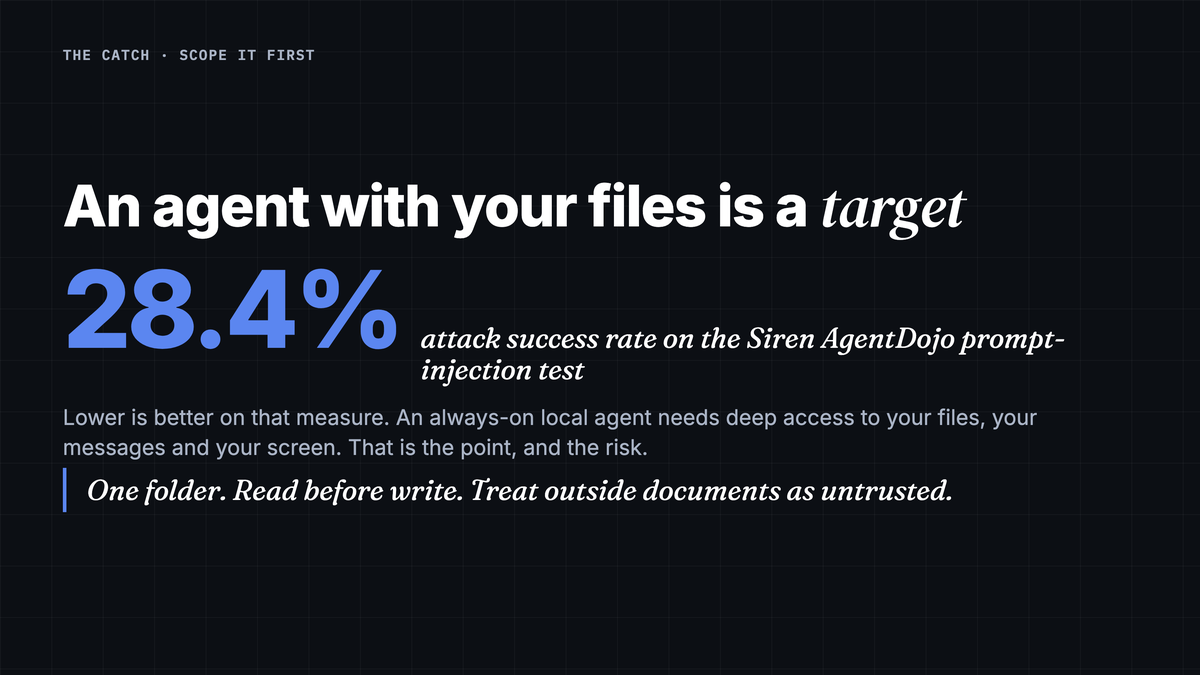
An always-on local agent needs deep access to your files, your messages and your screen. That is the whole point. It is also the whole risk.
MarkTechPost reports a result on Siren AgentDojo, a prompt-injection benchmark. Muse Glimmer records a 28.4% attack success rate, with 94.2% utility. On that measure, a lower attack success rate is better.
Read it plainly. In that test, a meaningful share of injection attempts got through.
Now picture the workflow. An agent reads a document a client sent you. The document contains instructions written for the agent, not for you. The agent has access to your files.
This is not a reason to avoid local agents. It is a reason to scope them. Do not give a day-one agent your whole drive. Give it one folder. Give it read access before write access. And treat any document from outside your team as untrusted input, because that is what it is.
New capability keeps arriving faster than new policy. We said the same when Google shipped three Gemini models in one day.
What to do this week
Five steps. Most of it is a download and an honest test.
- Check your hardware. Find out how many machines on your team have 24 GB or more of GPU or unified memory. That number is your real capacity.
- Download the weights from Hugging Face and read the developer docs. Meta says runners such as Ollama and LM Studio land in the coming days.
- Pick one repetitive, sensitive task. Something you currently do by hand because the data cannot leave. Run that task locally and time it.
- Scope the access before the first run. One folder, read-only. Write down what the agent may never touch.
- Take the result to the client who says no to cloud AI. A working local demo is a better argument than a policy document.
The limits to keep in mind
Be honest about the gaps.
It is a size-class model, not a frontier model. Meta compares it with 27B and 31B rivals for a reason. Do not expect flagship reasoning.
It loses on computer use. Qwen3.6-27B beats it on OSWorld-Verified by a wide margin.
Some of the ecosystem is still landing. Meta says optimised integrations for llama.cpp, MLX and ExecuTorch arrive in the coming days, along with partner runners.
The knowledge cutoff is January 4, 2026, so it does not know this year. For anything current, it needs tools and search.
And local is not the same as private. The model stays on your machine, but your own data handling still needs rules. The tool removes one risk. It does not remove your governance.
The YARD take
Two stories ran this week. One was a frontier image model that still has no API. The other was a 30-billion-parameter agent you can download, modify and ship for free.
The second one will matter longer.
For three years, the AI conversation has been about access. Who has the best model, and what does it cost per million tokens. Muse Glimmer points somewhere else. The question becomes what runs on the hardware you already own, and what you are allowed to do with it.
For an agency, that reframes the pitch. The interesting question stops being "which model do you use". It becomes "where does your client's data go, and can you prove it".
Download it. Scope it tightly. Test it on the work you currently refuse to send to the cloud. That is where the value is this week.
FAQ
What is Muse Glimmer? It is a 30-billion-parameter open-weights model from Meta Superintelligence Labs, released on August 10, 2026. It is built for always-on local agent workflows.
What licence is it under? Apache 2.0, which is permissive. You can use it commercially, modify it and build it into products.
What hardware do I need? A Mac or PC with a single consumer GPU, and 24 GB to 32 GB of memory. Full precision would need over 55 GB, so the shipped build is compressed to about 4-bit.
How fast is it? On an RTX 5090 it runs at 233.4 tokens per second with speculative decoding, up from 74.9 without. A MacBook M4 Max runs between 23.7 and 37.8 tokens per second.
Is it better than the frontier models? No, and Meta does not claim that. It is compared with Gemma4-31B and Qwen3.6-27B, which are models of a similar size.
Where does it lose? Computer use. It scores 65.9 on OSWorld-Verified against 75.6 for Qwen3.6-27B. It also trails on SWE-Bench Verified and TerminalBench 2.1.
Is a local agent automatically safe? No. On the Siren AgentDojo prompt-injection test it records a 28.4% attack success rate. Scope what an agent can read and write before you run it.
Sources
- Meta Superintelligence Labs — Introducing Muse Glimmer: an open agentic model that runs on your device (August 10, 2026; primary source)
- Hugging Face — Muse-Glimmer-30B model weights
- Meta — Muse Glimmer developer documentation
- MarkTechPost — Meta AI releases Muse Glimmer (August 10, 2026; benchmark and throughput figures)
- Meta — AI Developer Center model page
Insights from Our Experts
Explore our latest articles on digital marketing strategies.