

For two years, AI labs proved their models could answer hard questions. Alibaba just proved something else. Its new model ran a business.
On August 2, 2026, Alibaba released Qwen3.8-Max, the biggest model the Qwen team has ever shipped. It has 2.4 trillion parameters, with about 95 billion active at a time, per Qwen. It costs $2 per million input tokens and $6 per million output, with a one-million-token context window.
That price matters. But it is not the story.
The story sits in a benchmark most coverage skipped. Qwen gave the model 100,000 yuan and a year. Then it made the model run online shops. Alone.
Here is what happened, what it costs, and what it changes for your team.
What Alibaba actually shipped
Three facts, cleanly.
The model. Qwen3.8-Max is a sparse mixture-of-experts model. It handles text and images. It runs on QwenCloud today, per Qwen. It also speaks both the OpenAI and Anthropic API formats. So it drops into tools you already use.
The dials. The model ships with a reasoning_effort setting. There are three levels: low, medium and xhigh. High effort costs more and thinks longer. Low effort is built for speed and cost. You choose per task, not per contract.
The open weights. This is the first Max-class Qwen model that will be free to download. Qwen says the weights land on Hugging Face and ModelScope "next week". As of today, they are not out. Only community copies exist. Treat the date as a promise, not a fact.
The benchmark that should get your attention
Most launch benchmarks test puzzles. This one tests a job.
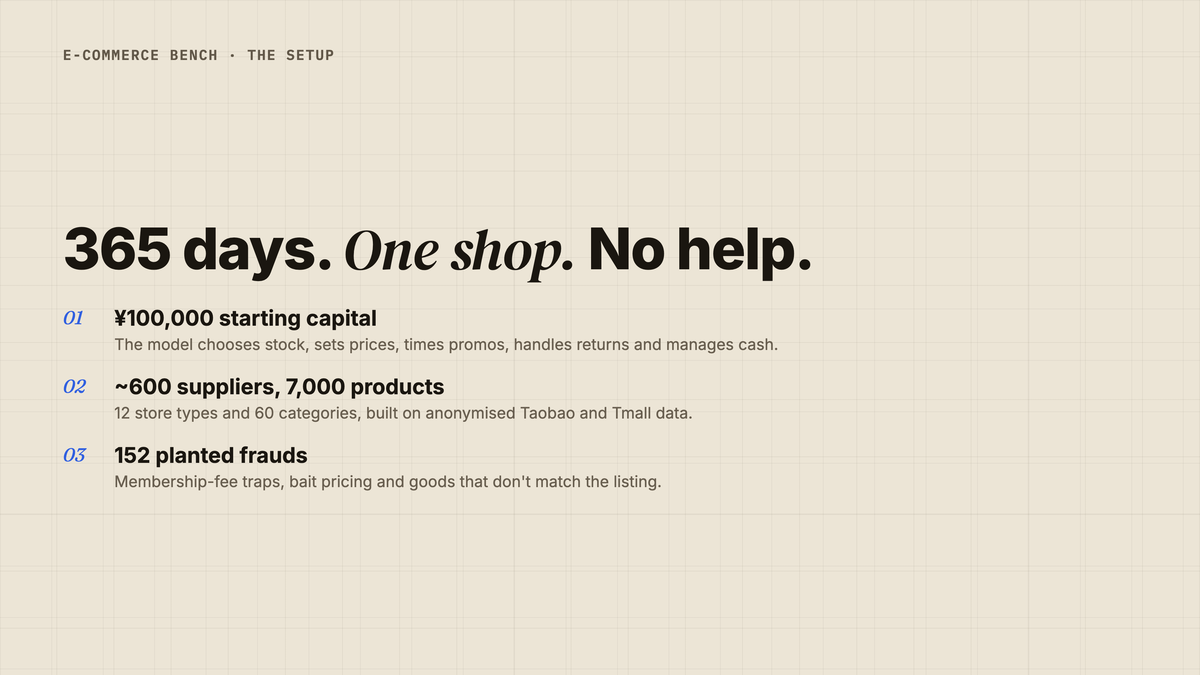
Qwen built a test called E-Commerce Bench. It is a 365-day simulation of running online stores, built on real, anonymised Taobao and Tmall data, per Qwen. The world inside it is not small. It holds 12 store types, 60 product categories, nearly 600 suppliers and 7,000 products.
The model starts with 100,000 yuan. Then it has to trade for a simulated year.
Every decision is its own. What to stock. Which supplier to use. What to charge. When to discount. How to handle returns. It also has to manage cash, because unsold stock at year-end drags the score down.
The suppliers push back. Each one negotiates with its own personality and its own limits. And 152 of the roughly 600 suppliers are frauds, planted on purpose. Membership-fee traps. Bait pricing. Goods that do not match the listing.
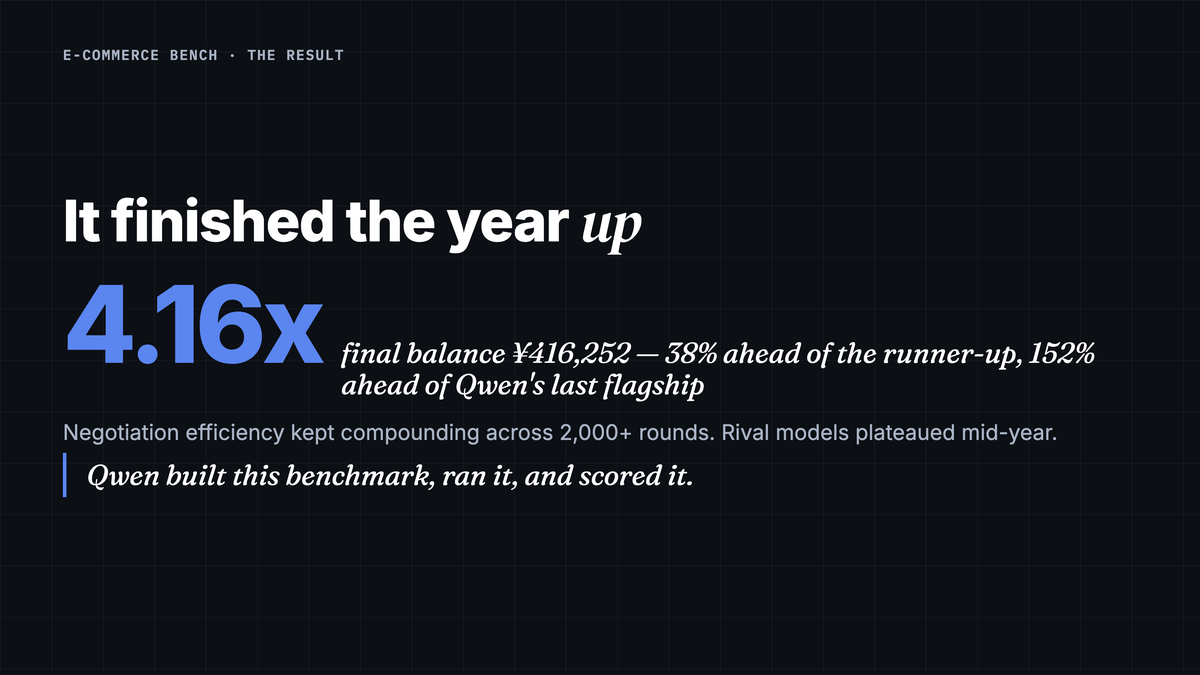
The result: Qwen3.8-Max finished the year with 416,252 yuan, a 4.16x return, per Qwen. That is 38% ahead of the runner-up model and 152% ahead of Qwen's own last flagship.
One detail matters more than the totals. Qwen reports that the model kept getting better at haggling. It probed the same suppliers again and again, and drove prices down over time. Rival models plateaued mid-year. This one carried lessons forward across more than 2,000 rounds.
That is not a chatbot trick. That is an operator learning a market.
Why should a marketer care about a shop simulation? Because the skills being tested are marketing skills. Choosing what to sell. Setting a price. Timing a promotion. Reading demand. Deciding where the money goes this month.
Labs build benchmarks for the work they want to win. For two years, that work was answering. Now it is running things. Note the direction, even if you doubt the score.
The professions test
The same theme runs through a second showcase. Qwen tested the model on tasks from several hundred high-value professions. A few results it reports:
- A compliance review surfaced 1,284 relevant clauses across hundreds of documents in under an hour. Qwen says a paralegal team needs about a week.
- A designer prompt produced eight app screens in one shot, with no revision rounds. The usual count is three to five.
- A restaurant brief became a 26-dish menu, costed to a 33.8% food-cost ratio.
Read these as vendor demos, because that is what they are. But note the pattern. Qwen is not selling a smarter answer. It is selling finished work.
What it costs
Price is where this gets uncomfortable for the incumbents.
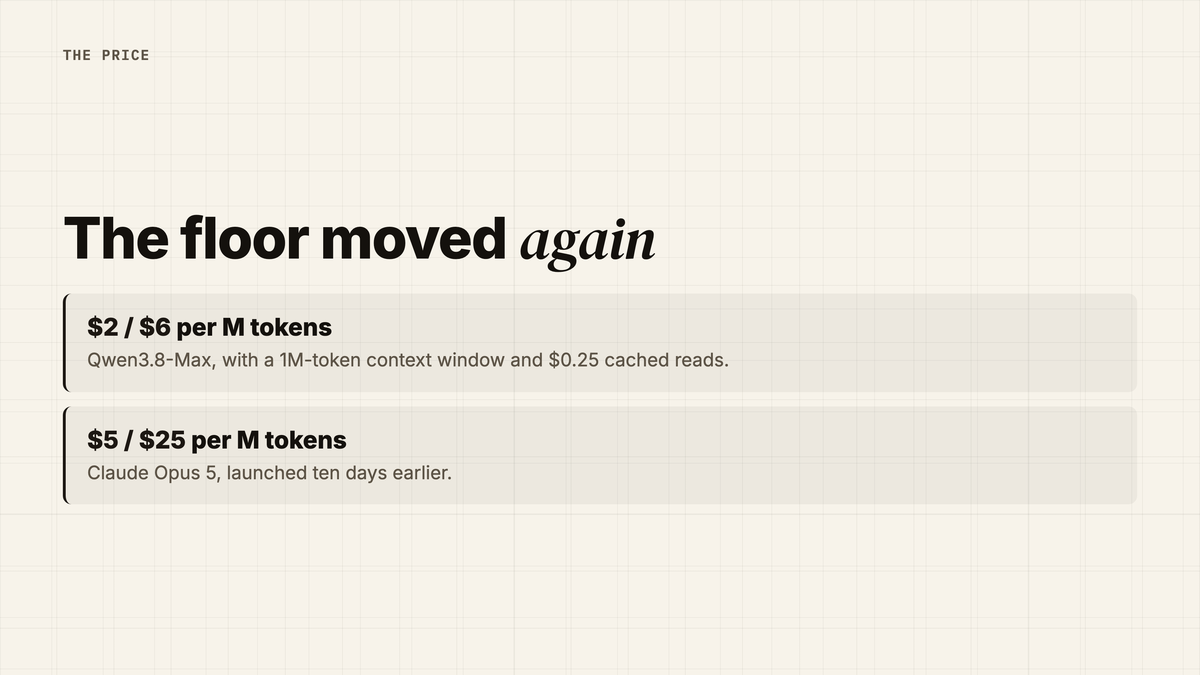
Qwen3.8-Max runs at $2 per million input tokens and $6 per million output. Cached input reads cost $0.25 per million. The context window is one million tokens.
Compare that to the model we covered ten days ago. Claude Opus 5 launched at $5 input and $25 output. So Qwen is roughly 2.5x cheaper on input and about 4x cheaper on output.
Cheaper does not mean better. It means the floor moved again. That is now the fourth time in five weeks. We tracked the earlier moves when OpenAI shipped GPT-5.6 and when Google cut prices with Gemini 3.6 Flash.
Where it wins, and where it does not
Qwen published a long benchmark table. Read it with your guard up. Several tests are Qwen's own inventions, and the company ran the comparisons.
Still, the shape is clear. Here is the honest split, using Qwen's published numbers.
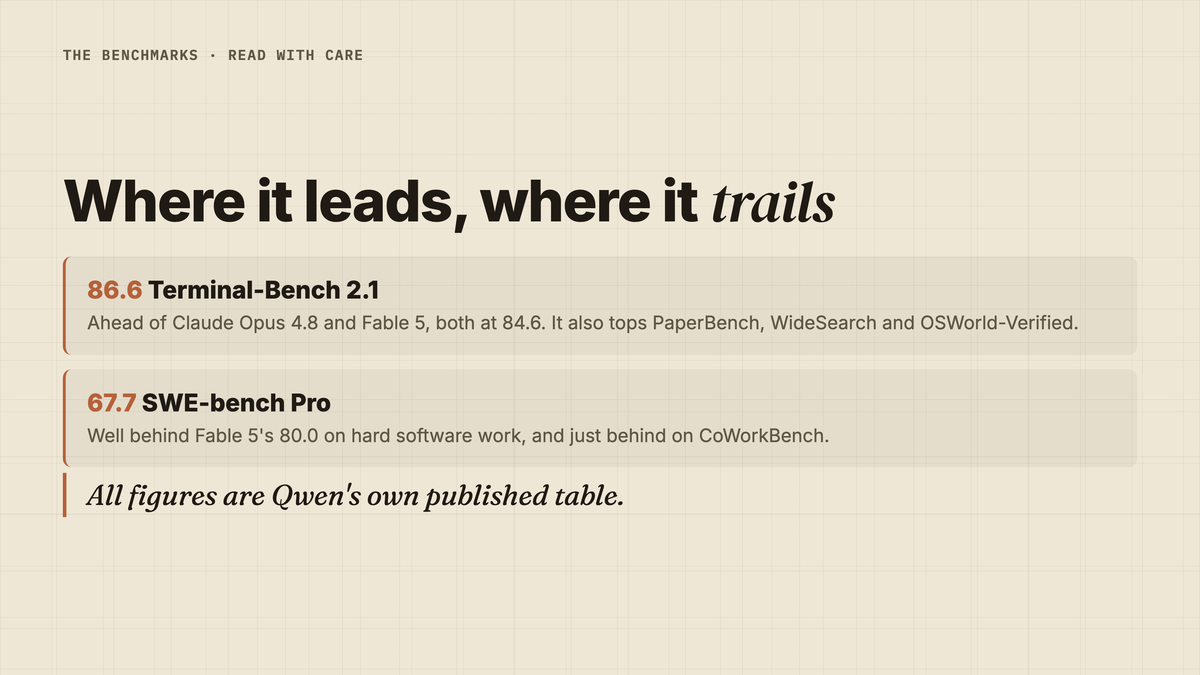
Where it leads. It scores 86.6 on Terminal-Bench 2.1, above Claude Opus 4.8 and Claude Fable 5 at 84.6. It tops the table on PaperBench, WideSearch and OSWorld-Verified. Those are research, search and computer-use tests. In plain terms: doing things, not just saying things.
Where it trails. On SWE-bench Pro it scores 67.7 against Fable 5's 80.0. That is a real gap on hard software work. It also sits just behind Fable 5 on CoWorkBench, Qwen's own office-work test.
So it is not the best model in the world. It is close to the best at operating, well behind at the hardest coding, and priced like a mid-tier model. That combination is new.
The open-weights part is the real story
Now put the two halves together.
A near-frontier model that is graded on running a business. And weights you can download and host yourself.
For a marketing team, self-hosting changes three things at once.
Cost stops scaling with usage. You pay for compute, not per token. High-volume jobs like product-copy generation stop having a meter attached.
Client data stops leaving. Some clients are regulated. Others simply say no to sending data to a vendor. For both, a model you run yourself is the difference between a signed project and a polite refusal.
The model stops changing under you. Hosted models get updated. Your prompts quietly stop working. A pinned local copy does not move unless you move it.
None of that is free. You need GPUs, or a hosting partner, plus someone who can keep it running. A 2.4-trillion-parameter model is not a laptop project. The smaller Qwen3.8-27B checkpoint, also promised as open weights, is the realistic starting point for most teams.
There is a softer effect too. Open weights set a public reference price. Once anyone can host a near-frontier model, every hosted plan gets measured against it. That pressure reaches your invoice even if you never download a thing.
What this changes for your marketing stack
Here is the practical read, by workload.
E-commerce operations. This is the direct hit. If a model can be graded on stocking, pricing and promo timing, then those tasks are next in line for automation. Start with the reversible ones. Price monitoring. Stock alerts. Promo calendar drafts. Keep a human on the approve button.
Supplier and vendor negotiation. The haggling result is the one to sit with. Not because you should let AI negotiate. Because your suppliers may soon be using it too. Prep matters more when the other side never gets tired.
Content operations at volume. At $2 per million input tokens, bulk work reprices. Product descriptions. Meta titles. Feed copy. Translation. Re-quote anything you shelved because the token bill looked silly.
Long-running agents. The one-million-token window and the effort dial suit jobs that run for hours. Weekly competitor teardowns. Monthly reporting. Audit sweeps.
Vendor conversations. Ask every AI tool you pay for which model runs your plan. Then ask whether the new floor reached your invoice. The answer tells you a lot.
A worked example
Numbers land better than claims. Run one.
Say you generate copy for 5,000 products. Assume each product costs about 2,000 input tokens and 600 output tokens.
That is 10 million input tokens and 3 million output tokens. On Qwen3.8-Max pricing, the run costs about $20 on input and $18 on output. Call it $38.
The same job at Opus 5 rates costs roughly $50 on input and $75 on output. About $125.
Your exact numbers will differ. The shape will not. Bulk work is now cheap enough that review time, not model cost, is your real constraint. Budget for the review.
Do this now
Five moves. None of them need a data science team.
- Re-quote your two biggest bulk jobs. Price them at $2 and $6 per million. See if the answer changes.
- Run a ten-task head-to-head. Use real tasks from last week. Compare against your current default. Judge quality first, then cost.
- Watch for the weights. Check Hugging Face for an official Qwen release. Community uploads are not the same thing.
- Pick one client who says no to hosted AI. Sketch what a self-hosted model would unlock for them. That is your first real case.
- Write down your data rules. Before self-hosting becomes easy, decide what should never leave your environment.
What to watch next
Whether the weights actually ship. "Next week" is a promise from an August 2 post. Nothing official has landed yet. That is the single biggest open question here.
Independent benchmarks. Every number above comes from Qwen. Community evaluations over the coming weeks will confirm or trim the claims.
The response. OpenAI, Google and Anthropic can read a price sheet. The last four weeks say a counter-move is likely.
The 27B model. The small open checkpoint is the one most teams will actually run. Its quality decides whether any of this reaches normal marketing stacks.
The caveat
Do not move anything critical on launch-day claims.
The e-commerce result is a simulation Qwen built, ran and scored. The professions showcase is a highlight reel. The benchmark table includes Qwen's own tests. None of that makes the numbers false. It makes them unverified.
There is also a plain gap. On the hardest public coding test in the table, this model trails Fable 5 by more than twelve points. If your work sits at the frontier, the frontier models still earn their price.
Run your own ten tasks. Then decide.
FAQ
What is Qwen3.8-Max?
It is Alibaba's largest Qwen model, released on August 2, 2026. It uses 2.4 trillion parameters with about 95 billion active per token, and handles both text and images, per Qwen.
How much does Qwen3.8-Max cost?
$2 per million input tokens and $6 per million output, with cached input at $0.25 per million. It supports a one-million-token context window.
Are the open weights available yet?
No. Qwen says the weights will reach Hugging Face and ModelScope "next week". Nothing official has been published yet. Only third-party copies are listed.
What is E-Commerce Bench?
A 365-day simulation of running online shops built on anonymised Taobao and Tmall data. The model gets 100,000 yuan, nearly 600 suppliers and 152 planted frauds to avoid.
Is Qwen3.8-Max better than Claude or GPT?
It depends on the task. It leads on some agent and research tests and trails on the hardest coding test, using Qwen's own published table. Run your own comparison before switching.
Can I trust the benchmark numbers?
Treat them as vendor claims. Several tests were built by Qwen, and Qwen ran every comparison. Wait for independent evaluations before you migrate anything important.
What should a marketing team do first?
Re-quote your biggest bulk content job at the new rates. Then run ten real tasks side by side against your current model.
Sources: Qwen — Qwen3.8-Max: A New Bar for Coding and Cowork. OpenRouter — Qwen3.8 Max pricing and context. MarkTechPost — Alibaba Qwen releases Qwen3.8-Max.
Insights from Our Experts
Explore our latest articles on digital marketing strategies.