

Off-page SEO in 2026 is not a link race. It is an authority race.
Backlinks still count. But Google and AI engines now read a wider signal set. Brand mentions. Topical trust. Citations inside AI answers.
The old play was volume. The new play is relevance plus reputation. AI link building helps you scale that without spamming the web.
This is a working playbook. You will get a four-part framework. A vs B comparisons. A real outreach process. And a checklist you can run this week.
Quick Facts: Off-Page SEO 2026 at a Glance
- Top-ranking pages hold 3.8x more backlinks than positions 2-10 — (Source: Backlinko via Ranktracker, 2024 — ranktracker.com).
- Most content fails to earn links; 94% gets zero backlinks — (Source: Ahrefs via Ranktracker, 2024 — ranktracker.com).
- Digital PR leads the field, named top tactic by 48.6% of SEOs — (Source: Editorial.Link, 2026 — editorial.link).
- Relevance ranks first for 58% of SEO professionals — (Source: Search Engine Journal via Ranktracker, 2024 — ranktracker.com).
- AI is now standard; 86% of SEO pros have built it into their workflow — (Source: SE Ranking, 2024 — seranking.com).
What Off-Page SEO Means in 2026
Off-page SEO is everything that builds authority away from your site.
Links are part of it. So are mentions, reviews, and digital PR. Now AI citations join the list too.
The shift is simple. Google no longer counts links alone. It reads your whole reputation across the web.
Brand signals matter more each year. Google tracks how often your brand shows up, even without a link.
That is why off-page SEO 2026 looks broader than 2020. It is less about chasing links. It is more about earning trust at scale.
Backlinks remain a heavy signal, though. Pages with at least one backlink rank in the top 10 far more often than pages with none. (Source: Moz via Ranktracker, 2024 — ranktracker.com).
So you do both. You earn links. You build mentions. You feed AI engines clean, citable proof.
Q: Is off-page SEO still relevant in 2026?
A: Yes, more than ever. Links, brand mentions, and AI citations all shape your visibility. The format changed, but off-page authority remains a top ranking signal across Google and AI answers.
Google reads authority as a pattern. Not as a single number.
It looks at who links to you. It looks at who mentions you. It looks at whether real people trust you.
Links are still a strong vote. A relevant, trusted link carries weight. A spammy link carries risk.
But links no longer stand alone. Mentions matter. Reviews matter. Consistent listings matter.
AI engines read the same web. They scan for sources they can name. They cite brands that show up often and clearly.
So your job widened. You build links. You earn mentions. You stay easy to cite.
Think of it as a reputation graph. Every signal connects to your brand. Stronger nodes win more visibility.
Quality is the through-line. One trusted source beats ten weak ones. Relevance ties it together.
That is the core of off-page SEO 2026. Build a clean, relevant reputation graph. Then both Google and AI reward it.
Q: How does Google measure off-page authority?
A: Google reads a pattern of signals, not one metric. It weighs relevant links, brand mentions, reviews, and trust. AI engines read the same web and cite brands that appear often and clearly. Relevance ties every signal together.
Why AI Changed the Link Building Game
Manual link building is slow. AI link building is fast.
The old grind was painful. Find sites. Hunt emails. Write each pitch by hand. Chase replies for weeks.
Most teams still struggle. 73% of link builders gain fewer than 10 links per month — (Source: SE Ranking, 2024 — seranking.com).
AI compresses that work. It scans competitor backlinks in seconds. It surfaces prospect lists fast.
It also drafts pitches that fit each publisher. Then it sequences follow-ups and tracks link status.
But speed is not the only win. AI also raises quality control.
It flags toxic links in your profile. It scores prospects for relevance before you ever reach out.
That matters because relevance now wins. 58% of SEO pros call relevance the top quality factor, above domain authority. (Source: Search Engine Journal via Ranktracker, 2024 — ranktracker.com).
So AI does not replace strategy. It removes the busywork around it.
There is a catch, though. AI is only as good as your input. Feed it a vague angle and you get vague pitches.
So treat AI as a junior teammate. Brief it well. Review its work. Approve the final send.
Used that way, AI lifts your whole output. You reach more relevant sites. You waste less time on dead ends.

Q: Does AI make link building easier?
A: It makes the slow parts faster. AI handles prospecting, pitch drafts, and tracking. You keep control over targets, angles, and final approval. The result is more relevant links in less time.
The 4-P Framework for Off-Page SEO 2026
You need a model, not random tactics. Use the 4-P framework.
Four pillars carry your off-page authority. Each one feeds Google and AI engines.
1. Profile. Your backlink profile. Earn relevant, high-trust links. Quality beats volume every time.
2. Press. Digital PR and earned media. Pitch data and stories that journalists want to cover.
3. Presence. Brand mentions and citations. Show up across forums, reviews, and listings, linked or not.
4. Proof. Original data and assets. Publish numbers no one else has so others cite you.
This order is deliberate. Profile and Press earn links. Presence and Proof earn AI citations.
Digital PR sits at the centre. It is the single most effective tactic for 2026. 48.6% of SEO experts picked it, far ahead of guest posting at 16%. (Source: Editorial.Link, 2026 — editorial.link).
Proof is the new edge. Original data gets cited as a primary source. AI engines love a source they can name.

Q: What is the 4-P framework for off-page SEO?
A: It is four pillars: Profile, Press, Presence, and Proof. Profile and Press earn links. Presence and Proof earn brand mentions and AI citations. Together they build durable off-page authority in 2026.
Digital PR is the heart of the 4-P model. It earns links and mentions at once.
The idea is simple. Create something newsworthy. Get journalists to cover it.
A good story earns links from trusted media. Those links carry real authority. They also drive referral traffic.
Original data is the strongest hook. Publish a survey. Run an experiment. Share numbers no one else has.
When you own the data, others cite you. AI engines name you as the source.
This is why digital PR leads the field. 48.6% of SEO experts call it the top tactic for 2026. (Source: Editorial.Link, 2026 — editorial.link).
Guest posting still has a place. But it trails far behind, at 16% — (Source: Editorial.Link, 2026 — editorial.link).
So lead with stories and data. Use guest posts to fill gaps, not as your core play.
AI helps here too. It scans the news cycle for angles. It drafts press pitches fast. You shape the story and the data.
Start small if you must. One data study can earn dozens of links. That beats a hundred weak guest posts.
Q: Why is digital PR the best link building tactic in 2026?
A: Digital PR earns trusted media links and brand mentions together. Original data makes you a primary source, so editors and AI engines both cite you. In a 2026 survey, 48.6% of SEOs ranked it the most effective tactic.
The Numbers That Should Shape Your Strategy
Data should drive your link building. Here is what the data says.
Backlinks still separate winners from the pack. Position one averages 213 backlinks against 56 for positions 2-10 — (Source: Backlinko via Ranktracker, 2024 — ranktracker.com).
But most content never earns a link. 94% of pages get zero backlinks — (Source: Ahrefs via Ranktracker, 2024 — ranktracker.com).
Relevance multiplies value. A link from a relevant niche site is worth 2.7x more than an unrelated one. (Source: Moz via Ranktracker, 2024 — ranktracker.com).
Domain diversity is rising too. The average top page now pulls links from 66.5 referring domains, up from 59.3 — (Source: Ahrefs via Ranktracker, 2024 — ranktracker.com).
Links cost real money. Buyers accept about $508.95 for one high-quality backlink — (Source: Editorial.Link, 2026 — editorial.link).
So budgets are tight and waste is costly. Agencies spend 32.1% of SEO budget on links; in-house teams spend 36.03% — (Source: Editorial.Link, 2026 — editorial.link).
Read those numbers together. Links are scarce. Most pages get none. The good ones cost money.
That is the case for relevance. Every link you chase should fit your niche. Off-topic links waste budget and trust.
Most SEOs already agree. 66.6% say finding unique link opportunities beats copying rivals — (Source: Editorial.Link, 2026 — editorial.link).
The lesson is clear. Chase fewer, more relevant links. Let AI cut the wasted outreach.
There is one more angle worth noting. Anchor text still matters. Partial-match anchors lead the field, used 41.7% of the time — (Source: Editorial.Link, 2026 — editorial.link).
So vary your anchors. Mix branded, partial, and exact match. A natural profile reads as trust to Google.
Q: How many backlinks do top pages have?
A: Position one averages around 213 backlinks, versus 56 for positions 2-10. But quality and relevance matter more than the raw count. A handful of trusted, on-topic links beats hundreds of weak ones.
Brand Mentions and AI Search Visibility
Links are not the only off-page signal. Brand mentions matter just as much now.
Google tracks how often your brand appears. A mention without a link still builds trust.
These are called unlinked mentions. They shape your entity authority. They tell Google your brand is real and active.
AI engines lean on this too. They cite brands they see often and clearly. Frequent, consistent mentions raise your odds.
So track where your brand shows up. Forums. Reviews. Roundups. Podcasts. News.
Then turn mentions into links where you can. A polite email often earns the link.
But even unlinked mentions help. They feed the reputation graph. They make you easier to cite.
AI search visibility is the new frontier. Your brand must appear inside AI answers. That starts with strong off-page signals.
Adoption is already wide. 86% of SEO pros have built AI into their workflow — (Source: SE Ranking, 2024 — seranking.com).
So plan for AI as a channel. Feed it clean data. Earn the mentions. Become the source it names.
Q: Do brand mentions help SEO without a link?
A: Yes. Unlinked mentions build entity authority and trust. Google tracks how often your brand appears across the web. AI engines cite brands they see often, so consistent mentions raise your visibility in AI answers.
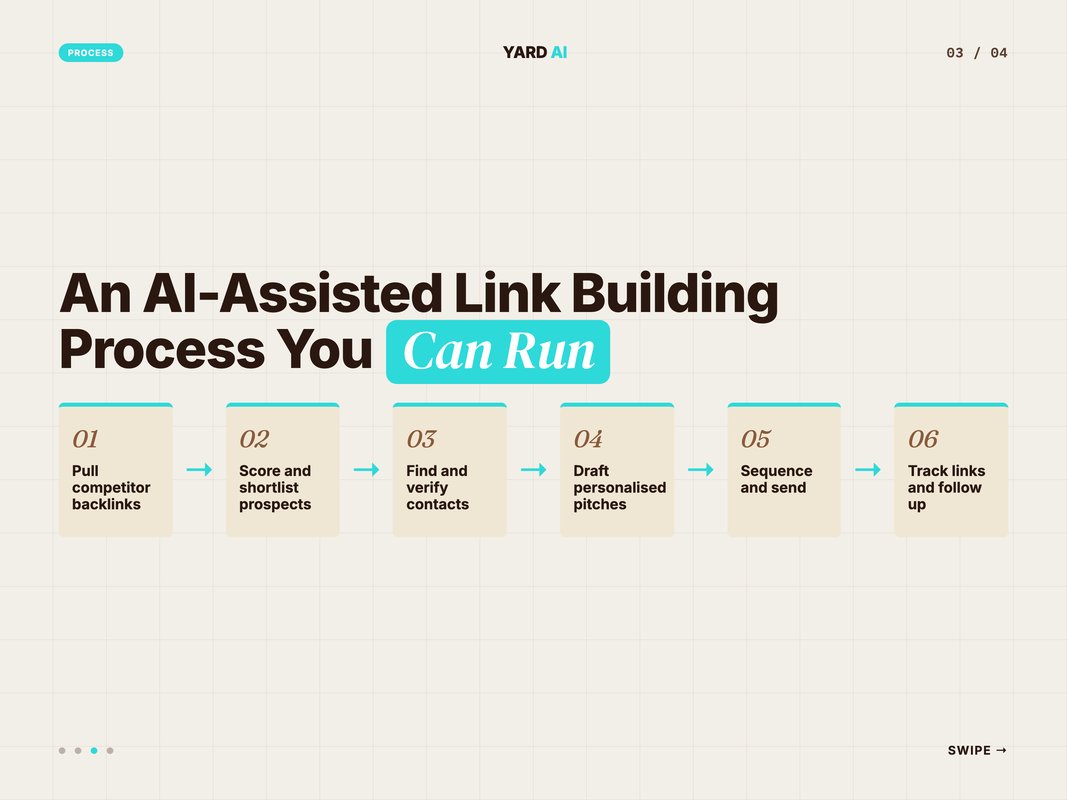
An AI-Assisted Link Building Process You Can Run
Theory is easy. Here is the process. Run these six steps.
- Pull competitor backlinks. Use an AI SEO tool to export rivals' referring domains. Filter for relevant, high-trust sites.
- Score and shortlist prospects. Let AI rank targets by relevance and authority. Drop anything off-topic.
- Find and verify contacts. Use an email finder, then a verifier. Protect your sender reputation.
- Draft personalised pitches. Prompt your AI with the site, the editor, and your angle. Edit every line.
- Sequence and send. Load pitches into an outreach platform. Cap volume to stay human and deliverable.
- Track links and follow up. Monitor placements and link status. Nudge non-responders once, politely.
This layered stack is how strong teams work now. AI to research, an LLM to draft, a platform to manage sends.
Let me unpack a few steps. Step one sets your whole campaign. Good prospects make everything downstream easier.
Step three protects your reputation. Verify every email first. A clean list keeps you out of spam folders.
Step four is where AI shines. But never send a raw AI draft. Edit each pitch for the specific site.
Step six closes the loop. Most links come after a polite nudge. One follow-up is enough.
One caution. Do not mass-blast. Mass automation kills deliverability and burns domains.
The teams that win treat outreach as a pipeline. Clean data. Real personalisation. Reputation safeguards on every send.
Speed without quality fails fast. So pace your sends. Keep volume human. Let relevance lead.
Q: What is the first step in AI link building?
A: Start with competitor backlinks. Export their referring domains with an AI SEO tool. Filter for relevant, trusted sites. That gives you a warm prospect list before you draft a single pitch.
Old Link Building vs AI-Native Link Building
The mindset shift matters as much as the tools.
Old link building chased volume. AI-native link building chases relevance and proof.
The table below maps the change. Read it as a direction, not a rulebook.
| Old Link Building | AI-Native Link Building |
|---|---|
| Maximise link count | Maximise relevant authority |
| Manual prospecting | AI-scored prospect lists |
| Generic mass pitches | Personalised, edited pitches |
| Links only | Links plus brand mentions |
| Rank in SERPs | Rank plus AI Overview citations |
| Guest posts at scale | Digital PR and original data |
Notice the last two rows. AI search visibility is now part of off-page work.
Your brand must appear inside AI answers. That comes from citations, mentions, and data others reference.
So treat AI engines as a new audience. Feed them clean, citable, original proof.

Q: What is the difference between old and AI-native link building?
A: Old link building chased link volume with manual, generic outreach. AI-native link building scores prospects, personalises pitches, and adds brand mentions and AI citations. The aim shifts from raw links to trusted authority.
Your Off-Page SEO 2026 Checklist
Strategy fails without execution. Use this checklist to stay on track.
Run it monthly. Tick each box before you call a campaign done.
- Audit your backlink profile and disavow toxic links.
- Export and filter competitor referring domains for relevance.
- Score every prospect by authority and topical fit.
- Verify all contact emails before any outreach send.
- Personalise each pitch with a site-specific angle.
- Cap daily send volume to protect deliverability.
- Publish one original-data asset worth citing.
- Track unlinked brand mentions and request links.
- Check whether AI answers cite your brand.
- Report links earned, mentions gained, and citations won.
Keep the list short and honest. A clean ten-point loop beats a messy hundred-item plan.
The point is rhythm. Same checklist, every month, slowly compounding authority.
Q: What should be on an off-page SEO checklist?
A: Audit links, filter prospects, verify contacts, and personalise pitches. Cap send volume, publish original data, track mentions, and check AI citations. Then report links, mentions, and citations together each month.
How YARD Approaches AI Link Building
We are an AI-first growth marketing agency. Off-page SEO is part of our SEO and content work.
We build link and mention systems, not one-off blasts. AI handles prospecting and drafting. Our team owns strategy and approval.
Our stack pairs AI research with human editorial judgment. We use Claude and MCP workflows to score prospects fast. Then a person reviews every angle and send.
We focus on relevance over volume. A few trusted, on-topic links beat a flood of weak ones. The data backs this approach.
We also build for AI search. Original data, clean entity signals, and citable assets help brands appear inside AI answers. That is where off-page SEO 2026 is heading.
We have seen this play out across clients. A D2C brand we work with leaned into original data. One small study earned links from several trusted sites.
The same brand started showing up in AI answers. Mentions compounded month over month. Authority followed.
That is the pattern we chase. Fewer links, more relevance, steady mentions. AI does the heavy lifting on research.
This is performance marketing, LLM SEO, AI creatives, and AI funnels for D2C and B2B brands. Off-page authority sits inside that wider system.
If your link building feels slow or random, there is a better way. See our AI SEO strategy guide. [internal link: ai-seo-strategy-guide].
Conclusion: Authority Wins in 2026
Off-page SEO 2026 rewards authority, not noise.
Links still matter. But relevance, mentions, and AI citations matter just as much now. The brands that win build all four.
AI link building is your force multiplier. It cuts the grunt work and sharpens your targeting. You stay in control of strategy.
Start with the 4-P framework. Run the six-step process. Work the checklist monthly.
Then watch authority compound. Want help building a system that scales? Talk to our team. [internal link: contact-yard-agency].
FAQ
Q: What is off-page SEO in 2026? A: Off-page SEO in 2026 is every signal that builds your authority away from your own site. It includes backlinks, brand mentions, digital PR, and citations inside AI answers. The goal shifted from link volume to trusted, relevant authority that both Google and AI engines reward.
Q: Do backlinks still matter for SEO in 2026? A: Yes. Backlinks remain a core ranking signal. Top-ranking pages carry far more backlinks than pages below them. Pages with at least one link rank in the top 10 much more often. Relevance and quality now matter more than raw count.
Q: How does AI help with link building? A: AI speeds up prospecting, qualifies link targets, and drafts personalised pitches. It scans backlink profiles, flags toxic links, and matches your angle to each publisher. You still approve every send. AI removes the grunt work, not the judgment.
Q: What is the best link building tactic in 2026? A: Digital PR leads. In a 2026 survey of 518 SEO experts, 48.6% named digital PR the most effective tactic, far ahead of guest posting at 16%. Original data and linkable assets earn the most citations from both editors and AI engines.
Q: Are brand mentions without links useful for SEO? A: Yes. Unlinked brand mentions help build entity authority and trust. Google and AI engines track how often your brand appears across the web, even without a clickable link. Consistent mentions raise your odds of being cited in AI answers.
Q: Can AI fully automate link building outreach? A: No, and you should not let it. AI can draft, sequence, and track outreach, but mass automation hurts deliverability and reputation. The best teams run AI as a co-pilot with human review on prospects, angles, and final sends.
Insights from Our Experts
Explore our latest articles on digital marketing strategies.