
Most hotel marketing still pays a 20% tax to OTAs.
That math is broken. Performance marketing for hotels closes the gap. You bid where intent lives. You attribute to booked revenue. You build a direct channel that compounds.
This guide is the full playbook. Channels, KPIs, the OTA vs direct math, the funnel, and the campaign hygiene checklist your team can ship Monday. We pulled the numbers from Skift, Phocuswright, Google, Expedia Group, CoStar, and Statista. Every stat is live-linked. The frameworks are the ones we run on hospitality accounts every week.
If your goal in 2026 is more direct bookings at a lower blended cost, start here.
What Performance Marketing for Hotels Actually Means
Performance marketing for hotels is paid acquisition tied to booked revenue.
Not clicks. Not reach. Bookings.
You set a target ROAS or cost per booked room night. You bid on metasearch, paid search, paid social, and programmatic. You attribute every confirmed reservation back to a touchpoint. Then you cut what does not work and double down on what does.
This is the opposite of "always-on display." It is also the opposite of dumping budget into OTAs. Both have a place. Neither is performance marketing.
The size of the prize is real. The global hotel market sits at about 2 trillion US dollars in 2026 (Source: Fortune Business Insights, 2026 — hotel market report). About 65% of all global travel bookings now happen online (Source: Statista, 2024 — digitalization of travel). That is the demand pool you are bidding into.
The catch is cost. OTA commissions run 15% to 30% of room revenue (Source: StayFi, 2026 — OTA fees in-depth guide). Direct bookings cost a hotel closer to 4% to 5% at maturity (Source: StayFi, 2026 — OTA fees in-depth guide). The job of performance marketing is to shift the mix.
Q: Is performance marketing the same as paid ads?
A: No. Paid ads are one tool. Performance marketing is the system: bids, attribution, creative, and CRM all tuned to booked revenue. Run paid ads without the system and you spend more for the same bookings.
The State of Hotel Demand in 2026
Read the room before you spend a rupee or a dollar.
Travel demand is steady. Not booming. CoStar and Tourism Economics expect US RevPAR to grow about 0.6% in 2026, with ADR up 1% and occupancy slipping to 62.1% (Source: Hotel Dive / CoStar, 2026 — US RevPAR forecast). Europe is forecast at 1.1% RevPAR growth and the Middle East at 4.2% (Source: Hotel Dive / CoStar, 2026 — US RevPAR forecast).
That is a margin story, not a volume story.
If ADR is doing most of the lifting, every direct booking matters more. You keep more of each rupee. You also get the data.
OTAs are not going away. They generated about 408 billion US dollars in gross bookings recently (Source: Phocuswright via PhocusWire, 2026 — Travel Forward research). But hoteliers want the mix to shift. Surveys cited by Skift show hotels want OTA share to drop from 25% to 13% and direct digital to climb from 25% to 42% (Source: Skift, 2026 — direct booking tug-of-war).
That gap is the whole opportunity.
Q: Why are 2026 RevPAR gains so thin?
A: Supply caught up to demand in many markets. Leisure has normalised. Group travel is recovering. Hotels now grow profit through rate and channel mix, not occupancy alone. Performance marketing is one of the few levers that still moves both.
The 5-Funnel Model for Hotel Performance Marketing
Use this model to plan every campaign. It maps spend to traveler intent.

The funnel has five stages. Each stage has a job, a channel, and a metric.
- Inspire. Capture the dreamer. Run paid social, Pinterest, YouTube, and influencer content. Measure cost per landed session.
- Research. Capture the planner. Run SEO, content, and broad-match brand search. Measure time on site and email opt-ins.
- Decide. Capture the shopper. Run Google Hotel Ads, Trivago, and TripAdvisor metasearch. Measure look-to-book ratio.
- Book. Capture the buyer. Run brand search, retargeting, and Performance Max for travel goals. Measure ROAS and cost per booked room night.
- Return. Capture the past guest. Run CRM, email, SMS, and lookalike audiences. Measure repeat rate and LTV.
Travelers do not move in a straight line. Expedia Group research found the average path to purchase is 71 days, with 33 days for inspiration and 38 days for research and planning (Source: Expedia Group, 2024. path to purchase research). Travelers view 141 pages of travel content in the 45 days before booking (Source: Expedia Group, 2024 — path to purchase research).
So you need touch in every stage. Not just bottom-funnel.
Q: Which funnel stage is most underfunded at hotels?
A: Research and return. Most hotels overspend on brand search and OTAs. Mid-funnel content and CRM are where direct share is won. Fix those and your decide-stage CPCs fall on their own.
OTA vs Direct: The Real Math
Stop guessing. Run the numbers.
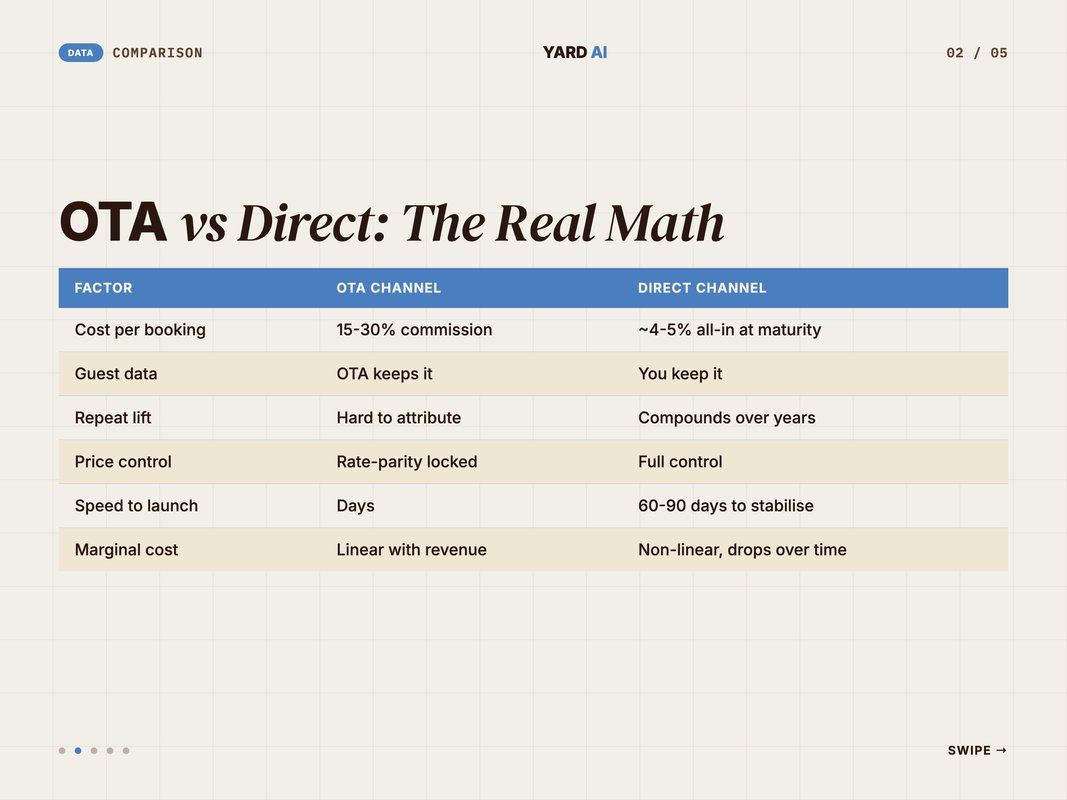
The OTA model is simple. They drive a booking. You pay 15% to 30% commission (Source: StayFi, 2026 — OTA fees in-depth guide). You also lose the guest data. Renewal lift is theirs, not yours.
Direct is harder to start. It is cheaper at scale. Hotels keep about 96% of guest-paid revenue from direct bookings versus 82% from OTAs (Source: Americas Great Resorts, 2026. luxury direct booking strategy).
Here is the side-by-side.
- Cost per booking. OTA: 15–30% commission. Direct: about 4–5% all-in at maturity.
- Guest data. OTA keeps it. Direct: you keep it.
- Repeat lift. OTA: hard to attribute. Direct: compounds over years.
- Price control. OTA: rate-parity locked. Direct: full control.
- Speed to launch. OTA: days. Direct: 60–90 days to stabilise.
- Marginal cost. OTA: linear with revenue. Direct: non-linear, drops over time.
That last point matters most. OTA costs scale linearly with revenue. Every ADR rise costs you more commission. Direct costs flatten as bidding models learn and CRM volume grows.
Phocuswright research backs this up: 18% of OTA-starters now convert to direct on a future stay, a 3.3 point jump (Source: Phocuswright via PhocusWire, 2026 — Travel Forward research). That is the flywheel performance marketing is feeding.
Q: Should I cut OTAs entirely?
A: No. Use them as a paid billboard. Let them fill rooms you would not have filled otherwise. Just stop relying on them for repeat guests. That is what direct is for.
The Channel × KPI Matrix for Hotels
Every channel has one job. Track one KPI for that job.
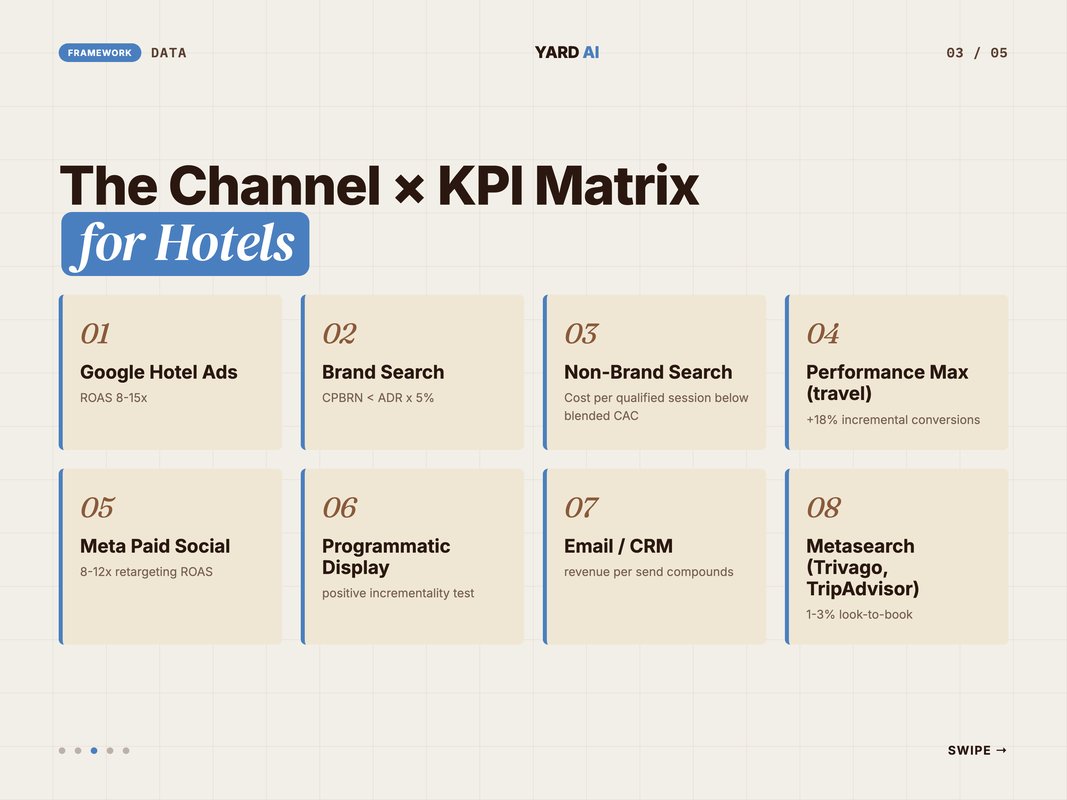
Pick a primary KPI per channel and stop chasing the rest.
- Google Hotel Ads (decide and book stages). Primary KPI: ROAS. Realistic target: 8–15x.
- Brand Search (book stage). Primary KPI: cost per booked room night. Target: under your ADR times 5%.
- Non-Brand Search (research and decide). Primary KPI: cost per qualified session. Target: below blended CAC.
- Performance Max for travel (cross-funnel). Primary KPI: booked revenue. Target: 18% incremental lift.
- Meta Paid Social (inspire and return). Primary KPI: cost per landed session and retargeting ROAS. Target: 8–12x on retarget.
- Programmatic Display (inspire stage). Primary KPI: view-through booking lift. Target: positive incrementality test.
- Email and CRM (return stage). Primary KPI: revenue per send. Target: compounds month over month.
- Metasearch on Trivago and TripAdvisor (decide stage). Primary KPI: look-to-book ratio. Target: 1–3%.
Google Hotel Ads is the heavyweight. It now captures over 30% of all hotel metasearch traffic globally (Source: ThePercentage, 2026 — metasearch guide). Performance Max for travel goals reports an average 18% lift in incremental conversions at similar CPA (Source: Google Ads Help, 2026. Performance Max travel goals). The Hotel Ads conversion rate averages 3.55% versus 4.72% on standard paid search (Source: ThePercentage, 2026 — metasearch guide).
Use the matrix as a planning tool. If a channel cannot hit its primary KPI in 60 to 90 days, kill it or rebuild creative.
Q: How many channels should a small hotel run?
A: Three to start. Brand search, Google Hotel Ads, and Meta retargeting. Add metasearch and CRM at month two. Add non-brand search and Performance Max once the first three are profitable. Layer, do not blast.Quick Facts: Hospitality Performance Marketing at a Glance
- The global hotel market is about 2 trillion US dollars in 2026 — (Source: Fortune Business Insights, 2026 — hotel market report).
- 65% of all global travel bookings now happen online — (Source: Statista, 2024 — digitalization of travel).
- OTA commissions run 15% to 30% per booking — (Source: StayFi, 2026 — OTA fees guide).
- Direct bookings cost hotels about 4% to 5% at maturity — (Source: StayFi, 2026 — OTA fees guide).
- Performance Max for travel goals delivers about 18% incremental conversions — (Source: Google Ads Help, 2026 — PMax for travel).
- The average path to purchase for a trip is 71 days — (Source: Expedia Group, 2024 — path to purchase).
- US RevPAR is forecast to grow 0.6% in 2026 — (Source: Hotel Dive / CoStar, 2026 — RevPAR forecast).
These are the numbers we anchor every hotel media plan against. Pin them to the wall.
Q: What is the single most important hospitality stat in 2026?
A: The 15–30% vs 4–5% gap between OTA and direct cost. Every other metric flows from closing that gap.
The Booking Funnel Process Flow
Here is the exact campaign sequence we run for a new hotel account.
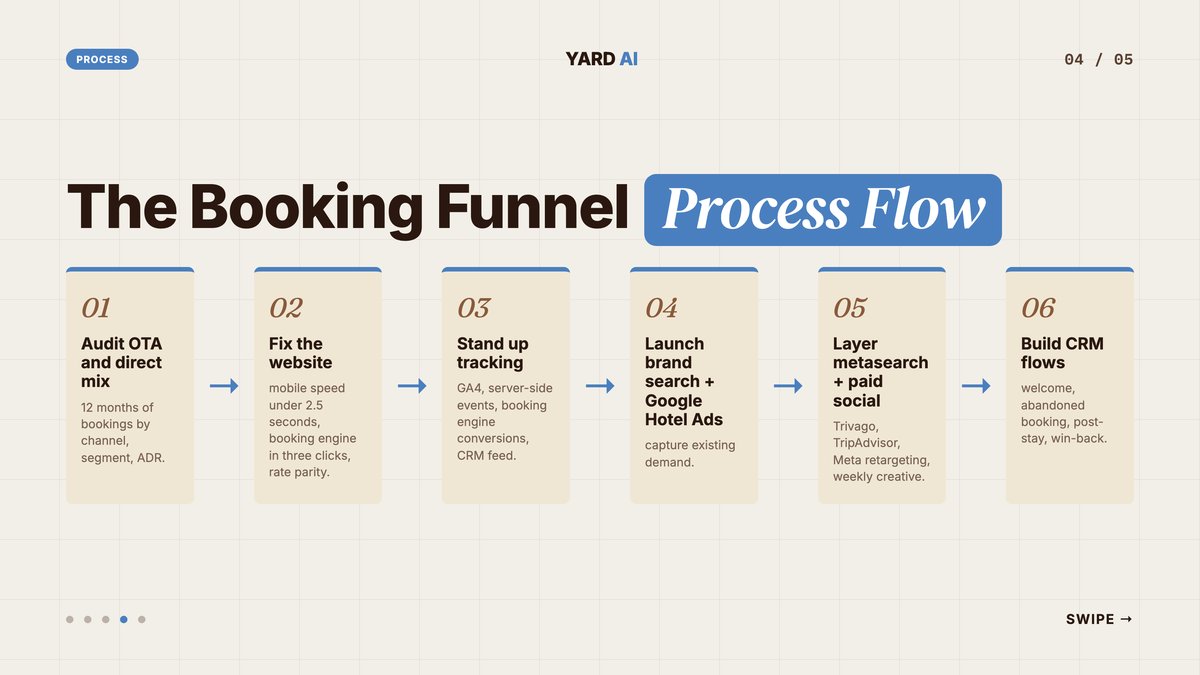
Six steps. Run them in order.
- Audit the OTA and direct mix. Pull 12 months of bookings. Split by channel, segment, and ADR. Find the OTA share you want to claw back.
- Fix the website. Mobile speed under 2.5 seconds. Booking engine in three clicks. Direct rate parity or better. The average hotel site converts at 2–3%; top sites hit 4–5% (Source: ROI300, 2026 — direct booking strategy).
- Stand up tracking. GA4, server-side events, booking engine conversions, and a clean CRM feed. Without this, attribution is fiction.
- Launch brand search and Google Hotel Ads first. Capture the demand already searching for you. These should hit positive ROAS in week one.
- Layer metasearch and paid social. Trivago, TripAdvisor, Meta retargeting. Test creative weekly. Cut what does not move.
- Build CRM flows. Welcome, abandoned booking, post-stay, win-back. Email and SMS turn first stays into LTV.
Skip step two and the rest will not work. The website is the conversion engine. Bids only move pre-qualified traffic to a page that already converts.
Q: What is the most common launch mistake?
A: Spending on paid social before fixing the site. You pay for clicks. The clicks bounce. You blame the channel. The channel was fine. The site was the problem.
Campaign Hygiene Checklist
Run this every week. It saves more money than any new tactic.
- Pull the search terms report. Cut every query with cost and zero bookings in the last 30 days.
- Check rate parity across OTA, brand site, and metasearch. Direct must match or beat OTA price.
- Refresh ad creative weekly. Two new images, one new headline, one new offer.
- Audit Google Hotel Ads bid strategy. Switch any commission-based campaign to Performance Max for travel goals if you have not already (Source: Google Blog, 2024 — Performance Max for travel goals).
- Verify GA4 booking conversions match your PMS. A 5%+ gap means a tracking leak.
- Score the funnel by channel. Drop budget from anything missing its primary KPI for two weeks running.
- Test one new audience per week. Lookalike, interest, geo, or seasonal segment.
- Update CRM segments. Past guests by season, ADR, length of stay, and lead time.
- Probe page speed. Mobile under 2.5 seconds, no exceptions.
- Review OTA dependency share. The number should trend down month over month.
Treat the checklist like preflight. Skipping it is how a hotel ends up paying for traffic that books on Booking.com.
We have run this checklist on accounts of every size. The pattern is identical. The first week kills 10% to 15% of waste. The next month tightens another 10%. By month three you are running a leaner book at the same revenue. Some hotels turn the savings into more direct campaigns. Others pocket the margin. Either way, the work compounds.
A small note on cadence. The weekly review is a meeting, not an audit. Keep it tight. 45 minutes. One scorecard. Three actions. Push deeper work into the monthly review.
Q: How long does the weekly review take?
A: 30 to 60 minutes if your dashboards are set up. Most hotels skip it because nobody owns it. Assign one person, one calendar slot, one shared report.
How AI Is Changing Hotel Performance Marketing
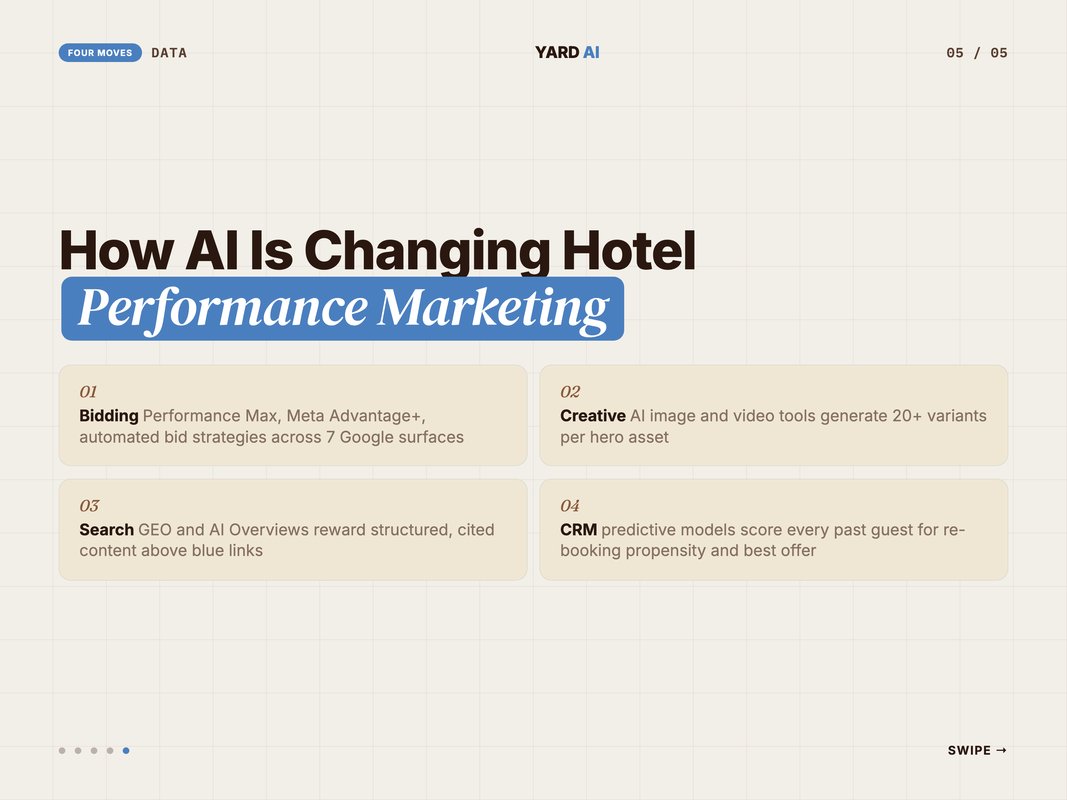
AI now sits between every bid, every creative, and every guest message.
Bidding is already AI-led. Performance Max chooses placements, creative, and audiences across seven Google surfaces (Source: Google Blog, 2024 — Performance Max for travel goals). Meta Advantage+ does the same on Facebook and Instagram. The human job has shifted from manual bid edits to asset feeding and outcome design.
Creative is shifting too. AI image and video tools turn one hero shot into 20 ad variants. Hotels that ship more creative win more impressions. Stale creative is the new hidden tax.
Generative search is the next wave. AI Overviews now sit above the classic SERP for travel queries. Your content needs to feed those answers, not just the blue links. That is GEO — generative engine optimisation. It rewards structured content, cited sources, and clear answers in the body.
CRM is also smarter. Predictive models score every past guest for re-booking propensity, ideal offer, and best channel. The CRM tells the ad platform who to target. The flywheel tightens.
Q: Will AI replace hotel marketers?
A: It will replace the parts that should not have been human anyway. Manual bid edits, A/B copy tests, audience math. Strategy, brand, and guest experience still need a human in the loop. Use AI to free up time for the parts that need taste.
One more shift worth naming. First-party data is the new moat. Cookies are gone or going. iOS limits tracking. Browser-level signals shrink each year. The hotels that pull guest emails, phone numbers, and stay history into a real CRM win on every front. They feed Meta and Google with hashed audiences. They retarget without leaking to OTAs. They build lookalikes that actually book.
Loyalty programs are part of this. So is post-stay email. So is a clean PMS feed into your ad platforms. Skip any one of these and your AI bidder learns slowly. Worse, it learns the wrong signals.
Even with AI doing the heavy lifting, most hotel media still wastes 20% to 40% of spend. The reasons repeat.
The first is over-indexing on brand search. You pay for traffic that would have come anyway. Some brand spend is needed for defensive coverage against OTAs bidding on your name. Most hotels overdo it.
The second is letting OTAs bid on your brand terms. Audit this monthly. Force partners to remove your brand from their keyword list. It is in your contract. Use it.
The third is ignoring metasearch entirely. Google Hotel Ads is non-negotiable in 2026 (Source: Mediaboom, 2026 — hotel ad campaigns). Skip it and you let OTAs take demand that was browsing your property by name.
The fourth is treating paid social as a brand channel. Run it with conversion goals, not reach. Retargeting on Meta still hits 8–12x ROAS when set up correctly (Source: Mediaboom, 2026 — hotel ad campaigns).
The fifth is no CRM. The first stay is expensive. The second, third, and fourth are nearly free. Without CRM, you keep paying acquisition cost for guests you already won.
Fix these five and you free 25% to 40% of budget for net-new tests. That alone usually pays for the team.
Q: What is the fastest way to find waste in a hotel ad account?
A: Pull the 90-day search terms report. Sort by spend. Cut everything with cost and zero conversions. You will find 10% of budget in 20 minutes.
Working With an AI-First Marketing Partner
A great hospitality account needs four things at once: bids, creative, CRM, and analytics. Most agencies do one well and three poorly.
YARD Agency is an AI-first growth marketing agency. We run performance marketing, LLM SEO, AI creatives, and AI funnels for D2C and B2B brands. The hospitality clients we have worked with sit in resort, city hotel, and destination categories.
What we do for hotel accounts:
- Direct-first media plans across Google Hotel Ads, brand search, metasearch, Meta, and CRM.
- Server-side tracking and GA4 conversion audits so attribution holds up.
- AI-led creative pipelines that ship 10x more ad variants per week than a traditional studio.
- LLM-SEO and GEO so your property shows up in AI Overviews and ChatGPT travel answers.
- CRM flows tied to PMS and booking engine data, not just email lists.
The work is built around one goal: more direct revenue at a lower blended cost than your OTA channel. We measure it in cost per booked room night, blended CAC, and the OTA dependency share trending down quarter over quarter.
Run a hotel, resort, or lodging brand? Book a 30-minute audit of your current channel mix. We will name the three highest-impact changes inside the first 15 minutes.
See also: [internal link: how-ai-is-rewriting-paid-search-2026].
Q: Do we need an agency to run performance marketing?
A: Not always. A senior in-house team plus the right stack can work. An agency makes sense when you need pace, creative volume, and tooling without hiring four roles. Pick the option that gets you to first-party data fastest.
Conclusion: The Next 90 Days
Performance marketing for hotels is no longer optional in 2026.
The math is too clear. OTAs cost 15% to 30%. Direct costs 4% to 5%. The flywheel rewards every hotel that builds first-party data, smart bids, and tight CRM.
Your next 90 days look like this.
Month one: audit the channel mix, fix the site, stand up tracking, and launch brand search plus Google Hotel Ads. Month two: add metasearch and Meta retargeting, ship weekly creative, and turn on CRM flows. Month three: layer non-brand search, Performance Max, and your first incrementality test. Then start the loop again.
Pin the channel × KPI matrix to the wall. Run the hygiene checklist every Monday. Cut what does not work in 14 days, not 90. Then keep going.
The hotel groups that win 2026 own the guest. The ones that lose still rent guests from a third party. Performance marketing is how you take ownership back.
If you want help building the system, book a 30-minute audit with YARD. We will look at your real numbers and tell you what to fix first.
FAQ
Q: What is performance marketing for hotels? A: It is paid acquisition tied to booked revenue. Not impressions. You bid on metasearch, paid search, paid social, and programmatic. You set a target ROAS or CPA. You attribute to confirmed reservations. You rebuild creative weekly. The goal is more direct bookings at a lower blended cost.
Q: How much should a hotel spend on digital marketing each month? A: A working floor for an independent hotel is about 1,500 to 5,000 US dollars per property. Split it across paid search, metasearch, and paid social. Bigger groups spend more on brand. Budget should be a percent of direct revenue target. Not a fixed line item.
Q: Is performance marketing better than OTA distribution? A: They serve different jobs. OTAs are a billboard with a 15 to 30 percent take rate. Performance marketing builds a direct channel. Direct costs about 4 to 5 percent at maturity. Most hotels need both. Shift the mix toward direct as your stack matures.
Q: What KPIs matter most for hotel performance marketing? A: Track booked revenue, ROAS, cost per booked room night, and blended CAC. Also look-to-book ratio, RevPAR uplift, and OTA dependency share. Impressions and clicks come last. If a channel cannot tie back to a stay, it has no place in the budget.
Q: Which channels drive the most direct bookings for hotels? A: Google Hotel Ads and brand search top the list. Meta retargeting and CRM come next. Metasearch closes high-intent demand. Paid social fills the inspiration phase. Email and SMS recover near-bookers. The full funnel matters more than any single channel.
Q: How long does a hotel performance marketing program take to work? A: Plan for 60 to 90 days to stabilise. Bidding models need bookings to train. Creative needs iterations. CRM needs first-party data flow. By month three you should see direct share rising. Blended CAC trends down. Year-on-year is the real test.
Insights from Our Experts
Explore our latest articles on digital marketing strategies.