
Think about the last time someone on your team said no to an idea because of credits.
Not because it was a bad idea. Because running it on everything would cost too much.
That sentence is the quiet tax on every marketing team using AI. You have the tool. You ration the tool.
On August 25, 2026, Perplexity launched Portable Computer. It runs the whole agent on a machine you own.
Perplexity puts the point plainly. Local work carries no per-credit charge. So people "no longer have to ration what they use intelligence for."
That is the story for marketing teams. Not privacy. The meter.
Here is what shipped and what it costs. Then what it is genuinely good at. Then how to work out whether it pays for itself.
What Perplexity actually shipped
Portable Computer is the same Perplexity Computer product, running on local hardware.
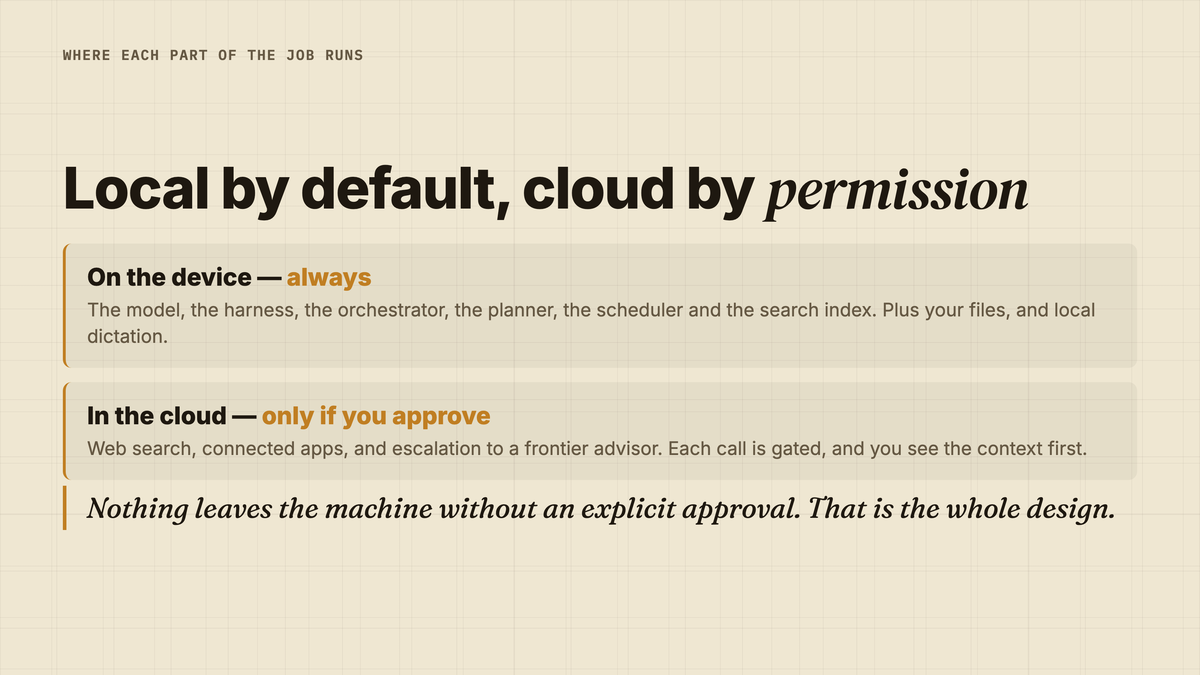
The whole stack sits on the device. Not just the model.
Every moving part of the agent runs locally, and so does the index it searches. The card below splits what stays on the machine from what only moves with your say-so.
It runs Qwen 3.8 27B, or PPLX 27B, which is Perplexity's own post-trained version of that model.
It connects to Google Drive, Gmail, Slack and GitHub. Dictation runs locally too. Code and tools execute in a sandbox.
When a job needs the web or harder reasoning, the local model can ask a frontier model in the cloud for advice. That step is opt-in, and you approve it.
It runs on the NVIDIA DGX Spark, and it is available to Pro and Max subscribers. Linux first. Windows is listed as coming soon.
Q: Is this just a local chatbot?
A: No. It is the full agent loop on your own machine. It reads your files, runs tools, keeps long jobs going, and only reaches the internet when you let it.
Why the meter matters more than the privacy pitch
Every AI tool your team uses today is metered. Per seat, per credit, per token.
That meter quietly writes your creative policy.
It is why nobody generates two hundred ad variants and picks four. It is why nobody runs the last three years of campaign reports through an analysis. It is why "let us just try it on everything" is a sentence people stop saying by month two.
Own the compute and that changes. The marginal cost of the four hundredth run is zero.
The limit stops being budget. It becomes taste. It becomes time. It becomes whether anyone checks the output properly.
That is a much better problem to have.
That is a different conversation to have with a finance team. It is capital expenditure against a monthly bill, not a new subscription line.

We made a related point when Meta open-sourced a local agent earlier this month. That story was about weights you could download. This one is about a finished product with a price tag.
Quick Facts: Portable Computer at a Glance
- Launched 25 August 2026, running the full agent stack on device — (Source: Perplexity, 2026 — launch post)
- Local inference carries no per-credit charge — (Source: Perplexity, 2026 — launch post)
- Scores 82.6% on Perplexity's 53-task knowledge-work benchmark, rising to 85.4% with its own post-trained model — (Source: Perplexity, 2026 — research post)
- Scores 59.6% on hard coding tasks against 82.4% for a frontier model — (Source: Perplexity, 2026 — research post)
- Requires an NVIDIA DGX Spark, listed at $4,699 — (Source: NVIDIA, 2026 — DGX Spark marketplace)
The payback maths, in one table
Here is the only calculation that matters to a marketing director.
The hardware is $4,699. A Perplexity Pro or Max subscription sits on top, and you would be paying that anyway.
So the question is simple. What does your team spend on metered AI each month, and how long does it take that spend to cover the box?
| Your monthly metered AI spend | Months to cover $4,699 | Verdict |
|---|---|---|
| $200 | About 24 | Not yet — stay on subscriptions |
| $400 | About 12 | Borderline; run a pilot first |
| $800 | About 6 | Worth a serious look |
| $1,500 | About 3 | Do the pilot this quarter |
| $3,000 | About 2 | You are already paying for it in rent |
Most agencies and in-house teams have no idea which row they are on. That is the real finding here.
Go and add it up. Every seat, every API key, every credit pack, across every tool. Most teams have never done that sum, and the total surprises them.
Q: Does the box replace our AI subscriptions?
A: No. It absorbs the high-volume, repetitive work. You keep frontier access for the hard problems and for anything needing live web data.
What the benchmarks actually say
Perplexity published real numbers, including the ones that make its product look worse. That is rare, and worth reading properly.
Two benchmarks matter.
| Benchmark | What it measures | Local model | Frontier model |
|---|---|---|---|
| Local Knowledge Work Bench, 53 tasks | Everyday knowledge work | 82.6%, or 85.4% post-trained | Not the comparison |
| Terminal Bench 2.1, 89 tasks | Hard coding and reasoning | 59.6% | 82.4% |
(Source: Perplexity, 2026 — research post)
Read those two rows together and the strategy writes itself.
Day to day work on the device is largely solved. Summarising. Sorting. Drafting. Pulling facts out of files. Lining two things up side by side.
That is most of what a marketing team does with AI.
Hard reasoning is not solved. On the tough benchmark the local model trails by nearly 23 points.
Perplexity says so itself. Its conclusion admits the local model "trails the frontier model across all three harnesses" on hard tasks.
There is a middle path.
Let the local model ask a frontier model for advice. The score climbs from 59.6% to 73.0%. That costs roughly two thirds of what the frontier model costs alone. The frontier model in that test was Claude Opus 5.
So you recover about three fifths of the gap. And you decide each time whether it is worth paying for.
Which marketing work moves on-device
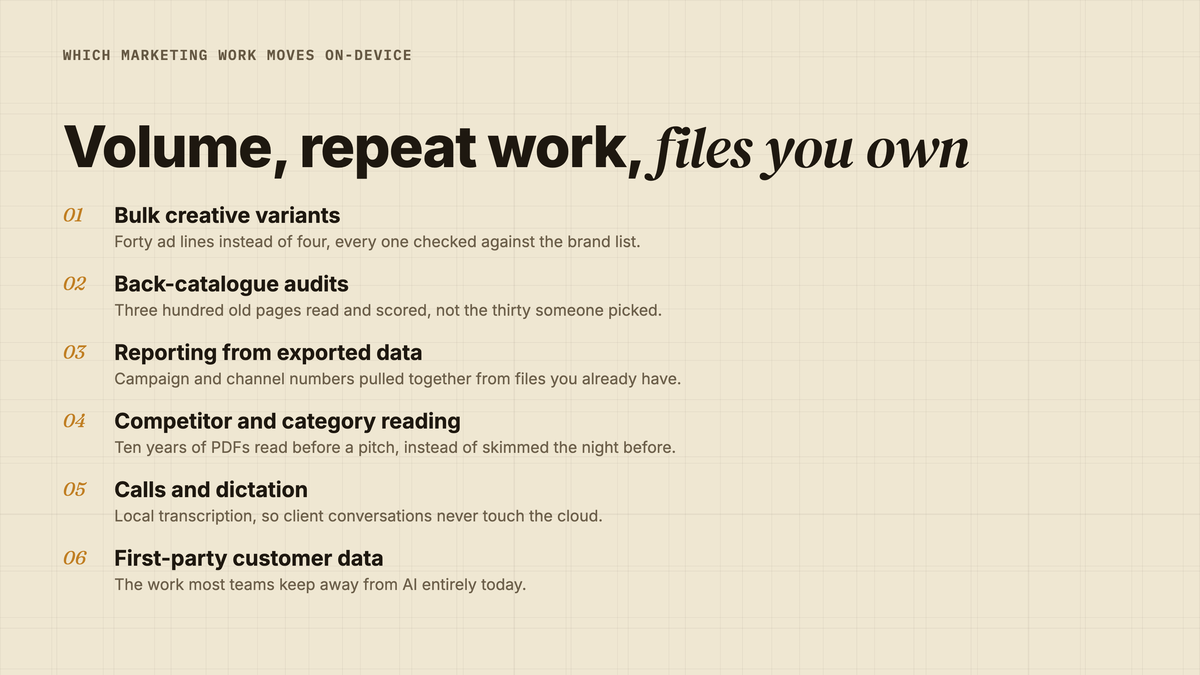
The pattern is volume, repeat work, and files you already have.
Think about a launch week. You need forty ad lines, not four. You need every one of them checked against the brand list.
Think about an audit. Three hundred old blog pages. Someone has to read them all and score them.
Think about a pitch. Ten years of a category, sitting in PDFs nobody has opened.
None of that is glamorous. All of it eats hours. And all of it is rationed today, because the meter is running.
Q: What should stay on frontier models?
A: Genuinely hard thinking. Strategy, positioning, novel analysis, anything that needs live web data, and anything where being wrong is expensive.
Client work stays in the building
If you run an agency, you sign things. Non-disclosure agreements, data processing terms, security questionnaires.
Portable Computer changes that conversation, because nothing leaves the machine unless someone approves it.
The design is careful here.
Before any cloud escalation, the system picks the context. It runs a classifier to flag personal information. Then it shows you exactly what would leave the device.
The cloud model returns text advice only. It never touches your files or tools.
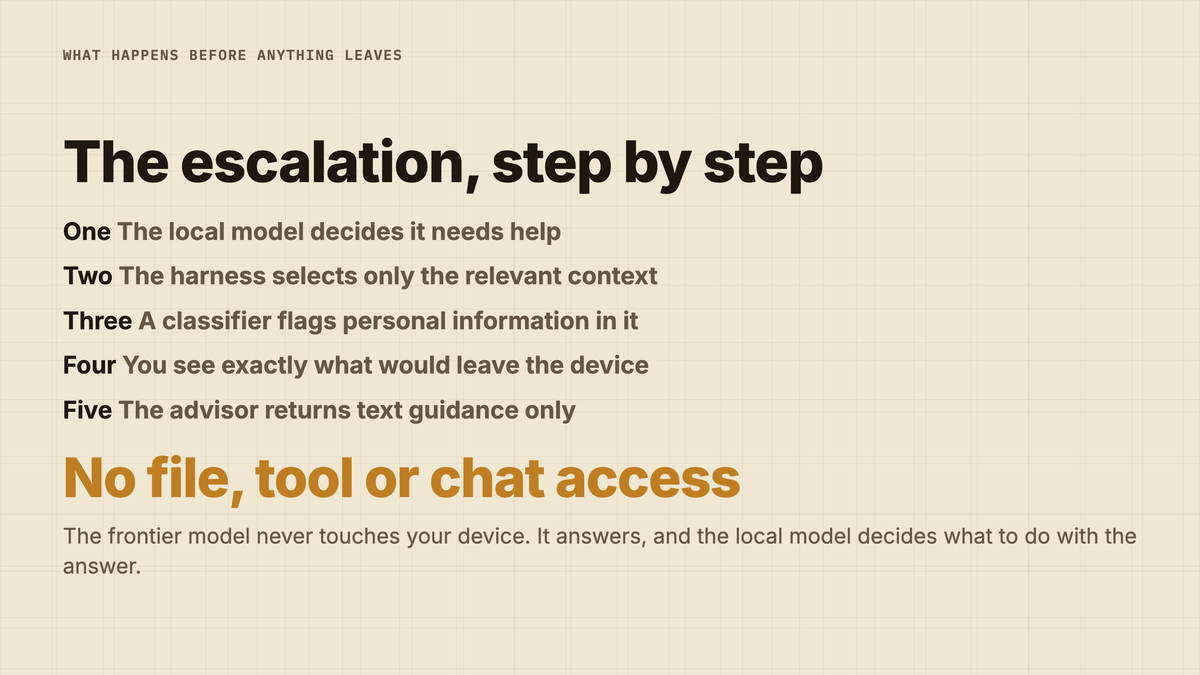
That unlocks work most teams currently keep away from AI entirely. Unreleased campaigns. First-party customer data. Client commercials.
We covered the disclosure side of this when Anthropic committed to watermarking and file provenance. Control over what leaves the building is becoming a feature people buy.
There is a sales angle here too. Enterprise clients ask how you handle their data. Right now most agencies answer with a policy document. Being able to answer with a machine is a stronger card to hold.
Q: Does this help us win security reviews?
A: It helps. You can show where the work runs and what leaves the device. It does not replace your data terms, and you still need a written escalation policy.
What this does not do
This is the section that decides whether you can act this quarter.
It is not free. It is $4,699 of hardware plus a subscription. Capex, not magic.
It is not on your laptop. It needs a DGX Spark. Linux at launch, with Windows and NVIDIA RTX PCs listed as coming. If your team is Mac-only, this is a watch item today, not a purchase.
It is not frontier-grade. The local model is 27B. On hard tasks it is well behind.
The benchmarks are self-reported. Perplexity ran them, and one of the two is a benchmark Perplexity built. No independent replication yet.
"No credits" means local only. Every cloud escalation bills again.
The connectors lean developer. Drive, Gmail and Slack are the three that matter to a marketing team. GitHub is not.
How to evaluate it in two weeks
You do not need a business case to start. You need one number and one list.
- Log every rupee or dollar of AI spend across the team for one week. Every seat, key and credit pack.
- Multiply by four. That is your monthly run-rate, and it is usually higher than anyone guessed.
- List the five jobs your team currently rations because of cost.
- Sort that list into everyday knowledge work and genuinely hard reasoning.
- Divide $4,699 by your monthly spend. That is your payback in months.
- If it pays back inside a year and you are not Mac-only, run one pilot workload for a fortnight.
Then compare like for like. Same job, same week, on the box against your current stack.
Score three things. Quality of the output. Time to finish. Cost to run.
If the box wins on two of the three, you have your answer.
The policy to write before the box arrives
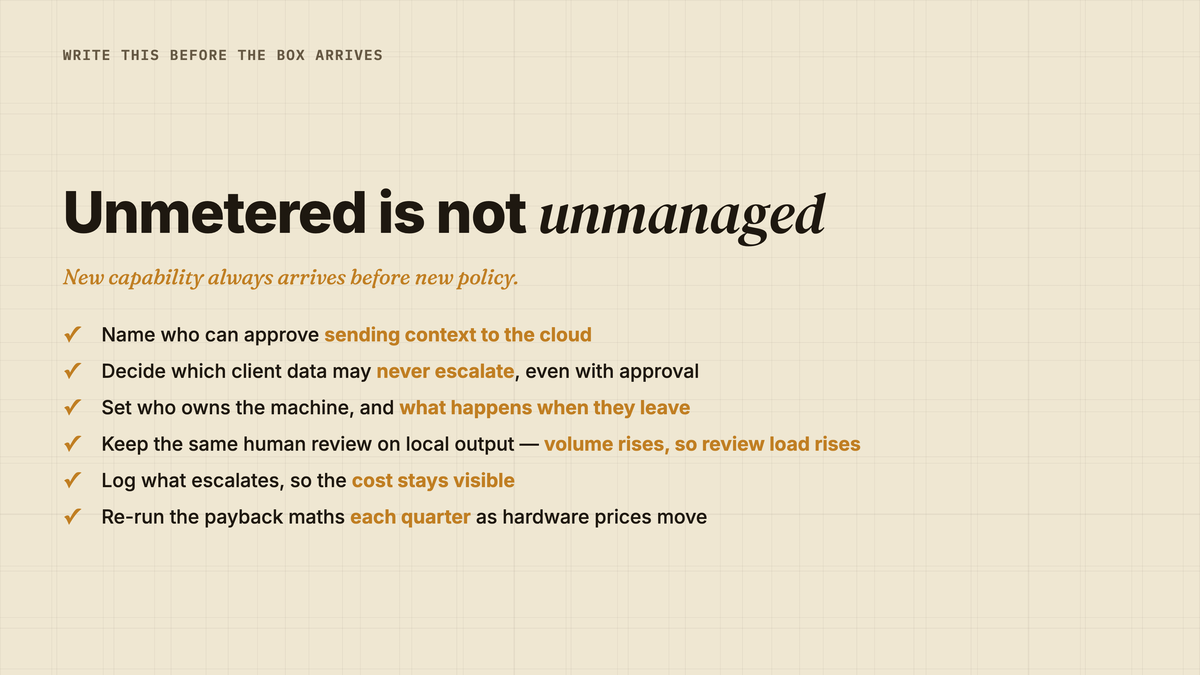
The fifth one catches people out. Unmetered does not mean unmanaged.
When output stops costing money, volume goes up, and review becomes the bottleneck instead of budget. Plan for that before it happens.
The YARD take
The interesting shift here is not that AI got private. It is that AI got a fixed price.
For three years every marketing team has run AI on a taxi meter. You watch the number. You make small decisions to keep it down. Those small decisions compound into a team that tests less than it should.
A box you own changes the shape of that. The cost is decided once, in a purchase order, instead of a thousand times, in people's heads.
That will not suit everyone yet. It is Linux, it is $4,699, and the model is not frontier. For plenty of teams the honest answer this quarter is to watch it.
But go and add up your monthly AI spend anyway. Even if you buy nothing, that number is worth knowing.
At YARD we build AI creative and AI workflow pipelines for brands. So we spend a lot of time on exactly this trade.
What belongs on a cheap model. What needs a frontier one. What should never leave a client's building.
Want that mapped against your own stack and your own numbers? That is the work we do.
FAQ
What is Perplexity Portable Computer? It is a version of Perplexity Computer that runs entirely on your own machine. The model, harness, orchestrator and search index all sit on the device.
What hardware does it need? An NVIDIA DGX Spark, listed at $4,699. NVIDIA RTX GPU PCs are listed as coming soon. The first release is Linux only.
Does local work really cost nothing? Local inference carries no per-credit charge. You still pay for the hardware and a Perplexity Pro or Max subscription, and any cloud escalation bills separately.
How good is the local model? It scores 82.6% on Perplexity's 53-task everyday knowledge-work benchmark. On hard coding tasks it scores 59.6% against 82.4% for a frontier model.
Is my data safe from the cloud? Nothing leaves without approval. Before an escalation the system flags personal information and shows you the exact context that would be sent.
Should a marketing team buy one today? Only if the payback works. Divide $4,699 by your monthly metered AI spend. Under twelve months, pilot it. Over twenty-four, wait.
What should we run on it first? Your highest-volume, most repetitive job. The one someone already refuses to run on everything because of cost.
Sources
- Perplexity — Introducing Portable Computer (25 August 2026; primary source for the product, connectors and availability)
- Perplexity — A Local-First Agent for Private and Cost-Effective Knowledge Work (25 August 2026; benchmark figures)
- NVIDIA — DGX Spark (hardware specification)
- NVIDIA — DGX Spark marketplace listing (price, checked 26 August 2026)
Insights from Our Experts
Explore our latest articles on digital marketing strategies.