
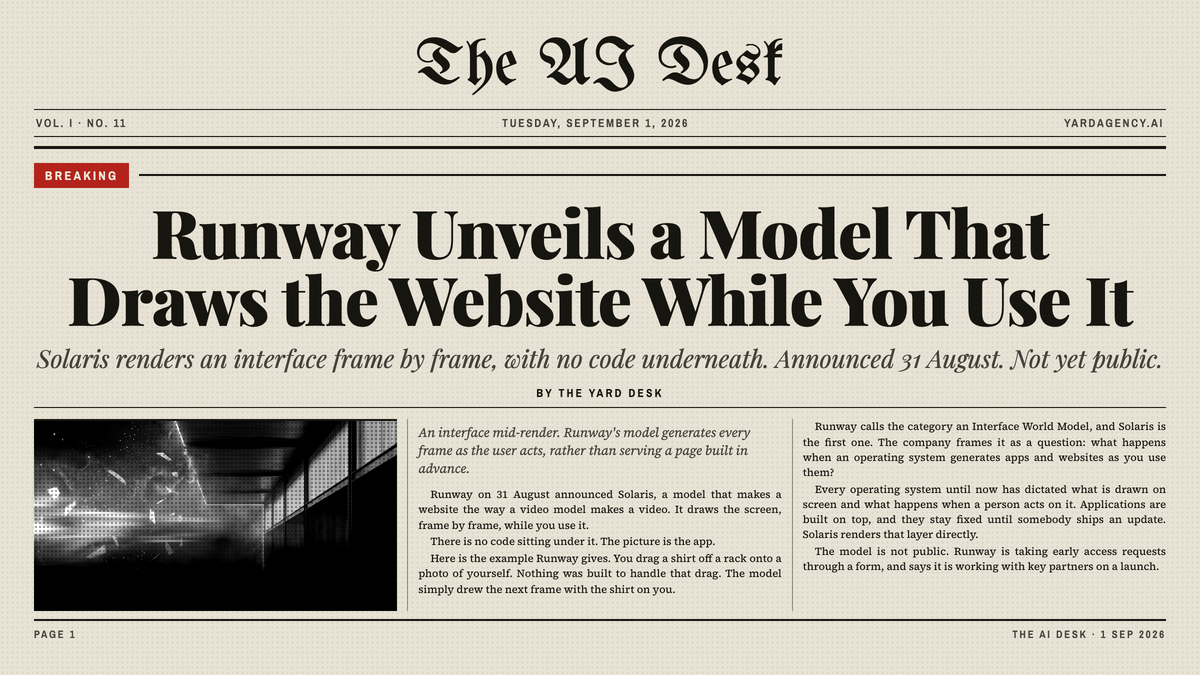
On 31 August 2026, Runway put out a model called Solaris.
Solaris makes a website the way a video model makes a video. It draws the screen, frame by frame, while you use it.
There is no code sitting under it. The picture is the app.
That is an odd sentence, so here is a plain example.
Picture a clothing shop online. You drag a shirt off the rack onto a photo of yourself. Nothing was built to handle that drag.
The model just drew the next frame with the shirt on you.
Runway calls this an Interface World Model. Solaris is the first one.
It is not out yet. There is a form to ask for early access. Runway says it is working with partners on a public launch.
So this is not a tool you can open today. It is a signal about where your site is headed.
Here is what shipped, what the numbers say, and the one question it leaves wide open for marketers.
What Runway actually shipped
Solaris is a live model that draws a screen while you use it.
Runway built it on Gen-4.5, its video model. It follows the path Runway opened with GWM-1, its world model (Source: Runway, 2026 — Introducing Solaris).
Every click and drag you make goes back into the model. The model uses it to pick what the next frame looks like.
That is the whole trick. No action is written down first. It is drawn on demand.
Think about what that removes. There is no button that had to be wired up. There is no state that someone had to store.
The model has watched enough of the world to know what a drag should do. So it draws it.
Runway says Solaris runs at 720p and holds live speed. It also notes that things stop feeling live at about half a second of lag (Source: Runway, 2026 — Building Runway Characters).
Half a second sounds small. It is the whole game here.
A video model can take a minute to make a clip. That is fine for an ad. It is useless for a screen you are touching.
Q: Is Solaris a video tool?
A: No. It borrows video methods, but the output is a screen you click and drag, not a clip you watch.
How software with no code underneath works
Normal software has two steps. A designer makes a mockup. Someone turns that mockup into code.
Runway's case is that the second step loses things.
Every action has to be spelled out before a user shows up. So the finished site only does what someone thought of first.
Runway calls this "a lossy compression of the space of possible interactions."
Strip the jargon and it is simple. Your site can only do what was on the list.
Detail gets lost too. A rich design gets flattened so it can load fast. You have seen this. The mockup always looks better than the build.
Solaris skips that step. One model draws the frame and handles the reply.
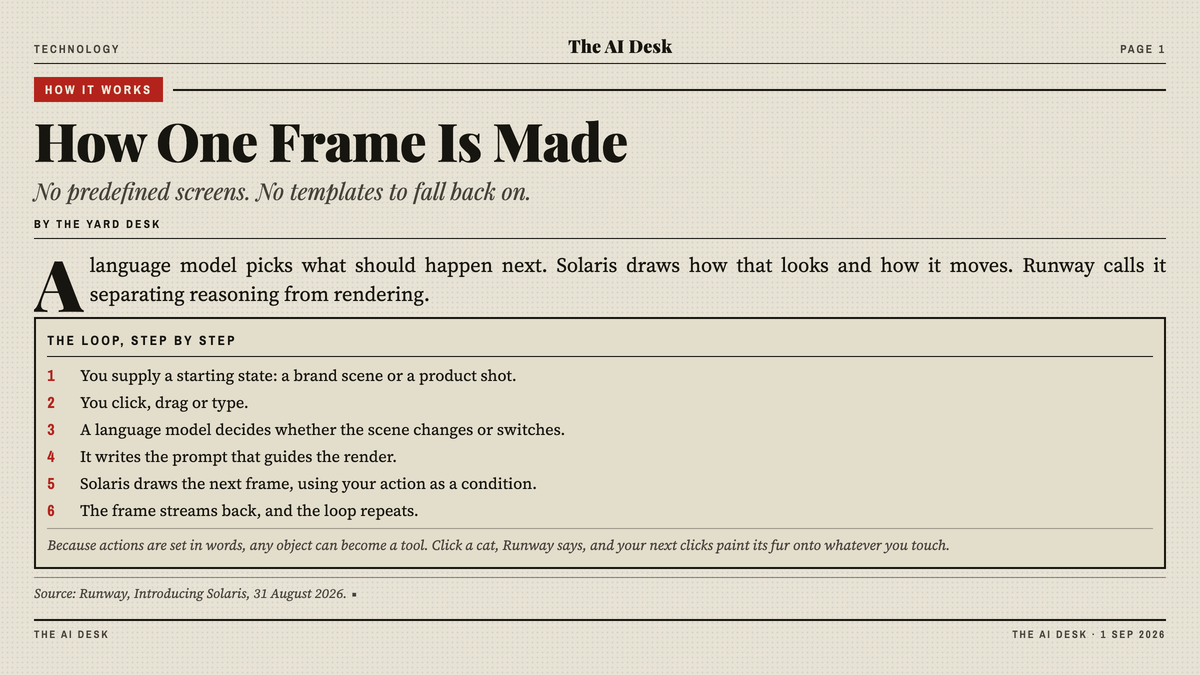
Two systems split the work. A language model picks what should happen next. Solaris draws how that looks and how it moves.
Runway sums it up as splitting reasoning from rendering. One part thinks. The other part paints.
That split matters more than it sounds. It means the thinking part can be swapped or tuned. The drawing part stays the same.
Notice what step five costs you, though. Every frame is a fresh render.
There is a neat side effect here. Because actions are set in words, any object can turn into a tool.
Runway gives an example. Click a cat, and your next clicks paint its fur onto whatever you touch.
Try to price that as a feature request. You could not. It was never a feature.
Why this did not exist until now
Runway makes a neat point about why this is new.
Digital screens rest on two kinds of system. Until now they lived apart.
The first kind knows things. Search engines and AI assistants sit here. They answer with fixed content: text, an image, maybe a video.
The second kind reacts fast. JavaScript, CSS and game engines sit here. They feel alive, but they know nothing about your products or your task.
An Interface World Model has to be both at once. It has to grasp what you want, and paint a live world around it.
Runway lists three walls it had to get past.
Speed was the first. A video model takes seconds or minutes for a clip. A screen you touch needs frames in well under half a second.
Staying whole was the second. A screen must hold its text, layout and objects for a whole visit. Small errors stack the longer it runs.
Cost was the third, and this one should interest you most.
Drawing every frame costs more than serving a page built once. Runway says the work that made Solaris fast also made it far cheaper to run than a standard video model. It says the cost curve keeps improving.
Read that as a warning about timing. The blocker here is price, and price falls.
Q: Is this just a game engine with AI on top?
A: No. A game engine reacts fast but knows nothing about your catalogue. This does both jobs in one model.
What Runway's own study found
Runway ran two tests. Both sets of numbers are Runway's own.
Read them as a vendor's claim, not as an outside result. That does not make them worthless. It just means you weight them.
The first test measured what gets lost in translation.
Runway asked the big AI models to rebuild a website from one screenshot. It ran this across 30 screens. Every model lost detail. The loss grew as the design got richer.
Photos suffered most. Rich visual detail does not survive a trip through words.
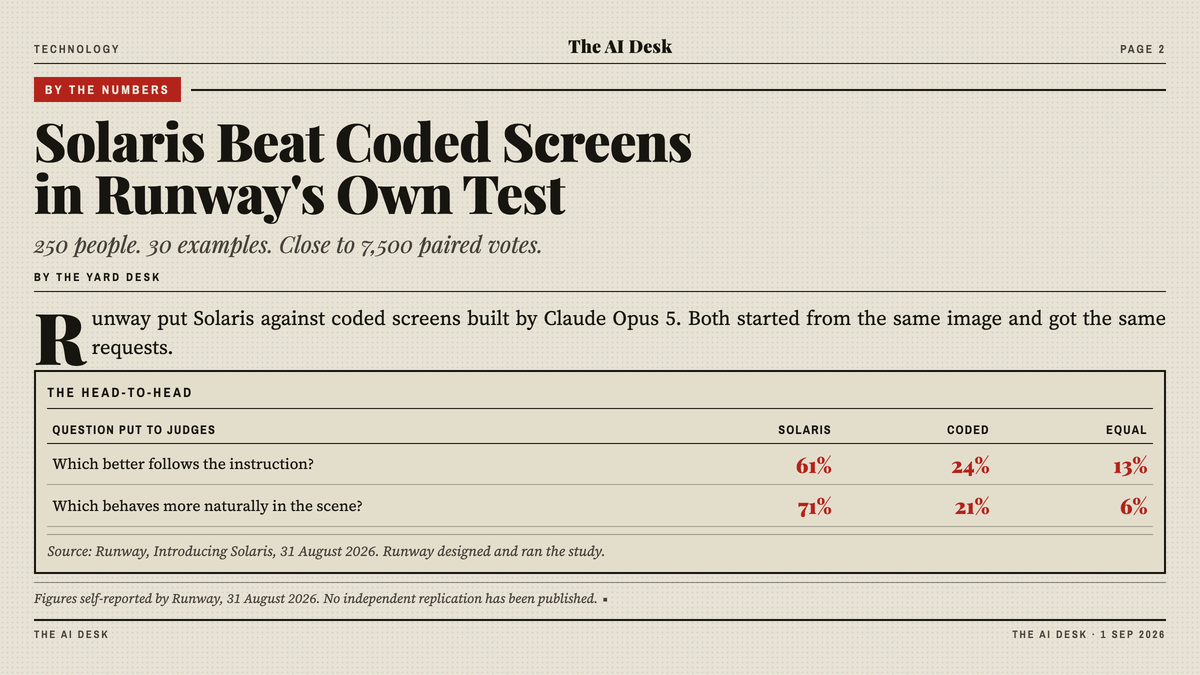
The second test was a head to head. Runway put Solaris against coded screens built by Claude Opus 5.
Both got the same starting image. Both got the same requests.
Then 250 people judged the results across 30 examples. That gave close to 7,500 paired votes.
| Question asked | Solaris preferred | Coded result preferred | Rated equal |
|---|---|---|---|
| Which better follows the instruction? | 61% | 24% | 13% |
| Which behaves more naturally in the scene? | 71% | 21% | 6% |
(Source: Runway, 2026 — Introducing Solaris)
The second row is the telling one. The gap is much wider there.
A coded page can usually make the change you asked for. It just treats that change as one edit, on its own.
Solaris already holds a sense of how things move. So the change lands in a scene that stays whole.
Light shifts. Shadows move. Nothing else in the frame breaks.
Q: Are these numbers independent?
A: No. Runway designed the test, picked the rival and ran the study. Treat them as a direction of travel.
What this could change for a storefront
Runway is blunt about retail, and it is the clearest use case for marketers.
Today a product page is one fixed layout. Every visitor gets the same one. You can swap a headline or a photo. The room stays the same room.
Runway describes a shop front that becomes a drawn scene instead. It keeps the brand look, but reshapes around each person.
Products, colours, materials and layout can all shift in real time.
That is a different order of tailoring. Not a swapped headline. A different room.
Work it through with a sofa. Today you offer four fabric swatches and a photo of each.
In Runway's version the buyer says "show it in a darker grey" and the room updates. Then they drag the sofa to the other wall to check the light.
None of that was built. It was drawn.
One more caution on the retail case. A drawn room is not a spec sheet.
Buyers still want the real size, the real fabric, the real price. Keep those as text on a page you control.
There is a second use worth flagging. Guides stop replaying one fixed path.
They draw the next step inside your own context. If you go off script, the scene recovers instead of breaking.
Runway also points at agents. It cites OSWorld 2.0, a test of 108 long real-world computer tasks. The best agent tested finished only 20.6% of them (Source: OSWorld 2.0, arXiv, 2026 — Benchmarking computer use agents).
Part of the reason is layout. Agents learn one site's shape and stall on the next one.
A drawn screen changes every time. So agents can train against shapes that never existed.
Q: Would this replace our website?
A: Not soon. Read it as a new surface for set moments, such as a product builder or a guided demo.
The gap nobody has closed: there is no page to crawl
Here is the part most coverage will skip. It is also the part your job runs on.
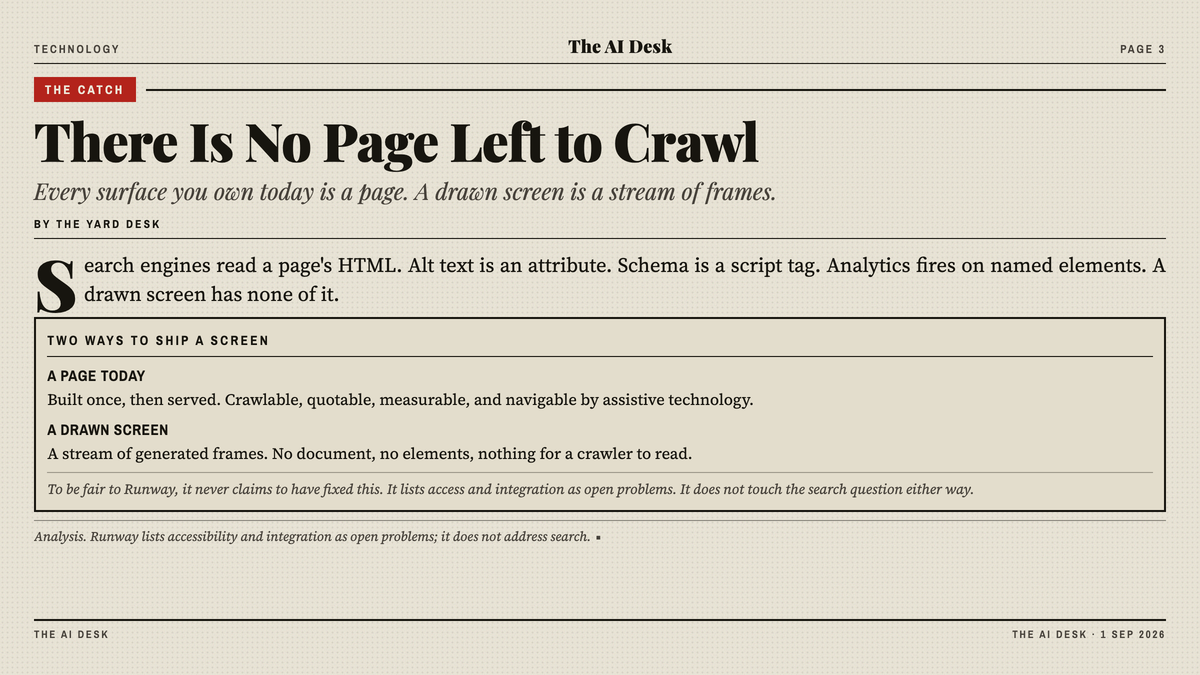
Every surface you own today is a page. Search engines read its HTML. Alt text lives in an attribute.
Schema sits in a script tag. Analytics fires on named elements. Screen readers walk the same structure.
A drawn screen has none of that. It is a stream of frames.
Sit with that for a second. No headings. No links. No text nodes.
There is a second-order problem too, and it is closer to home.
AI assistants answer by quoting pages. They need text they can lift and cite.
If your best product story only exists as drawn frames, there is nothing to quote. You can win the visit and still lose the mention.
To be fair to Runway, it never claims to have fixed this. It lists access and integration as open problems.
It says a drawn screen still has to work with the rest of the stack. That includes screen readers.
But it does not touch the search question at all. That question is ours to ask.
So the honest read is a split one.
The upside on feel is real and well evidenced. The plumbing that makes a page findable and countable is not built yet.
That is not a reason to write Solaris off. It is the reason to be the person in the room who asks about it.
Q: Does Runway say drawn screens cannot be crawled?
A: No. Runway raises access and integration. The search question is not addressed either way.
What Runway says Solaris cannot do yet
Runway published its own limits, which is a good sign. Four of them matter here.
Text is the first. Stable, readable text is still hard for video models.
That is awkward, because screens lean on text more than almost anything. Runway floats a mixed fix, with image models drawing the text-heavy views.
Trust is the second. Runway puts it plainly: "a convincing wrong answer is worse than no answer."
For a shop that is a live risk. A model could draw a product you do not sell. Or a colour you dropped last season.
Runway's answer for now is grounding. You supply the first frame from real product shots. The scene starts in things that exist.
Long visits are the third limit. Holding a scene whole over a long session is still open work.
Small errors stack up the longer it runs.
Screen readers are the fourth, as covered above.
What to do about it this quarter
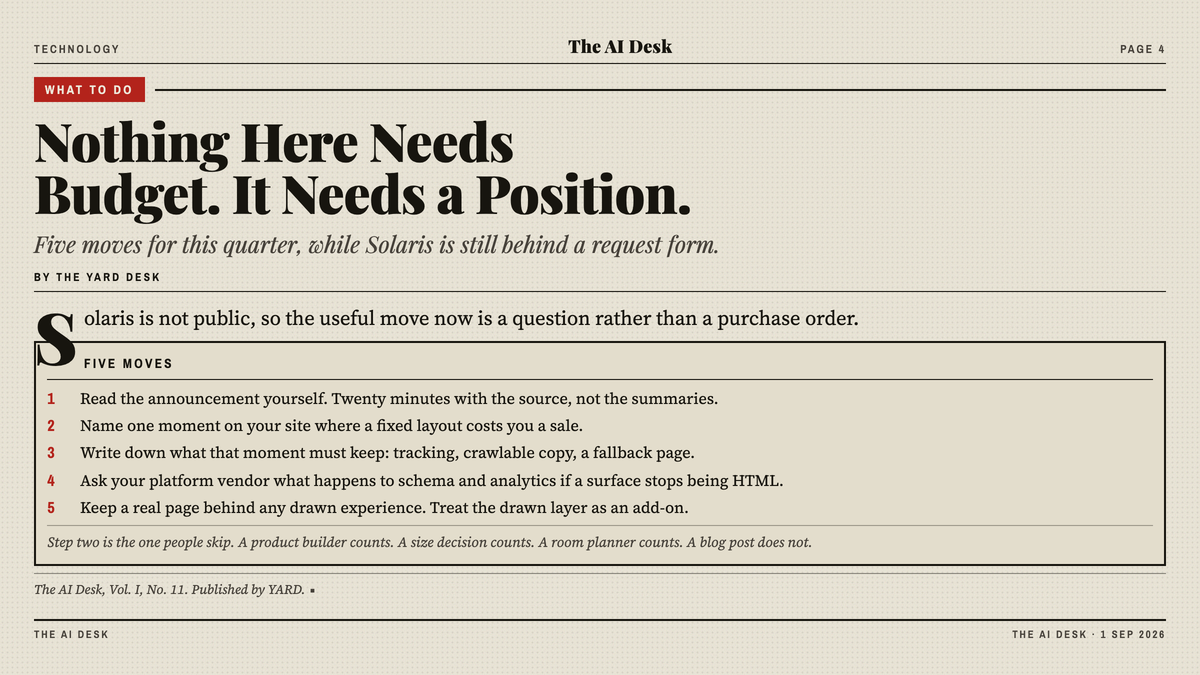
Nothing here needs budget. It needs a point of view.
- Read the post yourself. Give it twenty minutes, and skip the summaries.
- Name one moment on your site where a fixed layout costs you a sale.
- Write down what that moment must keep. Tracking, crawlable copy, a fallback page.
- Ask your platform vendor what happens to schema and analytics if a surface stops being HTML.
- Keep a real page behind any drawn experience. Treat the drawn layer as an add-on.
Step two is the one people skip. Be specific about it.
A product builder counts. A size or fit decision counts. A room planner counts. A blog post does not.
Step four is the one that gets you a straight answer. Vendors have to think it through before they can reply.
Quick Facts: Runway Solaris at a Glance
- Announced 31 August 2026 as the first Interface World Model — (Source: Runway, 2026 — Introducing Solaris).
- Built on Runway's Gen-4.5 video model — (Source: Runway, 2026 — Gen-4.5).
- Follows Runway's GWM-1 world model — (Source: Runway, 2026 — GWM-1).
- Draws at 720p in real time — (Source: Runway, 2026 — Introducing Solaris).
- Preferred over coded screens in 61% and 71% of paired votes, in Runway's own 250-person study — (Source: Runway, 2026 — Introducing Solaris).
- Not public; early access is by request only — (Source: Runway, 2026 — Introducing Solaris).
We spend a lot of time on the boring half of releases like this one. Which surface stays crawlable. Which event still fires.
What breaks when a page stops being a page.
At YARD we build AI-native growth systems for brands. The discovery layer is the part we guard hardest.
If you want your own stack mapped against a shift like this, that is the work we do.
For more on the models behind this one, see our reads on Claude Opus 5, on Wan 3.0 and drawn video. On agents that work behind a login.
FAQ
Q: What is Runway Solaris?
A: Solaris is a model that draws a website or app screen frame by frame while you use it. Runway announced it on 31 August 2026. It is the first model in a family Runway calls Interface World Models.
Q: How is it different from a normal website?
A: A normal website is built once as code, then served. Solaris draws each frame as you act, so no action has to be programmed first.
Q: Can I use Solaris now?
A: No. Runway is taking early access requests through a form. It says it is working with key partners on a public launch.
Q: How well does it perform?
A: In Runway's own study, 250 people gave close to 7,500 paired votes. Solaris was preferred in 61% of pairs for following instructions and 71% for natural behaviour. Runway ran the study, so treat the figures as vendor-reported.
Q: What can Solaris not do yet?
A: Runway lists four limits. Stable readable text, trust in what it draws, holding a scene whole over long visits, and support for screen readers.
Q: What does this mean for SEO?
A: The post does not address search. A stream of drawn frames has no HTML for a crawler to read. Keep a real indexable page behind any drawn experience.
Q: What should a marketing team do now?
A: Read the primary source. Pick one moment where a fixed layout costs you. Ask your vendor what happens to schema, analytics and screen readers if a surface stops being HTML.
Sources
- Runway — Introducing Solaris (31 August 2026; primary source for the model, the study figures and the stated limits).
- Runway — Introducing Gen-4.5 (the video model Solaris is built on).
- Runway — Introducing GWM-1 (Runway's general world model).
- Runway — Building Runway Characters (source Runway cites for the half-second threshold).
- OSWorld 2.0 — Benchmarking Computer Use Agents on Long-Horizon Real-World Tasks (arXiv, 2026; the computer-use test Runway cites).
Insights from Our Experts
Explore our latest articles on digital marketing strategies.