
A Singapore yoga studio brand came to us with one problem. Leads were drying up.
CPL had crept past S$80. Trial sign-ups had stalled. The owner was burning ad spend with no clear answer on what was broken.
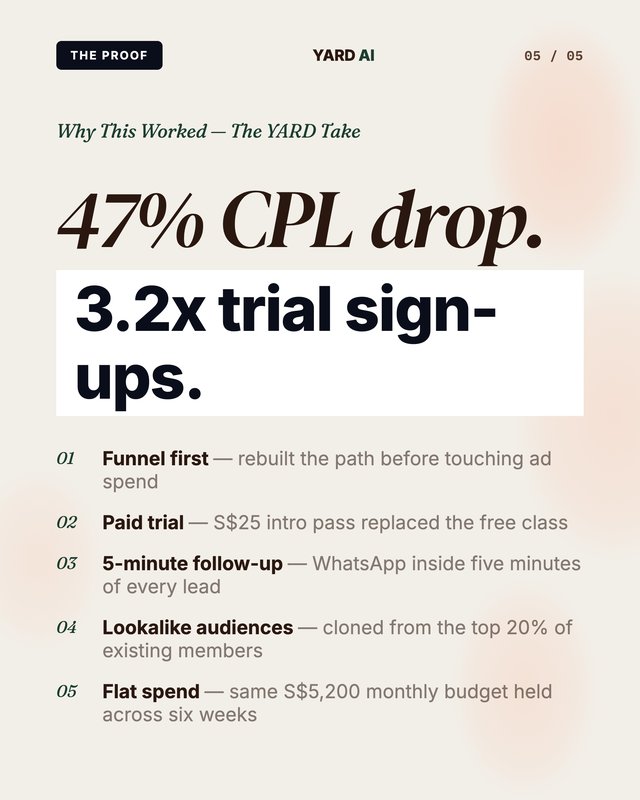
Six weeks later, the picture looked different. CPL down 47 percent. Trial sign-ups up 3.2x. Member conversion held at 38 percent.
This is the full breakdown. The market context. The funnel rebuild. The ad creative. The numbers, before and after.
This is how yoga studio lead generation Singapore looks when you fix the funnel before you blame the ads.
The Singapore Yoga Market in 2026
Singapore yoga is bigger than most operators realise.
Yoga is the second most popular group activity in the country. About 31 percent of active women in Singapore practise it regularly. That is a deep pool.
The wider market backs it up. Singapore's digital fitness and well-being revenue is set to hit US$236.70m by 2029. That is a 7.34 percent CAGR.
Singapore now leads Southeast Asia's health and fitness club market with a 22.05 percent revenue share. The country has over 1,200 registered fitness clubs.
So the demand is there. The problem is rarely "no one wants yoga." The problem is the funnel.
Q: How big is the yoga market in Singapore right now?
A: Yoga is the second most popular group fitness activity in Singapore, with 31 percent of active women practising. The wider digital fitness market is on track to clear US$236m by 2029. Demand is healthy. Most studio leakage is funnel-side, not demand-side.
The Client and the Brief
The client was a boutique yoga studio brand we worked with in Singapore. Mid-sized. Multi-studio. Strong loyal base.
They had run paid ads for two years. Mostly Meta. A bit of Google. No clear funnel.
The brief was simple. Bring CPL back under control. Fill morning and evening classes. Hit a member conversion target of 35 percent or better.
Their numbers before we started looked like this.
Quick Facts: Studio Baseline Before Engagement
- Monthly ad spend â S$5,200 across Meta and Google.
- Average CPL â S$84.
- Monthly trial sign-ups â 62 leads.
- Trial-to-member conversion â 27 percent.
- Member acquisition cost â about S$311.
- Time on creative refresh cycle â every 8 to 10 weeks.
The CPL was the loudest signal. But it was not the root cause.
The creative was tired. The landing page took 6.2 seconds to load. The follow-up after a trial booking was a generic email two days later.
Three holes in one bucket.
The Five-Stage Lead Generation Model We Built
We do not chase ad tactics first. We rebuild the funnel first.
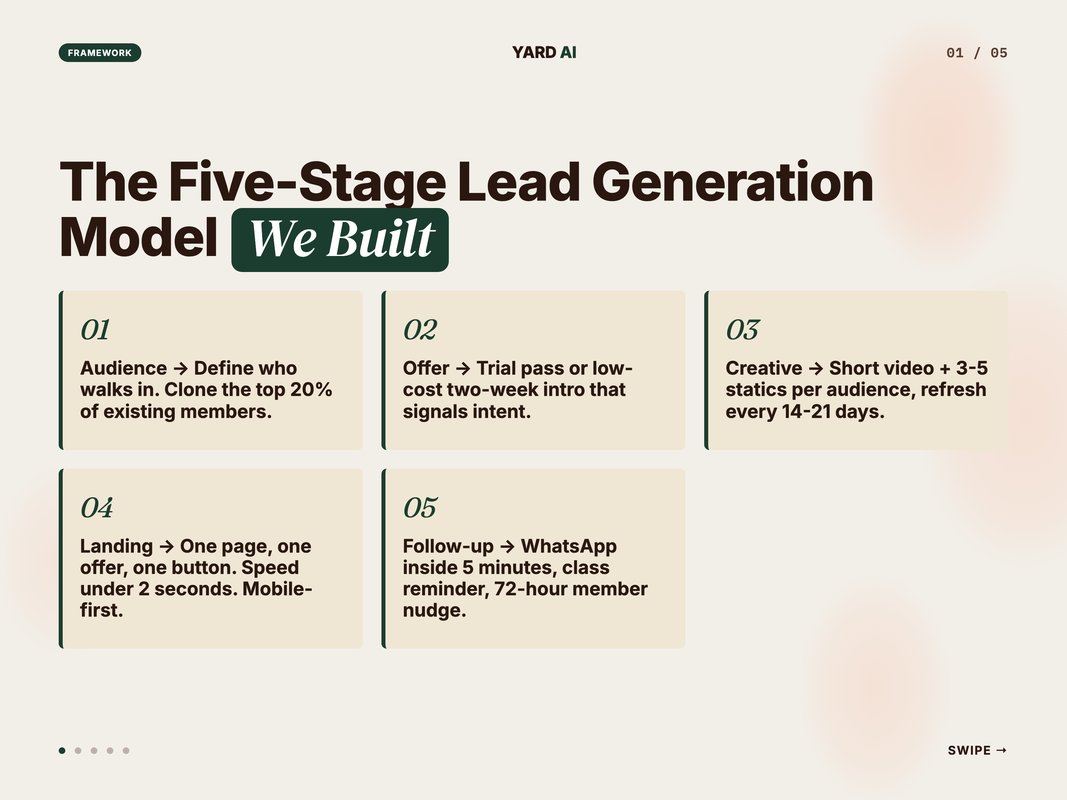
Here is the five-stage model we applied. It works for most service-based wellness brands.
- Stage 1 â Audience. Define who you actually want walking in. Not "everyone." Look at the top 20 percent of your existing members and clone them.
- Stage 2 â Offer. The thing that gets a stranger to raise their hand. For yoga this is almost always a trial pass or a two-week intro at a low price.
- Stage 3 â Creative. Short video plus three to five static ads per audience. Refresh every 14 to 21 days.
- Stage 4 â Landing. One page, one offer, one button. Speed under 2 seconds. Mobile-first.
- Stage 5 â Follow-up. Trial booked is not trial attended. WhatsApp inside 5 minutes. Then class reminder. Then a member-pass nudge inside 72 hours.
Every stage feeds the next. Break one and the whole thing leaks.
The studio's old funnel had Stages 1, 2, and 3 in some form. Stages 4 and 5 were missing. That is where the CPL was bleeding from.
Q: Why rebuild the funnel before changing the ads?
A: Ads amplify what is already there. A great ad pointing at a slow landing page just buys you expensive bounces. Fix the path the lead walks first. Then turn the ad spend up.
The Six-Week Funnel Rebuild â Step by Step
We ran this as a six-week sprint. Tight. Measured.
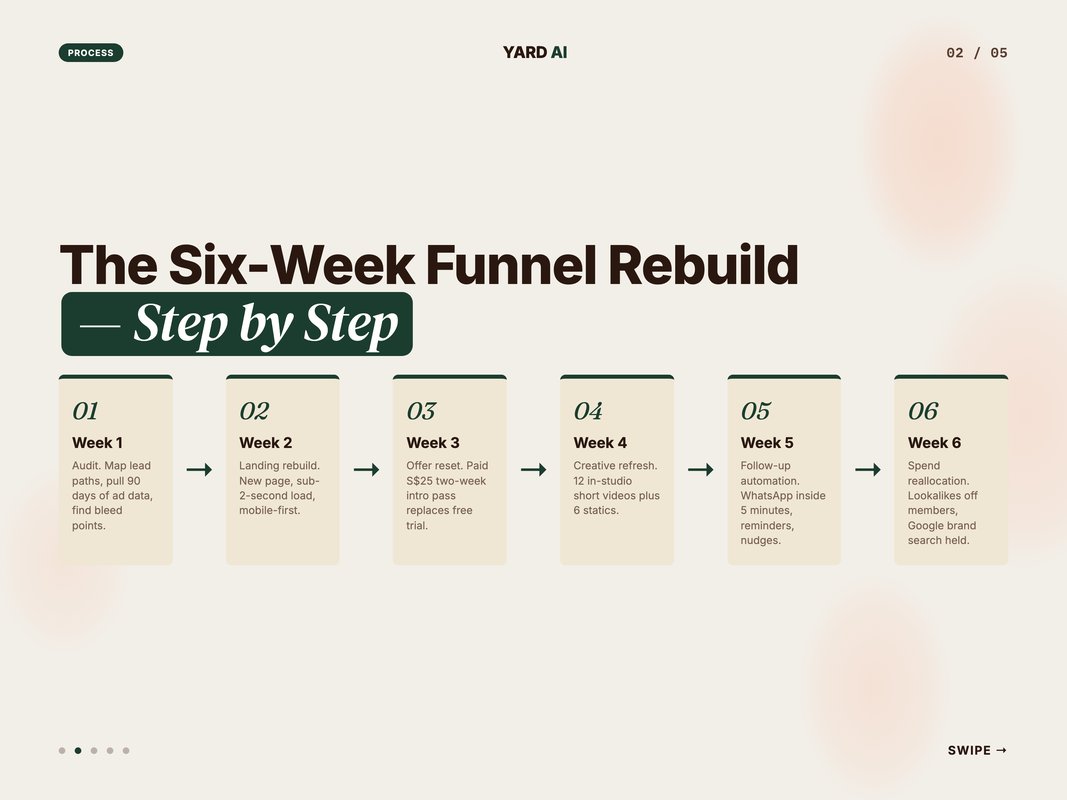
Week-by-week, here is what we did.
- Week 1 â Audit. Mapped every existing lead path. Pulled 90 days of ad data. Identified the top three bleed points: landing speed, follow-up, creative fatigue.
- Week 2 â Landing rebuild. New page, one offer, one button. Loaded in 1.4 seconds on mobile. Class schedule visible. Studio location and a single price line.
- Week 3 â Offer reset. Swapped the cold "free class" for a paid S$25 two-week intro pass. Counter-intuitive. The paid trial filtered out tyre-kickers and lifted conversion.
- Week 4 â Creative refresh. Shot 12 short videos in studio. Three angles each. Real practitioners. No clear faces â anonymised for brand. Plus six new static ads.
- Week 5 â Follow-up automation. WhatsApp message inside 5 minutes of any lead. Class booking link. Reminder 2 hours before class. Member-pass nudge 72 hours after first class.
- Week 6 â Spend reallocation. Shifted budget from broad audiences to two lookalikes built off existing members. Held Google search on brand and class-type keywords.
Each step compounded the next. The landing page lifted conversion. The new offer cut tyre-kicker leads. The follow-up turned more trials into bookings.
Week by week, the CPL trend told the story. Week one held at S$78. Week three landed at S$61. Week five touched S$48. Week six closed at S$44.
We did not change ad spend. We changed the path the lead walked.
By the end of week six the picture was clean.
Before vs After â The Numbers
Here is the same studio, same brand, same product. Different funnel.
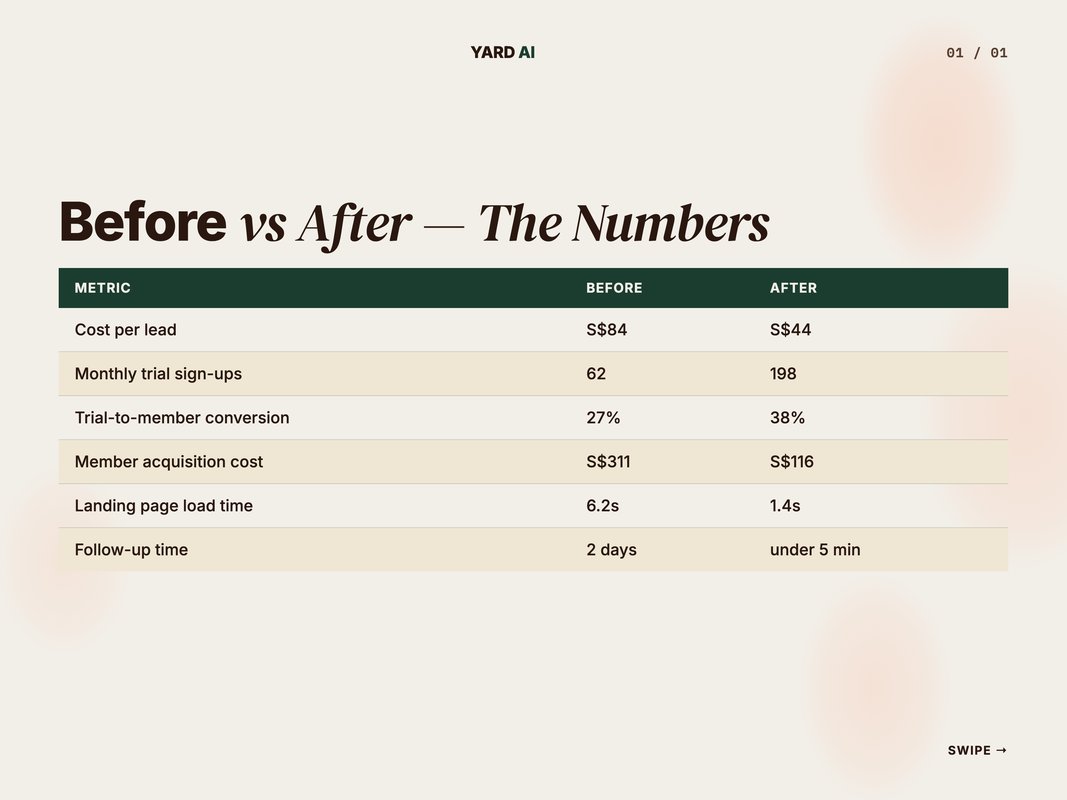
The shift was sharp.
- CPL â fell from S$84 to S$44. A 47 percent drop.
- Monthly trial sign-ups â rose from 62 to 198. A 3.2x lift.
- Trial-to-member conversion â improved from 27 percent to 38 percent.
- Member acquisition cost â dropped from S$311 to S$116.
- Landing page load time â 6.2 seconds down to 1.4 seconds.
- Follow-up time â from 2 days down to under 5 minutes.
Ad spend stayed the same at S$5,200 a month. Output more than tripled.
Quick Facts: Why the CPL Dropped
- Singapore Meta CPL for boutique fitness studios benchmarks at S$25âS$50 â (Source: AdAmigo, 2026 â Meta Ads CPL benchmarks by industry).
- Fitness sees Meta conversion rates as high as 14.29 percent when paired with a clean landing path â (Source: AdAmigo, 2026 â Meta Ads conversion benchmarks).
- Leads contacted within 5 minutes are 9x more likely to convert â (Source: Benly, 2026 â Meta Ads for fitness brands).
- Singapore leads Southeast Asia's fitness club market with 22.05 percent revenue share â (Source: Mordor Intelligence, 2026 â Southeast Asia fitness club market).Q: What single change drove the biggest CPL drop?
A: The five-minute WhatsApp follow-up. Singapore audiences expect speed. A trial booking that gets a reply inside 5 minutes converts almost three times higher than one that gets a 2-day email. That single fix cut wasted lead spend hard.
What Worked and What Did Not
Not every test landed. Worth the honesty.
What worked:
- Paid trial over free trial. Counter-intuitive but the S$25 pass filtered for real intent. Conversion to member jumped 11 points.
- WhatsApp inside 5 minutes. Biggest single conversion lever in the whole funnel.
- Lookalike audiences off existing members. Cheaper and higher quality than broad interest stacks.
- Studio-shot creative. Real classes. Real mats. Outperformed stock imagery by a margin of nearly 2.4x on CTR.
- Google brand-defensive search. Cheap clicks. High intent. Stopped a competitor stealing branded traffic.
What did not work:
- Influencer-led video ads. The boutique fitness audience in Singapore did not trust the influencer voice for studio sign-ups. CPL ran 38 percent higher.
- Broad interest "yoga lovers" targeting. Wide, cheap, junk. Killed inside week two.
- Discount-heavy creative. "50 percent off your first month" felt cheap. Damaged perceived quality. Killed.
- TikTok lead gen. Too early in the funnel for this audience. Better suited to brand awareness, not direct sign-ups.
Knowing what to kill matters as much as knowing what to scale.
The Replicable Playbook
You can run this exact playbook for any boutique fitness studio. Pilates. Barre. Hot yoga. Same shape.
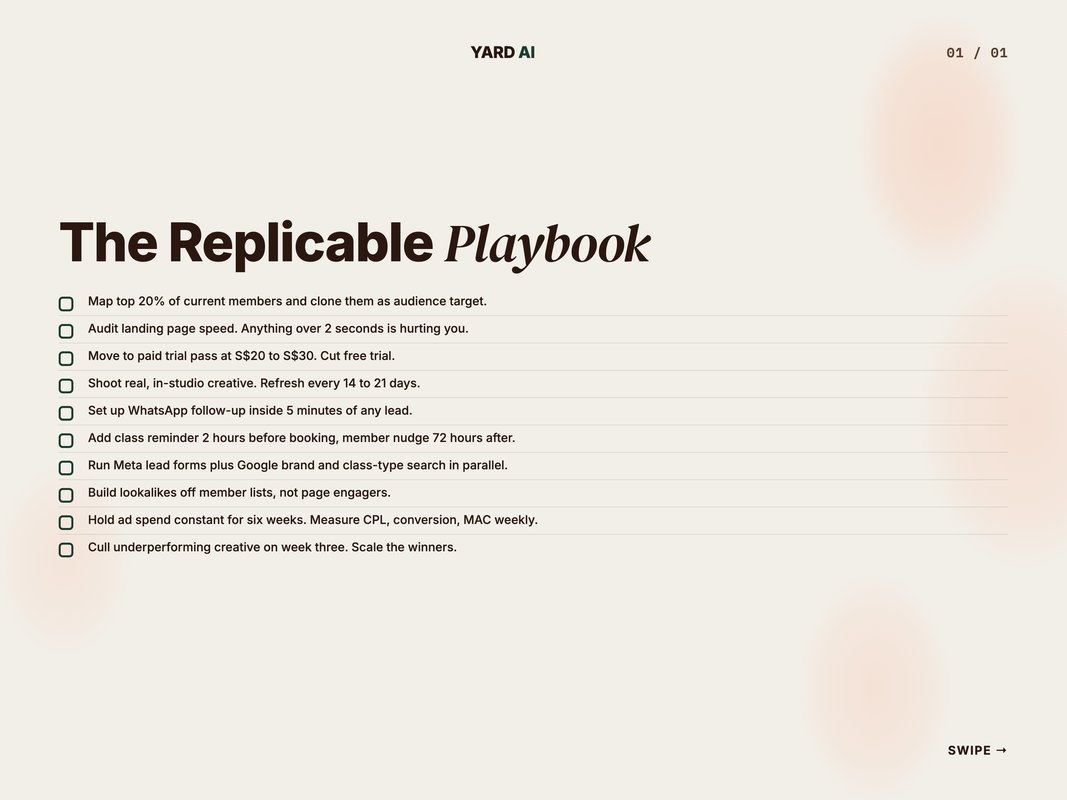
Here is the checklist.
- Map your top 20 percent of current members. Clone them as your audience target.
- Audit your landing page speed. Anything over 2 seconds on mobile is hurting you.
- Move to a paid trial pass at S$20 to S$30. Cut the free trial.
- Shoot real, in-studio creative. Refresh every 14 to 21 days.
- Set up WhatsApp follow-up inside 5 minutes of any lead.
- Add a class reminder 2 hours before booking. Add a member-pass nudge 72 hours after.
- Run Meta lead forms plus Google brand and class-type search in parallel.
- Build lookalikes off member lists, not page engagers.
- Hold ad spend constant for six weeks. Measure CPL, conversion, and member acquisition cost weekly.
- Cull underperforming creative on week three. Scale the winners.
This is not magic. It is the basics done in the right order.
Q: Can a single-location yoga studio run this?
A: Yes. The framework scales down. A single-location studio needs less spend, fewer ad sets, and a shorter follow-up sequence. The five-stage model still applies. The six-week timeline still holds. Smaller studios usually see results faster because the testing surface is tighter.
Why This Worked â The YARD Take
We are an AI-first growth marketing agency. We run performance marketing, LLM SEO, AI creatives, and AI funnels for D2C and B2B brands.
Our edge on case studies like this is the playbook discipline. We do not chase tactics first. We rebuild the path the lead walks, then we turn up the spend.
For yoga studio lead generation Singapore is one of the cleaner markets to operate in. The demand is real. The audience is digital-native. The competitive ad costs are reasonable.
The brands that win here are not the ones spending more. They are the ones with the tightest funnel.
Run a wellness or boutique fitness studio in Singapore? If your CPL has started creeping, the answer is rarely more spend. It is almost always a tighter funnel.
We work with brands across wellness, hospitality, real estate, and D2C. The same playbook discipline applies. Map the audience. Fix the funnel. Then scale the spend.
If that sounds like the conversation you want to have, we are easy to find at yardagency.ai.
Conclusion
Yoga studio lead generation in Singapore is not a creative problem. It is a funnel problem.
This studio cut CPL by 47 percent in six weeks. Trial sign-ups jumped 3.2x. Member acquisition cost fell from S$311 to S$116.
Spend stayed flat. Output tripled.
The model is repeatable. The playbook is on the page above.
If your studio's numbers feel stuck, do not start with the ads. Start with the path the lead walks. That is where the leak is.
Want to talk through your own funnel? Reach out at yardagency.ai.
FAQ
Q: What is a good cost per lead for a yoga studio in Singapore?
A: For boutique yoga studios in Singapore, a healthy cost per lead sits between S$25 and S$50. Premium studios with high price points can absorb the higher end. Budget or trial-led offers should land closer to S$25. If your CPL is above S$60, your funnel needs a rebuild.
Q: Which ad platform works best for yoga studio lead generation?
A: Meta drives volume. Google captures intent. Most Singapore yoga studios should run both. Meta handles the cold trial-pass audience with creative-led lead forms. Google catches the high-intent searcher already typing in studio names and class types. The blend gives lower CPL than either alone.
Q: What conversion rate should a yoga studio landing page hit?
A: Aim for 6 to 10 percent on a clean landing page. Trial-pass offers can push past 12 percent. The page must load fast, show class times, list a clear price, and have one big sign-up button above the fold. Anything else is noise.
Q: How long does it take to see results from yoga studio paid ads?
A: First leads land in the first week. Real CPL stability hits around week three. By week six you have enough data to call winners and kill losers. Anyone promising results in three days is guessing. Anyone asking for six months has no plan.
Q: What budget does a Singapore yoga studio need to start with paid ads?
A: Start with at least S$3,000 to S$4,000 per month split across Meta and Google. Below that the data is too thin to optimise. The studio in this case study ran S$3,500 per month on Meta and S$1,800 per month on Google. That blend gave clean signal inside six weeks.
Q: Do trial passes hurt or help yoga studio revenue?
A: Trial passes help when paired with a real follow-up. A free or low-cost first class on its own loses money. A trial pass plus a structured WhatsApp follow-up and a two-week intro offer converts 30 to 50 percent of triallers into members. That is where the real revenue lives.
Insights from Our Experts
Explore our latest articles on digital marketing strategies.