

Most accounts run Smart Bidding on autopilot.
That works until it does not.
Then the bidder hits a thin week. Or a budget cap. Or a tracking gap. Spend goes up. Revenue goes sideways. The team stares at the dashboard.
A clear Google Ads Smart Bidding strategy means knowing exactly when to trust the AI. And when to step in.
This post gives you the thresholds. The four modes. The failure patterns. And a decision tree you can run on Monday.
If you came in expecting a "Smart Bidding is bad" rant, you will be disappointed. If you came in expecting cheerleading, also disappointed. We will be exact.
What Smart Bidding Actually Does in 2026
Smart Bidding is Google's auction-time bidder.
It sets a bid for every single auction. It reads signals you cannot manually layer.
Those signals include device and time of day. They include location and query. They include audience list, browser, and operating system. The bidder also reads first-party data now. That happens through Enhanced Conversions and Customer Match. (Source: Google Ads Help, 2026 — About Smart Bidding).
Roughly 86% of Google Ads campaigns now use some form of automated bidding. (Source: Optmyzr PPC Study via Search Engine Explain, 2026 — Smart Bidding adoption).
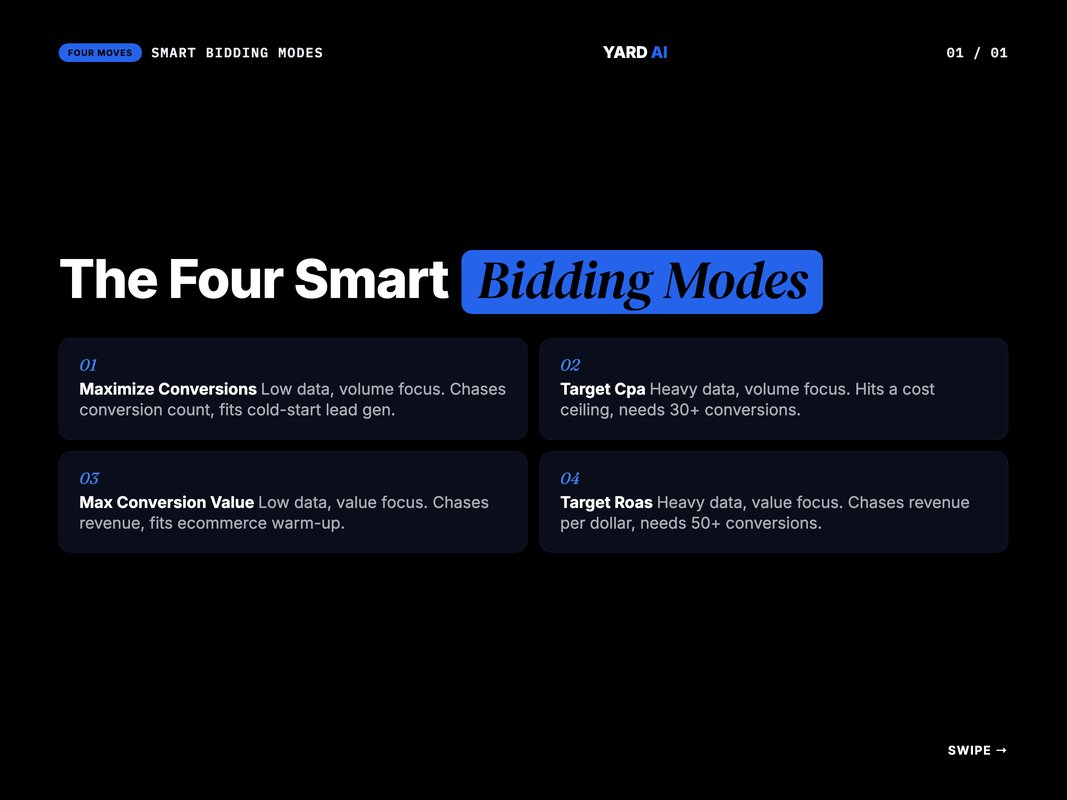
The four core Smart Bidding modes in 2026 are tCPA, tROAS, Maximize Conversions, and Maximize Conversion Value.
Each one solves a different problem. Each one fails for different reasons.
Some teams treat them as interchangeable. They are not.
Quick Facts: Smart Bidding in 2026
- 86% of Google Ads campaigns now use automated bidding. (Source: Optmyzr via Search Engine Explain, 2026 — Smart Bidding 2026).
- Smart Bidding switchers see about 20% more conversions at the same budget. (Source: Google Ads Best Practices via Search Engine Explain, 2026 — Smart Bidding gains).
- Target CPA needs at least 30 conversions in the last 30 days. (Source: Google Ads Help, 2026 — Bid strategy data needs).
- Target ROAS needs at least 50 conversion events in 30 days. (Source: Google Ads Help, 2026 — About Target ROAS).
- Under $2,000 per month, learning-phase burn can eat 30 to 50% of budget. (Source: Negator, 2026 — Smart Bidding failures).
- Learning phase typically lasts two to four weeks for a new bid strategy. (Source: Sarah Stemen, 2026 — Smart Bidding guide).
Numbers tell the story. The bidder is good. It is also data-hungry. Match those needs or do not run it.
Q: Is Smart Bidding the same as Performance Max?
A: No. Performance Max is a campaign type. It uses Smart Bidding under the hood. Search, Shopping, and Display campaigns also use Smart Bidding. The bidder is the same engine.
The Four Smart Bidding Modes Compared
The four modes look similar in the UI. They are not similar in behavior.
Pick the wrong one. The bidder will optimize for something you did not want. Then your budget walks out the door.
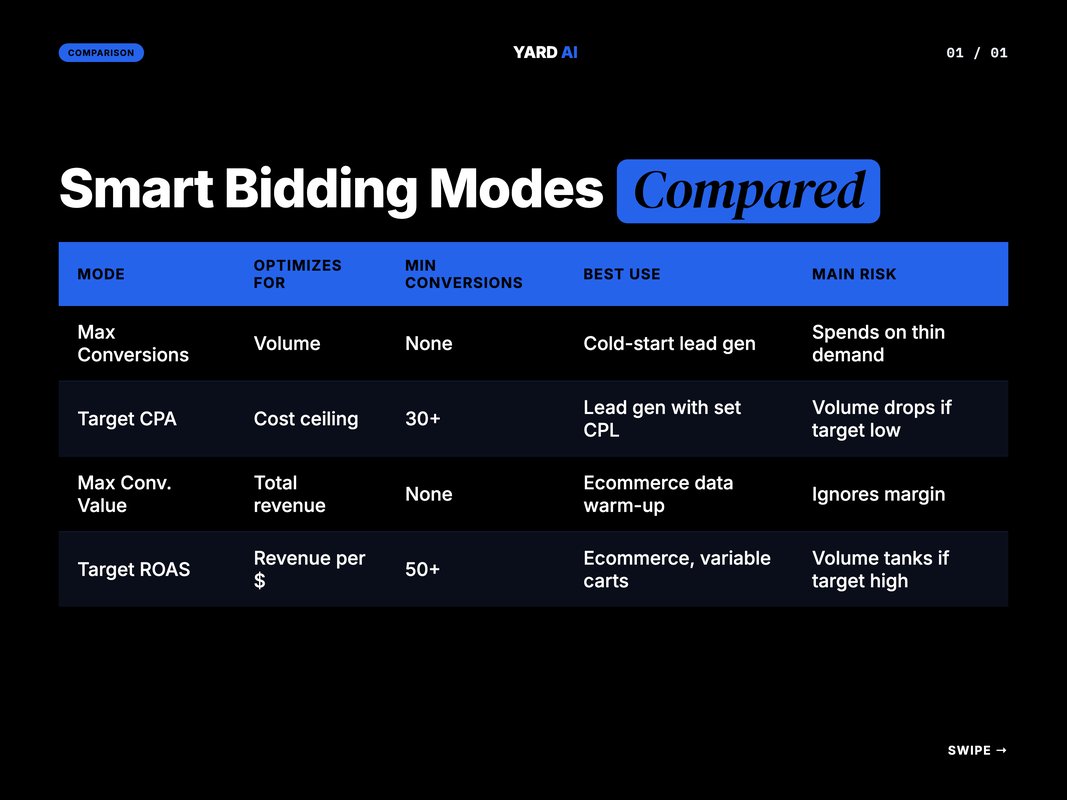
Here is the comparison at a glance.
Mode by mode:
- Max Conversions: chases volume, no minimum, fits cold starts, spends on thin demand.
- Target CPA: hits a cost ceiling, needs 30+ conversions, fits lead gen, kills volume when set too low.
- Max Conversion Value: chases revenue, no minimum, fits ecommerce warm-up, ignores margin.
- Target ROAS: chases revenue per dollar, needs 50+ conversions, fits variable carts, tanks volume when set too high.
(Source: Google Ads Help, 2026 — Bid strategies).
Maximize Conversions cares only about count. It will spend every cent of your daily budget. (Source: GROAS.ai, 2026 — Bidding strategies 2026).
That is great when demand is steady. It is terrible when demand drops. The bidder still spends. It just buys worse traffic.
Target CPA wants a cost ceiling per conversion. Set it too low and volume collapses. Set it too high and CPA bloats.
Maximize Conversion Value cares about total revenue. It does not respect margin. A high-revenue, low-margin SKU looks the same as a high-margin one.
Target ROAS cares about value efficiency. Set a 400% tROAS. Google tries to return $4 in revenue per $1 spent. (Source: GROAS.ai, 2026 — Smart Bidding guide).
tROAS is the default for ecommerce with variable basket sizes. Lead gen with equal lead values should stick with tCPA.
There is also Enhanced CPC. It is the legacy bridge between manual and Smart Bidding. It is being phased out. Do not start a new campaign on it.
A common trap is running tROAS with too few orders. The bidder optimizes hard against thin data. Performance looks erratic. CPC swings 3x in a day.
The fix is patience. Run Maximize Conversion Value first. Build the data. Then layer tROAS on top.
Q: Which Smart Bidding mode should I start with?
A: Start with Maximize Conversions or Maximize Conversion Value. They have no target to fight. Once you clear 30 to 50 conversions in 30 days, graduate to tCPA or tROAS.
When to Trust the AI
Smart Bidding earns trust when three things are true at once.
First, your conversion tracking is clean. Real events fire. Server-side or Enhanced Conversions is in place. No double-counting.
Second, you have data density. tCPA wants 30 conversions in 30 days. tROAS wants 50. (Source: Google Ads Help, 2026 — Bid strategy data).
Third, your offer and landing page have been stable for two weeks. Big changes mid-flight reset the bidder's signal map.
When those three line up, Smart Bidding usually beats manual.
Switchers see roughly a 20% lift in conversions at the same budget. (Source: Optmyzr PPC Study via Search Engine Explain, 2026 — Smart Bidding lift).
That lift comes from auction-time signals. A human cannot price 50 micro-signals per query in real time. The bidder can.
Performance Max in 2026 leans hard on first-party signals. Customer Match lists feed it. CRM uploads feed it. Remarketing pools feed it. (Source: Marketing Agent Blog, 2026 — Performance Max roadmap).
The more first-party data the bidder gets, the better the auction-time calls. That is the actual edge in 2026.
Brands that pass real revenue, real margins, and real lead scores beat brands that pass flat conversion counts. The bidder is only as smart as its inputs.
Trust also depends on account maturity. A six-month-old campaign with stable traffic earns trust faster. A two-week-old campaign with shifting ads does not.
The bidder needs pattern. Pattern needs time. Time needs discipline.
Another trust signal is conversion latency. If your buyers take 14 days to convert, set your conversion window to match. A 7-day window will starve the bidder of late conversions. The model will then underbid valuable queries.
Match the conversion window to the real sales cycle. Then the bidder sees full attribution.
Q: Does Smart Bidding work without Enhanced Conversions?
A: It works. It just works worse. Enhanced Conversions hashes first-party data like email and phone back to Google. That improves attribution across devices. It survives cookie loss. Turn it on.
When to Override Smart Bidding
The override list is short and specific.
Run through it once a month. Pull the right lever before the bidder bleeds budget.
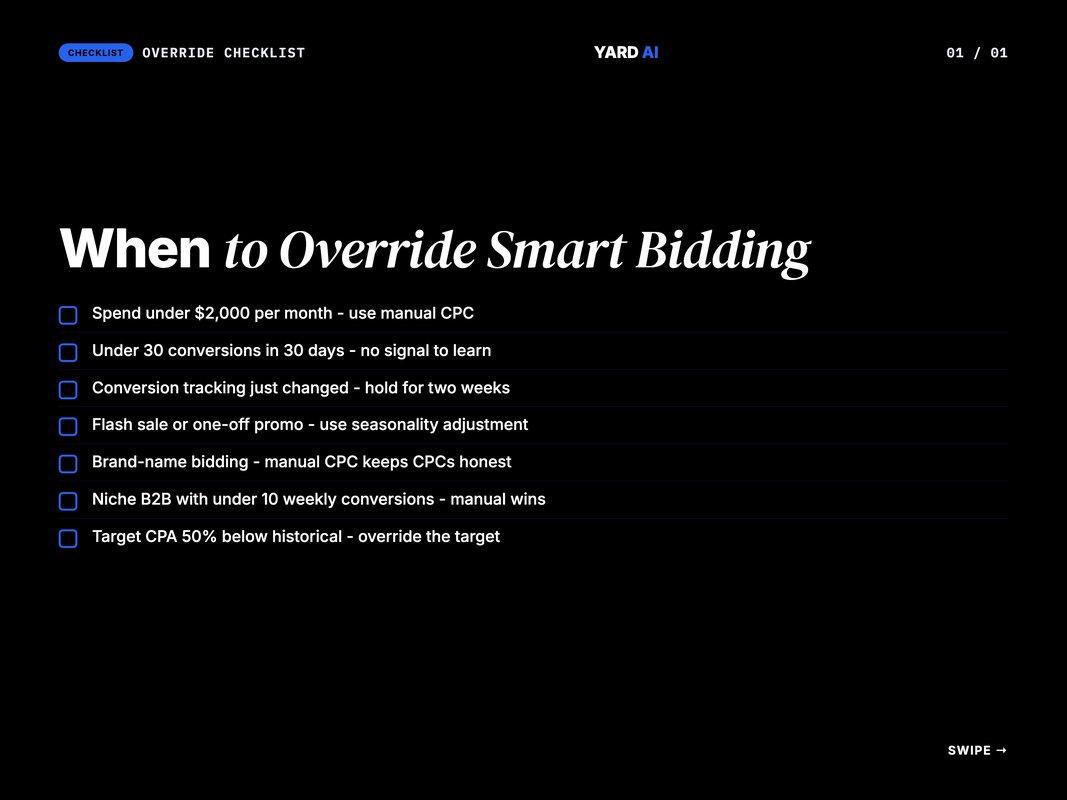
Here is the override checklist.
- Spend is under $2,000 per month. Manual CPC limits learning-phase burn.
- You have fewer than 30 conversions in the last 30 days. There is no signal to learn from.
- Conversion tracking just changed. Give the bidder two weeks before judging it.
- You are running a flash sale or one-off promo. Use a seasonality adjustment.
- You are bidding on your own brand name. Manual CPC keeps CPCs honest.
- You are in a niche B2B vertical with under 10 weekly conversions. Manual gives you control the AI cannot earn.
- Your target CPA is 50% below your historical CPA. Volume will collapse. Override the target.
(Source: Negator, 2026 — 7 manual bidding scenarios).
Manual is not dead in 2026. Google actually refreshed the manual CPC UI this year. (Source: ALM Corp, 2026 — Manual CPC update 2026).
The refresh added pro-level bid controls. It also surfaced bid simulators on a per-keyword basis.
Under $2,000 per month in spend, the learning phase alone can eat 30 to 50% of budget. (Source: Negator, 2026. Smart Bidding failure scenarios).
That is not a bug. It is the cost of feeding the model.
Manual CPC sidesteps that cost entirely. You set the bid. The bid is the bid. There is no learning tax.
Seasonality adjustments are a softer override. You stay inside Smart Bidding. But you tell the model a temporary change is coming.
You set a date range. You set an expected conversion rate change. Google adjusts bids inside that window. The model does not learn the spike as the new normal. (Source: Google Ads Help, 2026 — Smart Bidding overrides).
Use seasonality adjustments for known promos. Use manual CPC for thin-data accounts. Use target loosening when volume tanks.
Q: How long is the Smart Bidding learning phase?
A: Plan for two weeks to a month. Set your starting target a bit above your current average. Bring it down slowly once the bidder stabilizes. (Source: Sarah Stemen, 2026 — Smart Bidding guide).
Why Smart Bidding Fails (Even With Good Budget)
A funded account can still tank under Smart Bidding. The reasons are predictable.
Broken conversion tracking is the top one.
You track form fills but not phone calls. The bidder optimizes for form fills. You wonder why phones are dead. (Source: Negator, 2026 — Smart Bidding failures).
Too many conversion actions confuse the model. Google now recommends one primary action. Secondary actions are tracked, not bid on. (Source: Marketing Agent Blog, 2026 — Performance Max 2026 setup).
Cannibalization across campaigns hurts too. Two Search campaigns chase the same keyword. They starve each other. The auction price climbs. Both campaigns underperform.
Over-broad match types without negatives let the bidder spend efficiently on bad traffic. That is worse than wasting spend manually. It wastes spend with confidence. And at scale.
Sharp seasonality shifts break the model unless you flag them. A 3x conversion week looks like a permanent regime shift to the bidder. It will overbid the following week. Then it will course-correct. That correction costs money.
The seasonality adjustment tool fixes this. Use it before known peaks. Use it before known troughs.
A second silent killer is overlapping bid strategies. Two ad groups in the same campaign on different strategies. The bidder gets contradictory signals. Pick one strategy per campaign. Stick with it.
A third killer is target whiplash. Teams change tCPA every three days. Each change resets the learning phase. The bidder never stabilizes.
Hold a target for at least two weeks. Then adjust by no more than 15% at a time. Bigger jumps trigger fresh learning. (Source: Sarah Stemen, 2026 — Smart Bidding guide).
Budget pacing matters too. The bidder treats daily budget as a hard ceiling. If you set $50 a day but want $100 on weekends, use a budget schedule. Do not raise and drop budgets manually. That looks like noise to the model.
Q: Can Smart Bidding waste my budget?
A: Yes. With broken tracking or thin negatives, the bidder optimizes for bad traffic at scale. The fix is structural, not algorithmic. Clean the inputs first.
The Smart Bidding Decision Tree
Run this every month per campaign. Five questions. Hard answers.
- Do you have 30+ conversions in the last 30 days? If no, run Maximize Conversions or manual CPC.
- Are your conversion values roughly equal? If yes, use tCPA. If no, go to step 3.
- Are your conversion values variable? Use Maximize Conversion Value first. Move to tROAS once you clear 50 conversions.
- Is monthly spend below $2,000? Use manual CPC. Revisit at $3,000.
- Was there a recent tracking or landing page change? Hold the current strategy for two weeks. No new targets.
That tree handles 90% of real-account decisions.
It also kills the most common mistake. Teams jump straight to tROAS on a campaign that has not earned the data. The bidder then chokes. (Source: GROAS.ai, 2026 — Bidding strategies 2026).
The decision tree is also a reset button. Run it on every campaign at the start of each month. Flag the ones that need a strategy change. Schedule the change for the start of the week.
Avoid changing bid strategy mid-week. The bidder treats it as a learning reset. You burn a fresh learning phase every time.

Q: What is the safest bid strategy for a brand-new campaign?
A: Maximize Conversions with a daily budget cap. It gathers data fast without fighting a target. Once you clear 30 conversions, layer tCPA on top.
The Smart Bidding Health Audit (Quarterly)
Once a quarter, run this five-minute audit. Catch the failure modes before they bleed budget.
The audit is structural. It is not about the bid strategy itself. It is about the inputs feeding the bid strategy.
- Conversion tracking fires on every real conversion event.
- Enhanced Conversions is enabled. It is passing data.
- One primary conversion action drives Smart Bidding.
- Each campaign has 30+ conversions in the last 30 days. Or it is on Maximize Conversions.
- The negative keyword list was updated in the last 30 days.
- No two campaigns are bidding on the same primary keyword.
- Brand defense runs as a separate campaign. It has its own bid strategy.
- Seasonality adjustments are scheduled for known promos.
- Customer Match lists are fresh. They were uploaded in the last 90 days.
- Ad copy and landing pages have been stable for two weeks before any bid strategy change.
If you fail two or more, your Smart Bidding is leaking spend.
The fix is rarely the bid strategy. The fix is usually the structure feeding it. (Source: PPC Land, 2026 — Smart Bidding mistakes 2026).
Value-based bidding is where most of the 2026 upside sits.
Instead of treating every conversion as $1, pass real revenue or a margin-adjusted value back to Google. (Source: Brainmine, 2026 — Value-Based Bidding playbook).
The bidder then optimizes for the right outcome. The goal shifts from more leads to more high-value leads. The goal shifts from more orders to more high-margin orders.
For lead gen, score leads by stage. A booked demo is worth more than a content download. Pass the score back via Enhanced Conversions for Leads.
For ecommerce, use net margin per SKU. Not gross order value. Sending margin data into tROAS changes which products the bidder chases.
Google recommends at least three complete conversion cycles before activating tROAS on a new campaign.
That is the work most teams skip. It is also where the real wins are hiding.
Q: How often should I review my Smart Bidding setup?
A: Quarterly for the structural audit. Weekly for performance. Daily during the first two weeks of any new bid strategy. After that, hands off.
How YARD Approaches Smart Bidding
We are an AI-first growth marketing agency. We run paid, SEO, and content automation for D2C and B2B brands.
Smart Bidding is core to our paid playbook. We do not run it blind.
Every account gets the same structural audit before we touch a bid strategy. Tracking. Conversion hygiene. Negative lists. Campaign cannibalization. Brand defense. That work happens first.
Then we map each campaign to the right Smart Bidding mode. We use the decision tree from this post. Maximize Conversions for cold starts. tCPA once data is dense. tROAS for ecommerce once values flow.
We build the first-party signal layer next. CRM lists feed back. Enhanced Conversions for Leads pass lead scores. Margin data flows into tROAS.
When the bidder fails, we know which override to pull. Seasonality adjustment for promos. Manual CPC for thin budgets. Target loosening when volume collapses.
If your Smart Bidding feels stuck, the issue is usually the structure. Not the AI. Reach out at yardagency.ai. We will pressure-test the setup.
Conclusion
Smart Bidding is not magic. It is also not a scam.
It is a hungry, signal-driven AI. It wins when fed clean inputs. It loses when starved.
The job is to know which side you are on before you set the strategy.
Use the decision tree. Run the audit. Pull the right override at the right moment.
The accounts that scale in 2026 are not the ones with the smartest targets. They are the ones with the cleanest signals. And the discipline to override when override is the right call.
Trust the AI when it has earned it. Override it when the data says you must.
FAQ
Q: What is Google Ads Smart Bidding? A: Smart Bidding is the auction-time AI bidder in Google Ads. It sets each bid using live signals. Signals include device, time, query, and audience. The main modes are tCPA, tROAS, Maximize Conversions, and Maximize Conversion Value.
Q: How many conversions does Smart Bidding need? A: Target CPA wants 30 conversions in the last 30 days. Target ROAS wants 50 in 30 days. Below that, the model is mostly guessing. Hold off on automated targets until data is dense.
Q: When should I use Maximize Conversions vs Target ROAS? A: Use Maximize Conversions when leads are worth the same and you want volume. Use Target ROAS when order values vary and revenue per dollar must drive bidding. tROAS is the default for most ecommerce.
Q: When does Smart Bidding fail? A: It fails on broken tracking, thin data, niche B2B, and tight budgets under $2,000 per month. It also fails during sharp seasonality shifts. In those cases it spends with confidence on the wrong traffic.
Q: Can I still use manual CPC in 2026? A: Yes. Manual CPC still works for low-volume accounts and brand defense. It also works for tightly capped tests. Google shipped a manual CPC UI refresh in 2026 with better bid controls.
Q: What is a seasonality adjustment? A: It is a manual override inside Smart Bidding. You tell Google a temporary conversion rate change is coming. You set the date range and percent. The model adjusts bids for that window. It does not learn the spike as the new normal.
Insights from Our Experts
Explore our latest articles on digital marketing strategies.