

On 1 September 2026, Anthropic shipped two models. They are called Claude Fable 5.1 and Claude Mythos 5.1.
Most of the coverage led with test scores. That is the least useful part for a marketing team.
The useful part is one line on your bill.
Here is why. Every time Claude works on a task, it re-reads what you gave it. Your brand book. Your product list. The whole thread so far.
You pay for that re-reading. The industry calls it a cache read.
Anthropic just cut that price by three quarters (Source: Anthropic, 2026 — Introducing Claude Fable 5.1 and Claude Mythos 5.1).
If your team works with long briefs, that is the story. Here is the rest of it.
A quick note on what this piece is. It is a read of Anthropic's own announcement, not an independent test.
Where a number is the company's own, we say so.
What Anthropic actually shipped
Two models. One brain.
Fable 5.1 and Mythos 5.1 are the same model underneath. What changes is how tightly it is locked down.
Fable 5.1 is out today. It is on every platform. Anyone can use it.
Mythos 5.1 is not. It goes to a small set of US organisations only, inside trusted access programmes.
Why split them at all? The stronger a model gets at science and security, the more harm it can do in the wrong hands.
So the same model ships twice, with two sets of locks. One version for the open market. One for people who have been vetted.
This is not new in principle. Google did the same thing with its Cyber models. What is new is how wide the gap has become.
That split matters to you for a plain reason. A vendor may quote you a Mythos score for a model you cannot buy.
The numbers are not the same. On the coding test, Mythos 5.1 scores about five points above Fable 5.1.
So ask which one they mean. Every time. Then ask whether you are eligible for it.
For most agencies the answer will be no, and that is fine. Fable 5.1 is the model you will actually run.
Just do not let a chart for the locked one set your expectations for the open one.
The price cut lands on one line
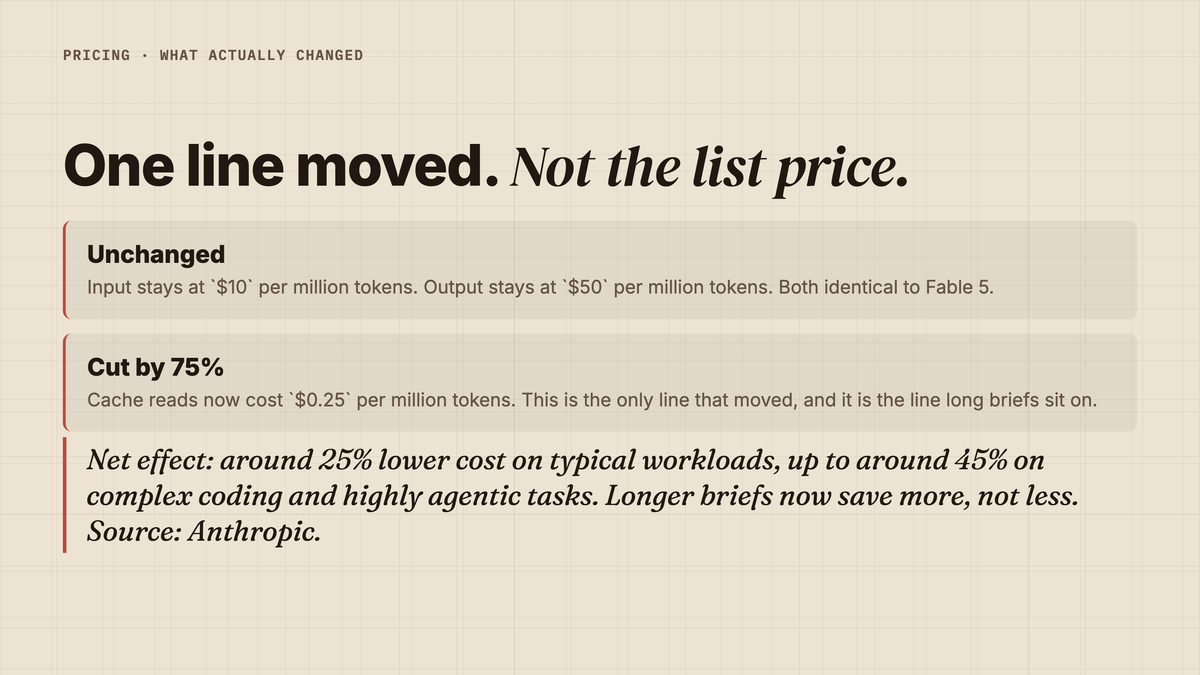
The list price did not move. Fable 5.1 is $10 per million input tokens and $50 per million output tokens (Source: Anthropic, 2026 — pricing).
One line did move. Cache reads now cost 75% less, at $0.25 per million tokens.
That sounds like a footnote. It is not, and here is why.
Think about how your team really works. Nobody sends one short question.
You send a 40-page brand book. Then six competitor pages. Then a tone-of-voice doc. Then you ask for a headline.
Then you ask for another. And another. Fifteen times.
Each of those fifteen goes back over the same pile. That pile is the cache read.
So the pile is where the money goes. And the pile just got four times cheaper.
Anthropic puts the net effect in two numbers. For typical work, costs drop by around 25% against Fable 5.
For complex coding and heavy agent work, the saving can reach around 45%.
Read that second number again. The harder the job, the bigger the cut.
Most price drops work the other way round. You get a discount on small things and pay full rate on the big ones.
This one rewards depth. The more context you load, the more you keep.
That flips a rule most teams built their habits around. For two years the advice was to keep prompts lean. Trim the brief. Strip the examples. Cut the reference pages.
That advice is now partly wrong. If context is what makes the output good, load it.
There is a caveat worth stating. The cut applies to cached reads, not to the first pass.
So a team that sends one fresh short prompt each time will barely feel it. A team running long threads all day will feel it a lot.
Work out which one you are before you promise anyone a saving.
What got better, in numbers
Anthropic published scores on ten tests. Three of them matter to a marketing team.
The first is AutomationBench. It checks whether a model can run a real business workflow from end to end.
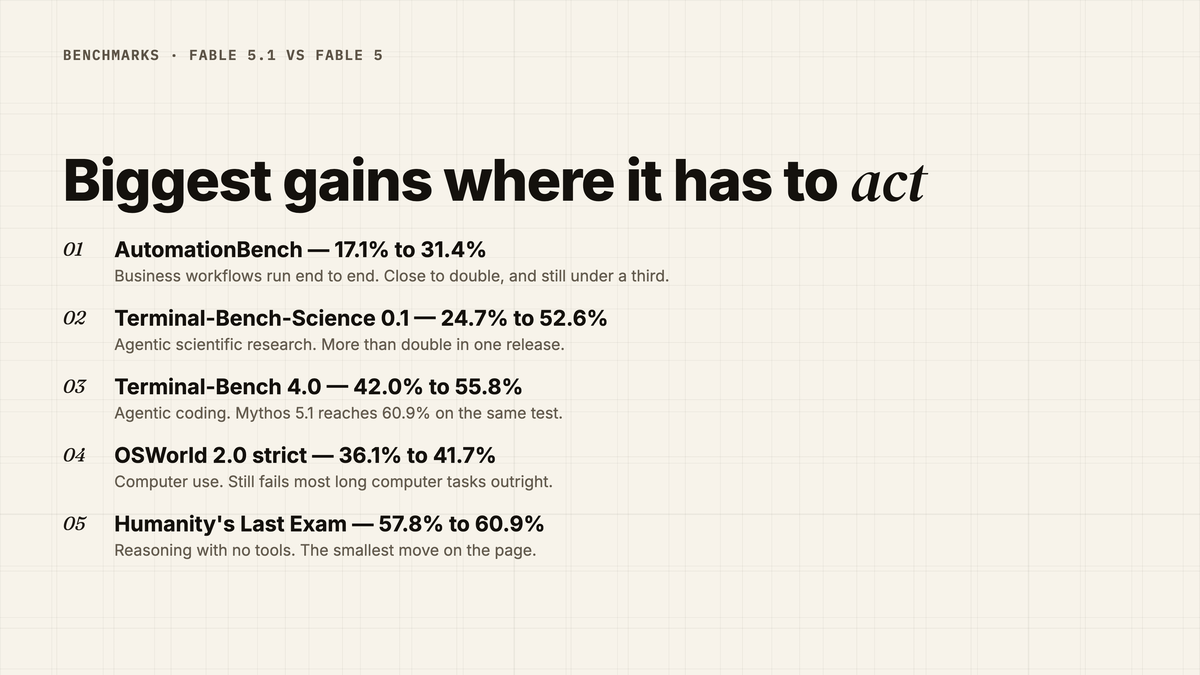
Fable 5.1 scored 31.4%. Fable 5 scored 17.1%.
That is close to double in a single release. It is also still under a third. Hold on to that second fact.
The second is Terminal-Bench-Science 0.1. It tests research work carried out by an agent.
Here the model scored 52.6%, against 24.7% for Fable 5. That is more than double.
The third is GDPval-AA v2, which scores knowledge work of the kind office staff do. It moved from 1723 to 1853.
There is also OSWorld 2.0, which tests a model driving a computer (Source: OSWorld 2.0, 2026 — benchmark paper). The loose score went from 72.9% to 77.9%.
The strict score went from 36.1% to 41.7%.
Sit with that strict score for a moment. Under 42% means the model still fails most long computer tasks outright.
Both things are true at once. The jump is real, and the ceiling is still low.
On coding, Terminal-Bench 4.0 rose from 42.0% to 55.8% (Source: Terminal-Bench — tbench.ai). Mythos 5.1 reached 60.9% on the same test.
On general reasoning, Humanity's Last Exam moved from 57.8% to 60.9% without tools. With tools it went from 63.8% to 65.0%.
That last pair is the least impressive set on the page. It is also the one closest to what a chatbot does for you all day.
So the pattern is clear. The gains are largest where the model has to act over many steps, and smallest where it just has to answer.
One more score is worth a line. CursorBench 3.2.0 went from 70.5% to 73.4%.
That is a small move on a test of everyday coding help. It fits the same pattern. Single answers improved a little. Long jobs improved a lot.
Keep that in mind when you plan what to hand over. The work most likely to pay off is the work with many steps in it.
The proof that did not come from a benchmark
Two items in the announcement are worth more than the whole score table. Neither is a benchmark.
The first is protein binder design. A binder is a molecule built to stick to a target in the body. It is how a lot of modern medicine starts.
On three targets, the binding strength was 10 times higher than the best designs people had submitted.
Across 12 targets, the hit rate reached nearly 50%. A normal hit rate is 10 to 15%.
Then comes the line that matters. Anthropic sent those designs to two outside organisations to be tested for real.
That is external proof. Almost nothing else in the announcement has it.
The same model also redrew part of Venus. The new map shows detail down to two or three kilometres, where the old one showed 10 to 20.
It also reads heights up to 25% more accurately than before.
There is a third result in the same section. Anthropic set the model on speeding up open-source software used by researchers.
It made seven of those models run up to 2.5 times faster. On that kind of work, the estimated compute bill fell by 30 to 60%.
That one is worth flagging to whoever runs your data or media-mix work. Faster code on the same hardware is a cost line, not a science story.
The second item is a customer story. A trading firm called Millennium had a crash in its code.
It showed up about once in a million runs. Nobody on the team had explained it in four to five years.
Fable 5.1 found the cause. To do it, the model pulled apart outside vendor libraries and read crash dumps.
Why should a marketer care about a trading firm's bug? Because it is a different shape of task.
Writing a headline is one step. Finding a fault buried in five years of noise is hundreds of steps, held together without losing the thread.
That second shape is what an agent has to manage to be useful in your stack. Pulling a report. Fixing a broken product feed. Auditing 4,000 pages for stale claims.
One customer story is not proof of anything general. But it is a better signal than a score you cannot audit.
Fewer wrong refusals
Anyone who has used an AI tool on client work has hit a silly refusal.
You ask for a read on a rival's ad copy. It says no. You ask about a health client's product. It says no.
Each one costs you ten minutes and a little more faith in the tool.
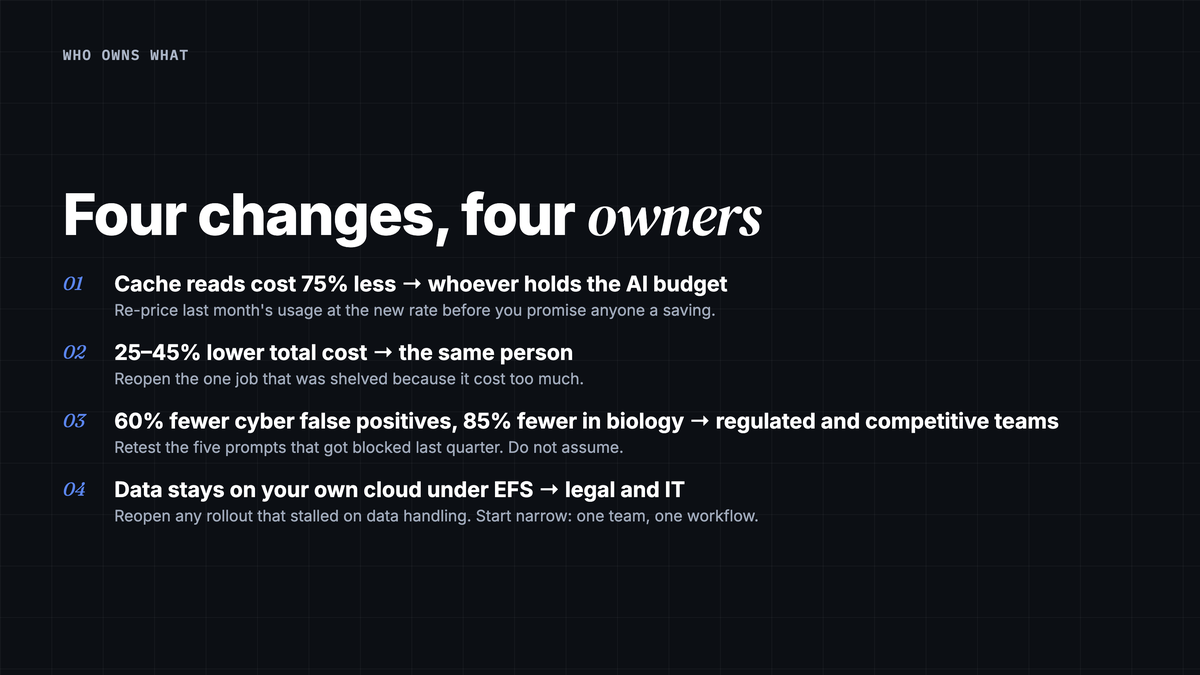
Anthropic says its guards are less jumpy now. In cybersecurity, they block 60% fewer false positives than before.
In biology, the guards fire 85% less often on harmless requests. In Claude Code, users should see around 60% fewer interruptions per session.
These were checked outside as well. Anthropic paid two organisations to test them, plus automated testing from Gray Swan (Source: Gray Swan — grayswan.ai).
For a team doing regulated or competitive work, that is worth more than a benchmark point.
A tool that says no at the wrong moment does not get used twice. People route around it, and then you have paid for a seat nobody opens.
There is a caution here. Fewer false positives is not the same as no false positives.
The guards still fire, and they should. What changed is how often they fire on work that was always fine.
So treat this as a reason to retest, not a reason to assume. Your prompts are not the ones Anthropic measured.
Your files can stay on your own cloud
The biggest blocker to AI at work is rarely quality. It is legal.
Anthropic went at that directly. Under an arrangement it calls EFS, customers store their data on their own cloud, not on Anthropic's systems.
It goes one step further. Any human review is done by the customer by default, not by Anthropic.
Read that as a marketer, not as an engineer. It removes the one sentence that has killed a hundred AI pilots.
That sentence is "we cannot send client data to a third party".
You have heard it from a bank. You have heard it from a hospital group. You have probably heard it from your own compliance lead.
If your rollout stalled on data handling, the ground under that decision has moved. Take it back and ask them to look again.
Go in with the specifics, not the headline. Ask what EFS covers, what it does not, and what it costs.
Bring the client's own rules to that meeting too. A retail brand and a hospital group will not read the same answer the same way.
And keep the scope small at first. One team, one workflow, one kind of data.
A narrow pilot that clears legal beats a broad one that never starts.
How to quote these numbers without getting burned
Here is the habit that keeps you credible in a client meeting.
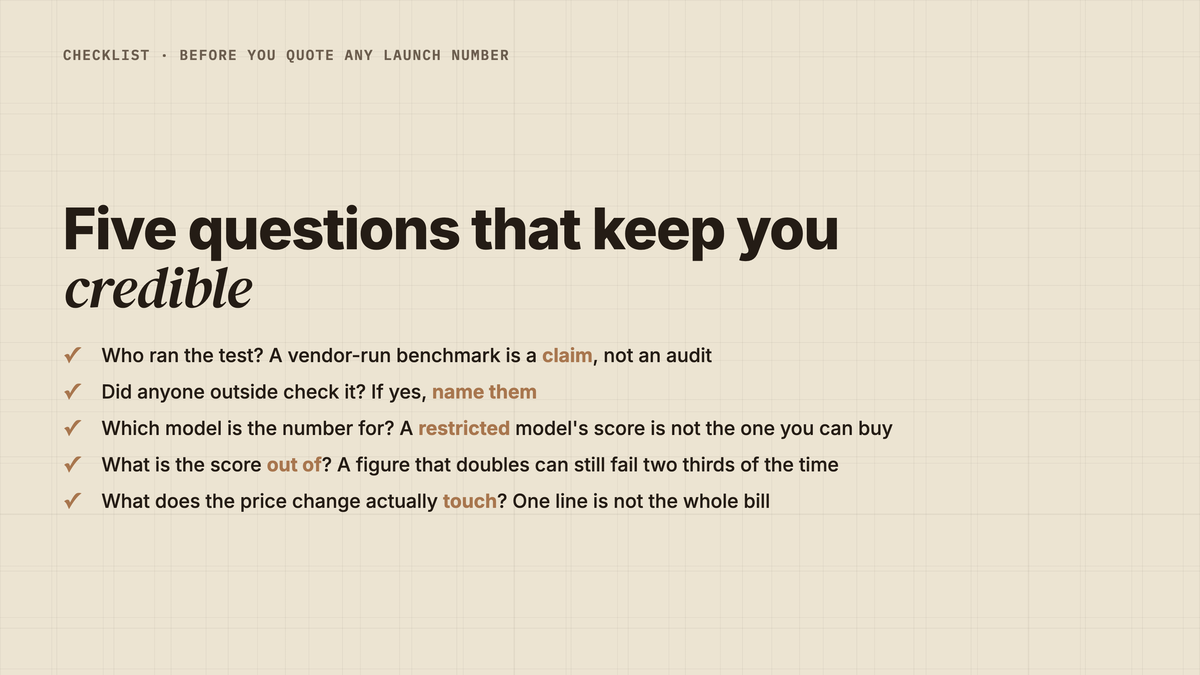
Anthropic ran nearly every test on that page. That does not make the numbers false. It makes them unaudited.
Two things had outside hands on them. The protein designs went to two outside organisations. The safeguards were tested by two organisations plus Gray Swan.
Everything else is a vendor score. So say so when you repeat it.
"On Anthropic's own AutomationBench" costs you four words. It also buys you the room.
The one person in that meeting who goes and checks will find you were straight with them. That is worth more than the slide.
There is a second habit worth keeping. Always ask what a score is out of.
A number that doubles from 17.1% to 31.4% still fails more than two thirds of the time. Both facts are true. Only one of them usually makes the deck.
A third habit. Check the date on any comparison.
Model pages compare against rivals that were current when the page was written. Those rivals move within weeks, and the chart does not.
We applied the same rules to Claude Opus 5 and to Runway's Solaris. It is not doubt. It is just sourcing.
What to do this week
Four moves. None of them needs a budget sign-off.
First, re-price last month. Pull your Claude usage and run the maths again at the new cache rate.
If your prompts are long, the drop will surprise you. If they are short, it will barely move.
That second outcome is worth knowing too. It tells you where your spend actually sits.
Second, reopen one shelved job. Every team has a task that died on cost alone.
Rewriting product copy across 4,000 lines. Alt text for a whole catalogue. Tagging three years of old posts.
Pick one. Run it on a sample of fifty this week and price the full job from what you learn.
Third, retest your refusals. Take the five prompts that got blocked last quarter and run them again.
Do not assume they now pass. Check, and write down which ones changed and which did not.
Fourth, take EFS to legal. If data residency was the reason you stalled, that reason has moved.
None of this is a purchase order. All of it is a position, and you can hold it by Friday.
One last note on timing. Model launches now land every few weeks, and each one resets the price you should be paying.
So make the re-pricing a habit rather than a one-off. A short check each month will catch far more than a big audit each year.
FAQ
Q: What is Claude Fable 5.1?
A: It is Anthropic's model for coding and knowledge work, released on 1 September 2026. It replaces Fable 5 and is available on all platforms today.
Q: What is the difference between Fable 5.1 and Mythos 5.1?
A: They are the same model with different safeguard levels. Fable 5.1 is open to everyone. Mythos 5.1 goes only to a set of US organisations inside trusted access programmes.
Q: How much cheaper is Claude Fable 5.1?
A: Anthropic says costs drop around 25% for typical workloads and up to around 45% for complex coding and heavy agent work. The change comes from cache reads, which now cost 75% less at $0.25 per million tokens.
Q: Did the list price change?
A: No. Fable 5.1 is $10 per million input tokens and $50 per million output tokens. Only the cache read price moved.
Q: Which results were checked outside Anthropic?
A: Two. The protein binder designs went to two external organisations for testing. The safeguards were tested by two organisations plus automated testing from Gray Swan.
Q: Does this fix the refusal problem?
A: Partly. Anthropic says cyber safeguards block 60% fewer false positives and biology safeguards fire 85% less often on harmless requests. Retest your own blocked prompts rather than assuming.
Q: Can we keep our data on our own systems?
A: Anthropic says yes, under an arrangement it calls EFS. Customers store data on their own cloud, and human review is done by the customer by default.
Sources
- Anthropic — Introducing Claude Fable 5.1 and Claude Mythos 5.1 (1 September 2026; primary source for pricing, every benchmark score, the safeguard figures, the protein and Venus results, the Millennium account and the EFS description).
- Anthropic — Pricing (list rates for input and output tokens).
- Terminal-Bench — tbench.ai (the agentic coding benchmark Anthropic reports against).
- OSWorld 2.0 — Benchmarking Computer Use Agents on Long-Horizon Real-World Tasks (arXiv, 2026; the computer-use test cited above).
- Gray Swan — grayswan.ai (the automated red-teaming used in the safeguard testing).
- YARD — Claude Opus 5 launch and Runway Solaris (the same vendor-number discipline applied to earlier launches).
Insights from Our Experts
Explore our latest articles on digital marketing strategies.