
Most Indian D2C brands still pick one platform and hope.
That worked in 2021. It does not work now. Meta CPMs are up. Google Shopping is crowded. The brands winning today run both. And run them differently.
This guide breaks down the 2026 split. You will see real ROAS bands. The right budget mix. When to lean Google. When to lean Meta. And the campaign hygiene that keeps both alive.
It is built for founders, growth leads, and operators running paid for D2C brands in India. No fluff. No theory. Just the playbook.
The State of D2C Marketing in India Right Now
The Indian D2C market is huge. And it is shifting fast.
Inc42 puts India's D2C GMV at $65 billion in 2026. That is set to hit $310 billion by 2031, with roughly 86% of new ecommerce GMV coming from D2C channels (Source: Inc42, 2026 — D2C 3.0: The New Rules Of India's D2C Economy).
But growth is not free anymore. CAC has climbed. Meta CPMs jumped 40 to 60% between 2023 and now (Source: upGrowth, 2026 — D2C Performance Marketing in India). Capital is pickier. Bain and others say 2026 rewards discipline, not scale (Source: Entrepreneur India, 2026 — Experts Say 2026 Will Reward Discipline, Not Scale).
So the question is not "should I run ads?" It is "what is the right channel mix?"
Funding tells the same story. Indian D2C brands raised more than $10 billion across 1,400 deals from 2015 to early 2026 (Source: Inc42, 2026 — D2C 3.0: The New Rules Of India's D2C Economy). Most of that capital flowed to scaled brands with proven unit economics. The hobby-D2C era is over.
The flip side is opportunity. Delhi NCR is now the country's biggest D2C hub. Mumbai and Bangalore are close. Quick commerce alone is on track to hit $68 billion in GMV by 2030 (Source: Inc42, 2026 — How Quick Commerce's $68 Bn GMV Opportunity Is Reshaping Brand Strategy). New SKUs land every week.
Quick Facts: Indian D2C Performance Marketing in 2026
- India's D2C GMV will scale from $65B in 2026 to $310B by 2031 — (Source: Inc42, 2026 — inc42.com/features/d2c-3-0-the-new-rules-of-indias-d2c-economy).
- Meta CPMs in India rose 40 to 60% between 2023 and 2026 — (Source: upGrowth D2C Playbook, 2026 — upgrowth.in/d2c-performance-marketing-in-india).
- 68% of Indian D2C brands with negative unit economics will shut by 2026 — (Source: Troopod Unit Economics Report, 2026 — blog.troopod.io/unit-economics-crisis).
- India digital ad spend will hit $20.46B by 2029 — (Source: GlobeNewswire, 2026 — globenewswire.com/india-digital-ad-2026).
The mix matters more than the spend. A ₹3L budget split well beats a ₹5L budget on one channel. We have seen it on every audit.
Q: Is paid marketing still worth it for new Indian D2C brands?
A: Yes. But only with a clear channel mix and tight unit economics. Pouring money into Meta alone is how most brands burn out. The split between Google Ads and Meta Ads is the real lever now.
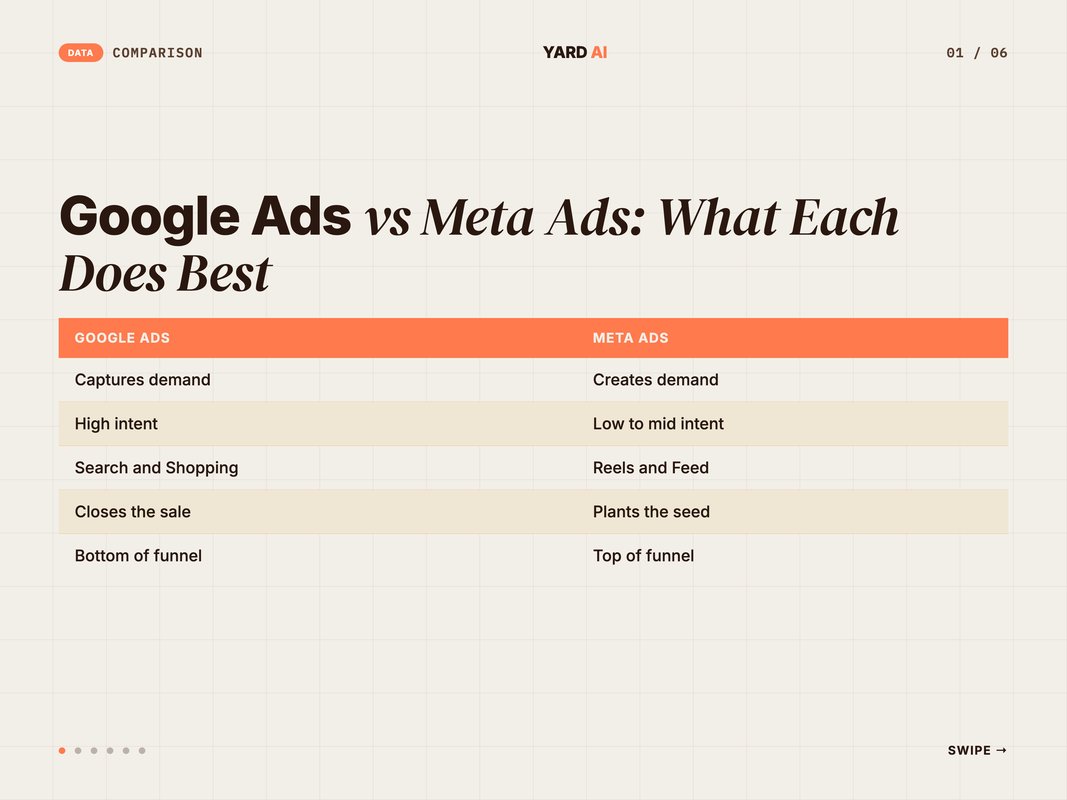
Google Ads vs Meta Ads: What Each Does Best
Google and Meta solve different jobs.
Meta builds demand. Google captures it. Treat them as one funnel, not two channels.
Meta sits at the top. People scroll Reels. They see a product. They become curious. They click. That click may not convert today. It plants the seed.
Google sits at the bottom. The same person searches "best D2C protein India" two days later. Or types your brand name. Or clicks a shopping result with your price. That is where the sale closes.
This is the demand-creation versus demand-capture model. Smart Indian D2C brands map every campaign to one side. Most brands skip the mapping. That is why budgets bleed.
Run one without the other and you leave money on the table.
Meta with no Google means you create demand competitors capture. Google with no Meta means you only fight for the small slice already searching.
Think of category demand as a glass jar. Meta fills it. Google empties it. If the jar is empty, only Meta works. If the jar is full, only Google works. Most categories sit in between. So most brands need both.
The other reason to run both is data. Meta and Google learn from different signals. Combined first-party data feeds back into each ad system. Pixel plus CAPI on Meta. Enhanced conversions on Google. Both get smarter when they see the same buyer.
Q: What is the core difference between Google Ads and Meta Ads for D2C in India?
A: Google captures intent. People search for what they already want. Meta creates intent. People scroll and discover. D2C brands need both — Meta to fill the funnel, Google to close it.
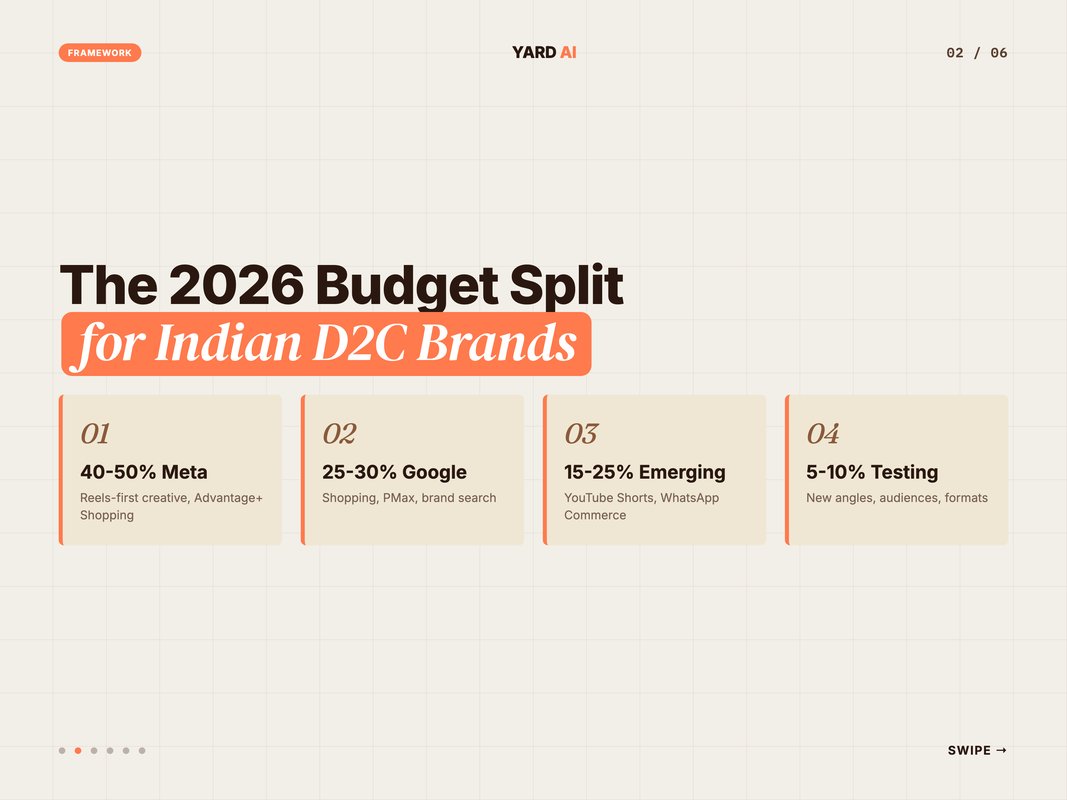
The 2026 Budget Split for Indian D2C Brands
Here is the split that works for most scaling Indian D2C brands today.
40 to 50% goes to Meta. Reels-first creative. Advantage+ shopping campaigns. Broad targeting and creative-led testing.
25 to 30% goes to Google. Split across Shopping, Performance Max, and brand search. Use Customer Match for lookalike scaling.
15 to 25% goes to emerging channels. YouTube Shorts. WhatsApp Commerce. Influencer seeding. These pull demand Meta and Google miss.
5 to 10% stays for testing. New angles. New audiences. New formats. No testing budget means no learning.
This is a big shift from 2021. Back then, most brands leaned heavily on Meta as their single channel. That stopped working when CPMs climbed.
The Balistro 2026 ranking of D2C channels puts Meta first by spend but Google first by ROAS. Both make the top five. Neither stands alone (Source: Balistro, 2026 — Top 10 Google Ads Strategies for D2C Brands).
The split also shifts by stage. A ₹50K monthly spender cannot run six channels. They should run two well. Meta plus brand search. That is it.
A ₹5L monthly spender can split across all four buckets. A ₹50L spender adds CTV, programmatic, and offline back into the mix. The mix grows with the budget.
There is also a category lens. Beauty and skincare lean Google heavier because search demand is huge. New-age health, niche fashion, and category creators lean Meta heavier because intent does not yet exist.
Q: Should a small D2C brand follow the same 40-50% Meta split?
A: Start lower on emerging channels. Put 50% on Meta, 35% on Google, 10% testing, 5% on WhatsApp until you cross ₹5L monthly spend. Then push more into discovery.
Google Ads Playbook: Where the Money Hides
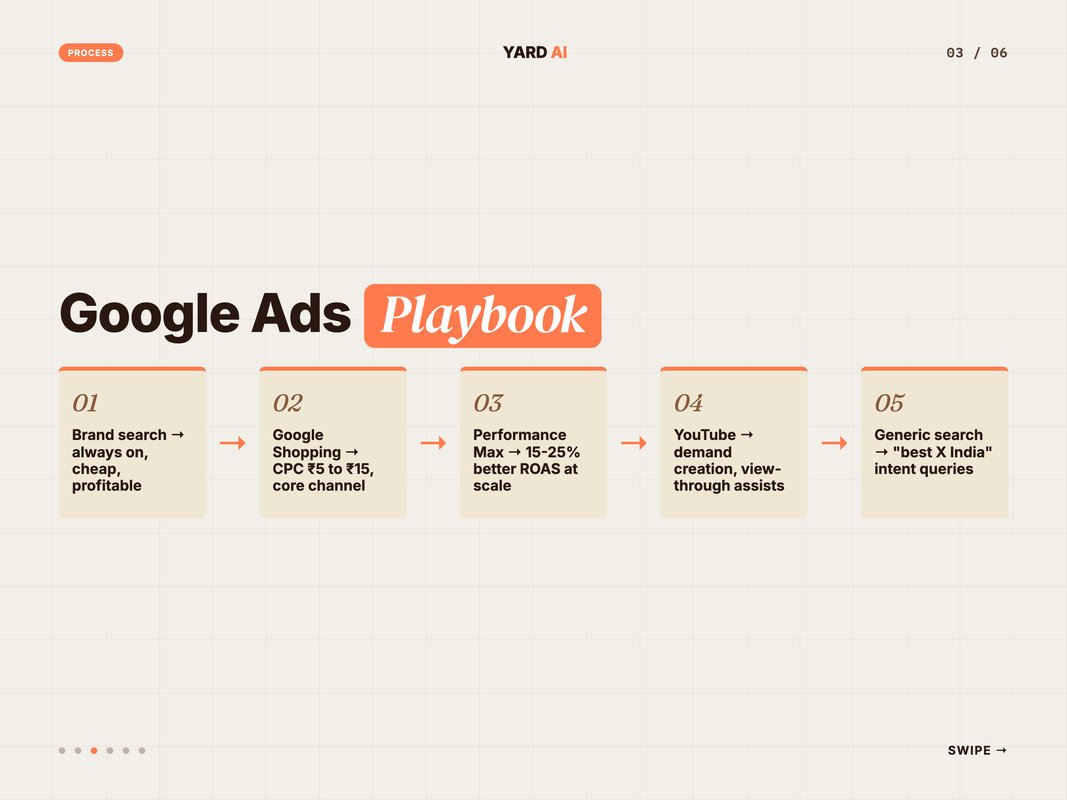
Google Ads has five places D2C spend should live in India.
The mix shifts by category. But the order rarely does.
- Brand search. Always on. Always cheap. Always profitable. Anyone typing your name should land on your site, not a reseller.
- Google Shopping. The single most reliable channel for product D2C. India CPC sits at ₹5 to ₹15 for most categories (Source: OwlClaw, 2026 — PPC Benchmarks India).
- Performance Max. Google's automated multi-channel format. 15 to 20% better ROAS than standard Shopping for catalog brands (Source: OwlClaw, 2026 — Google Shopping Ads Benchmarks).
- YouTube. Demand creation. View-through conversions feed your Shopping numbers.
- Generic search. The "best protein in India" or "ethical skincare brands" queries. Lower intent than Shopping. Still strong.
Top-quartile D2C ecommerce brands hit average Shopping ROAS of 6 times. Most brands sit at 3 to 5 times. That is the real benchmark (Source: OwlClaw, 2026 — Google Shopping Ads Benchmarks).
The lever most brands miss is feed quality. Better titles. Better images. Better category mapping. Brands that fix their feed see meaningfully higher CTR and lower CPC, per OwlClaw's 2026 Shopping benchmarks (Source: OwlClaw, 2026 — Google Shopping Ads Benchmarks).
Run Customer Match with Target ROAS bidding for a strong efficiency lift. Upload your buyer list. Build value-based lookalikes. Let Google bid harder on the buyers who matter.
A few quick wins inside Google. Build a separate campaign for branded search. Cap that bid low. Let the quality score do the work.
Use negative keywords ruthlessly. Strip out "free", "DIY", "recipe", and category noise. Every saved click goes back to performance.
On PMax, feed signals are everything. Upload audience lists. Add value rules. Use the asset group structure to separate categories. PMax without structure is a money pit.
Q: Is Performance Max worth running for an Indian D2C brand?
A: Yes — once you have at least 30 days of conversion data and a clean product feed. Below that, run standard Shopping. PMax is hungry. It needs signal to work.
Meta Ads Playbook: Creative Is Now the Channel
Meta has changed. Targeting is broad. Algorithm picks. Creative is the only lever left.
Brands hitting 3x to 4x ROAS on Meta share four things (Source: Sociolabs, 2026 — How D2C Brands in India Can Achieve 3x–4x ROAS with Meta Ads).
First, they ship 15 to 20 new ad creatives per month. Not one a quarter. Not five at launch. A constant feed.
Second, all of it is vertical. 9:16. Reels-first. The hook lands in 2 seconds or the user scrolls.
Third, they run Advantage+ Shopping Campaigns. Meta's own data shows ASC cuts cost per purchase 17% on average and lifts incremental ROAS up to 32% when layered onto manual campaigns (Source: Foxwell Digital citing Meta, 2025 — Advantage+ Shopping Updates).
Fourth, they trust the algorithm. Broad targeting. No tight interest stacks. Let Meta find buyers.
CPMs on Reels run 15 to 30% lower than Feed for D2C brands using vertical-first creative (Source: AdAmigo, 2026 — Meta Ads Benchmarks 2026 by Objective and Placement). That gap is real money.
The brands that lose are the ones still uploading square Canva tiles and pausing campaigns weekly. Meta penalises both.
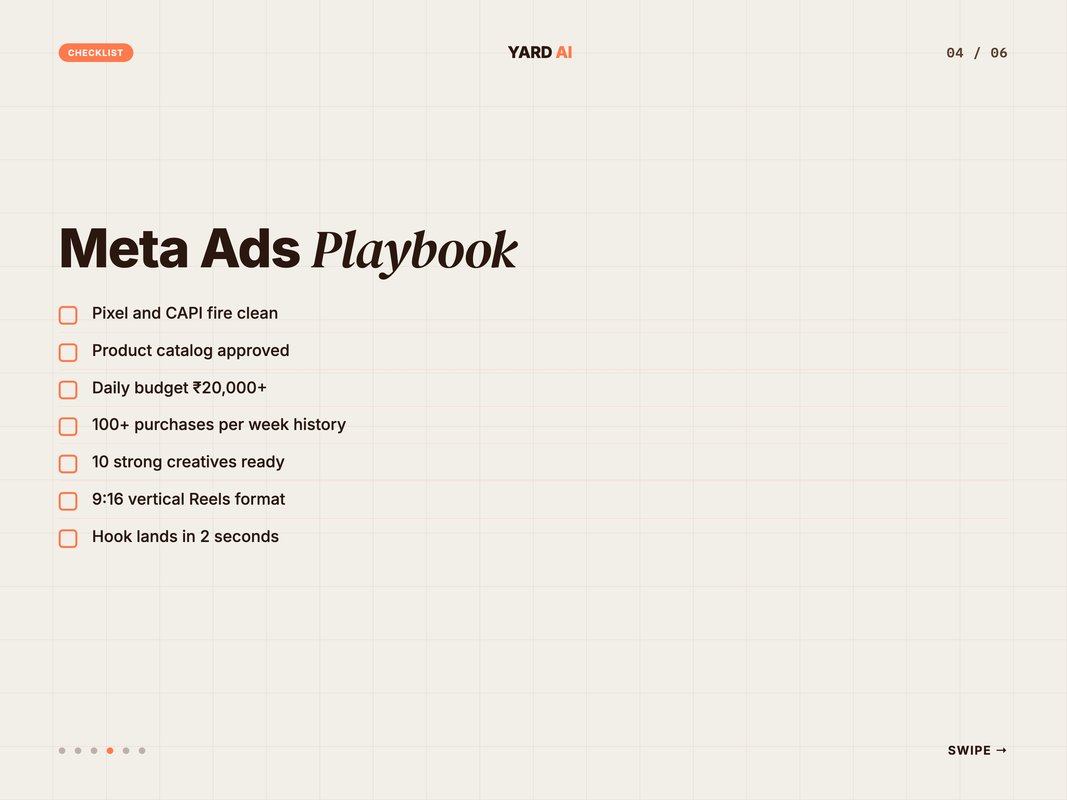
Before launching ASC, confirm five things. Pixel and CAPI fire clean. The product catalog is approved. Daily budget is at the level Meta recommends for learning-phase exit (Source: Meta Business Help — About Advantage+ Sales Campaigns). You have steady weekly purchase volume in the account. And a healthy bench of strong creatives is ready to upload.
Below those thresholds, ASC will burn cash and not learn. Build foundational sales campaigns first. Layer in ASC once volume hits.
Creative-wise, the brief is simple. Hook in 2 seconds. Product in shot by second 4. Benefit, not feature. UGC over polished. Subtitles on.
Test 4 to 6 angles in parallel. Kill anything under 1.5x ROAS after 4 days. Scale anything over 3x by duplicating into a fresh ad set. Refresh winners every 10 days.
Q: How often should we refresh Meta creative for an Indian D2C brand?
A: Aim for new creative every 7 to 10 days at minimum. Top performers ship daily during scaling phases. Creative fatigue is the single biggest reason ROAS drops.
Google Ads vs Meta Ads: The Full Side-by-Side
Put them next to each other and the picture clears up.
Both belong in the mix. Neither replaces the other. The right one to push depends on what your brand needs this month.
If you need fast revenue from existing demand. Push Google.
If you need to build demand and a new audience. Push Meta.
If you are in a low-search category like new-age supplements or niche fashion. Meta does more lifting.
If you are in a high-search category like beauty, electronics, or home. Google does more.
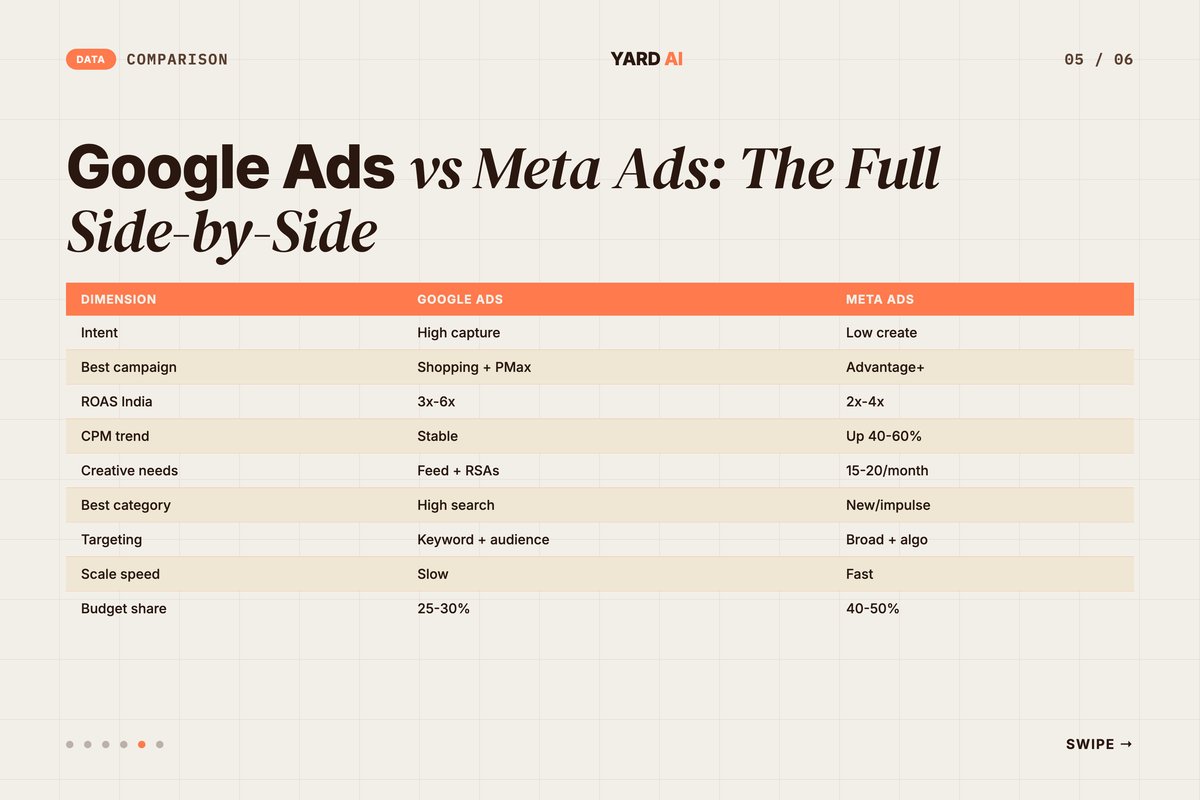
On intent, Google wins. It captures search demand. Meta sits lower in intent and creates demand. On best campaign type, Google leans Shopping plus Performance Max. Meta leans Advantage+ Shopping.
On typical ROAS in India, Google bands 3x to 6x for product D2C (Source: OwlClaw, 2026 — Google Shopping Ads Benchmarks). Meta bands 2x to 4x (Source: Sociolabs, 2026 — How D2C Brands in India Can Achieve 3x–4x ROAS with Meta Ads). On CPM trend from 2023 to 2026, Google has been stable. Meta is up 40 to 60% (Source: upGrowth, 2026 — D2C Performance Marketing in India).
On creative needs, Google wants a clean product feed plus 5 to 10 responsive search ads per campaign. Meta wants 15 to 20 new creatives per month, all vertical, all Reels-first.
On best category fit, Google wins high-search verticals. Meta wins new or impulse-led ones. On targeting style, Google is keyword and audience-driven. Meta is broad and algorithm-led.
On time to scale, Google is slow because it needs intent. Meta is fast because it needs creative. On budget share inside the D2C mix, Google holds 25 to 30%. Meta holds 40 to 50%.
We have seen D2C food and beauty brands stall on Meta-only mixes for months at sub-2x ROAS. Adding Google Shopping and brand search alongside, with no change to product or creative team, has consistently pulled blended ROAS into healthy profitable territory within a couple of months.
The lesson is simple. Single-channel D2C is fragile. Add the other half of the funnel and the same spend pulls more revenue.
Q: Can we run Meta-only or Google-only at any stage?
A: Below ₹1L monthly spend, Meta-only is fine to start. Above that, the brands that scale add Google. Single-platform D2C past ₹3L monthly leaves a meaningful share of revenue uncaptured.
How to Audit Your Current D2C Channel Mix
Before changing budgets, run this audit. It takes a day.
Pull the last 90 days of platform data. Look at spend, revenue, and ROAS per channel. Map every campaign to a funnel stage. Identify which channels are bidding on the same demand.
If Google and Meta are both crushing your brand keywords, you are double-paying. Fix that first.
If Meta CPMs are climbing month over month without ROAS improving, your creative engine is too slow. Fix that next.
If your blended ROAS is under 2x, pause everything and rebuild the math. Bain's 2026 read on Indian D2C is brutal but right. Discipline beats scale (Source: Entrepreneur India, 2026 — Experts Say 2026 Will Reward Discipline, Not Scale).
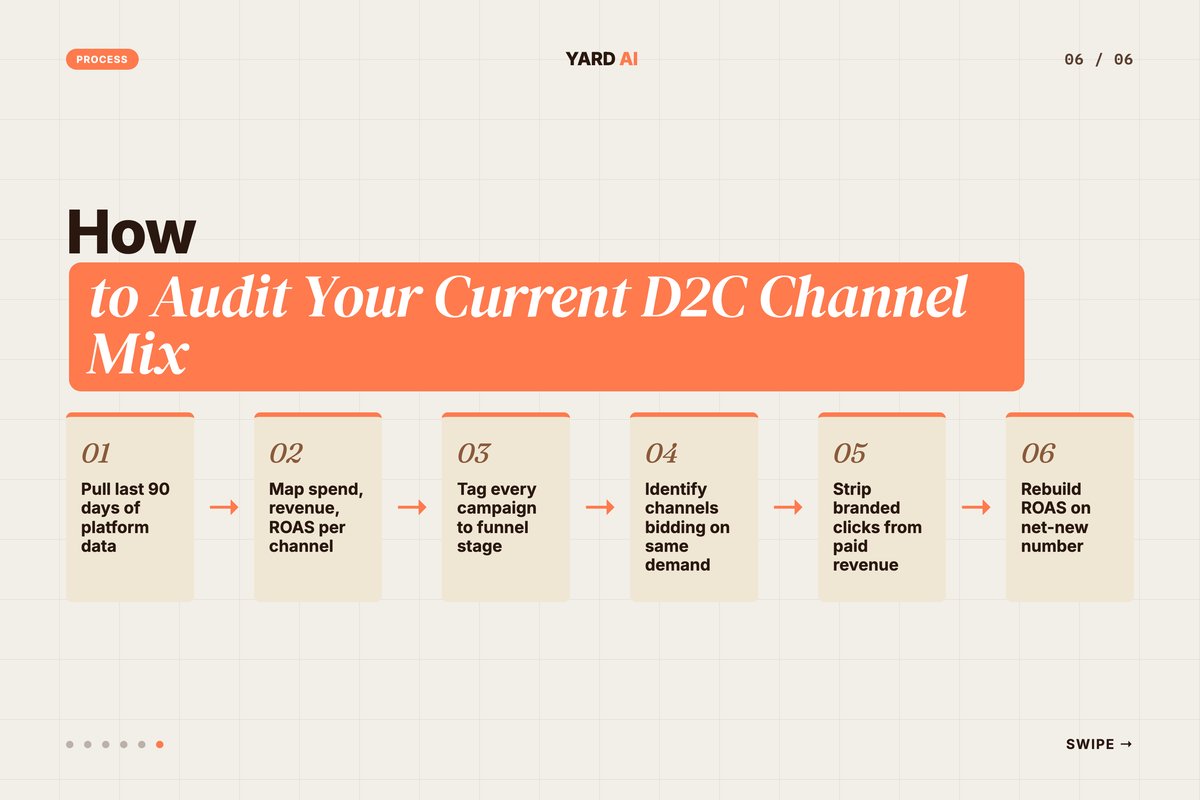
The audit needs hard numbers. Not vibes. Pull GA4. Pull Shopify or your cart system. Pull both ad managers. Stitch the spend per source to revenue per source.
Then strip out branded search and direct traffic from "paid revenue." Most platform ROAS numbers double-count branded clicks. Strip them. Look at the net-new number.
If net-new ROAS is under 1.5x on Meta, the brand is buying its own existing customers. That happens often. The fix is fresh creative and broader targeting.
If net-new ROAS is under 2x on Google Shopping, the feed is the problem. Audit titles, GTINs, images, and category mapping. Most brands have feed errors they never see.
Q: How often should a D2C brand re-audit its channel mix?
A: Every 90 days at minimum. After every major Meta or Google algorithm change. And after any quarter where blended ROAS drops sharply.
Where Most Indian D2C Brands Get the Mix Wrong
Five mistakes show up in nearly every audit we run.
One: Meta-only at scale. Past ₹3L monthly spend, the missing Google layer costs a meaningful share of potential revenue.
Two: No brand search defense. Competitors bid on your name. You lose buyers who already want you.
Three: Single creative running for months on Meta. CPMs spike. ROAS drops. Brand blames Meta. Meta blames the creative.
Four: Static product feeds on Google. No title tests. No image tests. No category cleanup. CPC stays high.
Five: Zero testing budget. Every rupee goes to "what worked last month." When the algorithm shifts, nothing is queued up.
Fix two of these five and most brands recover blended ROAS within 60 days.
There is a sixth mistake worth flagging. Confusing platform ROAS with blended ROAS. Meta says 3x. Google says 5x. Shopify says 2.1x. The Shopify number is the real one.
Trust the cart system. Use platform numbers only for in-platform optimisation. Make all budget decisions on the blended view.
One last note on the audit. Cohort math beats campaign math. Pull buyer cohorts by acquisition month. Track second-order revenue at 30, 60, and 90 days.
A buyer Meta brings in might have low day-zero ROAS but a strong 90-day LTV. The same buyer on Google might convert faster but never come back. Both stories show up in cohorts, not in the ad dashboard.
Q: What is the single fastest fix for a struggling D2C ad mix in India?
A: Add brand search on Google. It is the cheapest, highest-intent traffic in the funnel. Most brands underspend on it heavily.
YARD's View on D2C Performance Marketing in India
We run growth marketing for D2C and B2B brands across India and global markets. Our team blends performance marketing, LLM SEO, and AI creative production into one stack.
We are AI-first. That means Claude and MCP workflows in the campaign build. Programmatic creative generation. Funnel logic mapped end to end before any rupee is spent.
D2C is one of the verticals we work in most. Beauty. Skincare. Food. Apparel. Home. Wellness.
Every brand gets the same foundational audit before we touch a campaign. Channel mix, unit economics, creative cadence, feed health, and pixel hygiene. The audit shapes the engagement, not the other way round.
We do not do project-based "Meta only" or "Google only" engagements. The mix is the work. If a brand wants single-channel scale, we are the wrong partner.
Running paid for a D2C brand in India? Blended ROAS not where you want it? We can run the audit. No deck pitch. We send the same channel-mix breakdown you just read.
Conclusion
D2C marketing in India is not a Google vs Meta fight.
It is a Google plus Meta playbook. With WhatsApp, Shorts, and creative testing layered in. The brands that scale in 2026 treat the channels as one funnel.
Start with the audit. Map the mix. Push creative production hard. Defend brand search. Run Advantage+ on Meta. Run Performance Max on Google. Keep a testing budget alive.
The market is huge. India D2C will hit $310B by 2031 (Source: Inc42, 2026 — D2C 3.0: The New Rules Of India's D2C Economy). But the cost of staying single-platform is now too high.
If you want a second pair of eyes on your D2C ad stack, we are here. Email team@yardagency.ai or book a call from the site.
FAQ
Q: What is the right budget split between Google Ads and Meta Ads for D2C in India? A: Most scaling Indian D2C brands now run 40 to 50 percent on Meta and 25 to 30 percent on Google. The rest goes to WhatsApp, Shorts, and creative testing. This split assumes Meta builds demand and Google captures it.
Q: Which gives better ROAS in India, Google Ads or Meta Ads? A: Google Shopping and Performance Max usually hit higher ROAS for high-intent buyers. Top D2C brands see 3 to 5 times ROAS on Google (Source: OwlClaw, 2026 — Google Shopping Ads Benchmarks). Meta wins on volume and discovery. The two work together, not against each other.
Q: Why have Meta CPMs risen so much for Indian D2C brands? A: Meta CPMs in India climbed 40 to 60 percent between 2023 and 2026 (Source: upGrowth, 2026 — D2C Performance Marketing in India). More brands, more auctions, more creative fatigue. Cheap Facebook inventory is over. Strong creative is the only way out.
Q: What is Meta Advantage+ and should D2C brands use it? A: Advantage+ is Meta's automated shopping campaign type. It picks audience, placement, and creative for you. Meta says it cuts cost per purchase 17% on average and lifts incremental ROAS up to 32% versus manual campaigns (Source: Foxwell Digital citing Meta, 2025 — Advantage+ Shopping Updates). Most scaling D2C brands now run it.
Q: How many ad creatives should an Indian D2C brand produce each month? A: Aim for 15 to 20 new variations per month for Meta. Reels-first, vertical, hook in the first 2 seconds. Google needs fewer assets but a clean product feed and strong shopping titles.
Q: When does Google Ads beat Meta Ads for a D2C brand? A: Google wins when the category has search demand. Beauty, supplements, home, electronics. Google Search and Shopping pull buyers ready to convert. Meta wins when you are creating a new category or chasing impulse buys.
Q: What ROAS should a new Indian D2C brand target in year one? A: Aim for blended ROAS of 2.5 to 3 times in year one. Pure performance ROAS on Google can hit 4 times if intent is high. Meta will sit lower while the creative engine warms up.
Insights from Our Experts
Explore our latest articles on digital marketing strategies.