

For twenty years, SEO had one shape. Rank in a list of ten blue links. Win the click.
That shape is breaking.
Google now answers many queries at the top of the page with an AI Overview. AI Overviews scaled from 6.5% of queries in January 2025 to a peak near 25% by mid-year (Source: Search Engine Land, 2026 — AI Overviews surge and pullback). ChatGPT, Perplexity, Gemini, and Claude answer millions more without a search box at all. The user gets the answer. The link sometimes never gets the click.
This scares a lot of marketers. It should not. SEO is not dying. It is moving. The brands that understand where it is moving will own the next decade of search.
This is the honest map. What changed, why it changed, and the playbook to stay visible as the ground shifts.
What Actually Changed in Search
The interface changed. The mechanism underneath did not.
Search used to return a list. You scanned, clicked, and left. Now, for a growing share of queries, search returns a synthesised answer first. Built from web pages, with a few citations attached.
Google's AI Overviews sit above the classic results. When one appears, users click a traditional link in just 8% of visits, versus 15% without one (Source: Pew Research Center, 2025 — Google users click less with AI summaries). ChatGPT and Perplexity skip the results page entirely and hand back a written answer with sources.
The key thing to understand: these answers are still built from ranked, crawlable web content. The AI is not inventing knowledge. It is reading the web and summarising the best of it.
Q: So where did my click go?
A: Into the answer. The user got what they needed without clicking through. AI Overviews now correlate with a 58% lower click-through rate for the top-ranking page (Source: Ahrefs, 2025 — AI Overviews reduce clicks update). You lost the visit but you can still win the citation — your brand named and linked inside the AI answer. Visibility moved from the page to the answer panel.
The job is no longer only to rank the page. It is to become the source the AI quotes.
From SEO to GEO: The New Vocabulary
A new layer of vocabulary has grown up around this shift. It is worth knowing.
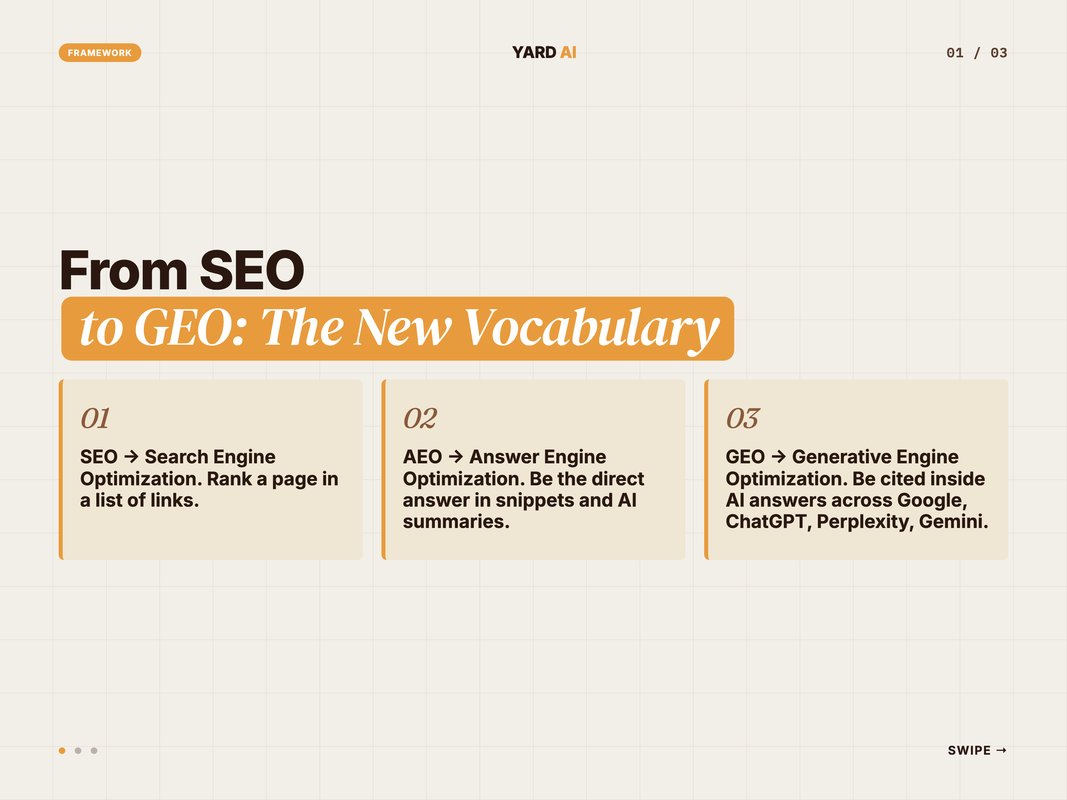
SEO — Search Engine Optimization. The classic discipline. Rank a page in a list of links. Still alive, still matters.
AEO — Answer Engine Optimization. Optimising to be the direct answer — in featured snippets, voice results, and AI summaries. Lead with the answer, structure cleanly, mark up with schema.
GEO — Generative Engine Optimization. The newest layer. Optimising to be cited inside AI-generated answers across Google AI Overviews, ChatGPT, Perplexity, Gemini, and Claude.
Q: Do I have to choose between SEO and GEO?
A: No. They share the same foundations — useful content, clean structure, real authority. GEO is not a replacement. It is the finish line moving from "ranked" to "cited." Do the foundations well and you compete on all of them at once.
The acronyms are new. The underlying work is familiar. Be clear, be useful, be quotable.
The Five Forces Reshaping SEO
Five shifts are driving the change. Each one rewards a slightly different behaviour.
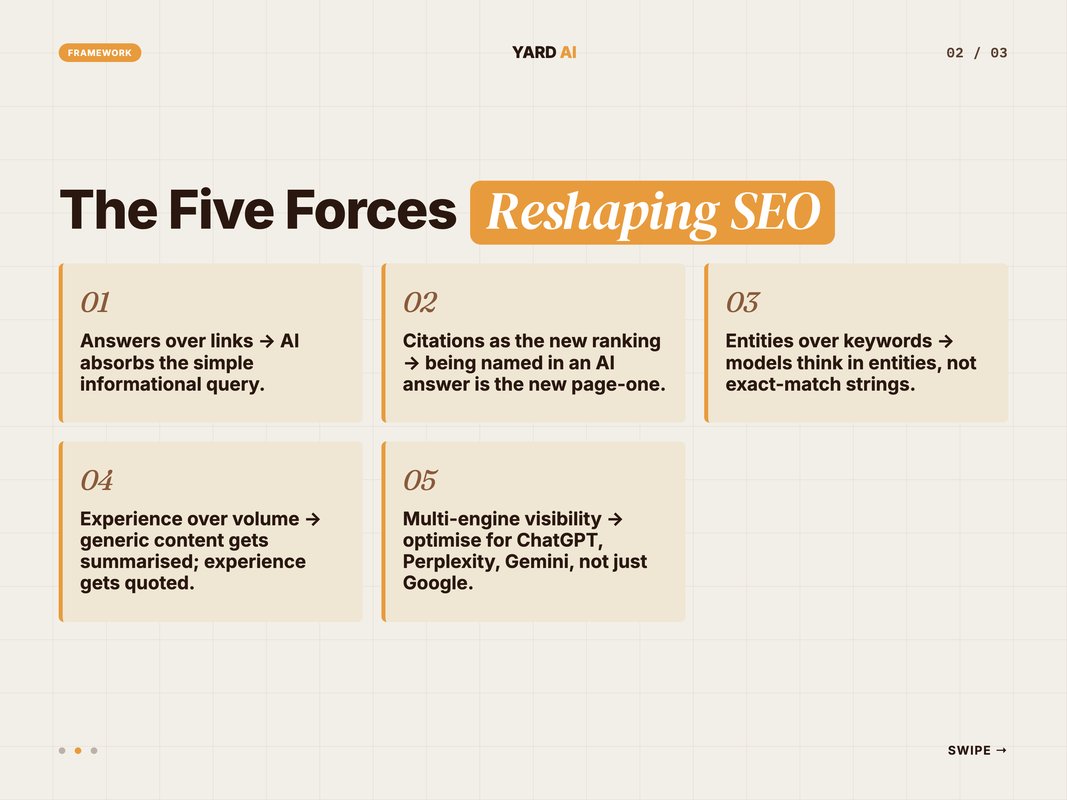
- Answers over links. AI Overviews and chat answers absorb the simple, informational query. Plan for fewer informational clicks and more answer-panel visibility.
- Citations as the new ranking. Being named inside an AI answer is the new page-one. Track where your brand gets cited, not just where it ranks.
- Entities over keywords. Models think in entities and relationships, not exact-match strings. Build topical depth around your subject, not a single keyword.
- Experience over volume. Generic content can be summarised from anywhere, so it loses. First-hand experience, original data, and a real point of view get quoted.
- Multi-engine visibility. Google is no longer the only search box. ChatGPT alone passed 800 million weekly active users in late 2025 (Source: TechCrunch, 2025 — ChatGPT hits 800M weekly users). ChatGPT, Perplexity, and Gemini are real discovery channels now. Optimise for all of them.
Quick Facts: The Shift at a Glance
- AI Overviews scaled from 6.5% of queries in January 2025 to a peak near 25% by mid-year — (Source: Search Engine Land, 2026 — AI Overviews surge and pullback).
- When an AI summary appears, users click a search result in just 8% of visits, versus 15% without one — (Source: Pew Research Center, 2025 — Google users click less).
- AI Overviews correlate with a 58% lower click-through rate for the top-ranking page — (Source: Ahrefs, 2025 — AI Overviews reduce clicks).
- Adding citations, quotations, and statistics can lift a source's visibility in AI answers by up to 40% — (Source: Aggarwal et al., 2024 — GEO research, arXiv).
Notice the pattern. Every force rewards clarity, depth, and authority. None of them reward thin, keyword-stuffed pages.
What Still Works (More Than Ever)
Here is the reassuring part. The foundations did not move. They got more important.
| Foundation | Why it matters more now |
|---|---|
| Genuinely useful content | AI quotes the most helpful source, not the most optimised one |
| Clear structure and headings | Machines parse structured pages to build answers |
| Schema markup | Helps engines understand and cite your content precisely |
| Topical authority | Models trust sources that go deep on a subject |
| First-hand experience | The one thing AI cannot summarise from elsewhere |
| Third-party mentions | Wide citation across trusted sites lifts AI visibility |
Thin content was always weak. Now it is invisible. Research on generative engines found that adding citations and statistics can raise a source's visibility in AI answers by up to 40% (Source: Aggarwal et al., 2024 — GEO research, arXiv). The bar for "useful" went up, and that favours brands willing to do the real work.
What Comes Next
Three things are coming into focus for the next 18 months.
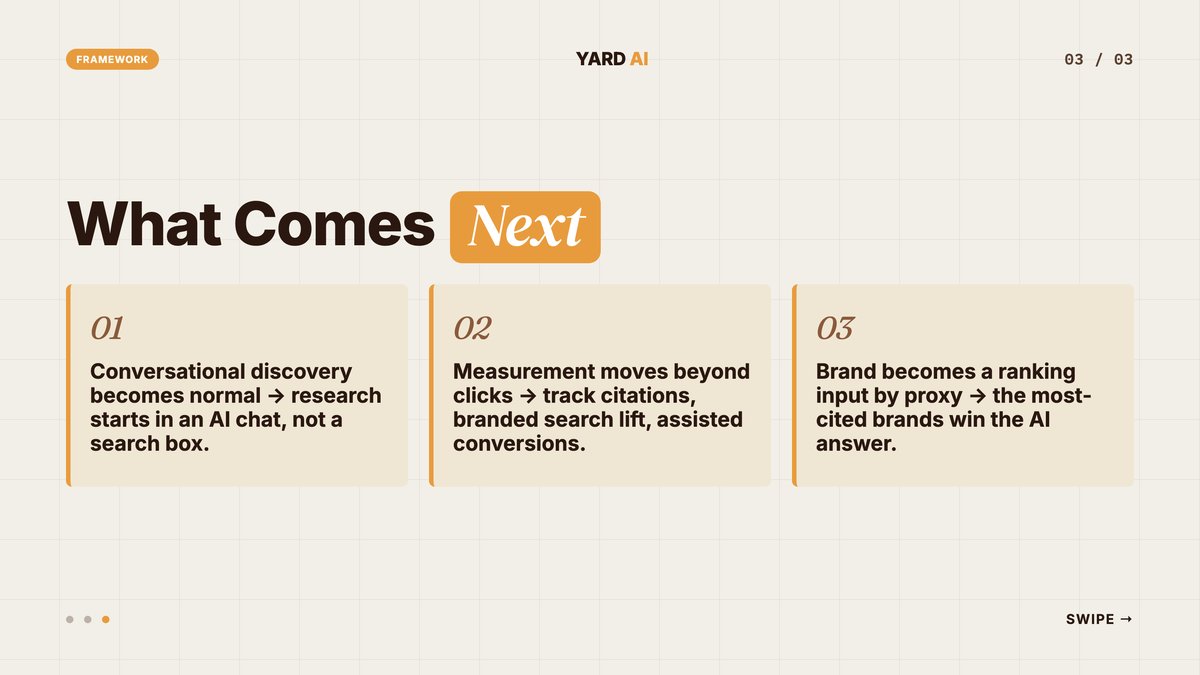
Conversational discovery becomes normal. More people will start research inside an AI chat, not a search box. The scale is already here. ChatGPT alone served over 800 million weekly active users by late 2025 (Source: TechCrunch, 2025 — ChatGPT weekly users). Your brand needs to be present in those answers. That means being clear and widely cited.
Measurement moves beyond clicks. Sessions alone stop telling the story. Top-ranking pages can shed more than half their clicks once an AI Overview appears (Source: Ahrefs, 2025 — click reduction data). The metrics that matter become AI citations, branded search lift, share of voice in answers, and assisted conversions.
Brand becomes a ranking input by proxy. When AI summarises the web, the brands mentioned most often, most clearly, win the answer. Building a known, referenced brand is now SEO work, not just marketing work.
Q: What is the single most future-proof move?
A: Become the clearest, most-cited authority on your topic. That wins blue links, featured snippets, and AI citations at the same time. Everything else is tactics on top of that one foundation.
How YARD Approaches SEO in 2026
We are an AI-first growth marketing agency. We run performance marketing, LLM SEO, AI creatives, and AI funnels for D2C and B2B brands.
We stopped treating SEO as a links game years ago. We treat it as a visibility game across every engine — Google, ChatGPT, Perplexity, Gemini, and Bing.
For one Indian kids' fashion brand, that approach roughly doubled monthly Google impressions. It also put the brand into AI-search answers, not just classic results. Same content discipline, wider visibility.
The work is the same shape every time. Answer the question clearly. Structure it for machines. Build authority that gets cited. Measure citations, not just clicks.
If your traffic has started to wobble as AI Overviews roll out, the fix is rarely more pages. It is becoming the source those answers quote.
Subscribe to the YARD newsletter for weekly breakdowns on AI search and GEO.
The Bottom Line
SEO is not dead. The blue link is just no longer the only prize.
The future of SEO is a visibility game played across search engines and AI answers at once. The mechanics underneath — useful content, clean structure, real authority — matter more than they ever did.
The brands that panic will chase the old click and lose. The brands that adapt will become the source the AI cites and win the answer.
Pick one page that matters. Rewrite it to lead with the answer, structure it cleanly, and back it with proof. Then watch where it shows up — not just on Google, but inside the AI answers your customers now trust.
FAQ
Q: Is SEO dead because of AI Overviews?
A: No. SEO is changing shape, not dying. AI Overviews still pull from ranked web pages. If your page is the source the AI summarises, you win the answer. The work shifts from chasing blue links to becoming the source the AI cites. The fundamentals — useful content, clean structure, authority — matter more, not less.
Q: What is the difference between SEO and GEO?
A: SEO optimises to rank in a list of links. GEO, or generative engine optimization, optimises to be cited inside an AI-generated answer on Google AI Overviews, ChatGPT, Perplexity, or Gemini. Same foundations, different finish line. GEO rewards clear answers, strong structure, and being quoted across the web.
Q: How do I get my brand cited by ChatGPT and Perplexity?
A: Be the clearest, most-cited source on your topic. Answer the question directly in the first lines. Use structured headings and schema. Earn mentions on third-party sites the models trust. LLMs surface brands that are referenced widely and explained clearly, not just brands that rank first on one page.
Q: Does zero-click search mean I lose all my traffic?
A: You lose some informational clicks, not all value. AI answers absorb the simple lookups. They send fewer but higher-intent visitors to your page. The shift is toward quality over quantity of clicks, plus brand visibility inside the answer itself. Measure citations and assisted conversions, not just raw sessions.
Q: What content still wins in AI search?
A: First-hand experience, original data, clear direct answers, and strong topical depth. AI can summarise generic content from anywhere, so generic content loses. What it cannot fake is your proprietary numbers, your case studies, and your expert point of view. That is what gets quoted.
Q: Should I still write blogs in 2026?
A: Yes, but write them to be cited, not just ranked. Lead with the answer. Add original framing and proof. Structure for both humans and machines. A blog that becomes the source an AI Overview quotes is worth more than ten that chase a fading blue link.
Insights from Our Experts
Explore our latest articles on digital marketing strategies.