

Most keyword research dies in a spreadsheet.
You pull a thousand terms. You stare at them. Nothing clusters. The brief never gets written.
We do it differently now. Keyword research with AI takes us from a blank page to a validated topic in minutes. Not hours.
The trick is not the tool. It is the order of moves. AI expands and clusters. Real tools confirm the demand. You ship a brief.
Below is the exact workflow. Real prompts. Real tools. Copy them and run them today.
Quick Facts: Keyword Research with AI at a Glance
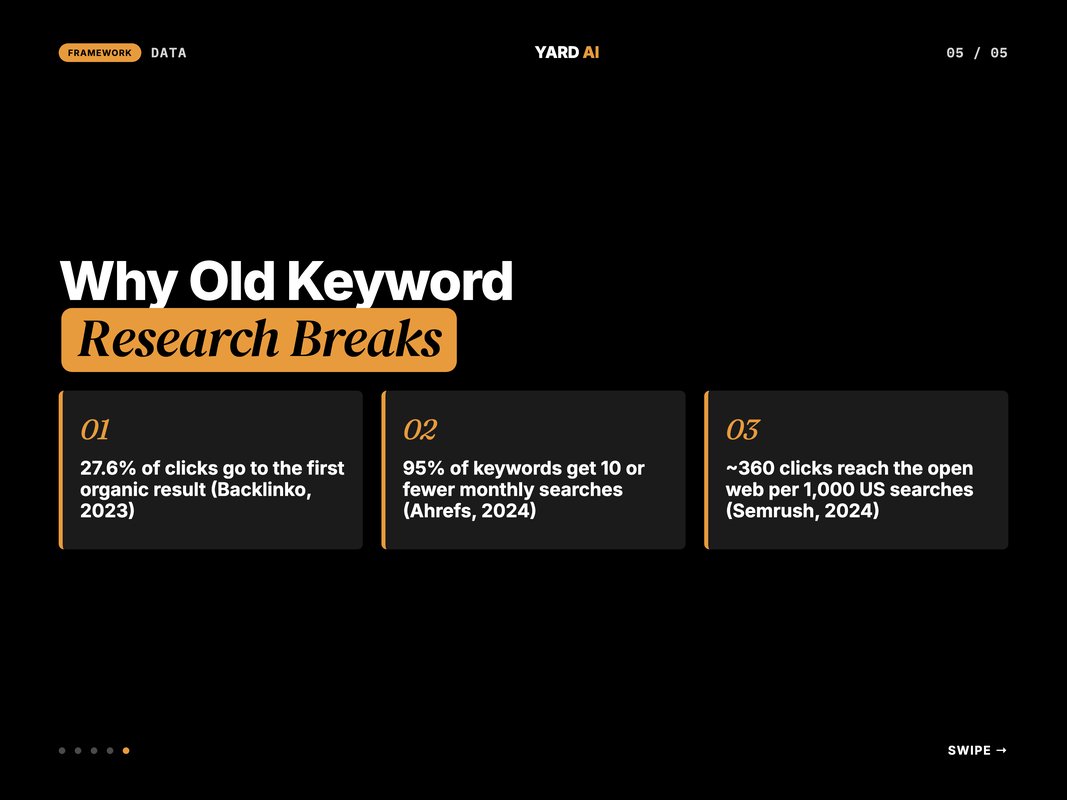
- The first organic result earns about 27.6% of clicks — (Source: Backlinko, 2023 — backlinko.com/google-ctr-stats).
- About 95% of all search keywords get 10 or fewer monthly searches — (Source: Ahrefs, 2024 — ahrefs.com/blog/long-tail-keywords).
- For every 1,000 US Google searches, only about 360 clicks reach the open web — (Source: Semrush, 2024 — semrush.com/blog/zero-click-searches).
- Long-tail keywords make up the bulk of all search demand — (Source: Backlinko, 2024 — backlinko.com/hub/seo/long-tail-keywords).
Why Old Keyword Research Breaks
Old keyword research starts with volume. You sort by it. You chase the big number.
That is the trap. The big terms are taken. The first result there grabs about 27.6% of clicks, and you are not first (Source: Backlinko, 2023 — backlinko.com/google-ctr-stats).
So you fight for scraps on a head term. Meanwhile the real demand sits in the tail.
About 95% of keywords get 10 or fewer searches a month (Source: Ahrefs, 2024 — ahrefs.com/blog/long-tail-keywords). That sounds tiny. Added up, the tail is huge.
The old method also misses intent. A spreadsheet does not know if "best CRM" means buy or browse. You guess. You guess wrong.
That single miss wastes a whole page. You write a guide when the user wanted a price. Or you push a product page at a curious reader. The page ranks for nothing.
Intent is the hidden cost of the old way. You only learn it after the page flops.
There is one more shift. Search behaviour changed. For every 1,000 US searches, only about 360 clicks now reach the open web (Source: Semrush, 2024 — semrush.com/blog/zero-click-searches).
So the topic has to be sharp. It has to match a real question. AI keyword research finds that question fast.
Read those three numbers together. They tell one story. Demand is real, but it hides in the tail and behind clear intent.
Q: Why does volume-first keyword research fail?
A: It pushes you toward crowded head terms you cannot rank for. It also ignores intent. AI-native research flips the order. You expand the tail, group by intent, then check volume last.
The Old Way vs The AI-Native Way
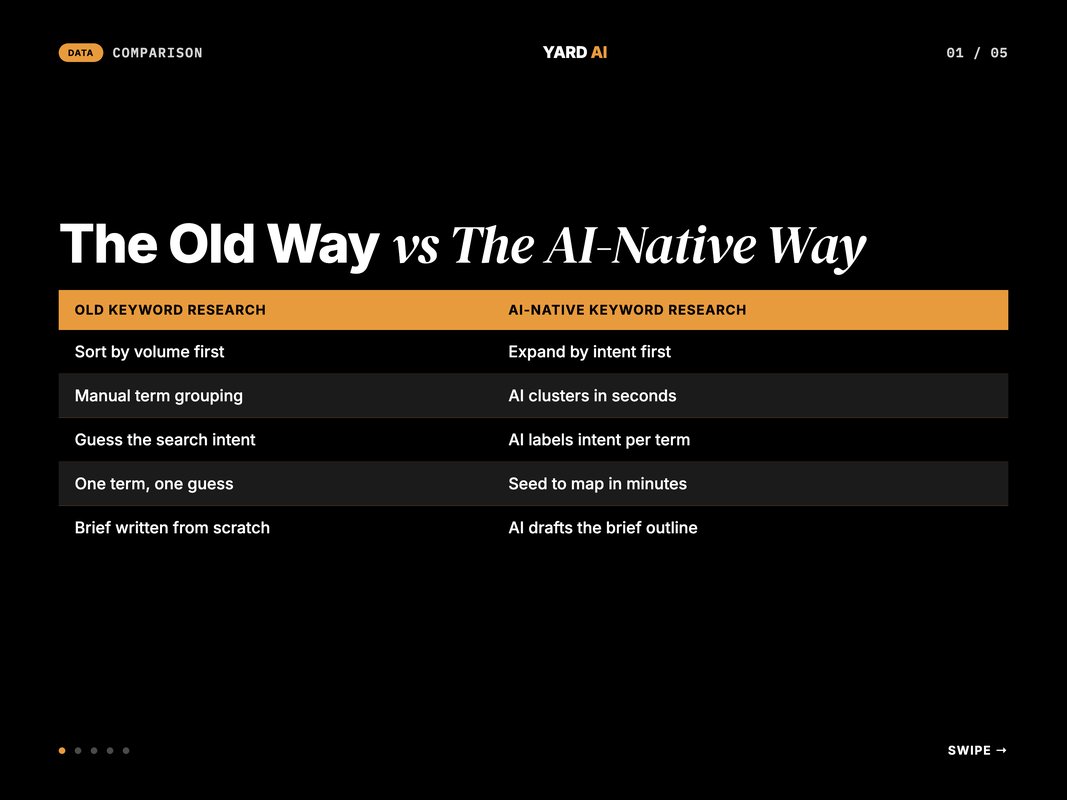
Here is the core change in one view.
The old way is slow and manual. The new way is fast and guided. You still use the same tools. You just point AI at the boring parts.
The model does not replace your judgement. It clears the clutter so you can judge faster.
So you move faster too. The grind shrinks. The thinking stays yours.
The shift shows up at every stage. The old way sorts by volume first. The new way expands by intent first.
The old way groups terms by hand. The new way clusters them in seconds. The old way guesses intent. The new way labels it per term.
And the old way writes the brief from scratch. The new way hands you a draft outline to edit. That last point is the big one.
Notice it. The model hands you a draft brief. You edit, not invent.
This is AI SEO in practice. Less typing. More deciding.
There is a mindset shift here too. Old research felt like data entry. The new way feels like strategy.
You spend your time on the calls that matter. Which cluster wins. Which angle to take. The model handles the rest.
Q: Does AI keyword research replace my keyword tools?
A: No. AI cannot see live volume or difficulty. It expands and clusters. Your tool confirms the numbers. The two work as a pair, never alone.
The 4-Filter Winning-Topic Test
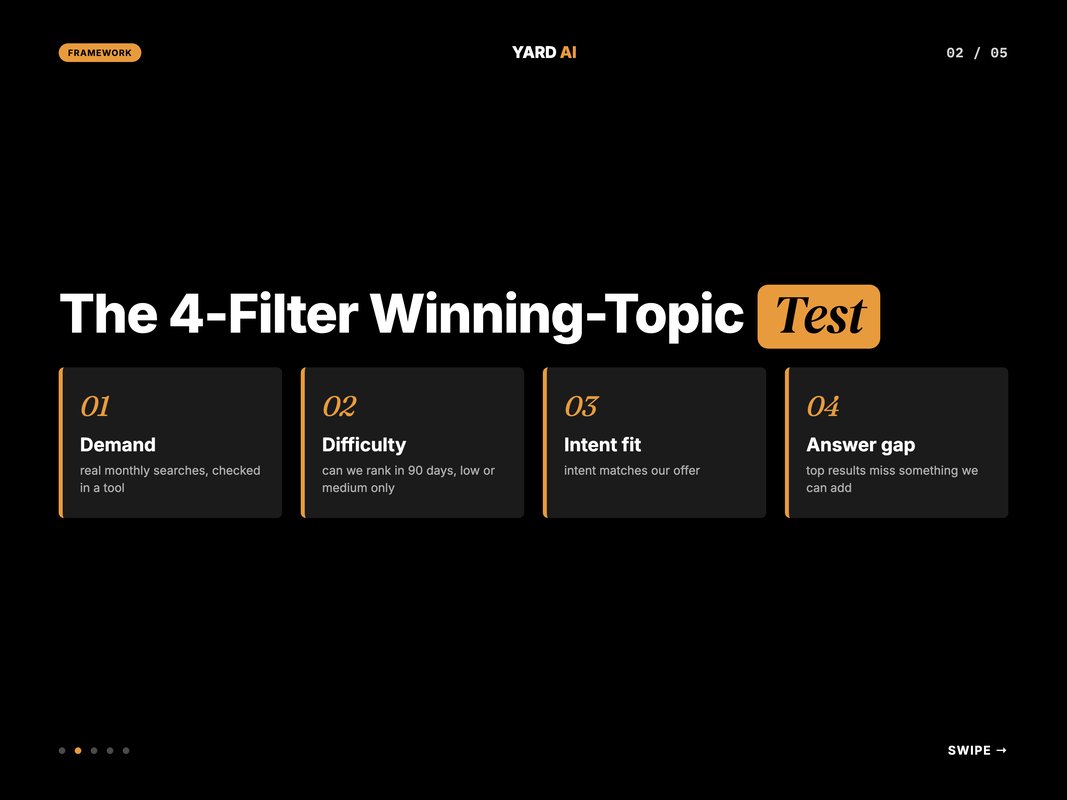
Not every cluster is worth a page. We run each one through four filters.
We call it the 4-Filter Winning-Topic Test. A topic must clear all four gates. If it fails one, it waits.
- Demand. Does the cluster have real monthly searches? Check it in a tool.
- Difficulty. Can we rank in 90 days? Low or medium difficulty only.
- Intent fit. Does the intent match our offer? A browse term is weak for a sales page.
- Answer gap. Do the top results miss something? If they all say the same thing, we can do better.
Difficulty matters most for new sites. High scores mean strong, linked competitors (Source: Semrush, 2024 — semrush.com/blog/keyword-difficulty).
The answer gap is the fun one. We read the top three pages. We ask what a reader still wants. That gap becomes our angle.
Most pages copy each other. They all say the same safe things. That sameness is your opening.
Find the missing piece. The unanswered question. The step everyone skips. That is where you win.
This filter set keeps us honest. It stops us chasing pretty terms with no path to rank.
Q: What makes a keyword a "winning" topic?
A: It clears four gates: real demand, beatable difficulty, matched intent, and a clear answer gap. Miss one and the topic is not ready. All four together means a page worth writing.
Step 1: Seed and Expand With AI
Start small. Pick three to five seed terms close to your offer.
For a CRM brand, seeds might be "CRM for agencies", "sales pipeline", "lead tracking". Keep them plain.
Now expand. This is where AI shines. One seed becomes fifty long-tail ideas in seconds.
Here is the exact prompt we paste into Claude or any strong LLM:
You are an SEO strategist.
Seed terms: [paste 3-5 seeds].
Expand each seed into 15 long-tail keyword variants.
Include questions people search, comparisons, and "how to" forms.
Output one keyword per line. No numbering. No commentary.
The output is raw and wide. That is the point. You want range first, polish later.
Resist the urge to trim. A wide list gives the next step more to work with. Narrow too early and you lose good angles.
Long-tail terms carry most of the real demand (Source: Backlinko, 2024 — backlinko.com/hub/seo/long-tail-keywords). They also match how people actually ask.
These are the terms you can win. They are specific. They are less crowded. And they convert better because the intent is clear.
To go wider, pull from Google autocomplete and Reddit. Type your seed into Google. Note the suggestions. Skim a few Reddit threads for real phrasing.
Why bother with Reddit? Because people there speak plainly. They ask the real question. No marketing gloss.
Those raw phrases often beat polished keywords. They match how a person types when stuck. That is exactly who you want to reach.
Drop those into the same list. Now you have a fat seed pool. Time spent: about three minutes.
Do not edit yet. Let the list stay messy. The next step sorts it for you.
Q: How many seed keywords should I start with?
A: Three to five is plenty. More seeds add noise, not value. A small, sharp set expands cleanly. AI does the widening for you.
Step 2: Cluster by Intent in Two Minutes
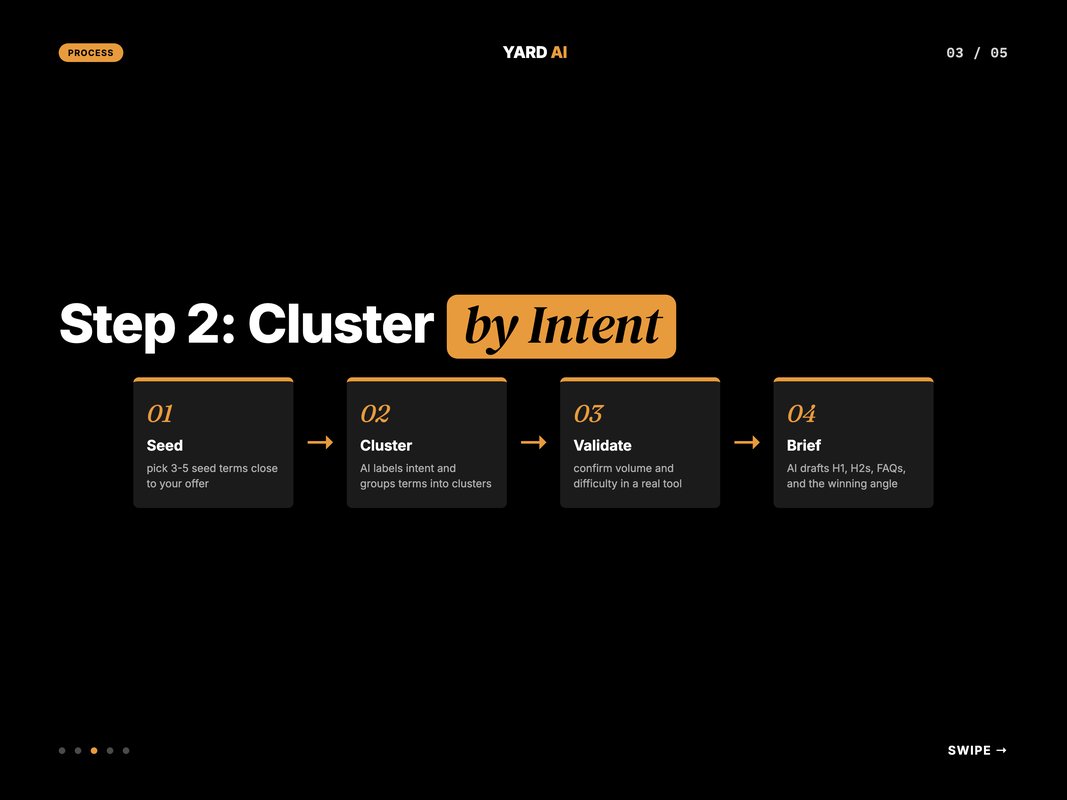
A flat list is useless. You need groups. One group becomes one page.
This is topic clustering, and AI does it well. Paste your fat list back into the model.
Use this prompt:
Here is a keyword list: [paste list].
Step 1: Label each term by intent: Informational, Commercial, or Transactional.
Step 2: Group terms into 5-8 clusters by shared topic and intent.
Step 3: For each cluster, give a short name and the best primary keyword.
Output as a simple table: Cluster | Intent | Primary keyword | Supporting terms.
In about two minutes you get a clean map. Each cluster is a possible page.
Intent labels matter. They tell you what kind of page to build (Source: Semrush, 2024 — semrush.com/blog/keyword-intent).
Informational clusters become guides. Commercial clusters become comparisons. Transactional clusters become product or landing pages.
This step is the heart of AI keyword research. The model sees patterns a tired human misses. You get structure for free.
One warning. Always read the clusters before you trust them. The model groups well, but not perfectly. A quick scan catches the odd term in the wrong bucket.
Fix those by hand. It takes a minute. Then your map is clean and ready to validate.
Q: How do I cluster keywords by intent with AI?
A: Paste your list and ask the model to label each term by intent, then group similar terms. One cluster equals one page. The whole step takes about two minutes.
Step 3: Validate the Numbers in a Real Tool
AI guesses. It does not know live data. So we never trust its volume.
This step is non-negotiable. Take your best cluster to a real keyword tool.
We use Ahrefs, Semrush, or Search Console. Each shows what AI cannot: live volume and difficulty.
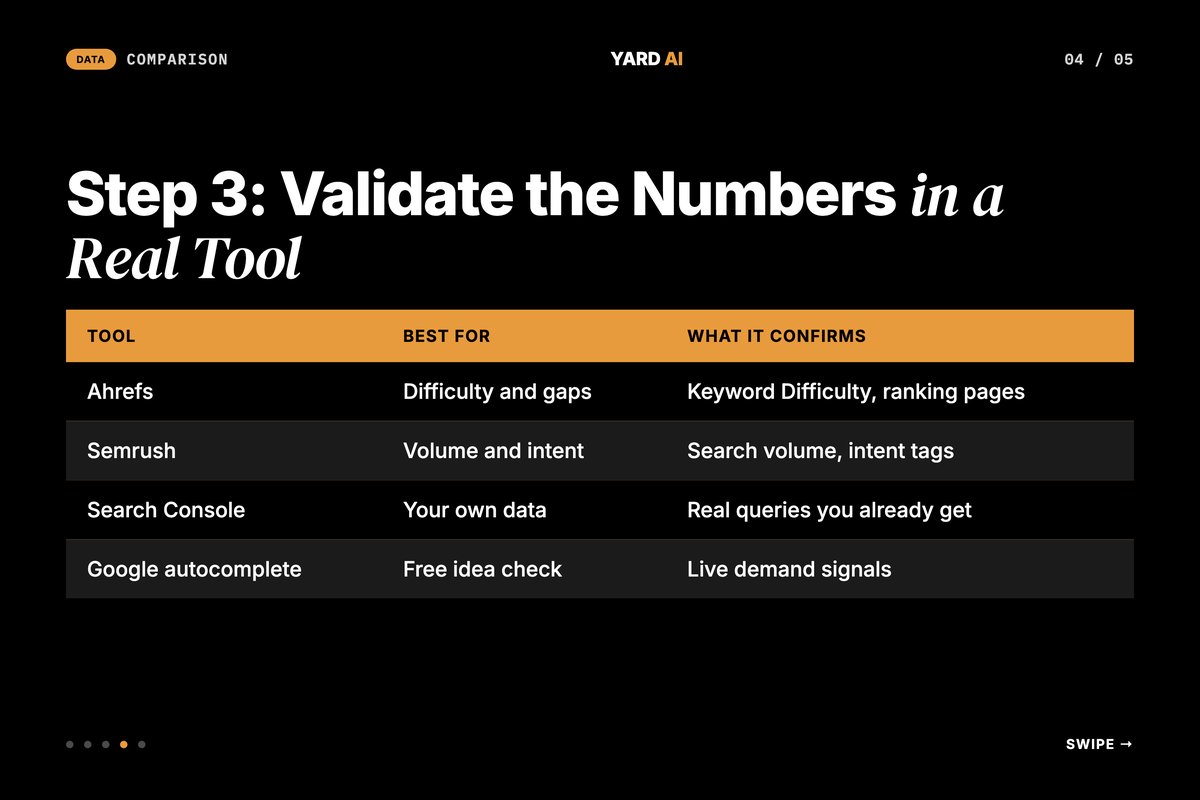
Here is the simple tool split we use.
Ahrefs is best for difficulty and gaps. It shows Keyword Difficulty and the pages already ranking. Use it to judge if you can win.
Semrush is best for volume and intent. It gives search volume and intent tags side by side. Use it to size the demand.
Search Console is best for your own data. It shows the real queries you already get. Use it to find near-misses.
Google autocomplete is a free idea check. Type a seed and read the live suggestions. Use it for fast demand signals.
You do not need all four. Pick the one that fits your data. One paid tool plus Search Console covers most teams.
Start with Search Console if the site has traffic. It shows queries you already rank near (Source: Google Search Central, 2024 — developers.google.com/search).
Those near-misses are gold. Small edits can push page two to page one.
It is the cheapest win in SEO. The page already exists. The demand already exists. You just close the gap.
For each keyword in the cluster, check two numbers. Volume and difficulty. Drop any term with high difficulty and no path to rank.
Be ruthless here. A pretty term with no path is a trap. Cut it without guilt.
What stays is your validated cluster. Real demand. Beatable. Time spent here: about five minutes.
Q: Why can't AI just give me search volume?
A: AI has no live link to search data. It predicts patterns from training. Real volume changes weekly. Only a connected tool like Ahrefs, Semrush, or Search Console shows the true number.
Step 4: Turn the Cluster Into a Brief
A validated cluster is not a blog yet. It needs a brief. AI drafts that too.
Feed the cluster back with this prompt:
Cluster primary keyword: [keyword].
Supporting keywords: [paste].
Top 3 ranking pages cover: [paste 3 bullet summaries].
Write a content brief: H1, 6-8 H2s, 5 FAQ questions, and the one angle the top pages miss.
Keep it tight. No fluff.
The model returns a full outline. H1, H2s, FAQs, and an angle.
The angle is the key line. It points at the answer gap from filter four. That gap is why your page wins.
Read it twice. If the angle feels obvious, push harder. The best angle says what no top page dared to say.
A weak angle is a warning sign. It means you have not found the gap yet. Go back to the top results and look again.
Check the draft against the top results. Featured snippets reward clear, direct answers, so build for them (Source: Ahrefs, 2024 — ahrefs.com/blog/featured-snippets-study).
This also sets you up for LLM SEO. When you answer the full question set, AI Overviews and chatbots can quote you (Source: Google, 2024 — blog.google/products/search).
Now run the final check. Use this short list before you write a single paragraph.
- Cluster has real monthly volume in a tool.
- Difficulty is low or medium for our site.
- Intent matches the page we plan to build.
- We found one angle the top pages miss.
- The brief names an H1, H2s, and FAQs.
- Every planned stat has a real source.
Clear the list and the topic is ready. Seed to brief, start to finish, in minutes.
Pin this list above your desk. Run it on every topic. It is the gate between a hunch and a real plan.
Q: How long does the full workflow take?
A: The AI steps take minutes. Validation adds about five more. Most topics go from blank page to a checked brief in under fifteen minutes.
Where AI Keyword Research Connects to LLM SEO
Search is splitting in two. There is classic Google, and there is the AI answer.
Both reward the same thing. A page that fully answers a real question.
AI keyword research finds those questions. The cluster step surfaces every angle people ask. Cover them all and you own the topic.
This matters more each month. Google now folds AI answers into search results (Source: Google, 2024 — blog.google/products/search).
So the goal shifts. You are not just ranking a page. You are becoming the source an AI quotes.
The fix is in the workflow. Cluster by question. Answer each one cleanly. Cite your facts.
Marketers feel this shift already. AI now shapes how teams plan content (Source: HubSpot, 2024 — hubspot.com/marketing-statistics).
Do the question mapping once. You serve Google and the LLMs at the same time.
Think of it as one map, two readers. Google reads it as a page. The LLM reads it as a source. Both want the same clarity.
So write for the question, not the keyword. Answer it in the first two lines. Then go deeper for the reader who stays.
Q: Does keyword research with AI help with LLM SEO?
A: Yes. It surfaces the real questions people ask. Those map to AI Overviews and chatbot answers. Cover the full set and you appear in both classic search and AI responses.
How We Run This at Scale
We are an AI-first growth marketing agency. We run this exact loop across many brands.
The pattern is always the same. AI expands and clusters. Real tools confirm the demand. A brief ships.
The speed gain is not magic. It is order. We let the model do the wide thinking. We keep the judgement.
For one wellness brand, the topic engine helped lift organic reach over time, with monthly impressions growing into the tens of thousands. The win came from clustering, not luck.
For a kids' fashion brand, the same loop grew organic impressions from roughly one million to over two million across a year. Better topics, cleaner intent, more pages that matched real questions.
We pair AI keyword research with LLM SEO, AI Creatives, and AI Funnels. The keyword step feeds them all.
If your topic pipeline keeps stalling, we can help. Book a call with us. We will map this loop to your brand.
We will not hand you a tool list and leave. We will run the workflow with you, seed to brief.
The point is repeatability. A good topic is not a one-off. It is a system you can run every week.
That is the real shift. You stop hoping for ideas. You start producing them on demand.
Conclusion
Keyword research with AI is not about one clever tool. It is about order.
Seed small. Let AI expand the tail. Cluster by intent in two minutes. Validate the numbers in a real tool. Then let the model draft the brief.
Four moves. Minutes, not hours. A blank page becomes a ranked topic.
The order is what makes it fast. Skip a step and the speed breaks. Follow it and the topic almost picks itself.
Try it on your next post. Use real seeds from your own offer. Watch how fast a clear winner appears.
The filters keep you honest. Demand, difficulty, intent, and the answer gap. Clear all four and the topic is real.
Do this once and you serve both Google and the AI answers. Same work. Twice the reach.
Open your model. Paste the first prompt. Find your next winning topic before lunch.
FAQ
Q: What is keyword research with AI? A: It is keyword research where an AI model does the heavy lifting. The model expands seeds, groups them by intent, and drafts a brief. You still validate volume and difficulty in a real tool. AI speeds up the thinking, not the checking.
Q: Can AI replace keyword research tools like Ahrefs? A: No. AI guesses patterns but it does not see live search volume or difficulty. You still need a tool like Ahrefs, Semrush, or Search Console for real numbers. Use AI to expand and cluster, then validate the data in the tool.
Q: How do I cluster keywords by intent with AI? A: Paste your seed list into the model. Ask it to label each term by intent: informational, commercial, or transactional. Then ask it to group similar terms into clusters. One cluster becomes one page. This takes about two minutes.
Q: Does keyword research with AI help with LLM SEO? A: Yes. AI keyword research surfaces the real questions people ask. Those questions map to AI Overviews and chatbot answers. When you cover the full question set, you show up in both Google and LLM responses.
Q: How long does AI keyword research take? A: The AI part takes minutes. A seed expands into clusters fast. Validation in a keyword tool adds a few more minutes. Most topics go from blank page to a checked brief in under fifteen minutes.
Q: What is the first step to find winning topics? A: Start with three to five seed terms close to your offer. Feed them to AI to expand into long-tail variants. Then cluster by intent and validate the best cluster in a tool. The winner is the cluster with demand and low difficulty.
Insights from Our Experts
Explore our latest articles on digital marketing strategies.