

The agency business is being rewired in public.
Models now write copy, build media plans, edit video, and pull reports in minutes. Work that filled a forty-person floor in 2022 fits inside a small pod in 2026. The AI agency model is not a slide on a deck. It is the new default delivery shape.
This piece is for marketers, founders, and ops leads watching the shift happen on their invoices. We will look at what is breaking, what is winning, and how the new playbook is built. You will also see hard numbers on in-housing, headcount, and AI spend.
If you run a brand, you will leave with five clean asks for your next agency review. If you run an agency, you will see the shape of the next contract.
Let us get into it.
What Is the AI Agency Model?
The AI agency model is a delivery system designed around AI from day one.
It is not "we use ChatGPT now." It is a full rebuild. The team chart is smaller. The price tag is closer to output than to hours. Models do the production. Humans do the calls that matter.
The shift is structural. Forrester says 91% of US agencies already use or test generative AI, but most still bolt it onto old workflows. That is the trap. AI inside a 2018 agency org chart still costs 2018 money.
A real AI agency model has three traits.
The first is automation by default. Drafting, editing, formatting, and reporting are model jobs. Humans review, not create.
The second is small pods. One senior owner. One AI-native operator. One QA layer. No floors of mid-level reviewers.
The third is output-based pricing. Brands pay for a number of assets, a CAC band, or a result. They do not pay for a timesheet.
Q: What is the AI agency model in one line?
A: It is an agency built on AI as the production engine, with humans owning strategy, judgement, and quality. Pricing, team shape, and tools all assume that model.
What Is Breaking in the Old Agency Model
The cracks show up in three places.
Pricing is the first. Old shops sell hours. AI just made one hour produce four. Clients see the math.
In-housing is the second. AI made small brand teams cost-real. About 82% of ANA member advertisers run an in-house agency, up from 78% in 2018. Routine work moves in. Big bets stay out.
Headcount is the third. Forrester forecasts a 15% drop in agency roles in 2026, on top of an 8% drop in 2025. Most of the loss is mid-level. The "people who push the slide" layer is gone.
The squeeze is brutal. Clients want lower bills. Models give clients leverage. Agencies fund the AI buildout themselves. Forrester found 75% of agencies bear AI costs without passing them through.
Quick Facts: The AI Agency Shift in 2026
- Sixty percent of US senior marketing leaders cut agency spend in 2025 due to AI â (Source: Typeface via Search Engine Land, 2026 â searchengineland.com).
- Ninety-one percent of US agencies use or pilot generative AI â (Source: Forrester via Marketing Dive, 2025 â marketingdive.com).
- Eighty-two percent of ANA members run an in-house agency â (Source: ANA via AdWeek, 2025 â adweek.com).
- Forrester forecasts a 15% drop in agency roles in 2026 â (Source: Forrester via ContentGrip, 2026 â contentgrip.com).
- Seventy-eight percent of marketers use AI tools daily â (Source: HubSpot State of Marketing, 2026 â hubspot.com).Q: Why are clients cutting agency budgets in 2026?
A: Models now do a lot of the production that filled an SOW. Clients see the unit cost fall. They keep the savings or move the work in-house.
Old Agency vs AI Agency: A Side-by-Side
The clearest way to see the shift is a flat compare.
The old model was built on volume. Big teams. Long timelines. Hours billed up the chain. Tools were add-ons.
The new model is built on leverage. Small pods. Short cycles. Output billed. AI is the spine, not a side tool.
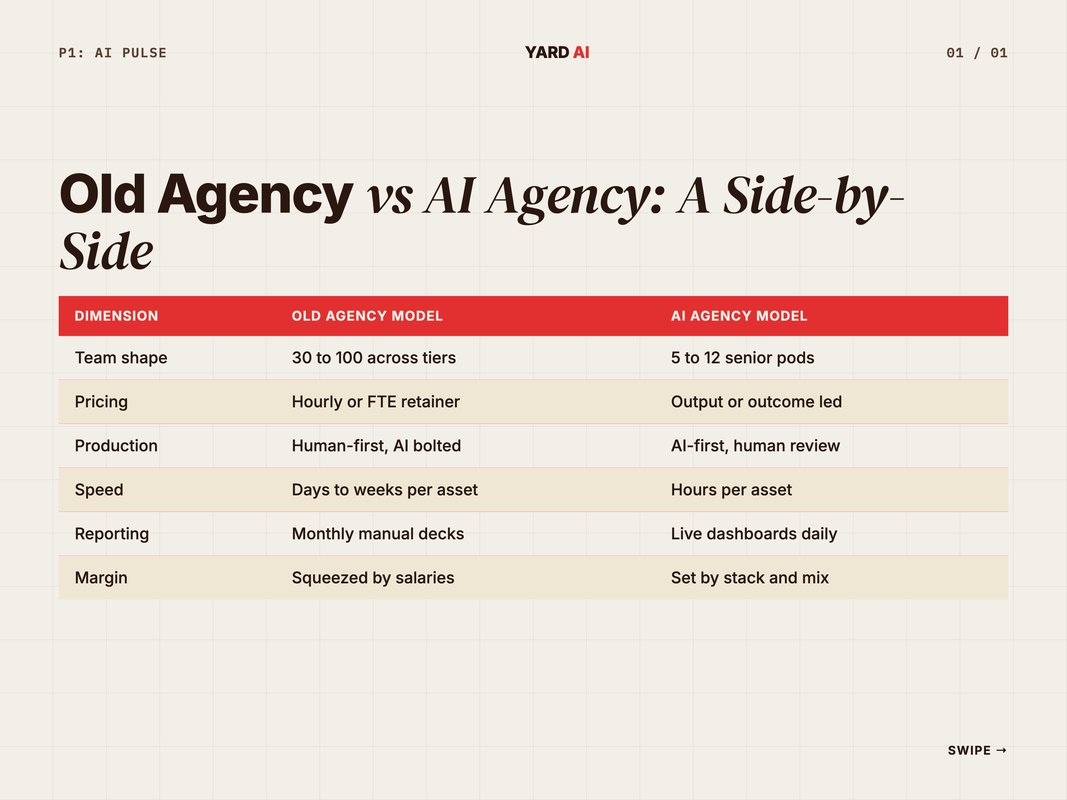
Here is the side-by-side view across six dimensions.
- Team shape. Old: thirty to a hundred people across layers. New: five to twelve senior operators in pods.
- Pricing. Old: hourly or retainer billed against FTEs. New: output, outcome, or asset based.
- Production. Old: human-first with AI bolted on later. New: AI-first with human review on top.
- Speed. Old: days to weeks per asset. New: hours per asset, days for full campaigns.
- Reporting. Old: manual decks on a monthly cadence. New: live dashboards and daily prompts.
- Margin. Old: squeezed by salaries. New: set by the tool stack and seniority mix.
The old model still works in narrow places. Heritage brand work. Deep platform partnerships. High-touch creative.
But the cost base is upside-down. Clients see one tool replace four mid-level roles. They will not pay for both for long.
Q: Can an old agency become an AI agency?
A: Yes, but only with a real teardown. New pricing. New org chart. New tools as default, not optional. A bolt-on AI layer does not change the cost base.
The AI Agency Stack: Five Layers Every Modern Agency Runs
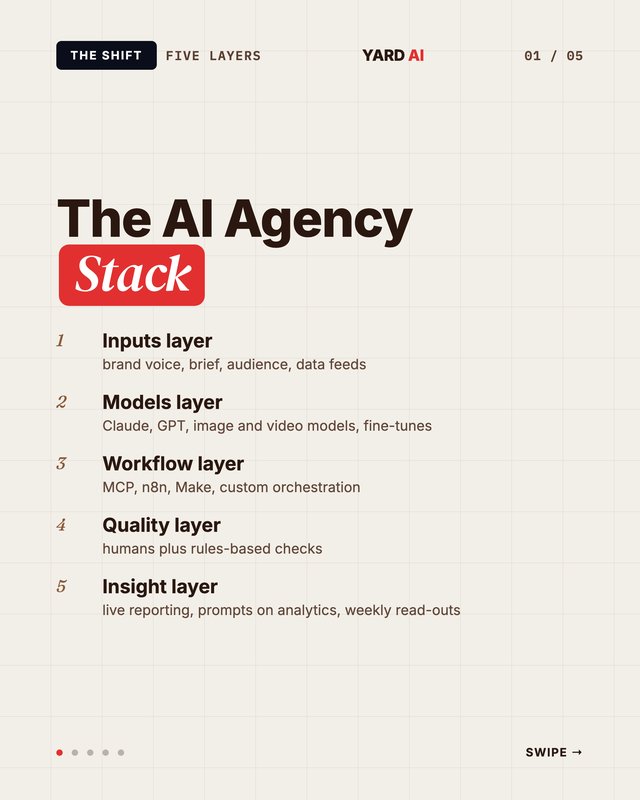
A working AI agency runs on a five-layer stack.
Each layer has one job. Each layer is a place where AI does the heavy lift.
The stack is what makes the small-pod model possible. Without it, you are still a slow agency with prompts.
Here is the shape.
- Inputs layer â brand voice, brief, audience, data feeds. The single source of truth for every model call.
- Models layer â Claude, GPT, image and video models, plus internal fine-tunes. Routed by job, not by habit.
- Workflow layer â MCP, n8n, Make, or custom orchestration. This is where the work actually flows.
- Quality layer â humans plus rules-based checks. Voice, brand, claims, and legal.
- Insight layer â live reporting, prompts on top of analytics, weekly read-outs.
Every asset moves through these five layers. Every billable hour saved sits here.
The stack also gives you a real moat. A pretty deck does not. A live, tuned, brand-aware stack does.
Q: What does the AI agency stack replace?
A: It replaces most of the mid-layer agency work. The brief, the draft, the edit, the deck, the report. Humans still own strategy, judgement, and the final yes.
The Five-Step AI Agency Audit
You can run this on any agency in under a day. Use it on yours, or on a partner you are about to hire.
It is built to expose the gap between "we use AI" and "we are AI-first."
The audit is sharp on purpose. Vague answers are a fail.
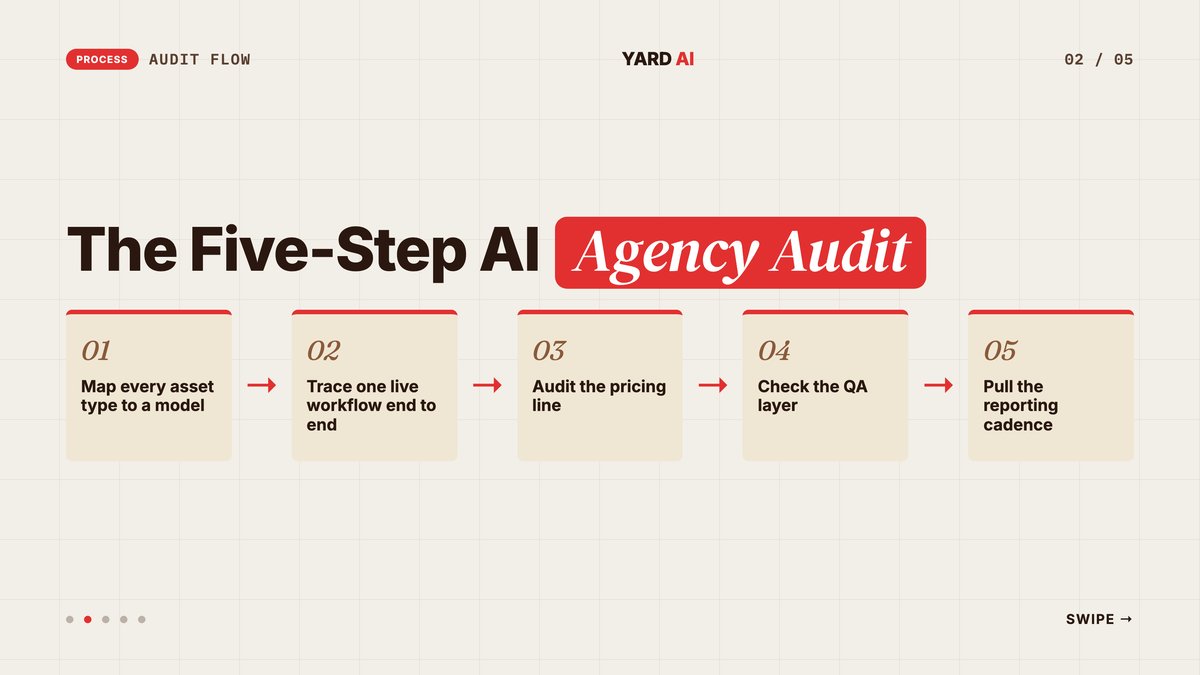
The five steps:
- Map every asset type to a model. Copy to Claude. Static creative to image models. Video to video models. If the team cannot name the routing, AI is not in the stack.
- Trace one live workflow end to end. Pick a real campaign. Trace brief to launch. Count human touchpoints. Over fifteen is old-model.
- Audit the pricing line. If the invoice still reads "Senior Strategist â 20 hours," the math has not moved.
- Check the QA layer. Ask who reviews model output, with what rules, and how often a draft gets killed. No QA, no quality.
- Pull the reporting cadence. Live dashboards plus weekly written reads beat monthly decks. Decks are a 2018 artefact.
Run all five. You will know in a day if you are buying an AI agency or buying an AI-flavoured legacy shop.

Q: How long does the AI agency audit take?
A: One working day for a mid-sized account. The hard part is honest answers, not the steps.
Where the Money and Time Now Go
The AI shift is also a budget shift. The line items moved.
Less goes to mid-level production. More goes to senior talent, tooling, and proprietary data. Brands are reading their own invoices and reshaping the spend.
Here is what the data says.
The picture is clear. AI cut the cost of production. It did not cut the cost of judgement.
The smart spend in 2026 sits in three buckets. Senior strategists. AI infrastructure. Proprietary data sets. Every other line is under review.
Brands that get this right run leaner and ship more. Brands that do not are paying old prices for new-cost work.
Q: Where should a 2026 marketing budget shift money to?
A: Move spend toward senior talent, AI tooling, and first-party data. Cut mid-level production hours. That is where AI gave you free margin.
The CMO Checklist for the AI Agency Era
Use this before signing your next SOW. It works for new agency picks and for renewals.
The checklist is short on purpose. Each item is a yes-or-no test.
- The agency can name the AI tool used for every asset type.
- Pricing is tied to output or outcome, not raw hours.
- Pod size for your account is under fifteen people.
- One named senior owner is on the hook for the result.
- A live dashboard exists for every paid channel you run.
- A written QA layer reviews model output for brand and legal.
- Reporting cadence is at least weekly, not monthly decks.
- The agency can show one client case where AI cut cost by 30%+.
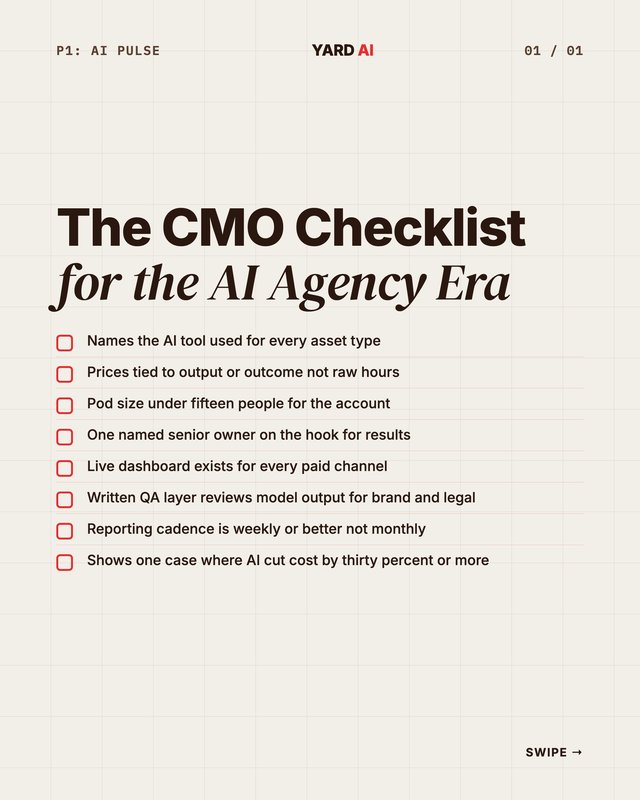
If you cannot tick six of eight, you are signing for the old model at the old price.
Q: What is the single best test for an AI-first agency?
A: Ask to see one live workflow, end to end, in their tools. Not a slide. The real screen. If they can show it, they are AI-first.
How YARD Approaches the AI Agency Model
We built YARD as an AI-first growth marketing agency from day one. The stack is not a tool we added. It is the way work moves.
We run performance marketing, LLM SEO, AI creatives, and AI funnels for D2C and B2B brands. The pods are small. The pricing is tied to output. The reporting is live.
The way we think about it is simple. AI takes the work that should not be a job. People take the work that should. That is the only split that holds in 2026.
Our team is built around the five-layer stack you read above. Each project moves through it. Each asset has a model, a workflow, and a human reviewer. Each invoice ties to a result you can read.
If you are reviewing an agency or replacing one, we can run the five-step audit on your current stack. No deck. No sales call setup. Just a clear read on where AI can take work off your plate and where senior judgement still earns its fee.
You can see how we run AI-first growth at yardagency.ai. Or send us a brief. We will walk through your current spend. We will also show what an AI agency pod would cost.
This is not a pitch. It is a practical look at what good now looks like.
The Bottom Line
The AI agency model is not a future. It is here. The invoices, the team sizes, and the contracts all show it.
Old agencies that bolt AI onto an old org chart will keep losing share. AI-first pods will keep winning the work that does not need a floor. In-house teams will keep eating the routine work.
The win for brands is real. Faster work. Lower unit cost. Sharper senior thinking. The cost is the discipline to stop paying for hours that should now be minutes.
Pick the agency that can show you the stack. Pay for the output. Hold one senior human on the hook. That is the new shape.
If you want a clean read on your current spend, run the audit. Or talk to us. Either way, do not sign the next SOW on the old terms.
FAQ
Q: What is the AI agency model?
A: The AI agency model is a delivery system built on AI from day one. Pricing, team shape, and workflows assume that models do most of the make-work. Humans own strategy, judgement, and quality.
Q: Are AI agencies replacing traditional agencies?
A: Not all of them. AI is replacing the parts of agency work that were always commoditised. Routine copy, media ops, and decks are now cheap. Strategy, taste, and real-world judgement still pay.
Q: Why are brands moving work in-house?
A: AI made in-housing cheap. Brands can now spin up a small AI-led pod for what one senior agency hire used to cost. Around 82% of large advertisers already run an in-house team.
Q: How fast is AI changing agency teams?
A: Fast. Forrester forecasts a 15% drop in agency roles in 2026 on top of an 8% drop in 2025. Most of the loss is in mid-level production and ops.
Q: What can AI not do for an agency?
A: AI cannot hold a P&L. It cannot read a room in a pitch. It cannot decide which brand bet to take. Those calls still need a senior human on the hook.
Q: What should a CMO ask an agency in 2026?
A: Ask what is automated, what is human, and where the price is set. If the answer is vague, the agency is still selling old hours. The AI agency model puts those answers on one page.
Q: Is the AI agency model right for every brand?
A: It fits most growth-stage and mid-market brands. Heritage brands with deep brand-world work still need senior craft. The smart move is a hybrid stack with an AI core and human leads on top.
Insights from Our Experts
Explore our latest articles on digital marketing strategies.