

Performance marketing in India just changed shape.
The Meta-only playbook is dead. AI runs the bids. First-party data is the new moat. Retail media, CTV, and WhatsApp are real channels now — not pilots.
This is what is working in 2026. The numbers, the channels, the mix, and the failure modes we keep seeing on audits.
If you run paid acquisition for a D2C, B2B, or services brand in India, you need a new frame. The old one will cost you. Let us walk you through it.
What Changed in Performance Marketing India 2026
The market got bigger. The work got harder.
India's digital ad spend will cross 71,621 crore rupees by end-2025 and ride to 98,034 crore by 2027. Digital is now 59% of total ad spend. By 2027, it will be 70%.
That is real growth. It is also more brands fighting for the same eyeballs.
Three forces define performance marketing India 2026:
One — AI took over the levers. Smart Bidding, Advantage+, and Performance Max do the work that used to live in your bid sheet. By 2026, AI handles ~90% of in-platform bidding and creative variation in real time.
Two — privacy locked down the data. Third-party cookies are gone or going. Apple's ATT prompts cut Meta's signal years ago. First-party data is now the only stable input.
Three — the channel mix exploded. Retail media on Amazon, Flipkart, Nykaa, and Meesho is scaling fast. CTV is real money. WhatsApp commerce reaches 500 million Indians. Influencers drive social commerce, not just awareness.
Most playbooks have not caught up. We see brands still spending 80% on Meta with no first-party data, no CTV, and no retail-media line. That is a 2022 setup in a 2026 market.
Q: What is performance marketing in India in 2026?
A: It is paid acquisition tied to measurable outcomes — clicks, leads, sales. AI runs the bidding. The marketer sets the goal, feeds clean data, and judges the output. The work has moved from levers to inputs.
The 2026 Numbers You Need to Know
Pricing is up across the board. Efficiency is up too, if you set it up right.
Quick Facts: India Performance Marketing at a Glance
- India digital ad spend hit 71,621 crore rupees in 2025, up 19% year-over-year — (Source: Dentsu e4m, 2026 — dentsu-e4m Digital Advertising Report 2026).
- India digital ad market will reach 20.46 billion USD by 2029, growing at 12% CAGR — (Source: GlobeNewswire, 2026 — India Digital Ad Spend Report 2026).
- Meta Advantage+ campaigns return 4.52 USD per 1 USD spent — 22% higher than manual — (Source: Dataslayer, 2026 — Meta AI Ads vs Manual).
- Indian D2C CAC moved from 800 rupees in 2023 to 1,800–2,500 rupees in 2025 — (Source: upGrowth, 2026 — D2C Performance Marketing Playbook).
- Indian D2C FAST42 ecosystem will unlock a 300 billion USD market by 2030 — (Source: Inc42, 2026 — FAST42 2026).
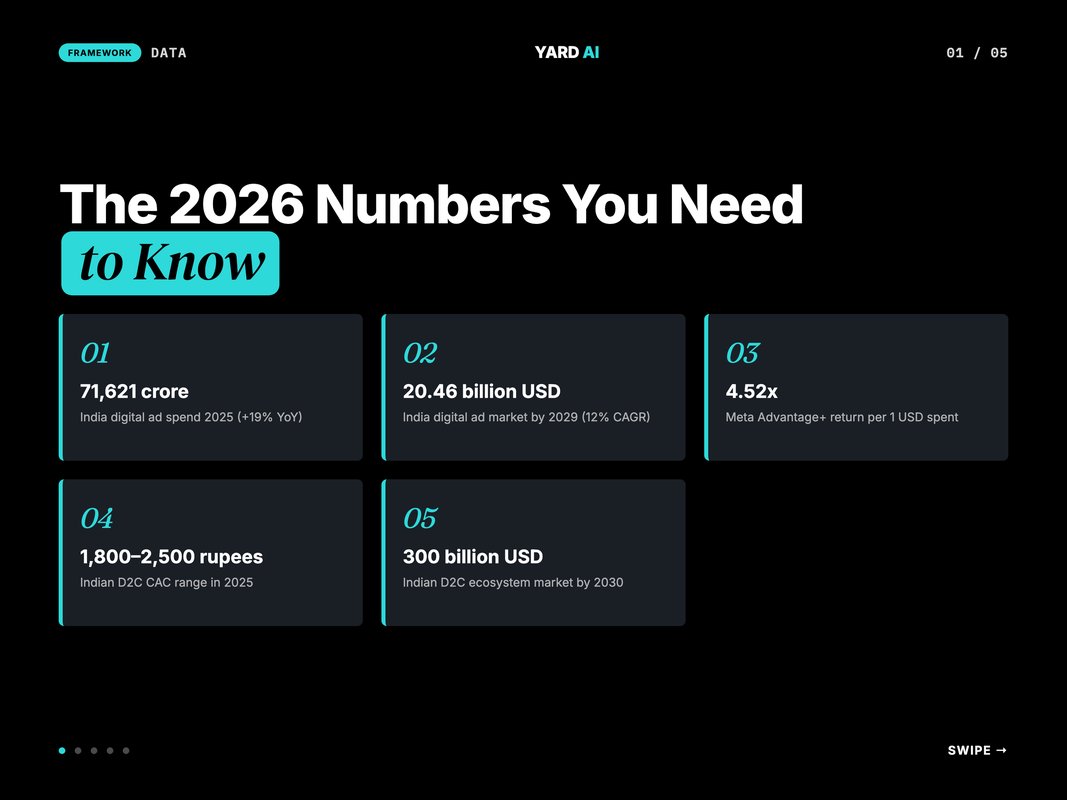
Read those numbers twice. The market is growing. The cost of entry is also growing.
The brands winning right now do three things differently. They run AI-native bidding. They pipe in first-party data. They diversify channels.
The brands losing keep buying Meta clicks at any CPM. Their unit economics collapse by month six.
Q: How much does performance marketing cost in India in 2026?
A: D2C CAC sits between 1,800 and 2,500 rupees per customer. Meta CPMs are up 40 to 60% versus 2023. Costs vary by category, geography, and creative quality.
The 4 P's of AI-First Performance Marketing
AI changed what a performance marketer does. The old four — pause, push, pull, panic — do not work when the machine bids faster than you can.
We use a new frame. We call it the 4 P's. It maps to how AI campaigns actually scale.
The 4 P's of AI-First Performance Marketing:
- Purpose — set one clear conversion goal per campaign. No vanity metrics. Smart bidding learns what you optimise for.
- Pipeline — feed clean first-party data into Customer Match, Advantage+ audiences, and Conversions API. Garbage in, garbage out.
- Prompts — write creative briefs the way you would prompt an LLM. Hook, value, proof, call. Variations come from the AI, not the agency.
- Proof — judge outputs on incrementality, not platform-reported ROAS. Run holdouts. Trust net-new revenue.
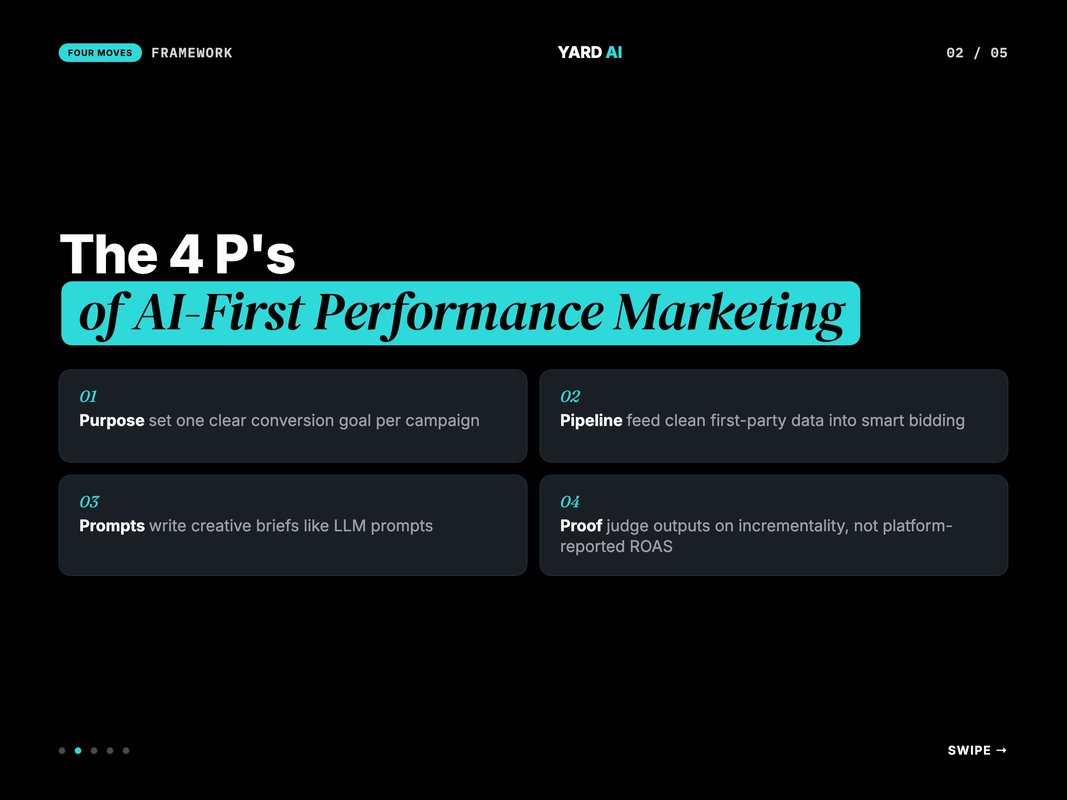
Use the 4 P's as a campaign checklist. Every new launch, walk down the list.
If you skip Pipeline, your AI bidding will plateau. If you skip Proof, you will scale a campaign that is not actually working. Smart bidding can game your attribution if your data is dirty.
Q: Is AI replacing performance marketers in India?
A: No. AI is replacing manual bidding and creative tweaks. The marketer's job has moved up the stack. Goal setting, audience strategy, creative briefs, and data hygiene now decide the win.
Old Performance Marketing vs AI-Native Performance Marketing
The shift is structural. Not a tool upgrade. A job upgrade.
Old performance marketing was a craft of micro-adjustments. Bids, schedules, keywords, audiences. The marketer was the optimiser. The platform was the canvas.
AI-native performance marketing is the opposite. The platform is the optimiser. The marketer is the strategist. You set goals, feed data, brief creative, and audit the output.
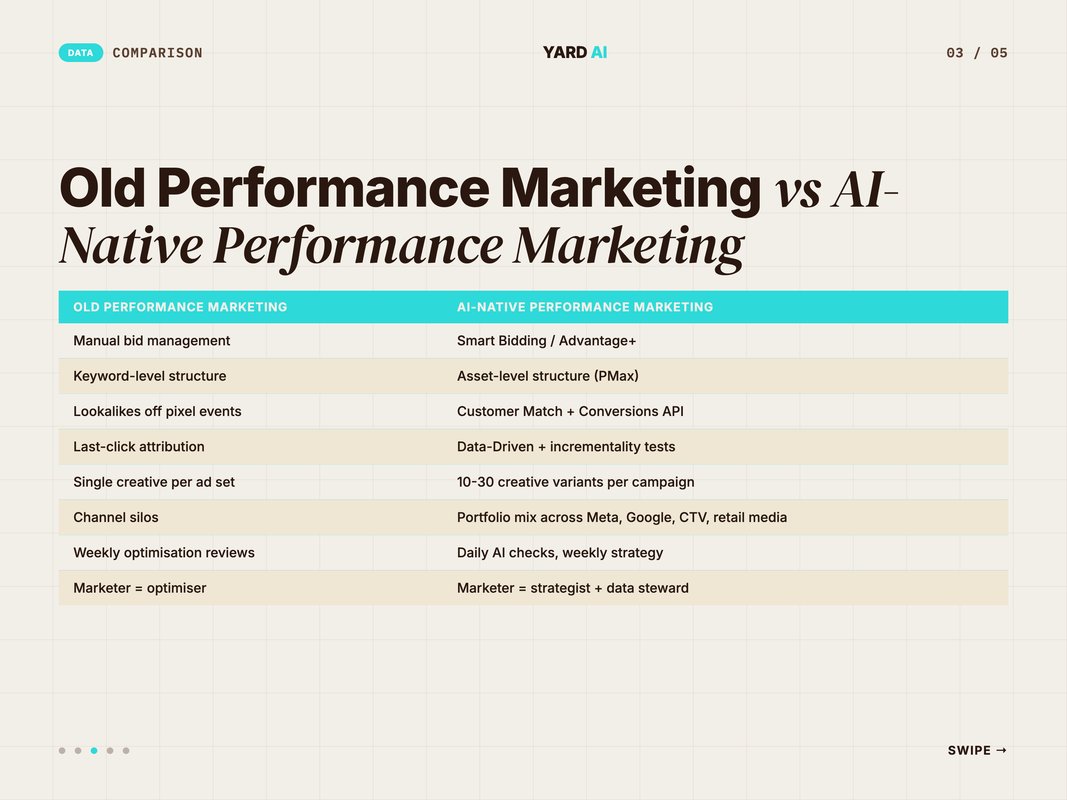
Here is the side-by-side our team uses on every audit. Old way on the left. AI-native way on the right.
- Bid management — manual → Smart Bidding / Advantage+.
- Structure — keyword-level → asset-level (PMax).
- Audiences — lookalikes off pixel events → Customer Match plus Conversions API.
- Attribution — last-click → Data-Driven plus incrementality tests.
- Creative — single ad per set → 10 to 30 variants per campaign.
- Channel — silos → portfolio mix across Meta, Google, CTV, retail media.
- Cadence — weekly optimisation reviews → daily AI checks, weekly strategy.
- Role — marketer as optimiser → marketer as strategist and data steward.
The right side is not a future state. It is what Meta and Google now reward in their auctions.
If your account still looks like the left column, you are paying a premium. Smart bidding favours brands that feed it the right inputs.
Q: Which platforms drive the most performance spend in India in 2026?
A: Meta and Google still take the largest share. Retail media on Amazon, Flipkart, and Nykaa is the fastest-growing slice. CTV and WhatsApp commerce are scaling fast.
The 2026 Channel Mix for Indian Brands
Spend allocation moved. The 80-20 Meta-Google split is gone.
The brands hitting profitable scale in 2026 run a portfolio. We have seen this across the audits our team runs each quarter. The math is consistent.
The new mix for a mid-stage Indian D2C brand:
- Meta gets 40 to 50%. Down from 80% three years ago.
- Google gets 25 to 30%. Split across Shopping, brand search, and Performance Max.
- Emerging gets 15 to 25%. YouTube Shorts, WhatsApp commerce, retail media, CTV, influencer seeding.
- Testing gets 5 to 10%. Reserved for new channels and new audiences.
That is a defensive mix. It survives a Meta CPM spike. It rides organic search and retail media when paid CAC gets ugly.
Why the diversification matters in plain numbers: Meta CPMs are up 40–60% since 2023. Google Shopping competition is brutal. CTV is growing 35%+ annually. Retail media on Amazon and Flipkart now captures buyers at peak intent.
A 5-step channel allocation audit you can run this quarter:
- Pull the last 90 days of platform-reported spend, revenue, and ROAS.
- Strip out branded search — that revenue is not net-new.
- Run a 2-week geo holdout on Meta. Measure incremental lift.
- Reallocate 10% of Meta into one untested channel — CTV, retail media, or WhatsApp.
- Re-audit after 6 weeks. Keep what beat the Meta baseline. Cut what did not.
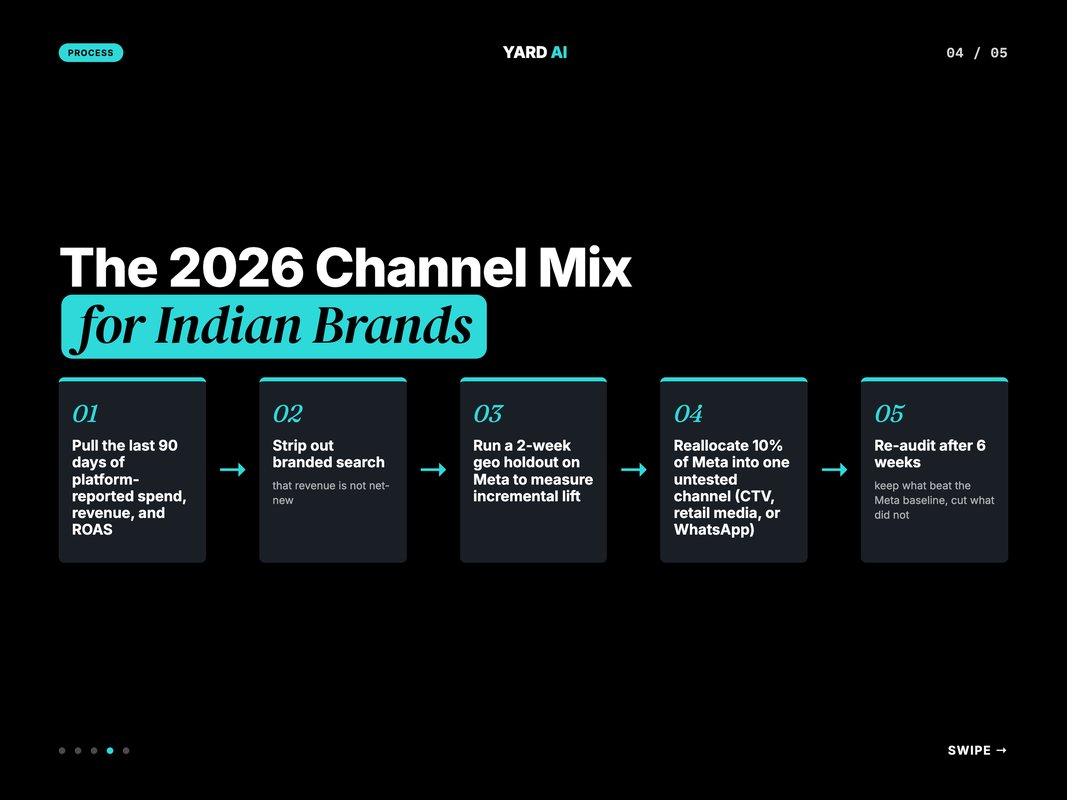
Most brands skip step 3. That is why their reported ROAS climbs but revenue stays flat.
Q: What ROAS should an Indian D2C brand target in 2026?
A: Blended ROAS of 2.5x to 4x is the working band. Beauty and personal care lands at 2.8x to 4.5x. Pet care can hit 3x to 5.2x.
First-Party Data — The Real 2026 Unlock
Smart bidding is only as smart as the data you feed it.
That is the single line that separates the brands scaling profitably from the ones bleeding. Without first-party data, you are bidding on the same generic signals as everyone else in the auction.
With clean first-party data, you are training the model on your actual buyers — not a platform-guessed lookalike. Google reports brands using Customer Match with Target ROAS see 30–40% better campaign efficiency.
The data you need is already in your stack. Most brands are not using it well.
A first-party data starter checklist for performance marketing India 2026. Tick the ones you have already done.
- Customer email and phone lists exported to Google Customer Match.
- Meta Conversions API live with deduplicated pixel events.
- CRM purchase data feeding Advantage+ audiences weekly.
- Post-purchase survey live to capture how each customer found you.
- Loyalty and repeat-buyer segments piped to a Tier-1 bid strategy.
- Suppression lists for existing customers on prospecting campaigns.
- First-party UTMs on every paid placement.
- Server-side tracking live for at least one platform.
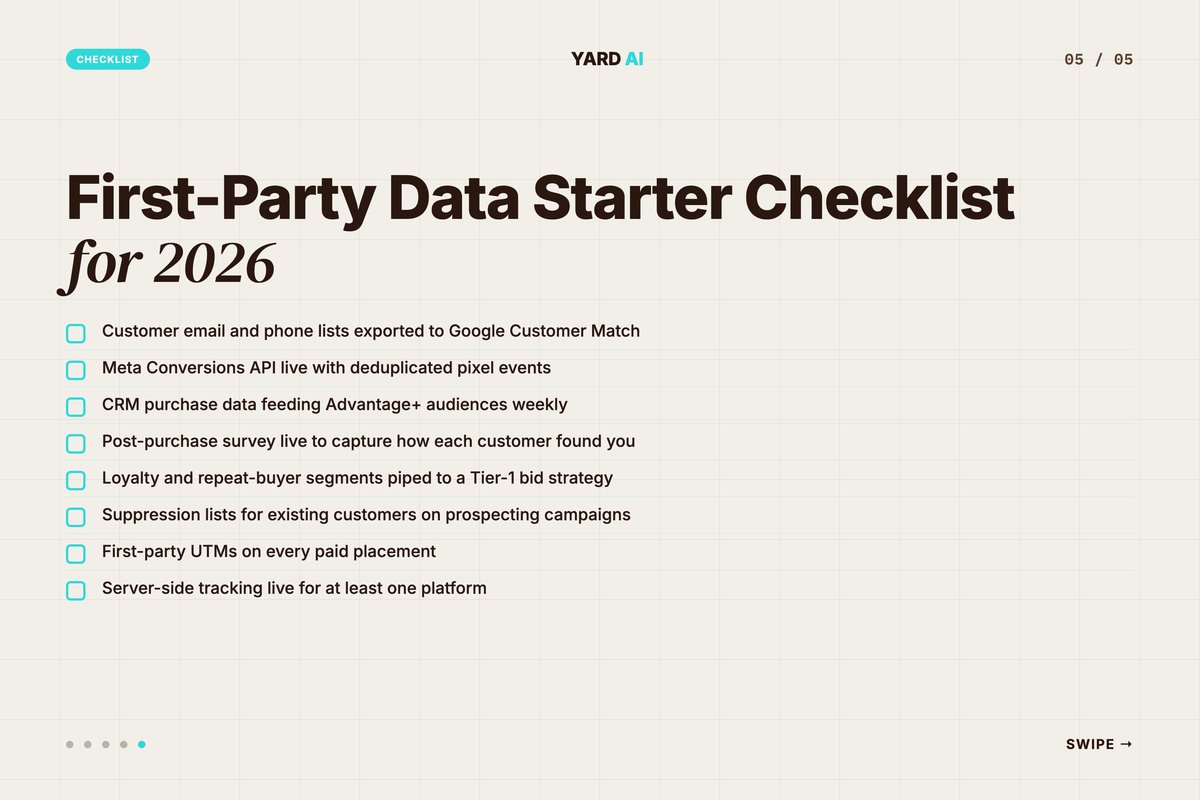
If you cannot tick six of eight, fix the data layer before you scale spend. We see this on every audit. Brands chase Meta optimisation while their pixel is missing half its events.
The fix is not glamorous. It is plumbing. It is also the highest-impact week of work you will do this year.
A real example pattern we see often. A brand spends 8 lakhs a month on Meta. Their pixel fires on page-view but not on checkout. Their Customer Match list is six months stale. Their post-purchase survey is not live.
We fix that data layer in two weeks. Spend stays flat. ROAS lifts 25 to 40% in the next month. No new media tricks. Just clean inputs.
The lesson holds across every audit. Smart bidding will scale a bad campaign just as fast as a good one. Your data is the difference.
Q: How important is first-party data in 2026?
A: It is the new moat. Customer Match, Conversions API, and CRM signals feed every smart-bidding model. Brands with clean first-party data see 30–40% better campaign efficiency.
CTV, Retail Media, and the New Performance Channels
Three channels deserve a real line in your 2026 plan. Not a pilot. A real allocation.
CTV. India's smart-TV adoption is accelerating. JioCinema, Disney+ Hotstar, and SonyLIV now sell performance-friendly ad formats. CTV claimed 29% of TV ad spend in 2024 and is projected to reach 42% by 2027. CTV in India is growing 35%+ annually. The early movers win the cheaper inventory before scale brings the auction in.
Retail media. Amazon Ads, Flipkart Ads, Myntra, Nykaa, and Meesho all run mature ad platforms now. These are buyer-intent moments. The user is on a product page, ready to add to cart. Conversion rates here beat top-funnel Meta by 3–5x. ROAS in retail media is also harder to fake — the sale happens on-platform.
WhatsApp commerce. With 500 million Indian users and 85%+ message open rates, WhatsApp is now a performance channel. Click-to-WhatsApp ads from Meta drive qualified conversations. AI agents close the sale. We see this work especially well in beauty, fashion, education, and high-consideration D2C.
Where each channel fits in the funnel:
- Meta Advantage+ — prospect and retarget. Best for D2C scale and broad audiences. Watch out for CPM inflation and signal loss.
- Google Performance Max — mid-funnel and branded. Best for high-intent search and Shopping. Watch out for branded search cannibalisation.
- CTV (JioCinema, Hotstar, SonyLIV) — awareness and consideration. Best for reach plays and premium recall. Watch out for limited measurement and higher CPMs.
- Retail media (Amazon, Flipkart, Nykaa) — bottom-funnel. Best for marketplace-heavy categories. Watch out for revenue locked to one platform.
- WhatsApp commerce — conversion and retention. Best for high-touch consult-driven sales. Watch out for manual setup and agent quality.
- Influencer + creator — awareness and social proof. Best for Tier-2 and Tier-3 reach. Watch out for brand-safety and fake reach.
Use this as a 60-second audit. Look at your last 90 days of spend by channel. Compare each line to the funnel stage. Any gaps? That is the first place to test new budget.
The most under-allocated channel for D2C brands right now is retail media. The cheapest channel to test is WhatsApp commerce. The fastest-growing line is CTV.
If your current account has no spend in any of the three, that is the gap. Pick one. Test for six weeks. Decide on data, not vibes.
What This Means for Your Team in 2026
The role of a performance marketer changed. Hiring should too.
Five years ago, you wanted a media buyer who could run a 50-campaign Google account in their head. Today, that person is helpful but not enough. Smart bidding does the manual work they used to own.
The new performance team needs four roles, not one:
- A strategist who sets goals, picks channels, and decides where to test.
- A data steward who owns Customer Match, CAPI, server-side tracking, and CRM hygiene.
- A creative producer who briefs and ships 10–30 creative variants per launch.
- A measurement lead who runs incrementality tests and reads platform-reported numbers with healthy doubt.
You can run all four on a lean team of three to four people. You cannot run zero of four with a single buyer. We see brands try this. It does not scale.
Tooling-wise, you want one bidding stack (Meta + Google). One data layer (CDP or warehouse). One creative pipeline (briefs + variants + tagging). One measurement layer (incrementality + MMM). The rest is noise.
Skill-wise, the new performance marketer is half analyst, half producer. They write briefs that an AI can execute. They read dashboards and ask why. They run a holdout test as easily as they swap a creative.
The teams we work with closely all share the same shape. Lean. Curious. Comfortable with AI tools. They ship more variants than they think they can. They kill what does not work fast.
How YARD Approaches Performance Marketing in 2026
We are YARD Agency. We are an AI-first growth marketing agency.
We run performance marketing, LLM SEO, AI creatives, and AI funnels for D2C and B2B brands across India and global markets. The shift from 2022-style performance marketing to AI-native is the work we do every week.
When we audit a new account, we look at four things first. Goal clarity at the campaign level. First-party data flow into smart bidding. Creative variant velocity. And incrementality testing — not just platform-reported ROAS.
We build the plumbing before we touch spend. Conversions API, Customer Match, server-side tracking, post-purchase surveys. Then we move to channel mix. Then we move to creative.
Our team treats AI as a teammate, not a vendor. Claude, MCP workflows, fal.io for creative variants, and custom dashboards plug into the same paid stack. The marketer's job is the goal and the brief. The AI takes the levers.
If your CAC has crept up, your Meta is plateauing, or your account still looks like 2022, that is the audit we run.
Conclusion — The 2026 Frame
Performance marketing India 2026 rewards different work than 2022 did.
The levers are now AI's job. The strategy, the data, the creative direction, and the measurement are yours. That is the trade.
The brands winning right now share three habits. They feed clean first-party data into smart bidding. They run a portfolio mix — not Meta-only. They judge their work on incremental revenue, not platform-reported ROAS.
The brands losing are running a 2022 playbook on 2026 CPMs. Their CAC keeps climbing. Their team keeps refreshing dashboards. The fix is structural.
If you are ready to rebuild the stack. Data layer first, channel mix second, creative third — we can help. [internal link: ai-marketing-stack-india]. Book a call when you want a real audit of your account.
The market is bigger than ever. The cost of doing it wrong is bigger too.
FAQ
Q: What is performance marketing in India in 2026?
A: It is paid acquisition tied to measurable outcomes. Clicks, leads, installs, sales. In 2026, AI runs the bidding. The marketer sets the goal, feeds clean data, and judges the output. The work has shifted from levers to inputs.
Q: How much does performance marketing cost in India in 2026?
A: D2C CAC sits between 1,800 and 2,500 rupees per customer. Meta CPMs are up 40 to 60 percent versus 2023. Google CPCs have climbed in lead-gen and finance. Costs vary by category, geography, and creative quality.
Q: Which platforms drive the most performance spend in India in 2026?
A: Meta and Google still take the largest share. Retail media on Amazon, Flipkart, and Nykaa is the fastest-growing slice. CTV and WhatsApp commerce are scaling fast. The mix is no longer Meta-only.
Q: What ROAS should an Indian D2C brand target in 2026?
A: Blended ROAS of 2.5x to 4x is the working band. Beauty and personal care lands at 2.8x to 4.5x. Pet care can hit 3x to 5.2x. New brands sit lower until retention kicks in.
Q: Is AI replacing performance marketers in India?
A: No. AI is replacing manual bidding and creative tweaks. The marketer's job has moved up the stack. Goal setting, audience strategy, creative briefs, and data hygiene now decide the win.
Q: How important is first-party data in 2026?
A: It is the new moat. Customer Match lists, post-purchase surveys, and CRM signals feed every smart-bidding model. Brands with clean first-party data see 30 to 40 percent better campaign efficiency.
Q: What is the biggest mistake brands make with performance marketing in India in 2026?
A: Treating it like a 2022 game. Manual campaigns, no first-party data, no CTV, no retail media. They keep buying Meta clicks and watch CAC climb. The fix is a portfolio mix, not a single channel.
Insights from Our Experts
Explore our latest articles on digital marketing strategies.