

Most weak Meta ad accounts don't have a targeting problem. They don't have a creative problem either. They have a structure problem. To be exact, they are over-built. They get sliced into dozens of campaigns and ad sets. This usually happens in a well-meaning try to control the budget.
In the Advantage+ era, that instinct works against you. Meta's system runs on conversion signal. Every extra ad set splits that signal into a smaller, weaker pile. The accounts that win now are combined, not split. This is the playbook for building one.
The principle: consolidate for signal, not control
One idea should drive every structural choice. The algorithm needs dense conversion data to optimize. Splitting starves it.
Spread spend across many ad sets, and each one gathers only a trickle of sales. None of them gather enough data to learn well. So the whole account optimizes slowly. Meta's own tools now push toward a simpler setup. Its Advantage+ Shopping product automates creative, audience, budget, and optimization. It runs inside one combined campaign, not many manual ones (Meta).
The takeaway is simple. Your job is not to micro-manage audiences. It is to give Meta clean structure, strong creative, and enough signal to learn fast.
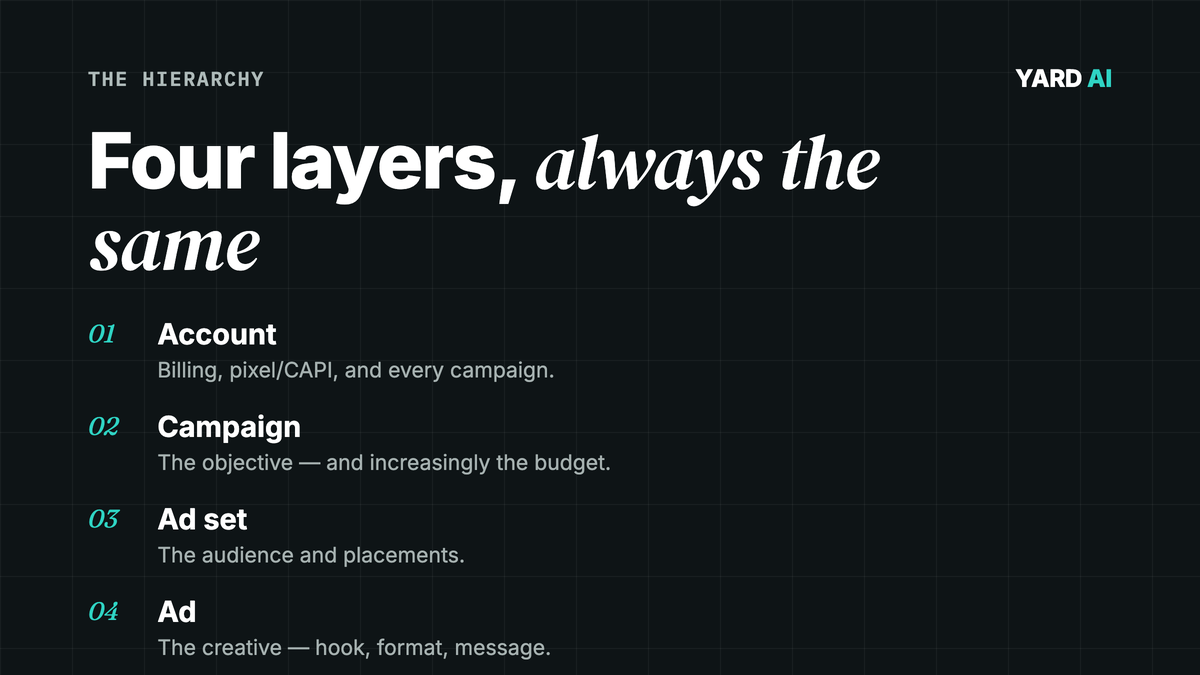
The hierarchy: four layers, always the same
Every Meta account is built on the same four levels:
- Account: the top level. It holds your billing, pixel/Conversions API, and all campaigns.
- Campaign: where you set the objective (usually Sales) and, more and more, the budget.
- Ad set: where the audience, placements, and (in older setups) the budget live.
- Ad: the creative itself. The hook, format, and message.
Get the campaign layer right and the layers below it stay simple. Most structural mistakes happen at the ad-set level. People try to fix campaign-level problems by adding more ad sets.
Prospecting vs retargeting: keep them separate
Cold and warm audiences do different jobs. So they belong in different campaigns.
- Prospecting finds new buyers who have never heard of you. Go broad and let Meta hunt. Advantage+ Shopping or broad targeting does the heavy lifting here.
- Retargeting closes people who already know you. Think site visitors, add-to-carts, video viewers, and engagers. These audiences are smaller. The creative should assume they know you.
Blending the two into one campaign hides what is truly working. Retargeting's naturally strong ROAS then flatters your prospecting numbers. Split them so you can read each one honestly.

The testing campaign: protect the money-maker
Never test new creative inside the campaign that pays your bills.
Run one dedicated creative-testing campaign. New hooks, angles, and formats launch here. Winners move up into your scaling campaign or your retargeting campaign. Losers get cut. This keeps your scaling campaign stable. It won't keep re-entering learning because you dropped in three untested ads.
Think of it as a farm system. Prove it cheaply, then promote it to the main roster.
Naming conventions: a name should tell you everything
A good naming convention turns reporting from a guessing game into a glance. Use brackets and a set order. Then you can filter and read fast.
A simple, copy-able pattern:
- Campaign: [PROSPECTING] ASC | Evergreen
- Ad set: [BROAD] All | Auto Placements
- Ad: [VID] Hook-Testimonial | UGC-03
The specifics matter less than the consistency. Pick a format, write it down, and make everyone use it.

Budgets and the learning phase
Every new ad set enters a learning phase. Meta uses it to figure out who to show your ads to. During this phase, delivery is less stable and results can swing. Meta says an ad set usually needs about 50 conversions in a 7-day window to exit learning (Meta). That threshold is the whole argument for combining. Industry explainers echo the same 50-events-per-week logic (Ad Library).
Split a fixed budget across ten ad sets. Most will never hit that number. They then optimize poorly forever. Pool budget at the campaign level instead. Use campaign budget optimization or Advantage+ Shopping. Meta can then flow spend to the best ads on its own. Each ad set also gathers enough sales to learn. Fewer ad sets with real budget beat many ad sets starved of it.
One more discipline: stop making constant edits. Big changes can restart the learning phase, so give campaigns time before you judge them (Meta).
Over-segmentation: the number-one mistake
The most common mistake is over-segmentation. It is also the most costly. It usually looks like this:
- One audience per ad set, with ad sets multiplying into the dozens.
- Tiny daily budgets that never exit learning.
- Copying a winning ad set five times to "scale" it. This just splits the signal that made it win.
- Stacking dozens of "related" interests into hyper-narrow audiences Meta could have found on its own.
- Editing constantly and restarting learning every few days.
Every one of these splits your conversion data into piles too small to optimize. Splitting feels like control. It is really the thing holding your account back.

A simple starter structure
Rebuilding from scratch? Start here. Add complexity only when the data demands it.
- Campaign 1: Advantage+ Shopping (prospecting and scale). Broad. Campaign-level budget. Your best 3-5 ads.
- Campaign 2: Retargeting. Warm audiences (site visitors, add-to-carts, engagers). Familiar, closer-style creative.
- Campaign 3: Creative testing. New angles and formats. Promote winners into Campaigns 1 and 2.
Three campaigns. Broad audiences. Pooled budgets. A clean naming convention. That covers most D2C and startup accounts. It will out-perform the 27-campaign monster it replaces.
FAQ
How many campaigns should a Meta ad account have?
Most accounts do best with two to three campaigns. A common split is prospecting, retargeting, and creative testing.
Why does over-segmentation hurt Meta ads?
Each ad set needs its own conversion signal. Splitting budget across many ad sets leaves each one with too little data to optimize.
How many events exit the Meta learning phase?
Meta says an ad set usually needs about 50 conversions within a 7-day period to exit the learning phase.
Should prospecting and retargeting share one campaign?
No. Keep them separate. Blending them hides what works and lets retargeting's high ROAS flatter your prospecting numbers.
What is Advantage+ Shopping?
It is Meta's automated campaign type. It rolls creative, audience, budget, and optimization into one machine-learning-driven setup.
Do frequent edits reset the learning phase?
Yes. Big changes can restart learning. Let campaigns run before you judge them.
Closing CTA
Does your account look like a spreadsheet exploded? The fix usually is not a new audience or a new bidding strategy. It is collapsing structure until every choice has enough signal behind it. Audit yours against the starter structure above this week.
Want a performance team to rebuild it for you? That is exactly what we do at YARD. See how we run paid media on our performance marketing page, then book a call and let's talk.
Insights from Our Experts
Explore our latest articles on digital marketing strategies.