

You have heard it on every marketing call. "What is our CAC?" "CAC is creeping up." "We need CAC down." The phrase gets repeated so often that nobody stops to define it. That is how founders end up nodding along to a number that quietly decides whether the business is profitable.
So let us fix that. This is CAC explained the way your agency should have explained it. Clearly, with the formula, a real example, and the context that makes the number useful.
What is CAC?
CAC stands for Customer Acquisition Cost. It is the total amount you spend on sales and marketing to win one new customer.
That is the whole idea. If you spent money to turn a stranger into a paying customer, that money is part of your CAC. It is one of the most important numbers you have. It answers a simple question. Is the growth you are buying worth what you pay for it?

The CAC formula
Here is the formula every performance marketer works from.
CAC = (Total Sales + Marketing Spend) ÷ New Customers Acquired
The denominator matters. It is new customers, not total orders. Repeat buyers already cost you something to acquire. Counting them again flatters your number and hides the truth.
The numerator matters too. "Total sales and marketing spend" is not just your ad budget. It includes more than most brands admit.
What counts as spend
- Paid media (Google, Meta, and the rest)
- Agency or freelancer fees
- Marketing tools and software
- Salaries of the people running acquisition
- Creative and production costs
Leave these out and your CAC looks better than it is. That is the most common and most expensive mistake brands make.
A worked example
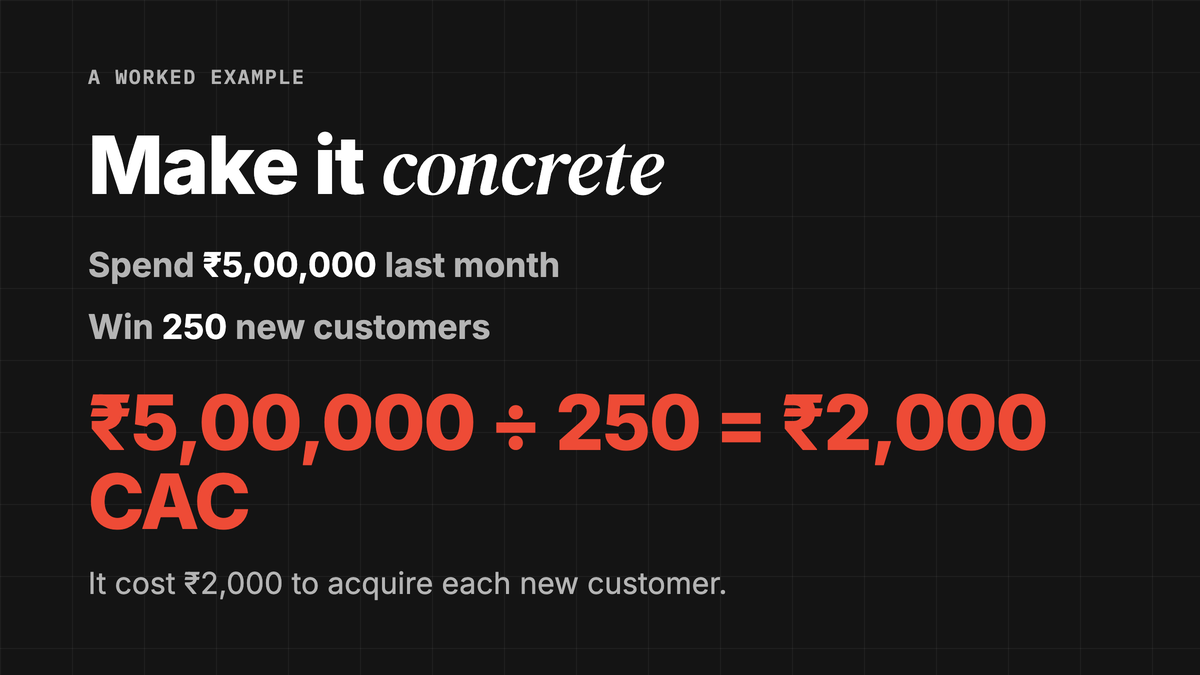
Let us make it concrete.
Say last month you spent ₹5,00,000 across ads, your agency retainer, and tools. In that same month, you won 250 new customers.
CAC = ₹5,00,000 ÷ 250 = ₹2,000
So it cost you ₹2,000 to acquire each new customer. Whether that is good or bad depends on what that customer is worth. We will get to that.
CAC vs CPA vs CPL
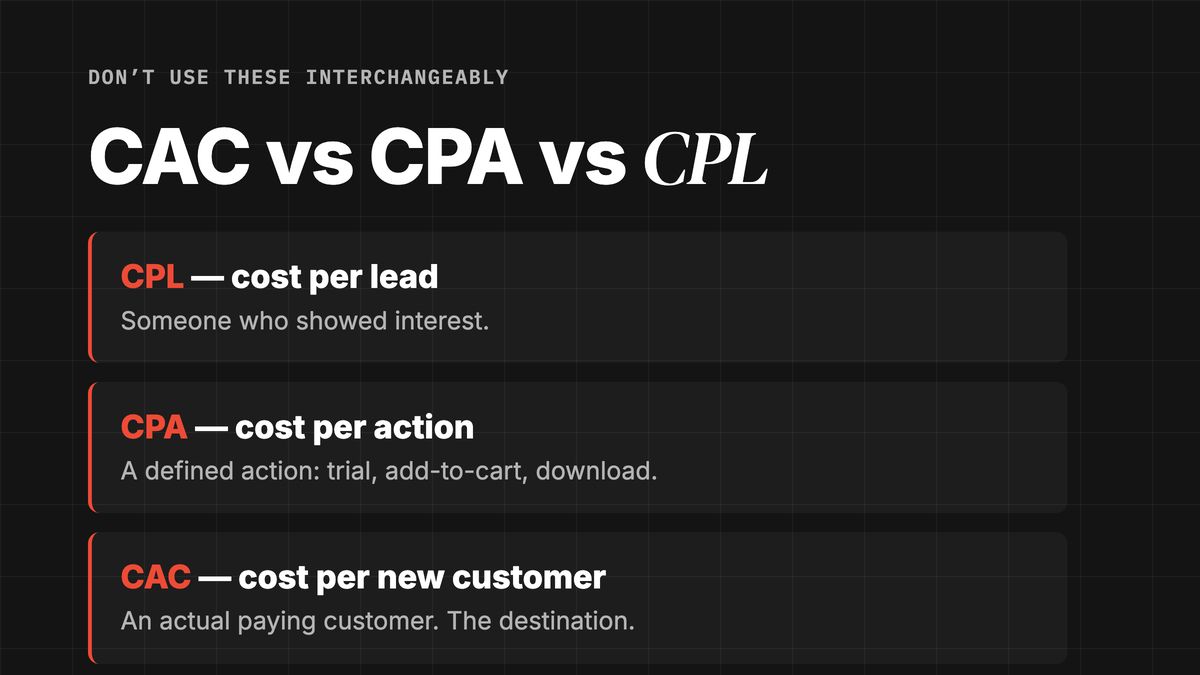
These three get used interchangeably. They should not be.
- CPL (Cost Per Lead): what you pay for one lead. Someone who showed interest, like a form fill or a sign-up.
- CPA (Cost Per Action): what you pay for a defined action. A click-to-trial, an add-to-cart, a download.
- CAC (Customer Acquisition Cost): what you pay to win an actual paying new customer.
Think of it as a funnel. CPL and CPA are steps along the way. CAC is the destination. It is the only one of the three that captures whether the money turned into revenue.
What is a "good" CAC? The LTV:CAC ratio
Here is the truth nobody likes. There is no universal "good" CAC. A ₹2,000 CAC is excellent for a brand selling a ₹40,000 product. It is disastrous for one selling a ₹500 product.
That is why CAC means little on its own. You have to read it against LTV. That is Lifetime Value, or how much profit a customer generates over their whole relationship with you.
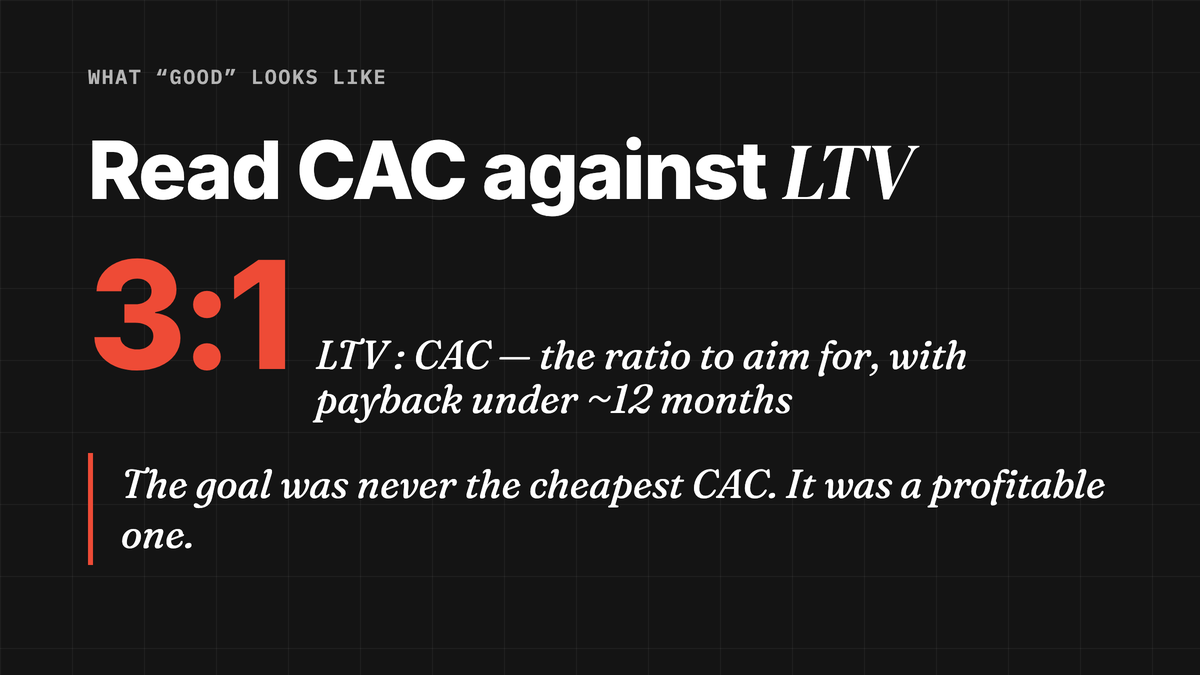
The rule of thumb most operators use is an LTV:CAC ratio of roughly 3:1. For every ₹1 you spend acquiring a customer, you want around ₹3 back over their lifetime. A good benchmark is 3:1 or better (Geckoboard), a target SaaS businesses generally aim for (Stripe).
The second half of the picture is payback period. That is how long it takes to earn your CAC back. The general benchmark for startups is to recover CAC in 12 months or less (Geckoboard). Faster is better for cash flow.
The takeaway is simple. A low CAC is not automatically a win. A cheap customer who never buys again can be a worse deal than an expensive one who stays for years.
Why agencies obsess over CAC
Because CAC is where strategy meets reality. You can have brilliant creative, a slick funnel, and rising revenue. You can still be quietly losing money if your CAC is higher than your customers are worth.
A good agency watches CAC by channel, by campaign, and over time. Rising CAC is an early warning. It signals that a channel is saturating, your audience is fatiguing, or your offer needs work. It is the metric that stops you from scaling a leak.
How to lower CAC
You do not lower CAC by spending less. You lower it by acquiring smarter. A few of the highest-leverage moves:
- Improve conversion rate. More customers from the same traffic drops CAC directly.
- Tighten targeting. Stop paying to reach people who will never buy.
- Strengthen creative and offer. Better hooks and clearer value lower your cost to convert.
- Reactivate and retain. Increasing LTV improves your LTV:CAC ratio even if CAC holds steady.
- Diversify channels. Over-relying on one platform pushes CAC up as you saturate it.
The bottom line
CAC is what it costs to win one new customer. It is total sales and marketing spend divided by new customers acquired. It is simple to calculate and easy to get wrong. The number only means something next to LTV. And the goal was never the cheapest CAC. It was a profitable one.
FAQ
What does CAC stand for?
CAC stands for Customer Acquisition Cost. It is the total sales and marketing spend needed to win one new customer.
What is the CAC formula?
CAC = total sales and marketing spend divided by new customers acquired. Count only new customers, not repeat buyers.
What is a good CAC?
There is no universal figure. Read CAC against LTV. A ratio of 3:1 or better is a common benchmark (Geckoboard).
What is the difference between CAC, CPA, and CPL?
CPL is the cost per lead. CPA is the cost per defined action. CAC is the cost to win a paying new customer.
What is a good CAC payback period?
A common benchmark is recovering your CAC within 12 months or less (Geckoboard). Faster helps cash flow.
How do I lower my CAC?
Improve conversion rate, tighten targeting, sharpen your offer, retain customers, and diversify channels. Spend smarter, not less.
Why does my agency keep talking about CAC?
Because CAC shows whether your growth is profitable. Rising CAC is an early warning that a channel or offer needs attention.
Not sure what your real CAC is, or whether it is actually healthy? That is the thing most brands are guessing at. YARD is an AI-first performance marketing agency, and we map real acquisition economics for a living. Book a free CAC and LTV teardown on our contact page. Or start at the YARD homepage to see how we help brands tighten the leaks.
Insights from Our Experts
Explore our latest articles on digital marketing strategies.