Ad copy is the cheapest lever you have.
A better hook can move CTR meaningfully on the same audience. The creative wins. The targeting just shows up. Nielsen's analysis of digital campaigns found creative quality is the single biggest driver of in-market success (Source: Nielsen, 2017 — nielsen.com).
Most marketers now reach for a chatbot before a copywriter. That part is fine. The problem is the prompt itself. "Write a Facebook ad for my product" gives you hollow lines everyone else gets.
Prompt engineering for ad copy fixes that gap. It is the line between AI as a junior intern and AI as a senior writer with your brief in hand.
This guide walks through the frameworks, the prompts, and the patterns we lean on. It covers paid social, search, and retargeting. Every prompt is copy-pasteable. Bring your offer, swap the brackets, ship the test.
You will leave with a working prompt library for hooks, headlines, RSAs, retargeting, and hero lines. Plus the rules of the road for keeping voice intact. Let us get into it.
A quick note on scope. This is a guide for performance marketers running paid campaigns. Not a primer on what an LLM is. We assume you have used ChatGPT, Claude, or Gemini at least a few times. You know what a prompt looks like. You just want yours to ship better copy.
We also assume you sit between strategy and execution. You write briefs. You approve creative. You watch the dashboard. The prompts below slot into your existing flow. They do not replace your campaign manager or your designer. They speed up the part where you stare at a blank doc waiting for a hook to land.
Why Prompt Engineering Matters for Ad Copy in 2026
AI writes the words. You set the rules.
That is the whole job. The model has read every ad ever indexed. It does not know your brand. It does not know your offer. It does not know which line your audience saw last week.
Your prompt is the brief. The cleaner the brief, the cleaner the copy.
Bad prompts produce safe, generic, forgettable lines. The kind that score "Good" on ad strength and still lose money. Good prompts produce lines you would have written yourself, but much faster.
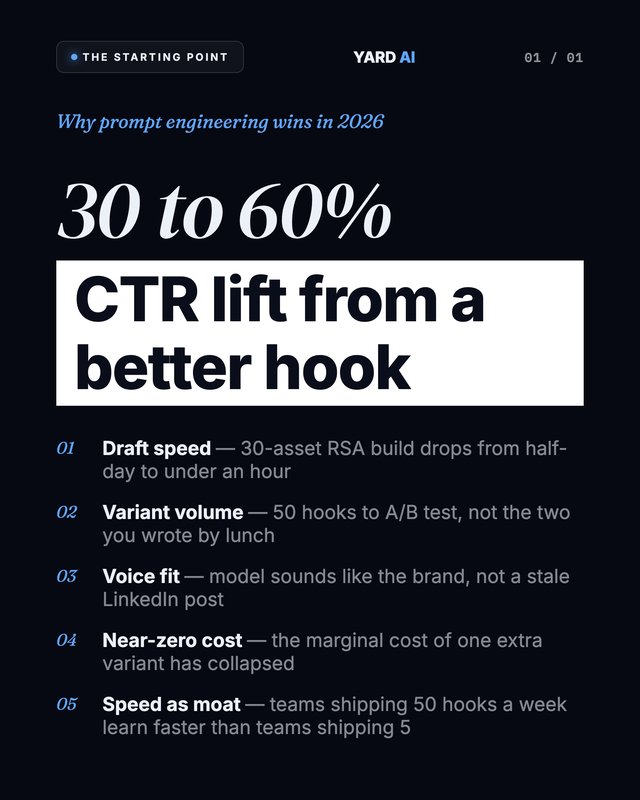
Three things change when you prompt well. First, draft speed. A 30-asset RSA build drops from a half-day to under an hour. Second, variant volume. You get 50 hooks to A/B test, not the two you could write before lunch. Third, voice fit. The model sounds like your brand, not like a stale LinkedIn post.
There is a deeper reason this matters now. The cost of one extra variant has dropped to near zero. A team that ships 50 hooks a week learns faster than a team that ships five. Speed becomes the moat.
Anthropic puts this plainly in its prompting docs. Well-specified, clear, accurate task descriptions upfront help maximise model intelligence (platform.claude.com). The same logic applies to ad copy. Tell the model what you want, in what format, for whom, and why.
Performance marketers feel this every week. The audiences are smaller now. The platforms have shifted to creative as the lever. CPMs keep climbing. Whoever can ship more variants and learn from them faster wins the quarter.
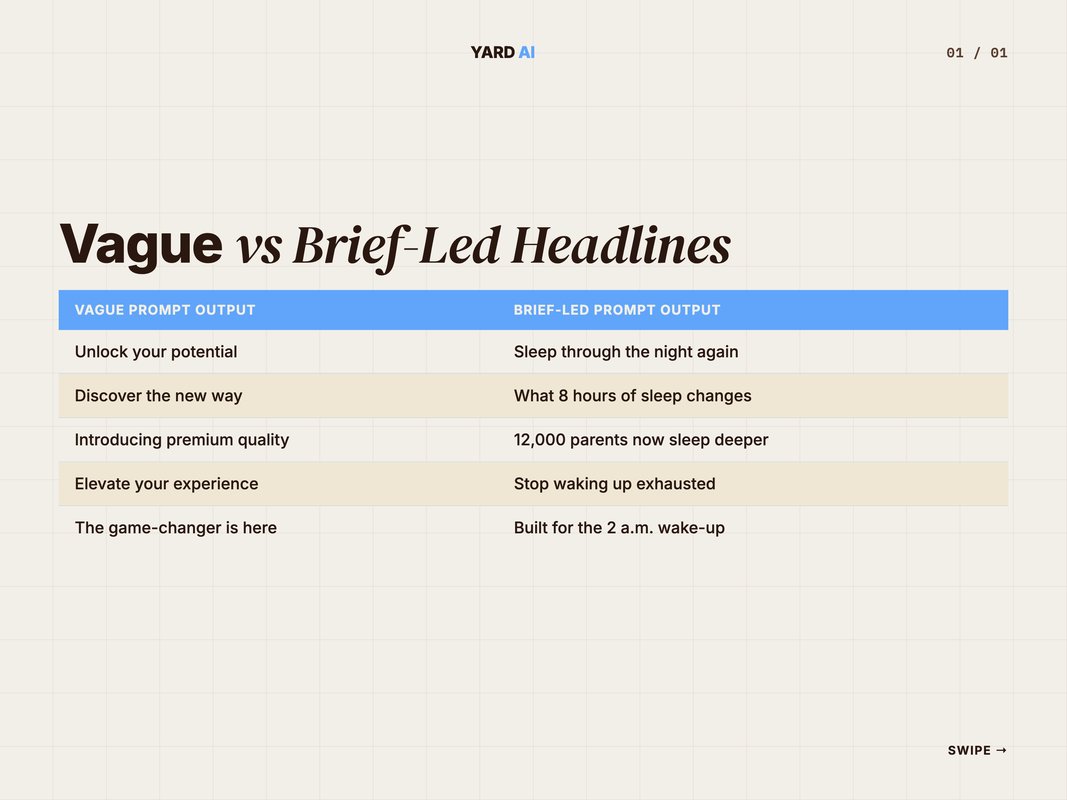
Generic AI ad copy has a tell. It loves words like "unlock", "elevate", and "introducing". It opens with the brand name. It promises everything. Real customers do not talk that way. They use short sentences. They mention specific moments. They name what hurts.
Your prompt has to enforce that real voice. The model will not get there on its own.
There is also a budget angle to all of this. Most paid teams test only a handful of creative variants per week. The good ones test many more. The gap is not budget. It is draft speed. Once draft speed becomes near-zero, the bottleneck shifts to picking, approving, and shipping. Prompt engineering moves you to that bottleneck faster.
One more reason this matters. AI Overviews and AI ad surfaces are rewriting how copy gets ranked. Lines that read well to a human now also have to read well to a model that summarises ads back at the user. Short, specific, fact-led copy wins both audiences. Vague, adjective-led copy loses both.
Q: What is prompt engineering for ad copy?
A: It is the craft of writing AI prompts that ship usable ad lines on the first or second try. It sets role, audience, offer, format, and tone for the model.
The RAOFT Framework: Five Layers Every Ad Copy Prompt Needs
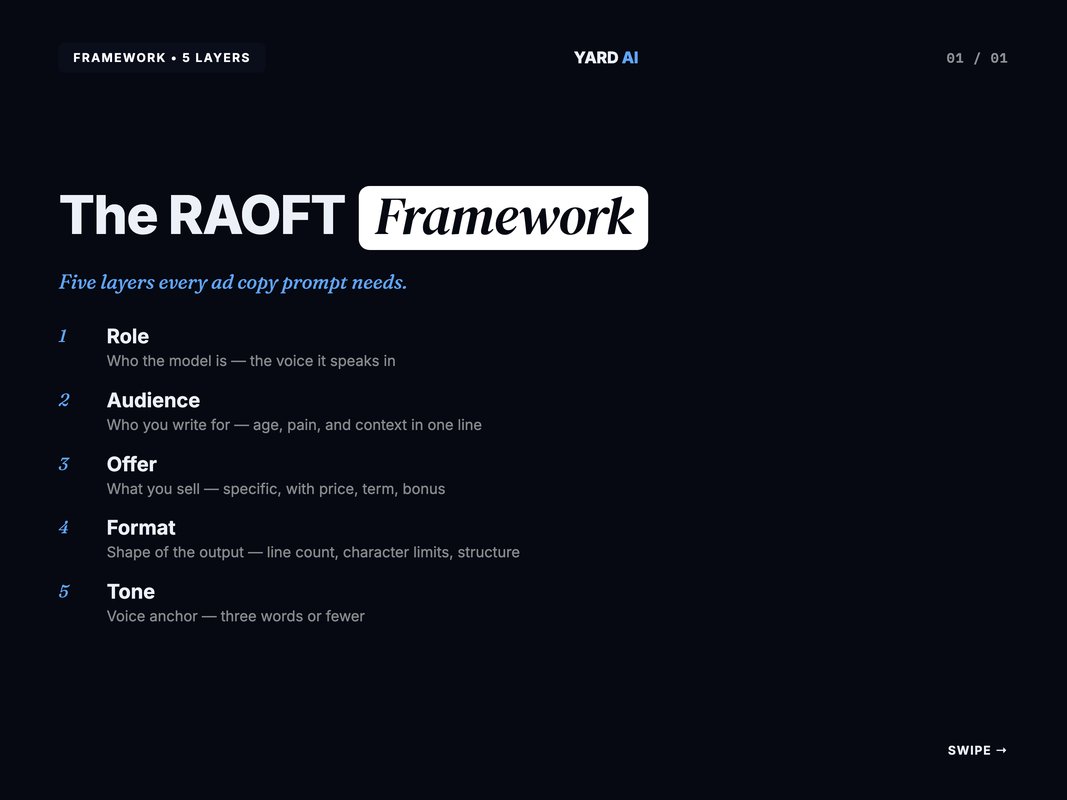
Every good ad copy prompt has five layers. Skip one, the copy drifts. Hit all five, the model lands the brief.
We call it RAOFT. Role, Audience, Offer, Format, Tone.
Here is what each layer does.
Role. Tell the model who it is. "You are a senior direct-response copywriter for D2C beauty." This anchors the voice. It changes the vocabulary, the cadence, and the references the model pulls from.
Audience. Name the persona in one sentence. Age band, pain, context. "Working mothers, age 28 to 40, short on time, exhausted by 9 pm."
Offer. Spell out the product, the price, the unique value. Skip this and the model writes about a product class, not your product.
Format. Specify the deliverable exactly. "Write 10 headlines, max 6 words each. No emojis. No exclamation marks."
Tone. Two or three words. "Warm, confident, slightly cheeky." Add a banned-words list if your brand has one.
The COSTAR framework gets cited a lot in 2026 too. Context, Objective, Style, Tone, Audience, Response (promptboost.sprklai.com). RAOFT is a tighter version aimed at one job. Pick whichever sticks in your head. The point is to never run a prompt missing one of the five anchors.
A prompt without Role drifts into LinkedIn voice. A prompt without Audience writes for a product category. A prompt without Offer hedges every line. A prompt without Format gives you prose when you wanted bullets. A prompt without Tone sounds like every other brand.
Most prompt failures we see in audits trace back to a missing layer. Teams jump straight to "write me 10 Meta ads". They skip the brief. The model fills the gap with its training data average. That average is bland.
The fix is small. Five extra sentences at the top of the prompt. The output quality jumps the moment they are in place.
A small note on order. Put Role first. Then Audience. Then Offer. Then Format. Then Tone. The model reads top-down. The earliest layers anchor the latest ones. If you bury Role at the bottom, the model has already started writing in default voice by the time it hits the brief.
Add an XML structure if you want belt-and-braces. Anthropic recommends wrapping each layer in tags like Role, Audience, and so on. The model parses tagged sections faster. The result is cleaner output with less drift. We use plain headers most days. Tags only come out for the trickiest accounts.
One last thing to bake in. Always include a "what NOT to do" block at the bottom of the prompt. Banned phrases. Banned formats. Banned moves. The model is much better at avoiding a named pitfall than guessing what you would hate. A short banned list stops a large share of the worst output.
Q: How long should an ad copy prompt be?
A: About 150 to 400 words. Shorter skips audience, offer, or format rules. Longer slows the model without lifting quality.
[internal link: how to brief AI like a creative director]
Prompts for Hooks That Stop the Scroll
The hook is the first three seconds. Or the first six words.
If the hook fails, nothing else gets read. Spend most of your prompt time here. We run hook prompts in batches of 20 to 30 lines per round.
Here is the prompt we lean on most. Paste, fill, run.
You are a senior direct-response copywriter for Meta and TikTok ads.
Brand: [Your Brand].
Product: [one-line product description].
Audience: [age, life stage, top friction point in their own words].
Offer: [discount, free shipping, free trial, etc.].
Banned phrases: "game-changer", "revolutionary", "unlock", "elevate".
Write 20 ad hooks. Each is one line. Each is under 8 words.
Each starts with one of these patterns:
- A direct question that names the friction
- A blunt confession from the customer POV
- A surprising number or stat
- A pattern interrupt that contradicts a common belief
- A "you vs them" framing
Output as a numbered list. No emojis. No quote marks.
This works because it forces variety. The model cannot give you 20 versions of the same line.
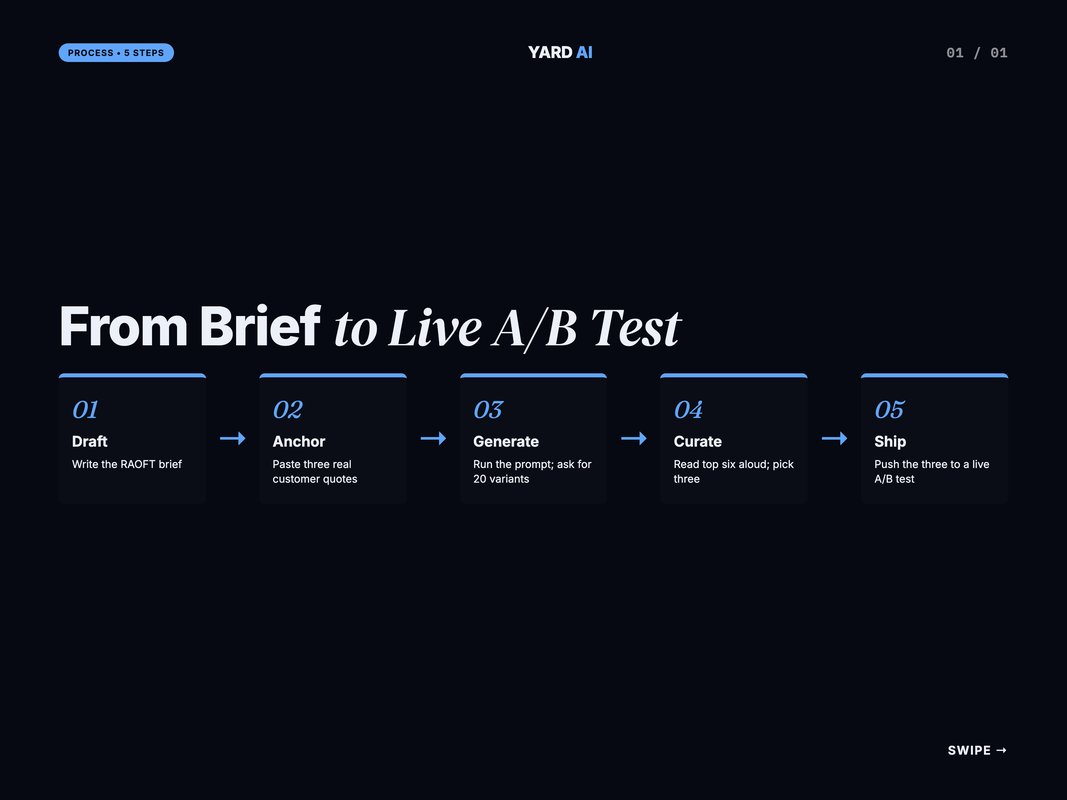
Run it twice. Keep the best six. Run those six as hook tests across one creative. The winner usually shows up in 48 hours of paid traffic.
Hook patterns that consistently win for paid teams:
- Friction-led hooks tend to beat feature-led hooks on CTR.
- Questions naming a specific pain tend to win more often than generic questions.
- Nouns and verbs in the first three words tend to beat adjective openers.
- Numbers in the first four words tend to lift the click rate.
- Pattern interrupts that name a common belief and break it win on cold audiences.
The single best prompt upgrade is to paste in three real review quotes from your product. The model latches onto the customer's exact phrasing and stops guessing. Pull these from Trustpilot, Reddit, and chat logs.
We also keep a hook log per brand. Every winning hook from the last 90 days lives in a doc. New prompts reference it. The model studies the past winners and finds new angles in the same voice. The hit rate climbs week over week.
One more rule worth pinning. Always ask for 20, never for 5. The model gets bolder when the volume target is high. The top three out of 20 always beat the top three out of 5.
For TikTok and Reels, we run a second pass with one extra instruction. "Each hook must be readable in under 1.5 seconds." The model gets brutal about word choice when that constraint lands. The output skews toward two and three-word openers. That is exactly what stops the scroll on a 4:5 vertical video.
Hooks also need a category test. Read the top six aloud. If three of them could be swapped between brands without anyone noticing, the prompt failed. Add more brand-specific friction. Add more customer phrases. Run again.
Q: How do I stop AI ad copy from sounding generic?
A: Force the model to name the friction, not the feature. Paste real customer language from reviews and chat logs. Ask for ten variants, not one.
Prompts for Meta, TikTok, and Google Ad Headlines
Meta wants short. Meta wants emotional. Meta wants you in two lines.
A Meta ad headline is not a Google headline. Different format, different goal. The headline supports the visual and the primary text. It is the closer, not the opener.
Here is the Meta prompt template. Tested across D2C, SaaS, and lead-gen accounts.
You are writing Meta ad headlines for a paid social campaign.
Brand: [Your Brand].
Product: [product, in one line].
Audience: [persona].
Offer or hook: [what the ad creative shows].
Stage: [cold / warm / retargeting].
Brand voice: [3 words, eg "warm, direct, no fluff"].
Write 15 Meta ad headlines.
Rules:
- Maximum 6 words per headline
- No emojis
- No all-caps
- Avoid "discover", "unlock", "introducing"
- Mix 5 benefit-led, 5 curiosity-led, 5 social-proof-led
- Each line works without the image
Output as a numbered list.
We split the output across three rounds.
Round one is benefit-led. Hits the rational brain. "Sleep through the night again." Round two is curiosity-led. Pulls the click. "What 8 hours of sleep changes." Round three is social-proof-led. Builds trust. "12,000 parents now sleep deeper."
Test one of each per ad set. Kill the dead ones in 72 hours.
About 80 percent of paid marketers now prefer Claude's output for customer-facing copy over GPT (stormy.ai). The reason is voice. Claude avoids the corporate cadence ChatGPT defaults to. For Meta on emotional verticals, Claude wins. For bulk RSA assets at speed, GPT still has the edge.
TikTok ads need one more rule. Add this line to the prompt. "First line must read like a friend texting, not a brand." That single instruction shifts the model from polished to plausible. Plausible wins on TikTok.
Now Google RSA. A different beast. 15 headlines. 4 descriptions. Each one tested by Google's own ML.
The win condition is "Excellent" ad strength. Moving from Poor to Excellent lifts clicks and conversions by about 15 percent on average (support.google.com). That is real money on a real budget.
You are a senior Google Ads copywriter for a search campaign.
Brand: [Your Brand].
Product: [one-line description].
Keyword theme: [primary keyword + 3 close variants].
Audience search intent: [what the user is trying to do].
Offer or value prop: [the thing that wins them].
USPs (list 5): [free trial, fast shipping, etc.].
Write 15 RSA headlines at MAX 30 characters each.
Write 4 RSA descriptions at MAX 90 characters each.
Headline rules:
- Each headline emphasises a DIFFERENT USP or angle
- 3 must contain the primary keyword
- 2 must end in a call to action
- 2 must include a number or stat
- No generic words like "best", "great", "amazing"
Description rules:
- Each ends with a CTA verb
- Each contains a benefit AND a proof point
- No repeat phrases across the 4 lines
Output:
HEADLINES (1-15):
DESCRIPTIONS (1-4):
This prompt almost always lands at Excellent ad strength on first paste.
You will still hand-edit. Trim character counts. Swap a weak line. Add a brand term to the pinned headline. But the lift is real.
Three rules from running RSAs at scale:
- Two RSAs per ad group beat one by about 6.6 percent on conversions on average (Source: Google Ads Help, 2025 — support.google.com).
- Three RSAs beat two by another 3.7 percent on conversions on average (Source: Google Ads Help, 2025 — support.google.com).
- Minimal pinning beats heavy pinning every time.
- Pin only when legal or trademark requires it.
- Always include the primary keyword in three of the 15 headlines.
The Google Ads docs are blunt about asset variation. Each headline should highlight a different USP, not just rephrase the last one (support.google.com). Your prompt has to enforce that rule. The model will default to paraphrase if you let it.
A simple trick we use on RSAs is to ask the model to label each headline. Tag each one with the angle it leans on. Price. Speed. Trust. Outcome. Curiosity. Brand. Reading the list with the tags makes weak overlaps obvious. You can ask the model to swap any duplicate tags before you copy the output into Google Ads.
One more pattern to copy. After the 15 headlines and 4 descriptions land, ask the model for 5 sitelink texts and 3 callout extensions. Same brief, same banned words. You will get the full RSA asset set in one prompt run, ready to paste into Editor.
Q: Can I write Google RSA assets with a prompt?
A: Yes. Set the model to write 15 headlines at 30 characters and 4 descriptions at 90. Tell it to vary the angle on every line.
Prompts for Retargeting, Hero Lines, and Newsletter Slots
Retargeting copy is different. The audience already saw you. They left. They had a reason.
The prompt has to name that reason. Then dissolve it.
You are a direct-response copywriter writing retargeting ad copy.
Brand: [Your Brand].
Product: [product].
Audience: warm audience, visited site, did not buy.
Top objections (rank in order):
1. price too high
2. unsure if it works
3. worried about return policy
4. waiting for next paycheck
Offer: [the thing you can lead with — guarantee, discount, free trial].
Brand voice: [3 words].
Write 12 retargeting ad copies.
Each has:
- A headline (max 8 words) that names the objection directly
- A primary text block (max 50 words) that dissolves it
- A CTA line (3 to 5 words)
Output as a numbered list with H, P, and CTA labels.
This prompt works because retargeting is not a hook game. It is a friction-removal game.
Most retargeting ads still lead with "Last chance" or "Forgot something." Those are weak. They speak to a generic dropout. Your dropouts left for a reason. The copy that wins names the reason in the first line.
Run four lines per objection. Test them as separate ad sets in the same campaign. Stack the dropout windows by recency. Day 0 to 3 gets one creative. Day 4 to 14 gets another. Day 15 to 30 gets a third.
The third window is where most teams fluff the offer. Push harder there. The user has had time to think and still has not bought. They need a stronger reason now.
Now hero lines. They run above the fold. They are the first thing a visitor reads on a landing page or in a primary text block.
A hero line has one job. Say the thing that makes the visitor stay another five seconds.
You are a senior brand copywriter writing hero lines for a landing page.
Brand: [Your Brand].
Product: [product description].
Audience: [persona].
Search intent: [what the visitor was looking for].
Feeling in 5 seconds: [the feeling you want to create].
Banned phrases: [3 banned phrases from brand style guide].
Write 10 hero lines. Each is max 12 words.
Each does ONE of these jobs:
- States the outcome in plain language
- Names the friction and the relief in one breath
- Sets up a contrast (before / after)
- Makes a confident promise with a proof anchor
Output as a numbered list. No quote marks.
Most hero lines fail because they describe the product. Good hero lines describe the visitor's new life.
"AI marketing software" is a description. "Ship five times more ad creative this month" is a hero line. The second one earns the next click.
Newsletter ad slots sit between social and search. The reader has opted in. They trust the sender. The job is to earn one more click.
For newsletter slots, add this single line to the prompt. "Match the newsletter's tone, not the brand's house tone." The model pulls away from corporate voice and toward the editorial voice the reader already trusts. That swap alone tends to lift click-throughs noticeably.
A few more retargeting rules worth pinning. Always pair the objection-named headline with a proof anchor in the primary text. The proof can be a review, a number, a guarantee, or a side-by-side. The user already considered you. They need one more reason to come back. Vague reassurance does not work in the third window.
For hero lines, the test is sharper than for ads. Read the line. Picture the visitor's life one week after they bought. If the line names that picture, it wins. If it names the product feature instead, it loses. Real customers buy outcomes, not features. The prompt has to push the model toward outcomes every time.
Newsletter ads also reward concrete numbers. Subscribers are used to op-eds and analysis. They expect a fact-led pitch in a sponsor slot. A line like "five times faster ad copy drafts" beats "powerful AI for marketers" every time. Add a specific number to the prompt brief and the model will reach for it.
Q: Will AI ad copy hurt my brand voice?
A: Only if you skip the brief. A brand voice doc fixes most issues. Add five sample lines, three banned phrases, and a short tone line.
Bad Prompt vs Good Prompt: What Actually Changes
Most marketers paste a one-line prompt and blame the model.
The fix is in the brief. Here is the side-by-side that shows up most often when we audit a team's prompt library.
The bad prompt is "Write a Facebook ad for my running shoes." The result is five generic lines, all features. The good prompt is the full RAOFT brief plus three customer quotes. The result is 20 testable lines with real friction-led hooks.
Another common pair. The bad prompt is "Make it sound human." The result is no behaviour change. The model still defaults. The good prompt is "Tone: warm, direct, slightly self-aware. Banned: literally, game-changer, unlock." The result is a voice shift on the first pass.
One more pair. The bad prompt has no examples. The result drifts toward LinkedIn voice. The good prompt has three real review quotes pasted in. The result is copy in the customer's own words.
The pattern is clear. Vague prompts produce vague output. Specific prompts produce specific output. The model is a mirror of the brief.
A useful audit move is to track every prompt's hit rate. Hit rate is the share of variants that ship to a live test. A weak prompt has a low hit rate. A strong one runs much higher. The job is to drag every prompt in your library toward the higher end.
When a prompt slips, it is almost always one of three things. The audience persona got stale. The banned words list is too short. Or the brief lost a recent customer quote and the model started guessing. Refresh those inputs once a month. The hit rate snaps back.
The other failure mode is over-prompting. Adding too many rules. Asking for too many constraints at once. The model gets cautious. The output reads safe. If your prompt is more than 500 words, cut it in half. Pick the five rules that matter most. Drop the rest.
Quick Facts at a glance.
Quick Facts: Prompt Engineering for Ad Copy in 2026
- Moving Google RSA ad strength from Poor to Excellent lifts clicks and conversions by about 15 percent — (Source: Google Ads Help, 2025 — support.google.com).
- Adding a second RSA to a Google ad group lifts conversions by about 6.6 percent on average — (Source: Google Ads Help, 2025 — support.google.com).
- About 80 percent of marketers prefer Claude over GPT for customer-facing ad copy in 2026 — (Source: Stormy AI, 2026 — stormy.ai).
- Anthropic recommends task context, role, tone, and rules in every prompt — (Source: Anthropic, 2026 — platform.claude.com).
- The COSTAR framework remains the most cited prompt structure for marketing in 2026 — (Source: PromptBoost, 2026 — promptboost.sprklai.com).Q: Which AI model is best for ad copy in 2026?
A: Claude wins on voice-led copy and long-form variants. GPT is faster for bulk asset generation. Most teams use two side by side.
Common Mistakes That Kill AI Ad Copy Quality
Most teams hit the same five potholes. Knowing them in advance saves a quarter of bad output and a lot of dead test budget.
The first mistake is starting from a blank prompt. Every time. No template. No library. The writer types the brief from scratch on a Tuesday morning. The output drifts. The voice slips. The hit rate stays flat. The fix is a shared prompt doc that everyone forks from. Five minutes of setup. Months of compounding gain.
The second mistake is naming features instead of friction. The brief says "highlight our patented foam technology." The model writes about foam. The customer does not care about foam. The customer cares about getting through a 12-hour shift on their feet. Rewrite the brief to name the friction. The output flips overnight.
The third mistake is asking for one final line. The model will give you one safe line. Always ask for 10 to 20. Pick the boldest three. Test them. The model gets braver as the volume target rises.
The fourth mistake is no banned-words list. Every brand has bad words. "Unlock", "revolutionary", "introducing", "game-changer", "elevate". Write them down. Paste them into every prompt. The model avoids them like a fence. The output sounds like a real human draft.
The fifth mistake is treating one model as the only model. Claude wins on voice. GPT wins on volume. Gemini wins on data-rich prompts. The smart move is to keep all three open in tabs. Run the brief through whichever fits. We default to Claude for hooks and Meta headlines. We switch to GPT when an account needs 200 RSA assets by end of day.
A short rule of thumb. If the output reads like a LinkedIn post, the brief was vague. If the output sounds smart but flat, the brief had no friction. If the output uses the same five adjectives, the brief had no banned words. If the output is all one angle, the brief did not force variety.
There is also a sixth pothole worth a line. Skipping the read-aloud check. The output looks fine on screen. It reads awkward out loud. Always read the top six aloud before you ship. The bad cadence is the first thing to fix.
A seventh, less obvious, mistake is copying competitor ads into the prompt as "examples to match." The model will paraphrase the competitor. The output reads like a knockoff. The fix is to pull your own past winners as examples. Or to pull customer reviews. Never paste a competitor ad as a north star.
And one more. Forgetting the offer in the brief. Many teams nail the audience and tone, then leave the offer field blank. The model writes about the product in general. The line never closes. Always paste the live offer with the price, the term, and the bonus. The CTA follows naturally.
Most of these are small habits. Each is a 30-second fix in the prompt. The compound effect over a quarter is dramatic. Hit rate climbs. Test velocity climbs. Spend efficiency climbs. The prompt becomes the cheapest growth lever in the stack.
If you only fix three of the seven, fix these. Add the banned-words list. Paste in three real customer quotes. Ask for 20 variants, not 5. That trio alone tends to lift hit rate by a wide margin. The rest of the fixes refine from there.
The point is this. AI does not write bad ad copy. Vague briefs do. Tighten the brief, the model lifts the rest.
A Pre-Flight Checklist Before You Run Any Ad Copy Prompt
Run through this before you press send. It catches the failure modes that show up most often. Each line takes 10 seconds to verify. The lift is worth it.
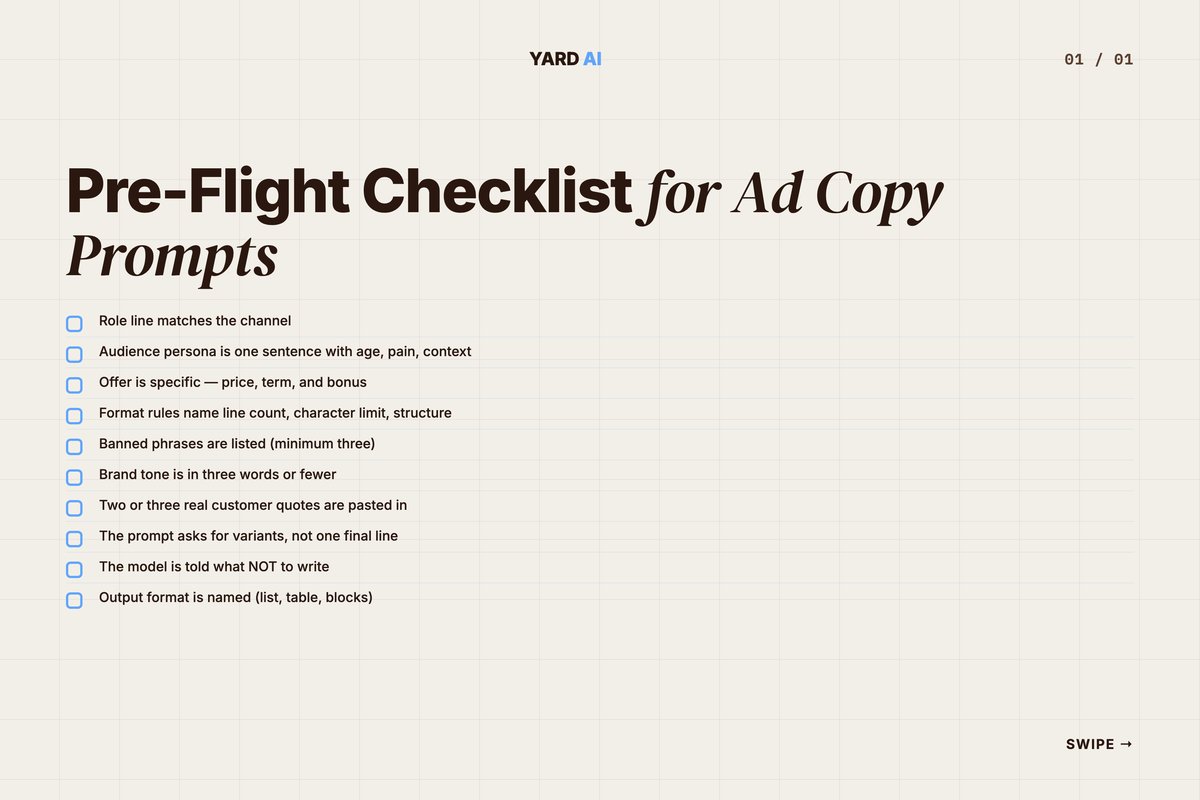
- Role line is in the prompt and matches the channel.
- Audience persona is one sentence with age, pain, and context.
- Offer is specific. Price, term, bonus, all listed.
- Format rules name the line count, character limit, and output structure.
- Banned phrases are listed, at least three of them.
- Brand tone is in three words or fewer.
- Two or three real customer quotes are pasted in.
- The prompt asks for variants, not one final line.
- The model is told what NOT to write, not just what to write.
- Output format is named (numbered list, table, blocks).
- One or two short examples of "good" are included if voice is tricky.
- A negative example of "bad" is included if the brand has a banned voice.
If even one is missing, the output will drift. The fix takes 90 seconds. The lift is real.
We keep this checklist pinned in every paid team workspace. New writers run it once. By week two, they run it from memory. By month two, the prompt library is doing most of the work.
There is one more habit worth building. Save every winning prompt back to a shared file. Tag it by channel and goal. Over six months, a team will build a library of 40 to 60 prompts. New campaigns inherit from the library. Speed compounds.
We also rotate prompts every quarter. Audiences shift. Friction points change. Competitors move. A prompt that won in Q1 may not win in Q3. Set a calendar reminder to audit the library. Kill the ones that lost their hit rate. Promote the ones that climbed.
Treat the prompt library as a creative asset, not a doc. It is the engine of your test velocity. Version it like code. Comment on what you changed. Note the campaign and the result. The next writer onboards in a day, not a month.
Two more habits round out the checklist. Always read the output aloud before you copy it into the ad platform. Your ear catches awkward cadence that your eye skims past. A line that trips you up will trip up the reader. Cut it, swap a word, run it again.
The second habit is to A/B test the prompt itself, not just the output. Run the same brief through two variants of the prompt. Ship the top six from each. See which prompt seeded more winners. Promote that prompt. Retire the loser. Over a quarter, your library shifts toward what actually performs, not what feels good in the doc.
How YARD Approaches AI Ad Copy
We build ad copy systems for D2C and B2B brands. The mix is paid social, search, and retargeting.
Our default stack uses Claude for voice-led drafts. We pair it with GPT for bulk variant generation when an account needs 200 RSA headlines in a sprint. Gemini reads live performance data and rewrites underperforming lines.
Prompts live in shared workspaces. Every campaign has a brand-voice file, a banned-phrases file, and a top-objection file. New prompts inherit from those. New writers can ship inside a week.
The point is not that AI replaces copywriters. The point is that AI removes the slow drafting layer. Copywriters then do the work that compounds. Strategy. Voice. Offer architecture. Hook bets.
We are an AI-first growth marketing agency. Performance marketing, LLM SEO, AI creatives, and AI funnels for D2C and B2B brands. The prompt library is one piece of a broader stack. The same logic applies to landing pages, email, and creative briefs.
If you run paid and want a faster draft layer without losing voice, that is the system we ship. Get in touch and we will walk through what an AI-first ad copy stack looks like for your account.
The accounts that benefit most are the ones running a high volume of ad sets each week. The volume creates a feedback loop that smaller accounts cannot match. Each week, the prompt library learns from the prior week's winners. Over a quarter, teams using this workflow tend to ship copy that meaningfully beats their pre-AI baseline.
We also keep humans in the loop for every campaign. A growth lead picks the final set. A copywriter polishes the lines that need a tweak. A media buyer runs the live test. AI sits in the draft layer, the variant layer, and the rewrite layer. It does not push the spend button. That stays with the team.
Conclusion
Prompt engineering for ad copy is a habit, not a hack.
The brands that ship more variants, test faster, and learn more per week will win the next two paid quarters. The brands that paste one-line prompts and blame the model will not.
Build the prompt library once. Run it weekly. Test in tens, not in ones.
Start with the RAOFT framework. Add real customer language. Force variety. Kill the dead lines fast. The good ones will surface in pass two or three, every time.
That is the whole playbook. The rest is reps.
Want a hand setting it up? Get in touch and we will share the prompt files we use across paid social and search.
One last reminder. The prompts in this guide are starting points. Your account has its own audience, offer, and history. The library only really earns its keep when you fork the templates, paste in your own customer voice, and run them weekly. The brands that treat prompts as a one-off freebie miss the compounding gain. The brands that treat them as a working asset get faster every quarter.
Start small. Pick one campaign. Pick one prompt. Run it twice this week. Watch what happens to your variant volume. Then add a second. Then a third. Inside a month, you have a working library and a faster paid stack. That is how this rolls out for every team we have shipped it with.
FAQ
Q: What is prompt engineering for ad copy?
A: It is the craft of writing AI prompts that ship usable ad lines on the first or second try. It sets role, audience, offer, format, and tone. The model then writes for a real campaign, not a blog post.
Q: Which AI model is best for ad copy in 2026?
A: Claude tends to win on voice-led copy and long-form variants. GPT is faster for bulk asset generation. Gemini reads briefs and live data well. Most paid teams use two side by side.
Q: How long should an ad copy prompt be?
A: About 150 to 400 words. Shorter skips audience, offer, or format rules. Longer slows the model without lifting quality. Aim for clear role, audience, offer, format, and a short example.
Q: Can I write Google RSA assets with a prompt?
A: Yes. Set the model to write 15 headlines at 30 characters each. Add 4 descriptions at 90 characters each. Tell it to vary the angle on every line. Then paste into Google Ads and rate ad strength.
Q: Will AI ad copy hurt my brand voice?
A: Only if you skip the brief. A brand voice doc fixes most issues. Add five sample lines, three banned phrases, and a short tone line. The output will sound like you.
Q: How do I stop AI ad copy from sounding generic?
A: Force the model to name the friction, not the feature. Paste real customer language from reviews and chat logs. Ask for ten variants, not one. The good ones surface in pass two or three.
Q: Do I still need a human copywriter?
A: Yes. The model drafts. The human picks, edits, and ships. Final calls on hook, offer, and proof still sit with a copywriter or a growth lead.
Insights from Our Experts
Explore our latest articles on digital marketing strategies.