
Meta did not update the algorithm. Meta replaced it.
In late 2024, the old ad system retired. Andromeda took its place. It runs on NVIDIA Grace Hopper hardware. By 2026, every Meta ad dollar runs through it.
The accounts that win this year are built for Andromeda. Not for 2022 Facebook. The shift is that big.
Old habits are now expensive. New habits are cheap to learn. This guide gives you the new habits.
Quick Facts: Meta Andromeda
- Andromeda scores 10,000x more ad-creative-audience combos than the old model.
- It runs on NVIDIA Grace Hopper GPUs inside Meta's data centres.
- It scans tens of millions of active ads per user, then shortlists ~1,000.
- Broad targeting now beats lookalikes by 49% ROAS in Lebesgue data.
- REP Fitness UAE hit 2x revenue with Andromeda-optimised campaigns. (Source: Meta Engineering, 2024 — engineering.fb.com).
The Engine in One Paragraph

Andromeda is a deep neural retrieval engine. It reads your creative pixel by pixel. It parses your headline by meaning, not keywords.
Then it ranks ads against a user model. Tens of millions of ads enter the funnel. About 1,000 survive. Your ad either makes that shortlist or it does not run.
According to Meta Engineering, the model is 10,000x more complex than the old one. That is not a tweak. That is a new system.
The old engine guessed at user intent. The new engine models it. It uses signals from billions of past ad views.
Andromeda runs on Grace Hopper hardware. That hardware was built for AI. That is the point.
Q: Is Andromeda the same as Advantage+?
A: No. Advantage+ is the campaign type. Andromeda is the engine that runs it. Advantage+ campaigns get the most signal flow under Andromeda. That is why Meta pushes them so hard.
What Actually Changed for Marketers

Five real shifts since Andromeda went live. Each one breaks an old habit. Each one rewards a new one.
1. The retrieval gate is creative-first. Audience used to be the filter. Now creative is. Your image, hook, and video decide if you make the 1,000-ad shortlist. The audience targeting is downstream of the creative read.
2. Narrow interest stacks are dead. Andromeda already knows the user. A 47-interest stack adds noise. Lebesgue data shows broad beats lookalikes by 49% ROAS. (Source: Search Engine Land, 2026 — searchengineland.com)
3. Creative diversity is mandatory. Aim for 20 to 30 different creatives per ad set. UGC, studio, founder, demo, catalog. Two colour swaps do not count. The system needs real format variety.
4. Campaign structures are simpler. One to three campaigns now beat dozens of ad sets. Fragmented spend dilutes the learning signal. Consolidation is the new edge.
5. The learning window collapsed. Peak hits week one. Plateau follows. The 14-day rule is dead. Plan for a 7-day learning window.
Q: How does this change my targeting strategy?
A: Stop stacking interests. Use age, gender, country. Let the creative do the targeting. Andromeda reads it directly. It matches to users by what the ad shows and says.
The New Account Setup
Three changes to make this week. Audit first. Then rebuild. Then ship creative.
Step 1 — Consolidate campaigns. Count your active campaigns. Count your ad sets. More than three campaigns? Cut. More than six ad sets per campaign? Cut.
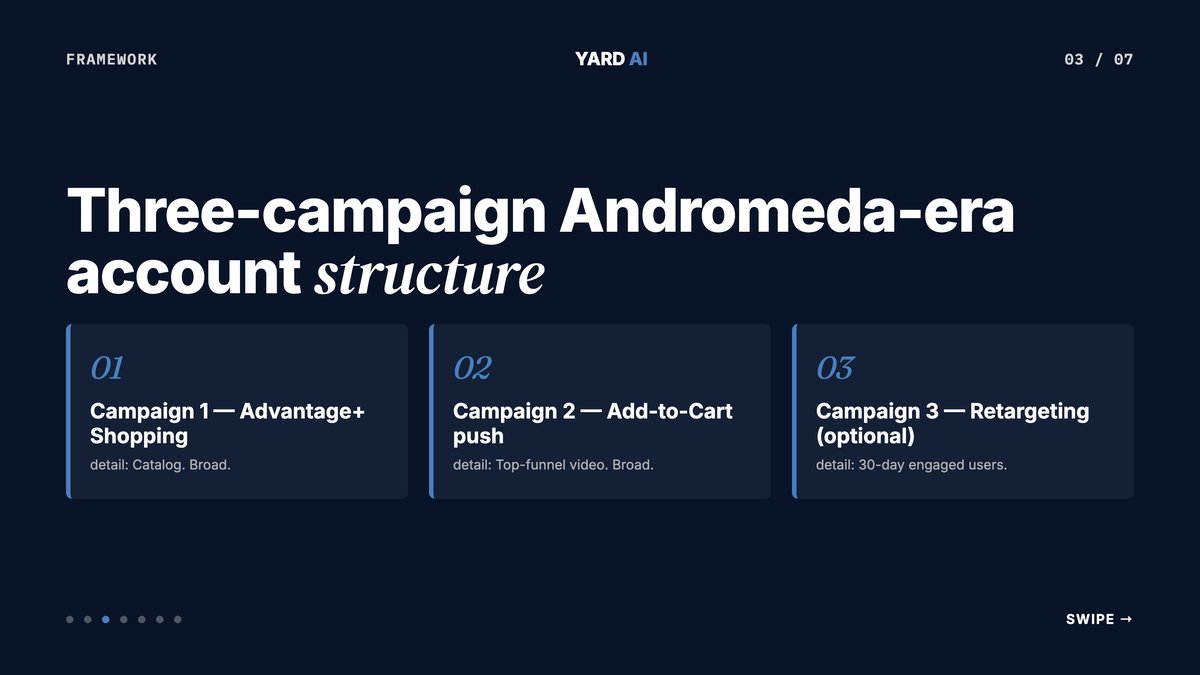
A clean Andromeda-era e-com structure looks like this:
- Campaign 1 — Advantage+ Shopping. Catalog. Broad targeting.
- Campaign 2 — Add-to-Cart push. Top-funnel video. Broad targeting.
- Campaign 3 — Retargeting (optional). 30-day engaged users.
That is it. Three campaigns. a footwear brand UAE ran a version of this for 12+ months. The result: 4x revenue and CAC down 52%. We call it the Dual-Funnel Meta Architecture.
The Dual-Funnel splits work in two halves. Campaign 1 handles add-to-cart. Campaign 2 handles purchase. Both run broad. Both feed Andromeda the same way.
Step 2 — Switch to broad. Drop interests. Drop lookalikes as the main lever. Use age plus gender plus country. For local brands, swap country for city.
For a footwear brand UAE, we ran broad plus condition-based creative angles. Flat feet. Arch support. Plantar fasciitis. Revenue went 7.4x in 6 months. CAC fell 50%. The targeting was broad. The creative carried the angle.
That is the lesson. Broad does not mean generic. Broad targeting plus sharp creative beats narrow targeting plus generic creative.
Step 3 — Build a creative library. Twenty to thirty creatives per ad set is the floor. Build a system, not a one-shot.
Here is the YARD weekly cadence we run for clients.
- Five UGC reels per week.
- Three studio statics per week.
- Two founder or testimonial videos per week.
- One or two catalog refreshes per week.
That ships about 30 creatives every two weeks. Sustained four weeks, you have a 50-asset library. That is what Andromeda needs to optimise against.
The cadence matters more than the polish. A week without new creatives is a week of decay. The system stops learning. CAC drifts up. Frequency climbs. Save rate falls.
Pick a shoot day. Pick an edit day. Pick a launch day. Three days a week, three roles. That is the operating model.
Brief writers also need a system. Each brief should call out hook, angle, format, and CTA. One page. No more. Anything longer slows the team.
Hooks matter most. The first 1.5 seconds of a reel decide its fate. Test hooks before bodies. Two hooks per body cut shoot cost in half.
Q: Should I switch from manual to Advantage+?
A: Yes if you have 30+ weekly conversions and a clean catalog. Below that, the model lacks signal. Start with one Advantage+ Shopping campaign. Layer manual only when there's a real reason.
What Andromeda Reads in Your Creative
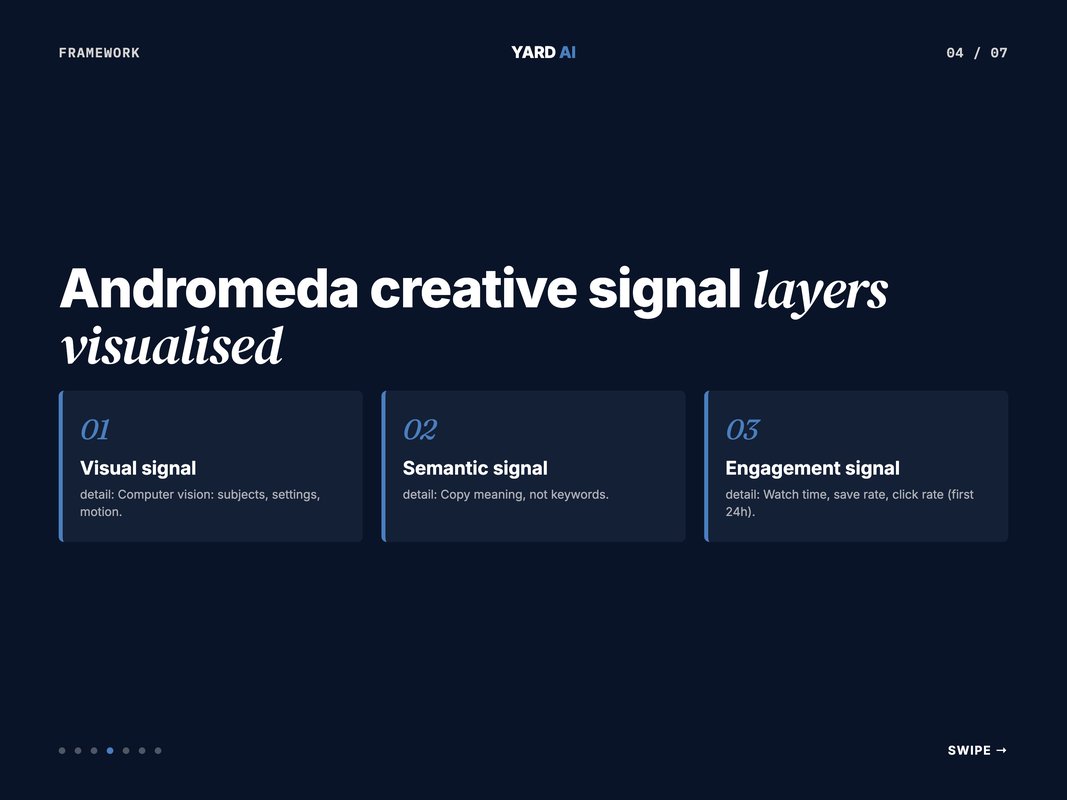
The retrieval engine reads three signals. All three matter. None can be skipped.
Visual signal — what is in the frame. Computer vision tags subjects, settings, products, faces, motion. A barefoot shoe with a bare foot in frame matches a different user pool than the same shoe on a hiker. Both can win. Both reach different buyers.
The model also reads colour, light, and pace. A bright UGC clip lands different than a moody studio shot. Neither is better. Both teach the engine something new.
Semantic signal — what the copy means. Andromeda parses meaning, not keywords. "Built for healing arches" reaches the same pool as "Designed for flat feet." Zero shared keywords. Same intent.
This kills old SEO-style copy hacks. Stuffing keywords helps nothing. Clear writing helps a lot. The model rewards clarity.
Engagement signal — early reactions. The first 24 hours are the heaviest learning window. Watch time, save rate, click rate. Andromeda extrapolates which user clusters resonate. Then it doubles down on the winners.
This is why volume matters. The engine needs many distinct experiments. Few creatives means few experiments. Few experiments means weak learning.
The Homes by Hosi case proves the volume point. We shipped multilingual UGC plus studio creative across English, German, French, and Russian. Video completion hit 72% versus a 15% platform average. Conversion rate hit 2% versus a 0.5% norm.
Two listings drove the headline number. Palmiera Villa and Palm Jebel Ali. Each sold for 65M AED off a starting ad spend in the millions. Total: 130M AED in sales on 200,000 AED of ad spend. That is a 650x ROAS in four months.
That campaign ran on Instagram. The creative variety did the work. Broad targeting handed the engine a clean signal. The model picked the right buyers.
What Stops Working Under Andromeda
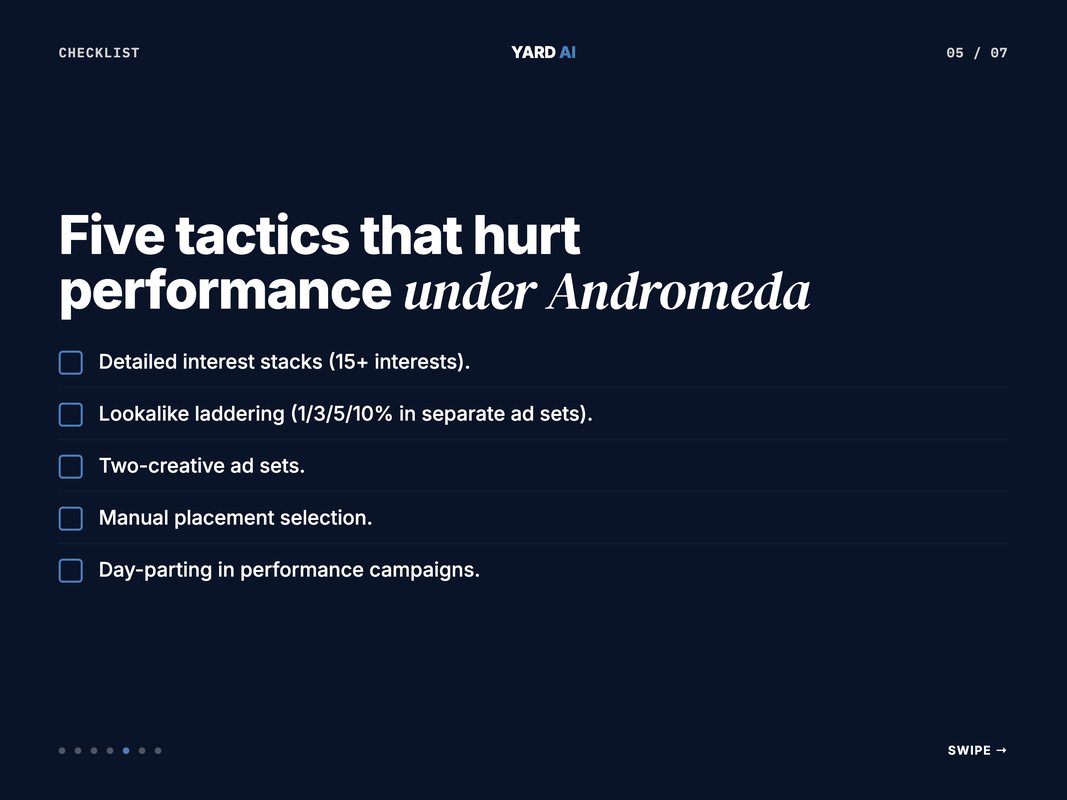
Five old tactics that now actively hurt. Cut them this week. Replace them with the new defaults.
1. Detailed interest stacks. Fifteen interests on "Health & Wellness" used to narrow the audience. Now it confuses the signal. Drop to broad.
2. Lookalike laddering. Splitting 1%, 3%, 5%, 10% across separate ad sets fragments learning. Andromeda already reconstructs these clusters. Use one broad ad set instead.
3. Two-creative ad sets. With only two creatives, budget burns on the dominant one. The diversity signal stays near zero. Aim for 20+.
4. Manual placement selection. Forcing feed-only or stories-only blocks the optimiser. Run Advantage+ Placements unless you have a real brand-safety reason.
5. Day-parting in performance. Andromeda's bid pacing already reads time-of-day patterns. Manual day-parting subtracts from the surface. Trust the model.
Q: Do lookalikes still have a place?
A: Mostly no. Reserve them for niche brands where broad genuinely is not the buyer. For most D2C and B2C accounts, broad plus creative diversity beats targeting every time.
The CAPI and Catalog Layer
Signal is the new lever. Andromeda is signal-hungry. CAPI is the feeder.
A study by Meta found that brands sending CAPI events alongside Pixel saw a clear lift in attributed conversions. Reporting accuracy also improved. (Source: Meta for Business, 2025 — business.facebook.com)
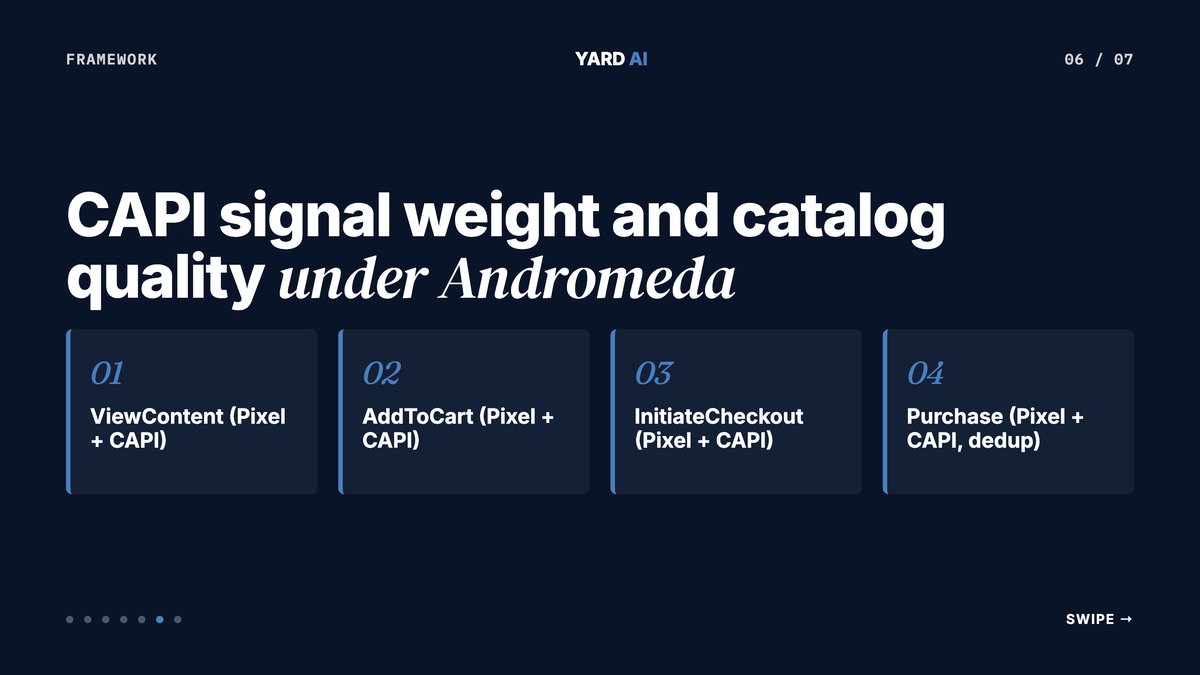
Send these events at minimum:
- ViewContent (Pixel + CAPI).
- AddToCart (Pixel + CAPI).
- InitiateCheckout (Pixel + CAPI).
- Purchase (Pixel + CAPI, deduplicated).
Match quality matters too. Send hashed email, phone, name, city. Aim for an Event Match Quality score of 7 or higher. Below 5, the model discounts your signal.
Then there is the catalog. Research shows feed quality now affects bidding. The economics mirror Google Merchant Center logic. Bad feeds bid at a disadvantage. Clean feeds get more delivery.
Fix titles. Fix images. Fix availability flags. Run nightly feed checks. Set GTIN and brand fields where you can.
A clean catalog is not a nice-to-have. It is a delivery lever. Two brands with the same creative can see different ROAS purely on feed quality.
Naming conventions help too. Use a simple test code in every ad name. For example: BR-UGC-FOUNDER-V1-2026-04. That tells you brand, format, angle, version, and date. You can pull reports faster. Your creative team ships faster.
Test new audiences with one creative. Test new creatives in one audience. Never change both at once. That is the testing rule.
A note on attribution windows. Set 7-day click and 1-day view as your default. The 28-day window flatters reports. It hides poor short-term performance. Stick with 7-day click for clarity.
Server-side events also help with iOS attribution. CAPI fills the gap left by ATT prompts. Without CAPI, expect 20% to 40% under-reporting. With CAPI live and clean, expect close to platform parity.
Q: What CAPI Event Match Quality score should I target?
A: Seven or higher in Events Manager. Below five, Andromeda discounts the signal. Above seven, it weights the data the same as in-platform behaviour. Hash and send first-party data on every event.
How to Read Andromeda's Performance Signals
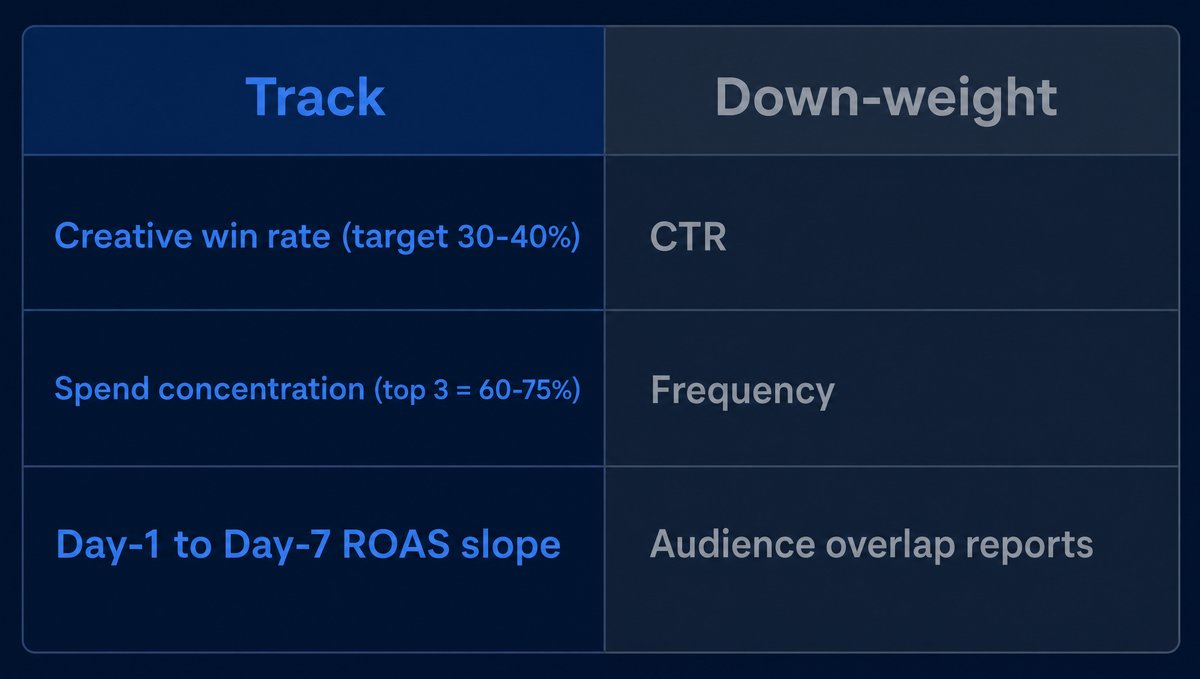
Three signals to track. Three to ignore. Old dashboards mislead.
Track creative win rate. What percent of your creatives sustain ROAS above target after day seven. Healthy is 30 to 40 percent. Below 20%, your hooks are weak.
Track spend concentration. How much budget went to the top three creatives. Healthy is 60 to 75 percent. Higher means too few winners. Lower means none have broken out yet.
Track the day-1-to-day-7 ROAS slope. Peak is week one. If your slope keeps rising into week two, the buyer cycle is long. Or the creative is unusual. Either way, dig in.
Down-weight CTR. It is less predictive now. Down-weight frequency. Andromeda manages it across creative variety. Down-weight audience overlap reports. They were built for the old narrow-audience model.
Industry analysts at Adweek confirm the same shift. Engagement-side metrics now matter less than creative-side metrics in Meta's stack. (Source: Adweek, 2025 — adweek.com)
Build a weekly creative review. Pull each new ad's day-7 ROAS. Sort. Cut the bottom third. Re-cut the top third. Ship two new variants per top performer. That is the loop.
The review takes 30 minutes. Do it on Monday. Brief the cuts on Tuesday. Shoot Wednesday. Edit Thursday. Launch Friday. That is one shippable week.
A second metric to watch is hook stop rate. It is the percent of viewers who watch past the first three seconds. Healthy is 30% or higher. Below 25%, the hook is the problem.
Also watch impressions per dollar. Under Andromeda, impressions per dollar should fall as your creative diversity rises. The model finds cheaper inventory when you give it more options to test.
Q: What is a healthy creative win rate under Andromeda?
A: Thirty to forty percent. If you ship 30 creatives a week and 10 sustain ROAS above target after day seven, you are on track. Below 20%, your hook quality is the issue, not the engine.
How YARD Runs Meta Under Andromeda
We run Meta across 40+ active brand accounts. The playbook is consistent. The audit is fast.
Every account audit starts with four questions. Campaign count. Audience width. Creative volume. Conversion signal quality. Most accounts fail on at least two. Usually creative volume and signal.
Then we run the consolidated structure. One to three campaigns. Broad targeting. A 20-to-30 weekly creative cadence. Advantage+ Placements on. Enhanced Conversions live. CAPI deduplicated.
REP Fitness UAE is the cleanest Andromeda example we have. Premium fitness e-com. Brands include 247, LNDR, and Nike Strength. We ran mid-funnel video for awareness. Then bottom-funnel Andromeda-optimised conversion campaigns. The result: 2x revenue and CAC down 44% in three months.
That is the same playbook applied with discipline. No magic. No new tools. Andromeda did the heavy lifting once we fed it volume, broad audiences, and clean signal.
If your Meta numbers are flat despite steady spend, the issue is almost always structure. Pre-Andromeda structure on a post-Andromeda engine. The fix is rarely the bid strategy. It is the inputs.
We can audit your Meta account against the Andromeda playbook in 48 hours. We surface the structural changes — usually three to five — that unlock performance. yardagency.ai has the form. No long sales cycle. No 90-day discovery.
The audit is free. The fix is simple. The results show up in week two. That is the whole pitch.
The Bottom Line
Andromeda is not an update. It is a new ad system.
Creative-first. Broad-first. Consolidated. Fast-learning. Accounts that adapt early outperform. Accounts running 47-interest stacks and 12-ad-set funnels watch CAC drift up.
This week: count your campaigns. Count creatives per ad set. Pick one campaign. Consolidate. Go broad. Ship 20+ creatives in the next two weeks. Measure on day seven.
Then run it again next week. And the week after. The cadence is the moat. The model rewards the team that ships.
One last note. Andromeda will keep changing. Meta ships updates monthly. Some shift the bid logic. Some shift the creative scoring. Track Meta's release notes. Test fast. Cut what fails.
The brands that stay nimble win. The brands that lock in a 2022 playbook keep paying for it. Pick a side this quarter.
The new playbook is short. Ship volume. Go broad. Send clean signal. Trust the model. Read day-7 ROAS. Cut the losers. Re-cut the winners. Then ship again.
Hold to that loop for 30 days. Most accounts break even by week three. Most pull ahead by week six. The math is simple once the inputs are clean.
That is the playbook. Run it.
FAQ
Q: What is Meta Andromeda?
A: Andromeda is Meta's new ad delivery engine. It runs on NVIDIA Grace Hopper hardware. It replaced the old auction system in late 2024. Meta says it scores 10,000x more ad combinations than the old model.
Q: How does Andromeda change targeting?
A: Narrow interest stacks are mostly dead. Andromeda reads the creative itself. It matches ads to users by what the ad shows and says. Broad targeting now beats lookalikes by a wide margin in third-party tests.
Q: How many creatives do I need per ad set?
A: Aim for 20 to 30 truly different creatives. Mix UGC, studio, founder, and catalog. Two colour swaps of one hero shot do not count. Andromeda rewards real diversity.
Q: Should I switch from manual to Advantage+?
A: Yes if you have 30+ weekly conversions and a clean catalog. Below that, the model lacks signal. Start with one Advantage+ Shopping campaign. Layer manual only when you have a clear reason.
Q: Do lookalikes still work?
A: Mostly no. Broad beats lookalikes by 49% on ROAS in Lebesgue data. Reserve lookalikes for niche brands. For most D2C, broad plus creative diversity wins.
Q: How fast does Andromeda learn?
A: Peak hits in week one. Plateau follows. Plan for a 7-day window, not 14. If a campaign has not stabilised by day 10, the issue is creative or signal, not the algorithm.
Q: What kills performance under Andromeda?
A: Low creative volume. Narrow audiences. Fragmented campaigns. Weak CAPI signal. Fix in that order. Each step compounds the next.
Insights from Our Experts
Explore our latest articles on digital marketing strategies.