

Most SEO audit checklists in 2026 are noise.
They list hundreds of line items. They mix critical fixes with cosmetic ones. They miss the AI Overview layer that now drives more than half of all Google searches.
This SEO audit checklist 2026 is different. It runs on a five-pillar framework. It covers 135 checks in full. But the body below zooms into the ten that matter most. The ones that move rankings, citations, and revenue inside a quarter.
You will leave with a clear order of operations. A copy-paste list of the most critical checks. And a way to spot what your audit is missing before AI search skips you for good.
Why The Old SEO Audit Is Broken
SEO audits used to end at Googlebot.
That stopped being enough. More than half of Google searches now show an AI Overview. 58% of searches end with no click at all (Source: ALM Corp, 2026. Complete SEO Checklist 2026). Your page can rank first and still lose the visit.
ChatGPT alone has 800 to 900 million weekly users (Source: TechCrunch, 2025 — Altman says ChatGPT has hit 800M weekly users). Perplexity and Claude pull citations from a different signal stack. Most AI crawlers do not run JavaScript.
That breaks the old audit. A site that passes every Googlebot check can still be invisible to AI search.
The fix is structural. You need a single audit that scores Google and LLM readiness in one pass. That is the heart of any SEO audit checklist 2026 worth running.
The old audit was a pass-fail report. The new audit is a sprint plan. It names what breaks, who owns the fix, and how long it takes. That shift in format matters as much as the new check list.
We have run this across many sites over the past year. Every one had at least one P0 issue hidden behind a healthy Search Console graph. The audit is the moment those issues surface.
Q: Why has the SEO audit changed in 2026?
A: Google now answers most queries with an AI Overview. AI engines like ChatGPT, Perplexity, and Claude pull from a different signal mix. A 2026 audit must score Google and LLM readiness together, not in two passes.
- More than 50% of Google searches now show an AI Overview, and 58% of searches end with zero clicks —
- Core Web Vitals targets stay LCP under 2.5s, INP under 200ms, CLS under 0.1, with INP replacing FID in March 2024 —
- Semrush Site Audit now scans for over 140 issues and adds a top-line AI Search Health score —
The 5-Pillar SEO Audit Framework
A real audit needs structure. Otherwise it drifts.
We group the 135 checks into five pillars. Each pillar maps to a job. Each job has an owner. Each owner has tools.
The framework is simple. It is also stable. Most audit tools fall short of one or two pillars. The pillar model fills those gaps.
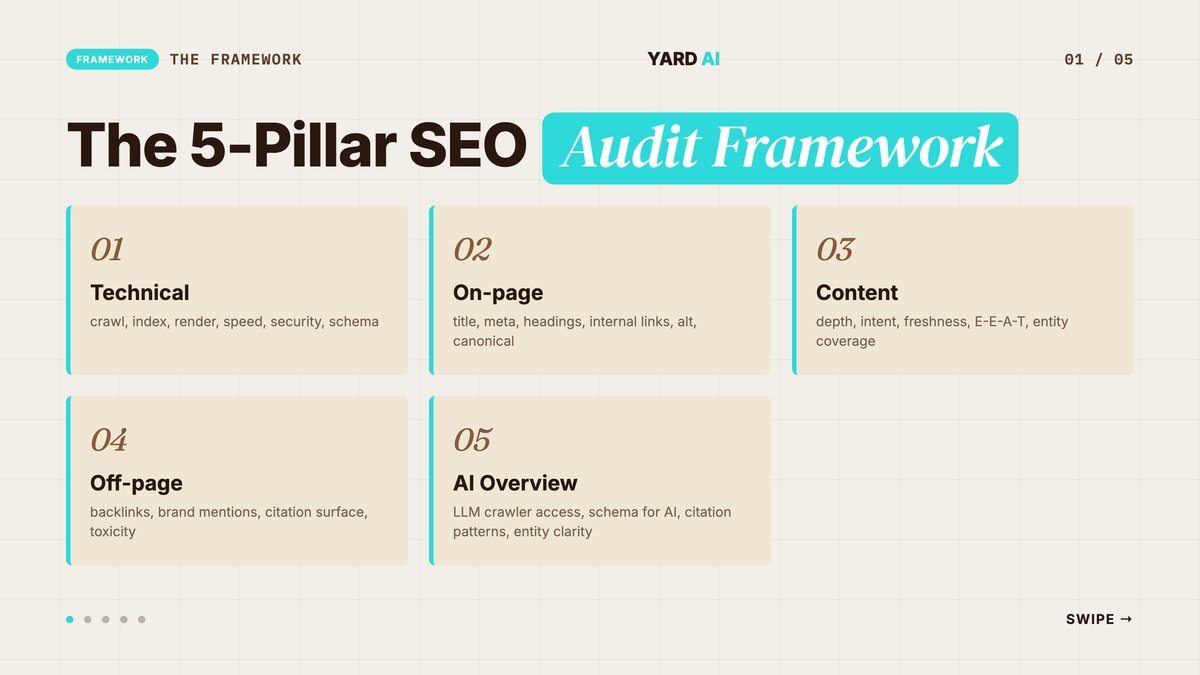
Here is the model in full:
Run them in that order. Technical issues block everything downstream. AI Overview readiness depends on the first four being clean.
Each pillar maps to a tool stack you already own. Search Console and PageSpeed Insights cover most of pillar one. A crawler like Screaming Frog or Sitebulb covers pillars one and two. Ahrefs or Semrush handle pillar four. Pillar five needs a manual query loop across Google, ChatGPT, and Perplexity.
We keep the 135 checks in a single shared spreadsheet. Each row has a pillar tag, a severity score, a fix-time estimate, and an owner. The point is not the list. It is the shared view of what gets done first.
Q: Can I skip a pillar?
A: No. Skipping technical breaks the rest. Skipping AI Overview readiness leaves visibility on the table. Each pillar covers a unique signal class that the others do not.
Pillar 1: Technical Checks That Still Matter Most
Technical SEO is the engine room. If Googlebot or GPTBot cannot reach a page, nothing else counts.
These checks unlock more ranking than any other category. Run them first. Re-run them after every major release.
- Crawl budget is healthy. No 5xx spikes in Search Console.
- All key URLs return 200. No 404, 410, or chained redirects.
- LCP under 2.5s, INP under 200ms, CLS under 0.1 on mobile —
- HTTPS valid sitewide. No mixed content warnings.
- XML sitemap submitted. Robots.txt does not block key paths.
- Canonical tags point to self where unique. No conflicting signals.
- hreflang is correct for multi-region sites.
- JavaScript renders critical content server-side or via SSR.
- Schema validates. Article, FAQ, and Product types as relevant.
- Log files show no crawl traps or infinite parameter loops.
INP replaced FID in March 2024 and stays the responsiveness metric in 2026 (Source: DebugBear, 2026 — Technical SEO Checklist 2026). A page that ignores INP loses on mobile.
JavaScript is the silent killer. Most AI crawlers do not execute it. If your hero copy, headings, or product specs need JS to render, AI search will not see them.
The fix is server-side rendering or static prerendering. Frameworks like Next.js and Nuxt make this routine. Older single-page apps need a render proxy or a hybrid build. Either way, the audit needs to flag JS-only content before AI search penalises it.
Crawl traps still bite. Faceted navigation on ecommerce sites spawns millions of parameter URLs. Each one wastes crawl budget. A log file scan catches the worst offenders inside an hour.
Schema is the second silent killer. Most CMS templates ship with stale Article schema. AI Overviews favour pages with rich, validated schema. Run every key URL through the Schema Markup Validator before you sign off.
Q: What is the single biggest technical SEO miss in 2026?
A: JavaScript-only rendering. Googlebot can handle it. Most AI bots cannot. If your key content needs JS, AI search skips you, even when Google ranks you.
Pillar 2: On-Page Audit Without The Padding
On-page is the easy pillar. It is also the most ignored.
Titles drift over time. Meta descriptions get auto-generated. Headings break their own hierarchy. Internal links rot.
The fix is dull but high-impact. A single afternoon of on-page cleanup often beats a month of link building on a mid-size site.
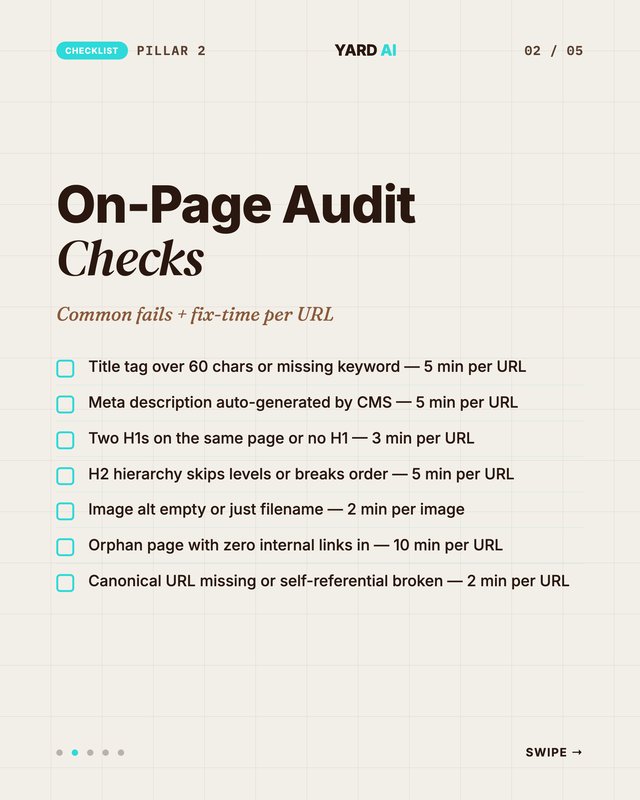
Run the matrix below across your top 50 URLs.
- Title tag length and primary keyword. Common fail: over 60 chars, no keyword
- Meta description length and intent. Common fail: auto-generated by CMS. Fix time: 5 min per URL.
- H1 present and unique. Common fail: two H1s or no H1. Fix time: 3 min per URL.
- H2 hierarchy clean. Common fail: skipped levels. Fix time: 5 min per URL.
- Image alt text descriptive. Common fail: empty or filename. Fix time: 2 min per image.
- Internal links to and from page. Common fail: orphan page. Fix time: 10 min per URL.
- Canonical URL correct. Common fail: self-referential missing. Fix time: 2 min per URL.
That matrix covers most on-page wins. It also gives you a sane time estimate so you can plan the work.
Most CMS platforms break two or three rows on every release. We rebuild the table after every site push and treat it as a living document.
The biggest leak is image alt text. Visual search and AI Overviews both lean on it. Empty alt fields lose you ground every week they stay broken.
Q: Do meta descriptions still matter for SEO?
A: Not for ranking directly. They matter for click-through rate, AI Overview citation framing, and brand voice. A good meta description still pays for itself in CTR.
Pillar 3: Content Depth, Intent, And E-E-A-T
Content is where most audits go soft.
It is easy to say "improve quality." It is harder to spot what AI search will actually cite. The 2026 fix is structural, not stylistic.
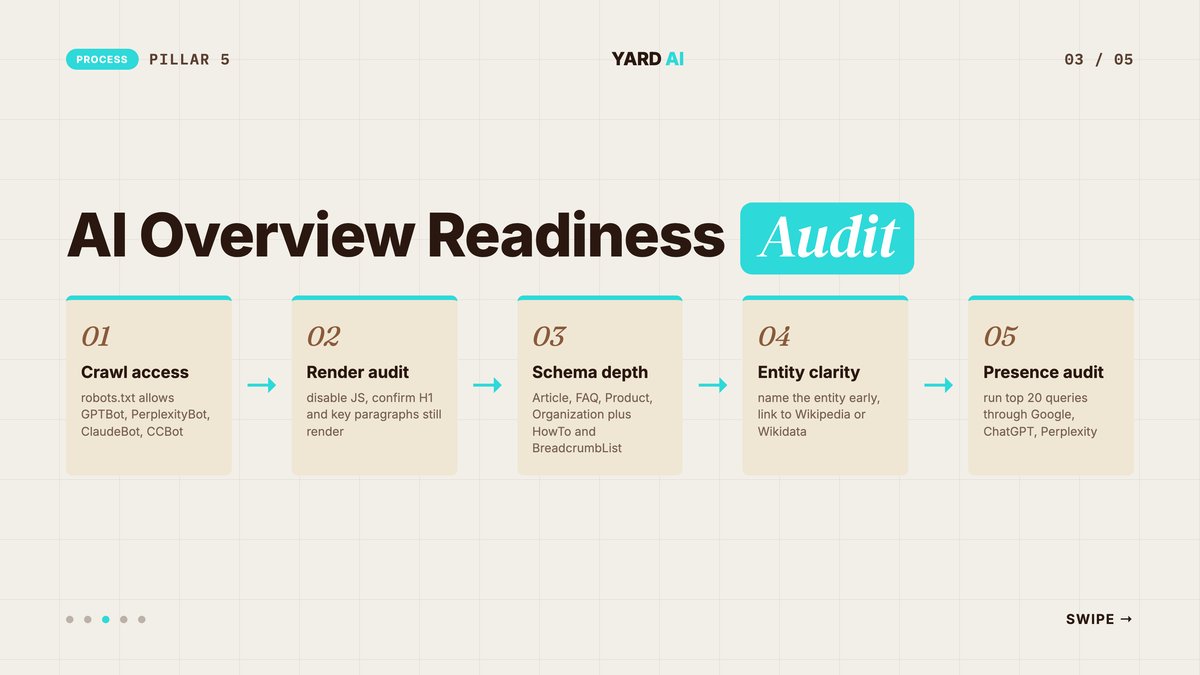
AI models do not rank pages. They extract answers. If your content is not structured for extraction, AI Overviews skip it.
- Each page has a clear primary intent. One job per URL.
- H2s answer who, what, why, and how questions.
- Definitions appear early. AI models pull these as answer snippets.
- At least three live-linked citations per long-form page.
- E-E-A-T signals visible. Author bio, credentials, sources.
- Entity coverage matches search intent. Use the top SERP results as a guide.
- Freshness dates updated. Old timestamps tank AI citation rates.
If a page lacks E-E-A-T or authoritative citations, AI search rarely lists it (Source: Slate, 2026 — Ultimate AI SEO Checklist).
Old content needs the same treatment. Run a content refresh cycle every six months. Update stats. Add new sources. Rewrite intros. Re-publish.
Author bios carry more weight than they used to. AI models pull author entity data when they cite a page. A bare byline tanks citation rate. A linked bio with credentials, a photo, and prior work boosts it.
Definitions earn citations. AI Overviews prefer pages that name the entity in plain English in the first paragraph. We rewrite intros on every audit to make the definition explicit and front-load it.
Entity coverage is the new keyword density. Pull the top three SERP pages for your target query. Note every named entity they cover. Make sure your page touches each one, even briefly. Gaps in entity coverage are the most common reason a page ranks but does not get cited.
Q: How do I know if my content is AI-ready?
A: Open your page in plain text. If the opening paragraphs give a clean answer to the H1 question, AI models will likely cite it. If the answer is buried below an intro, they will not.
Pillar 4: Off-Page And Backlink Health
Backlinks still matter. Just not in the way they did five years ago.
In 2026 the signal mix shifted. Brand mentions, citation surface across LLMs, and unlinked references all count. Toxic links still drag rankings down.
A modern off-page audit covers four things:
That fourth check is new. It is also the one most audits skip. It is the bridge between off-page and AI Overview readiness.
Use Ahrefs or Semrush for backlink toxicity. Pair with Google Search Console for link context (Source: SEOmator, 2026 — Semrush vs Ahrefs).
Q: How many backlinks does a page need to rank in 2026?
A: The right answer is "enough to beat the top three competitors." Numbers vary by niche. The signal that matters more is authority diversity, not raw count.
Pillar 5: AI Overview Readiness, The New Pillar
This is the pillar most audits still miss.
AI Overviews and LLM citations now drive a chunk of organic visibility that ten blue links no longer own. The signals are different. The audit needs new checks.
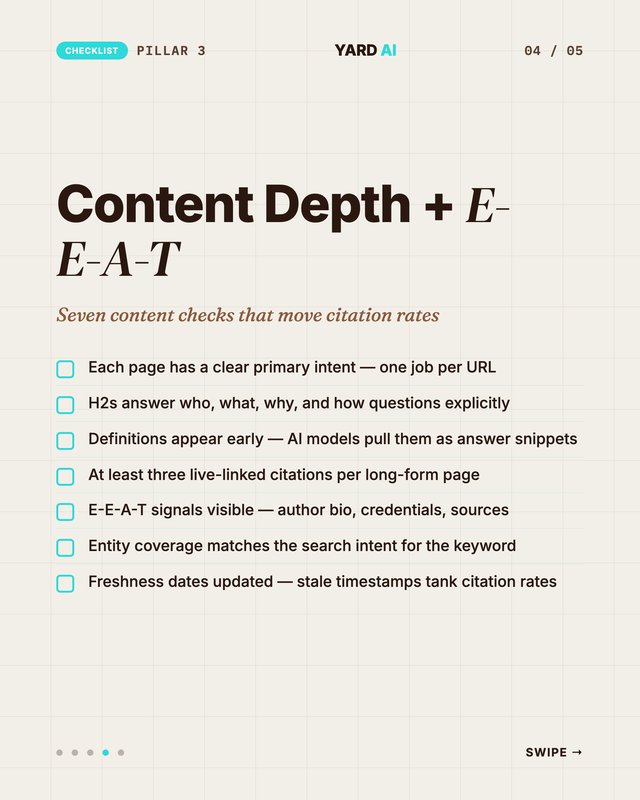
Here is the workflow we run on every audit:
That last step turns the audit into a feedback loop. You stop guessing whether AI search sees you.
Schema for AI is a different beast. Article and FAQ schema are table stakes. Add HowTo schema where you teach a process. Add Product schema with full reviews and ratings on commerce pages. Add Organization schema with sameAs links to social profiles and Wikidata. AI models lean on these signals to confirm entity identity.
Citation surface is the metric to track. Pick your top 20 commercial queries. Run them through Google AI Overview, ChatGPT, and Perplexity once a month. Log every time you appear. Note the citation context. Use that log to plan next quarter's content sprint.
The audit closes when you ship the fix. Most teams stop at the report. The audit only pays back when the P0 and P1 items hit production inside the next two sprints.
Q: Does blocking AI bots help or hurt SEO?
A: It hurts visibility. If you block GPTBot or PerplexityBot, you lose AI citation. There are valid reasons to block them, but ranking is not one. Decide based on your business model, not your SEO instinct.
The Issue Severity Matrix
Not every audit finding is equal.
A 5xx crawl error blocks the page. A missing alt tag annoys a screen reader. The audit needs a way to rank what gets fixed first.
We use a three-tier severity matrix. It pairs with fix-time estimates so you can plan the sprint.
- 5xx server errors on key URLs. Severity: P0, fix today. Fix time: 1 to 4 hours.
- Robots.txt blocking key paths. Severity: P0, fix today. Fix time: 30 minutes.
- INP over 500ms on top landing pages (Google's "Poor" band). Severity: P1, fix this week. Fix time: 1 to 3 days —
- Missing schema on top 50 URLs. Severity: P1, fix this week. Fix time: 1 day.
- Orphan pages in top 100 by intent value. Severity: P1, fix this week. Fix time: 2 to 4 hours.
- Title tag drift across top 20 URLs. Severity: P2, fix this month. Fix time: 1 day.
- Backlink toxicity above 5% (Semrush flags 3-9% as Medium risk). Severity: P2, fix this month. Fix time: 2 to 3 days —
- Empty alt tags on long-tail pages. Severity: P3, fix this quarter. Fix time: rolling.
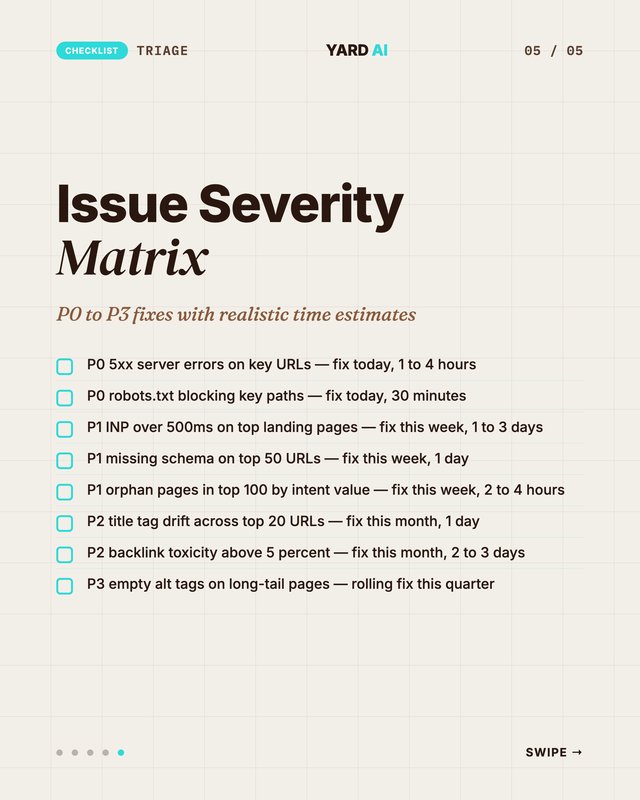
A clean matrix forces priority. It also gives your dev team something they can resource against.
Q: Can I run a 135-point SEO audit checklist 2026 myself, or do I need an agency?
A: You can run it yourself with the right stack. Search Console, PageSpeed Insights, Screaming Frog, and Ahrefs or Semrush cover most of the surface. Where most teams fall short is execution, not diagnosis.
How YARD Runs A 135-Point SEO Audit
We have run this framework across D2C, B2B, and hospitality brands.
YARD is an AI-first growth marketing agency. We run performance marketing, LLM SEO, AI creatives, and AI funnels for D2C and B2B brands. The site is yardagency.ai.
Our 135-point audit follows the five-pillar model above. It pairs Search Console and PageSpeed Insights with Screaming Frog and Ahrefs. It adds a custom AI Overview tracker that runs queries through Google, ChatGPT, Perplexity, and Claude.
We do not believe in bloated reports that no one reads. We deliver a P0 / P1 / P2 / P3 sprint plan with named owners and fix-time estimates. The point of the audit is the fix, not the report.
If you want a look at how the framework runs on a real site, our team can walk you through it. Same checklist. Your data. Your sprint.
[internal link: how-we-run-135-point-seo-audits]
Conclusion
A good SEO audit checklist 2026 does three things.
It catches what Google sees. It catches what AI search sees. It tells you what to fix first.
The 135-point version exists for completeness. The ten checks in this post cover most of the gain. Start with the five pillars. Run the severity matrix. Ship the P0 work this week.
The brands that win the next year are the ones that audit for AI Overview readiness, not just blue links. The audit cost is low. The visibility cost of skipping it is not.
Want this run on your site? Reach out and we will scope the pilot together.
FAQ
Q: What is an SEO audit in 2026? A: An SEO audit in 2026 is a structured review of your site across five pillars. Those pillars are technical health, on-page quality, content depth, off-page authority, and AI Overview readiness. A full audit catches issues that block Google and LLM crawlers from ranking or citing your pages.
Q: How often should I run an SEO audit? A: Run a full SEO audit every quarter. Run a lightweight technical scan every month. Run a fast crawlability check after every major site release. AI Overview citation is volatile, so monthly tracking matters more than it did last year.
Q: What are the most important SEO audit checks for 2026? A: Start with crawlability for both Googlebot and AI bots. Add indexation and Core Web Vitals including INP. Then layer in schema, internal linking, content depth, backlink health, and AI Overview presence. These checks unlock most gains.
Q: Do AI Overviews use the same SEO signals as Google search? A: Not exactly. AI Overviews lean harder on schema, entity clarity, and citation patterns. They also weigh E-E-A-T more than ten blue links do. A page can rank in classic SERPs and still be skipped by AI Overviews if structure is weak.
Q: What tools do I need to run a 135-point SEO audit? A: You need Google Search Console, PageSpeed Insights, and one deep crawler like Screaming Frog or Sitebulb. Add Ahrefs or Semrush for backlink and competitor data. Add a JavaScript renderer test for AI bot visibility. The rest of the 135 points are manual checks against this stack.
Q: How long does a full SEO audit take? A: A 135-point audit on a mid-size site takes about three to five days. Larger sites with deep ecommerce trees need a week. Most of the time goes into manual review, not tool runs. The crawl itself finishes overnight on most setups.
Q: What is the difference between an SEO audit and an AI SEO audit? A: A classic SEO audit checks Googlebot signals. An AI SEO audit adds checks for LLM crawlers, schema depth, entity coverage, citation surface, and AI Overview presence. In 2026 the two audits merge. You cannot ship one without the other.
Insights from Our Experts
Explore our latest articles on digital marketing strategies.