
Ageasy — How a Senior-Care Brand Scaled 3–4x by Pairing Google Search With a Real Demand-Gen Engine
Project Breakdown
Ageasy is Max Group's at-home senior care service. The buyer is almost never the patient — it's the adult child, making one of the hardest decisions of their year, in the middle of a moment they didn't plan for. YARD took a search-only Google account, added the missing category-education layer, and tripled monthly revenue inside the first quarter.
| Client | Ageasy |
|---|---|
| Industry | At-Home Senior Care (Max Group) |
| Region | India |
| Channels | Google Ads (Search + Demand Gen + PMax), HubSpot CRM |
| Engagement | Performance Marketing + Lead Qualification |
| Timeline | 3–4 months to 3–4x monthly qualified leads + revenue |
The Client
Ageasy is Max Group's at-home senior care division — companion care, medical care, post-discharge recovery, and chronic-condition management for elderly Indians whose families want professional caregiving inside the home rather than in an institutional setting.
The category is structurally distinctive. The buyer is the adult child (or, increasingly, the adult grandchild). The decision is high-trust — strangers entering the home, providing intimate care to a family member who often resists the idea. The trigger is usually an event: a fall, a hospital discharge, a deterioration the family can no longer manage alone. The decision window is short, the emotional load is heavy, and the willingness to research is high — but the willingness to wait is low.
That shape of buyer behaviour creates two simultaneous demands on the marketing channel: it must be findable in the high-intent search moment AND familiar in the months before the moment hits. Most senior-care brands solve one and ignore the other.
The cultural context
Senior care in India is also shaped by a still-dominant cultural narrative that the family handles its own elderly. That narrative is rapidly evolving — urbanisation, dual-income households, geographical dispersion of adult children, the rise of nuclear family structures in tier-1 cities — but the evolution is incomplete, and many families experience a real internal conflict when they begin researching external care.
The buyer (the adult child) is often making the decision against a sibling's resistance, a parent's reluctance, and their own residual guilt. The decision rarely happens cleanly inside one head; it happens across multiple WhatsApp conversations, late-night phone calls between siblings in different cities, and quiet negotiations with the parent themselves. Marketing into this context is not the same as marketing into a typical considered-purchase journey — it has to make space for the conversation, not collapse it into a single click-to-convert flow.
This is not a context where the standard performance marketing arsenal of confident urgency works. Messaging that respects the family's discomfort, normalises the choice, and frames professional caregiving as help for the family rather than replacement of the family — that messaging converts. The opposite messaging actively repels. Most existing senior-care marketing in India misses this. It defaults to either institutional gravitas (which signals "we'll take her away") or generic care language (which signals "we're a commodity"). Neither is what the adult child needs to hear at 11pm on the night of the fall.
The Problem
Ageasy walked in with a Google Ads account that was solving the first half well and the second half not at all.
Search-only account
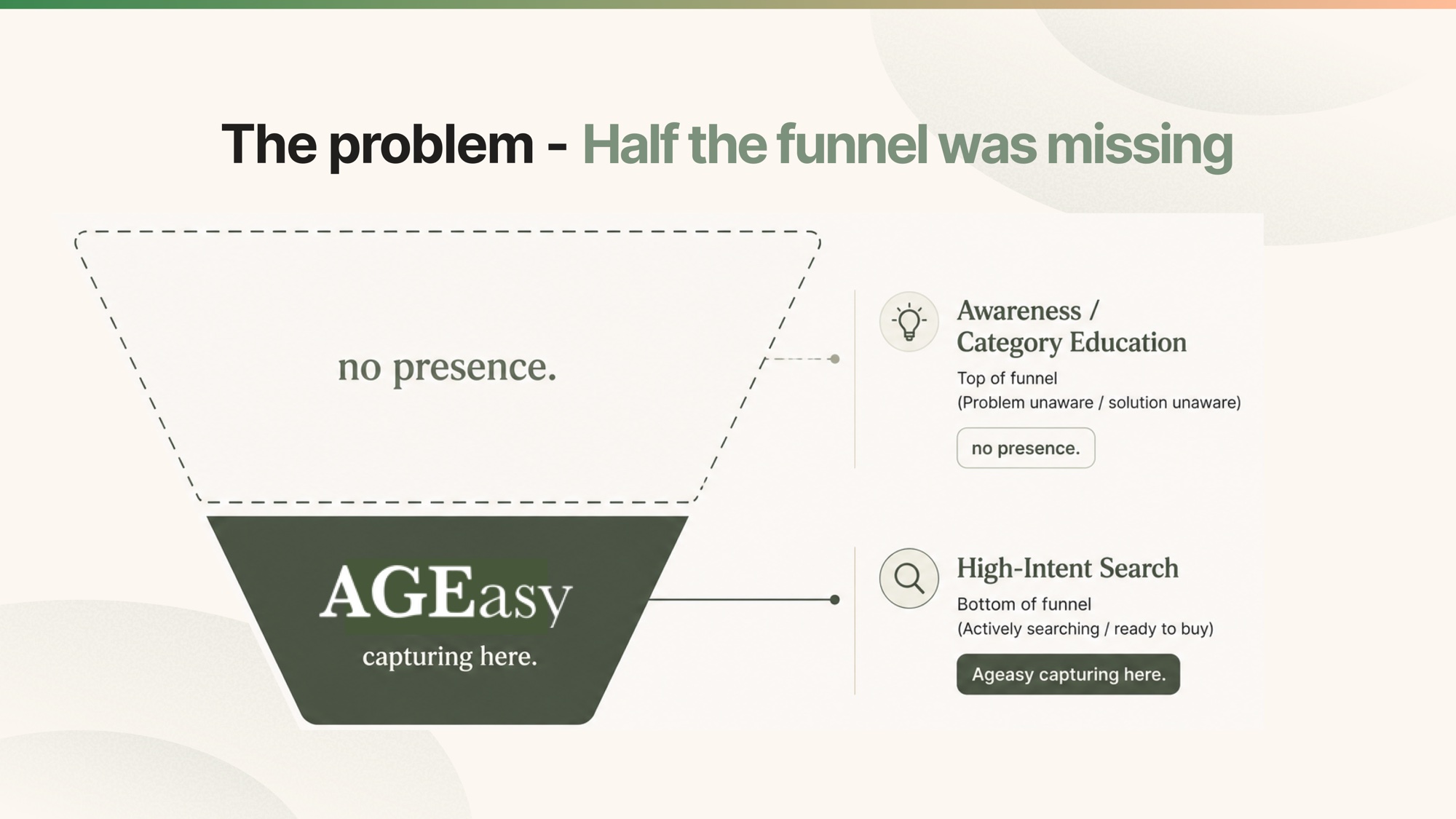
The legacy account was running Search campaigns — Brand, Generic, some Competition — and almost nothing else. No PMax, no Demand Gen, no top-of-funnel presence. When the adult child Googled "at-home elder care Delhi" at 11pm after their mother's fall, Ageasy was findable. When the same adult child was scrolling YouTube two months earlier and might have absorbed the message that at-home care was a real option (instead of either no help or full institutional care), Ageasy was invisible.
The structural symptom: the brand was capturing a fraction of the demand that existed inside the immediate moment and zero of the demand that needed to be built before the moment.
Category-education debt
Senior care in India is a category that still needs explaining. Many adult children don't realise at-home care is an option — the cultural default is either "the family handles it" or "the parent moves into an institution," and the gap between those is enormous. A search-only account assumes the buyer already knows the category exists. For a meaningful share of Ageasy's addressable market, that wasn't true.
Lead quality signal noise
Underneath the volume issue was a quality issue. "Qualified lead" was defined by sales-team eyeball, not by a structured scoring framework. CPL looked acceptable on paper but masked the fact that a non-trivial share of inbound calls were not commercially viable (geography out of service area, care intensity outside Ageasy's clinical scope, family already committed elsewhere).
The Strategy
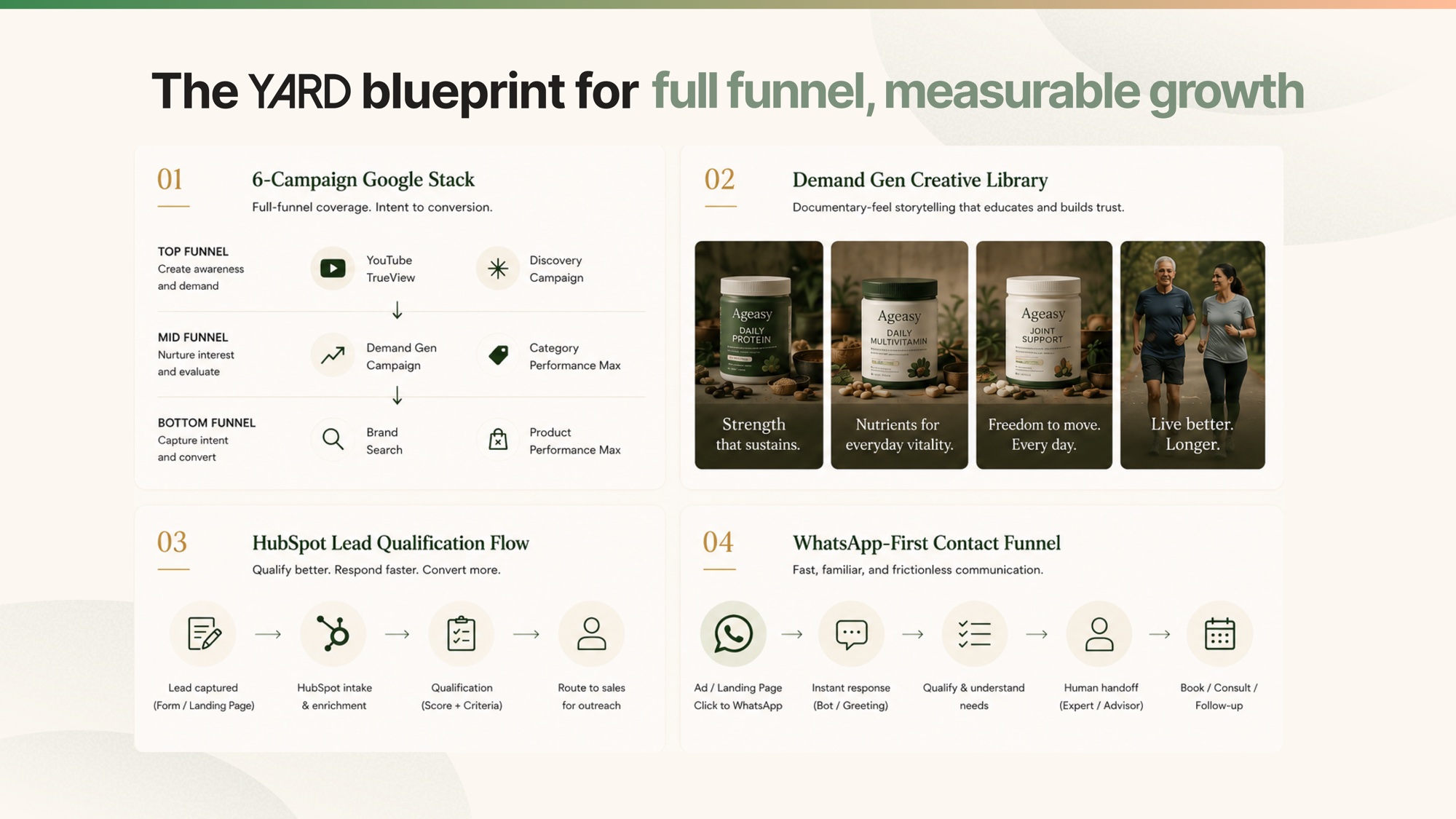
The 6-Campaign Google Ads Architecture — same playbook deployed across our retail and B2B roster — tuned for a high-trust, high-consideration services category. The structural shift was less about Search and more about everything upstream of Search.
| # | Campaign | Job |
|---|---|---|
| 1 | Brand Search | Defend brand queries; protect adult-child Googling Ageasy directly |
| 2 | Generic Search | Capture category demand ("home care for elderly parents Delhi," "post-discharge recovery care") |
| 3 | Competition Search | Controlled bidding on adjacent senior-care services |
| 4 | Category PMax | Segmented asset groups by care-intensity outcome (companion / medical / post-discharge / chronic-condition) |
| 5 | Service PMax | Bottom-funnel CPL-tuned capture across the Ageasy service line |
| 6 | Demand Gen | Top-of-funnel category education on YouTube, Discover, Gmail — the unlock |
Demand Gen as the heaviest lift
For Ageasy, Demand Gen was not a top-of-funnel afterthought. It was the primary new investment in the architecture. The creative job was specific: walk an adult child through what at-home care actually involves — who the caregivers are, how the safety protocols work, what a typical week looks like, how the family stays in the loop.
This is not the kind of category education that fits in a 6-second pre-roll. We produced longer-form video content (45 seconds to 2 minutes) and used the Demand Gen surface to seed it. The format mattered: documentary-feel footage of real caregivers and (with consent) real families, not stock-footage smiling-elderly-people imagery.
Lead qualification rebuilt against HubSpot
In parallel with the campaign work, the lead funnel was migrated into HubSpot with a structured qualification framework — service area, care intensity, decision-maker role, urgency window. Anything outside threshold was filtered upstream and surfaced separately to the sales team. CPL stopped looking inflated by leads that were never going to convert.
WhatsApp as the primary contact surface
Indian healthcare and home-services buyers contact, decide, and convert on WhatsApp. The acquisition funnel was reconfigured so that the primary post-click action was a WhatsApp conversation (with automated routing and a human handoff inside business hours), not a form fill. Form fills still existed for buyers who preferred them; WhatsApp moved to default. Inbound conversion at the top of the funnel improved materially.
The Execution
The first 30 days were architecture, HubSpot setup, and Demand Gen creative production. The creative cycle was longer than for retail accounts — documentary-quality video with real caregivers takes longer to produce than studio product shots — and we deliberately did not rush it.
Days 30–60: budget shifted from search-only into the broader stack. Generic Search and Category PMax absorbed more of the spend. Demand Gen went live with the first creative batch and started building the warm audience that the bottom-funnel campaigns would later harvest.
Days 60–120: the architecture began to compound. Demand Gen view-through behaviour drove Brand Search volume two to three weeks later (the consideration cycle for senior care is unusually long — families think, then talk, then decide, then search). PMax learnings from the first 60 days fed sharper bidding in the next 60.
What didn't work first
Our first Demand Gen creative leaned too heavily on the "professional caregiver" angle and not enough on the "family relief" angle. Adult children weren't searching for a caregiver primarily — they were searching for relief from the weight of being the only family member who could be there. We rebuilt the creative around the family relief narrative and engagement metrics shifted.
We also under-estimated the cultural sensitivity required in the messaging. The first round used the phrase "professional care for your elderly parents"; the version that actually performed used softer, more respectful language and acknowledged the cultural difficulty of bringing outside care into the family home. Honest acknowledgement of the difficulty was a stronger trust signal than confident reassurance.
"Search captures the moment. Demand Gen builds the months before the moment. A search-only senior-care brand is invisible in the months that matter most."
The Results
| Metric | Outcome |
|---|---|
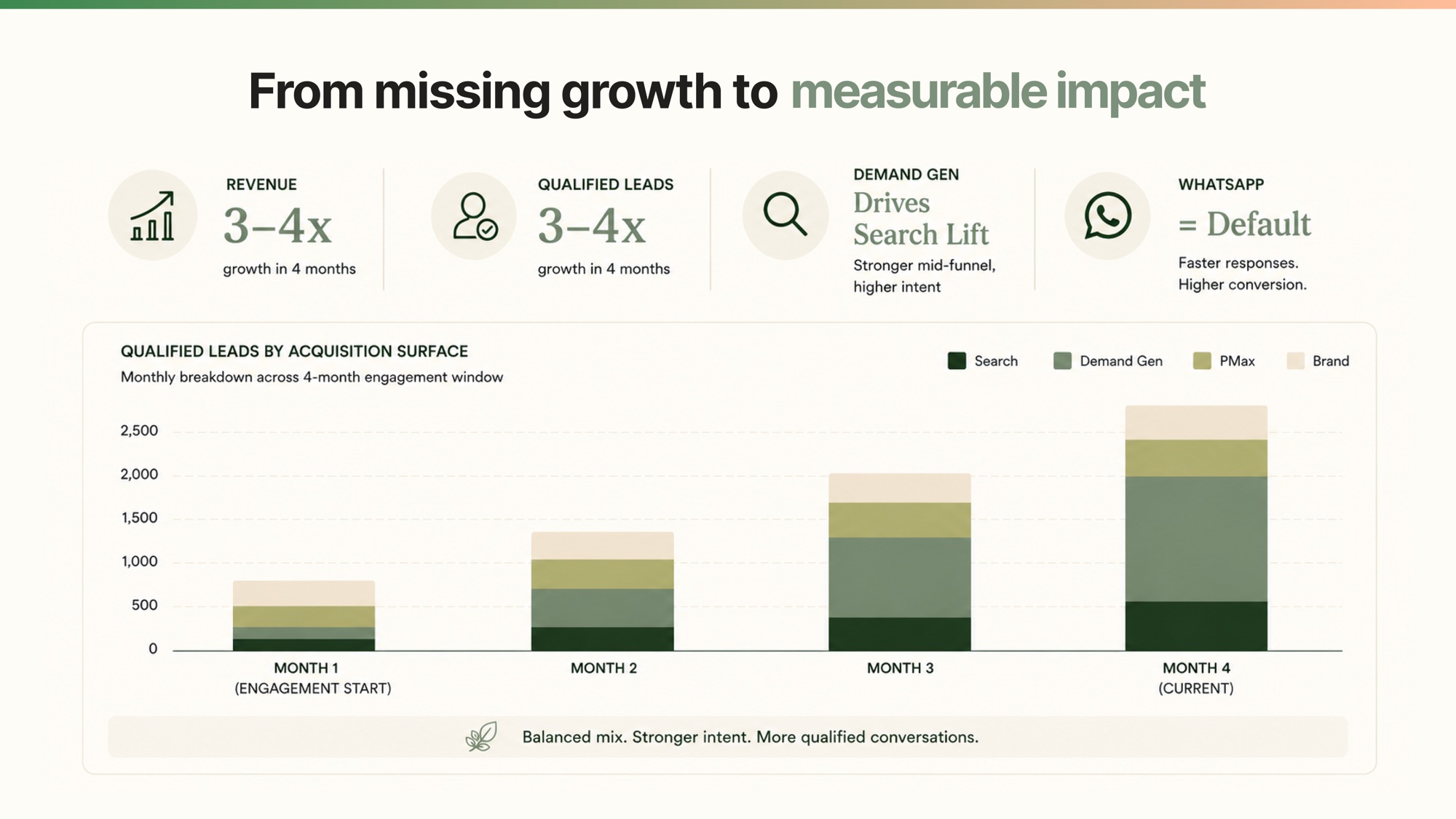
| Monthly revenue | 3–4x vs pre-engagement baseline, within 3–4 months |
| Qualified lead volume | 3–4x vs pre-engagement baseline |
| Lead quality | CPL stabilised after structured scoring removed noise from the numerator |
| Demand Gen contribution | Measurable lift in Brand Search volume 2–3 weeks after Demand Gen campaign starts |
| Inbound contact-method shift | WhatsApp overtook form fills as the primary first-touch channel |
| Sales-team conversion efficiency | Lifted as upstream filtering removed out-of-scope leads |
The headline number is 3–4x. The deeper story is that the brand can now keep scaling against an architecture that was never going to scale on Search alone.
Why It Worked
- Demand Gen was treated as the primary new investment, not the afterthought. Most senior-care accounts run Demand Gen as a brand-awareness side-show. We made it the leverage point.
- The 6-campaign architecture absorbed the spend without any single campaign becoming the bottleneck. Generic Search alone could not have done this. Demand Gen alone could not have done this. Together — yes.
- Lead qualification removed noise from the numerator. CPL is a fraction. Improving the denominator only goes so far if the numerator is inflated by junk leads.
- WhatsApp is the funnel. Treating it as the default first-touch — not as a fallback — is what made the inbound conversion improvements stick.
Lessons for Senior-Care and High-Trust Service Categories
- Search captures intent. Demand Gen builds the consideration set. A search-only account is leaving the upstream half of the funnel uncovered.
- Family relief is a stronger creative angle than professional capability. The buyer is not buying a service. They are buying back the time and emotional bandwidth they don't have.
- Cultural sensitivity in messaging is a conversion lever, not a brand-polish lever. Soft, respectful language outperformed confident-clinical language by a measurable margin.
- Structured lead scoring is the only honest way to measure CPL. Eyeball qualification inflates the numerator and hides what's actually working.
- Build for WhatsApp first. The form fill is the fallback, not the default.
Repeatable Playbook
Ageasy's 6-campaign architecture matches the structure now running across YARD's broader portfolio — same skeleton as REP, Vivobarefoot, SoleTherapy, and Little Bansi. The category-specific tuning lives in the creative pool, the qualification framework, and the contact-surface configuration — not in the campaign structure itself.
Closing Thought
A successful senior-care engagement looks like every other performance marketing engagement on the dashboard — 3–4x revenue, lower CPL, better lead quality. What's actually happening underneath is harder to capture in a metric: a family that was going to spend three weeks of stress trying to figure out what to do for a parent has found a credible answer, faster. The marketing is the trailing indicator of having actually helped them.

Stealth REIT — Building a Regulated PropTech's Martech Stack From Zero, and Cutting CPL 67%

Manvar — How a Heritage Thar Desert Brand Broke Its OTA Dependency and Grew Direct Room Nights 56%