
Astroport Sariska — How India's First Astronomy Resort Broke Its OTA Dependency in Six Months
Project Breakdown
Astroport Sariska is a once-in-a-decade product — India's only purpose-built astronomy resort, sitting on a Bortle-3 night sky two hours from Delhi. The problem wasn't demand. The problem was that 100% of the demand was being routed through OTAs that didn't know how to sell stargazing.
| Client | Astroport Sariska |
|---|---|
| Industry | Premium Hospitality · Astronomy Resort |
| Region | Sariska, Rajasthan |
| Target Market | Delhi-NCR |
| Channels | Google Ads, SEO, SMM |
| Engagement | Lead Generation + SEO + Social |
| Timeline | 6 months |
The Client
Astroport Sariska is a heritage-style hospitality property built around a single, defensible idea: stargazing as the hero experience. Telescopes, astronomers-in-residence, dark-sky-protected accommodation, two hours' drive from one of India's largest leisure-travel markets.
It's the kind of product that should be impossible to compete with — and almost impossible to find, if your only digital footprint is an OTA listing labelled "Astroport Sariska Resort."
The property sits on a real geographic and astronomical asset. Sariska is one of the closer locations to Delhi with a sky dark enough to see the Milky Way arc with the naked eye — a Bortle-3 sky, which puts it in the same observational class as some of the best-known stargazing destinations globally. The resort itself was built to leverage that specifically: telescope decks, low-spill lighting, viewing sessions led by astronomers who actually know the sky overhead. None of that nuance was communicated in the OTA listing, which described the property as a standard heritage resort with an "astronomy experience."
The Problem
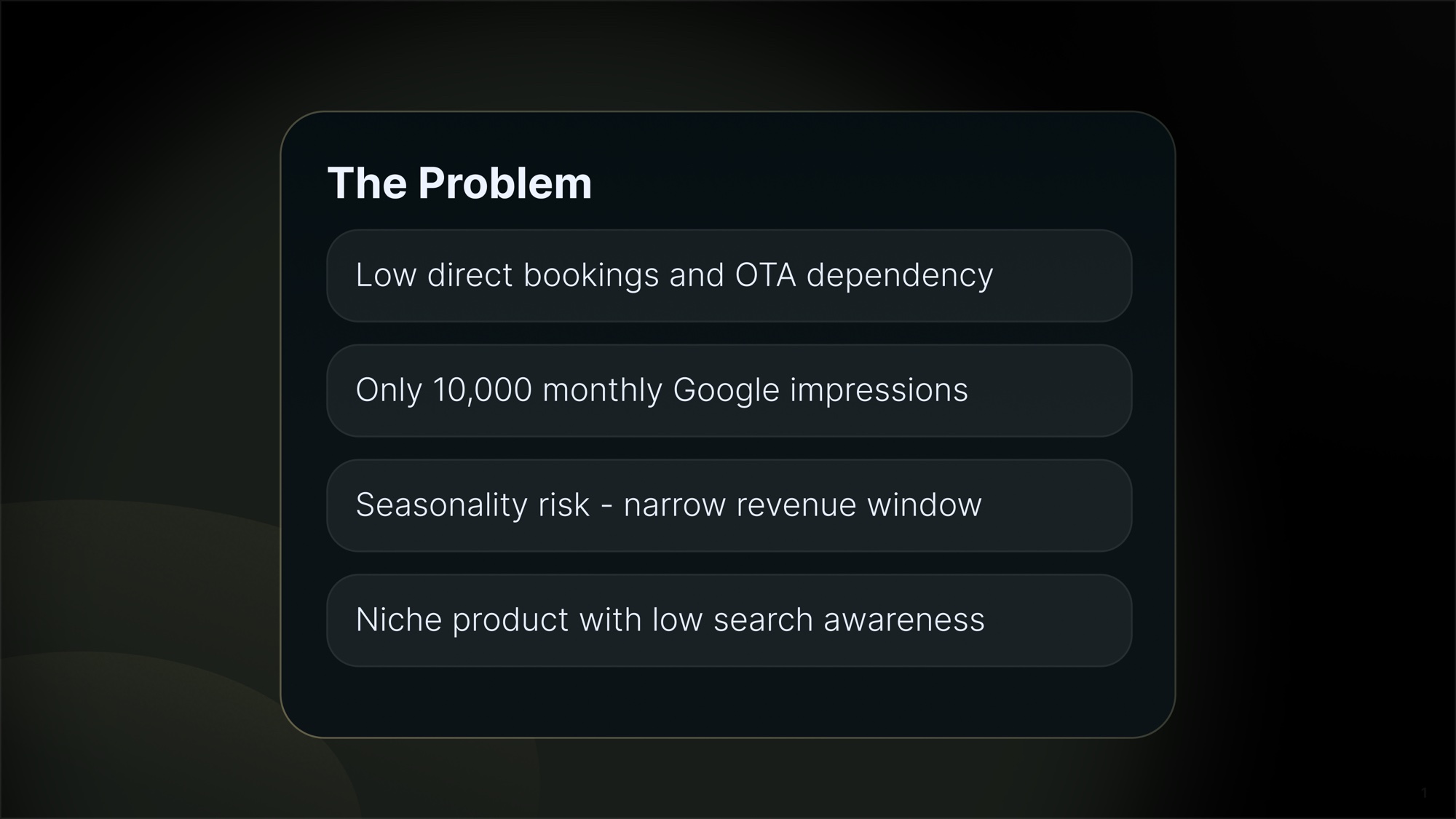
Three commercial issues stacked on top of each other:
1. Low direct bookings — heavy OTA dependency
Almost every reservation was coming via MakeMyTrip, Booking.com, Agoda. Margins were thin (OTA commissions in India typically run 18–25%), brand storytelling was lost inside a generic listing template, and the customer relationship belonged to the OTA, not the resort. Repeat bookings were uncertain because the OTA owned the email address.
There was a second-order consequence too. OTAs were bidding on the brand's own name on Google — running paid placements on "Astroport Sariska" searches and intercepting buyers who were already looking for the resort directly. The brand was effectively paying a commission on customers it had already acquired.
2. Revenue compressed into a 6–8 month window
Sariska is a winter / shoulder-season destination. From May through August, daytime temperatures make a Rajasthan-desert stay unappealing for the leisure-travel buyer, and the season effectively closes. Every additional room night inside the open window has outsized financial impact, and every room night lost outside it is permanently gone — there's no off-season pricing strategy that will recover it.
This concentrates the commercial pressure. A property with a 12-month season has time to learn from each month's data and adjust the next. A property with a 6–8 month season needs the strategy right before the season opens, because by the time the data tells you what's wrong, the season is already half over.
3. Niche product with low search awareness
"Astronomy resort India" is not a high-volume search query — yet. The brand had to build the category as it scaled the channel. There were two distinct demand pools to reach: existing astronomy-curious buyers (smaller, easier to convert) and weekend-leisure-curious Delhi-NCR buyers who had never considered stargazing as a vacation category (larger, harder to convert but the strategic prize).
The Strategy
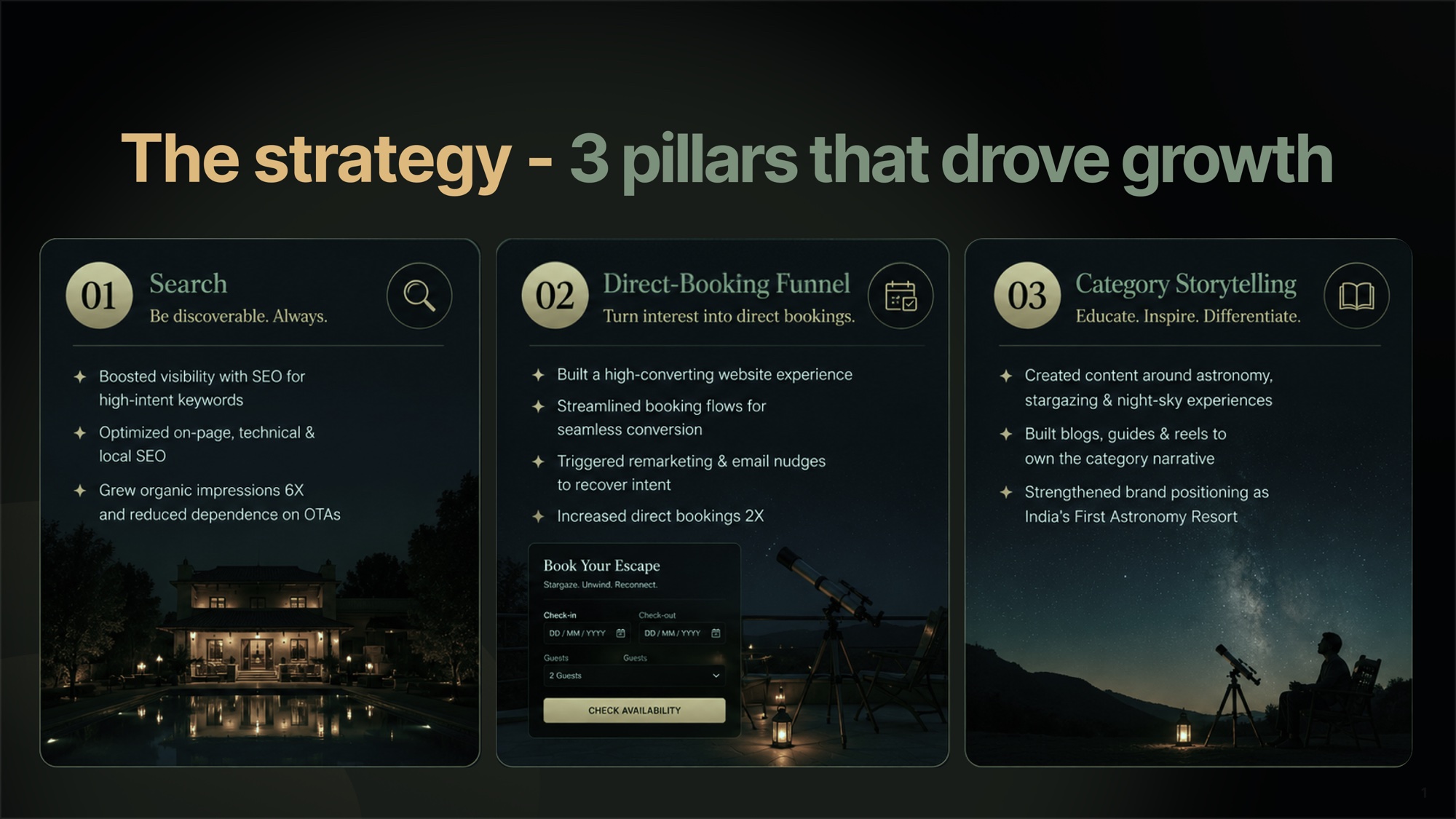
A three-pillar approach built specifically for narrow-season premium hospitality.
1. Own the search layer
Astroport had to dominate every variant of "astronomy resort," "stargazing weekend Delhi," "Sariska resort," and the long-tail astronomy/dark-sky/telescope-experience queries. We rebuilt the site for SEO from the ground:
- Full schema implementation (LodgingBusiness, Event, FAQPage, Article, BreadcrumbList)
- Sitemap, robots.txt, llms.txt — same LLM-SEO base layer we deploy across the YARD roster
- City-pair pages targeting "Delhi to Sariska weekend," "Jaipur to Sariska," "stargazing near NCR"
- Pillar content built around astronomy events (meteor showers, planetary alignments, eclipses) so the site could rank for the cultural calendar around the product
The pillar content strategy is worth describing. Rather than write generic "best resorts in Sariska" content, we anchored articles to specific astronomical events on the upcoming calendar — the Geminid meteor shower in December, the lunar eclipse in March, conjunction events visible from latitude 27°N. Each article ranked against people already searching for the event, then converted them to weekend bookings at the resort timed to coincide with it.
2. A direct-booking acquisition funnel
A clean Google Ads stack targeting weekend Delhi-NCR leisure intent — Brand Search, Generic Search ("astronomy resort," "dark sky resort India"), and a tightly-bid Property PMax campaign sending traffic to a direct-book landing page that didn't exist before.
The direct-book page was engineered to convert against the OTA listing — better storytelling, better imagery, transparent pricing, and direct WhatsApp into the property team. It said the things the OTA listing couldn't say: who the astronomer-in-residence is, what a typical viewing session feels like, what's visible from the telescope deck this month.
The Brand Search defence was the fastest unlock in the engagement. Anyone Googling "Astroport Sariska" was, until then, being intercepted by OTA-paid placements on the brand's own name. We took that real estate back inside week 1.
3. Social content built to teach the category
Reels and stories were built to teach Delhi-NCR audiences that stargazing weekends are a category, not just a hotel. Sky-event calendars, astronomer interviews, what-to-pack guides, BTS of telescope sessions, real Milky Way captures from the property's own decks. Once we built the audience, the conversion campaigns had warm prospects to bid against.
The most effective social format turned out to be the astronomer-narrated short. A 60-second clip with the resort's resident astronomer explaining what was visible that weekend, shot at the actual viewing deck, with audible night sounds. Stock-style "luxury hotel" content was an order of magnitude less effective.
The Execution
Months 1–2: site rebuild + SEO base layer + content production. The direct-book landing page went live in week 4. Brand Search defence campaign went live in week 1 — the highest-leverage, lowest-effort move in the engagement.
Months 2–4: Google Ads stack live, tightly bid against weekend leisure intent. Generic Search and PMax began acquiring outside the brand's existing audience. Social content built the warm-audience pool.
Months 4–6: organic SEO started to compound. Long-tail astronomy queries began ranking. The city-pair pages — "Delhi to Sariska weekend" being the highest-volume — started showing up on page one. Direct-booking share of total bookings climbed steadily across the window.
What didn't work first
Our first Generic Search keyword set was too astronomy-niche — heavy on "stargazing," "telescope sessions," "dark sky." Volume was low and the buyers it captured were the smaller, easier-to-convert pool we'd already identified. We expanded the keyword set into "weekend getaway from Delhi," "unique resort experience Rajasthan," and other general-leisure variants — and used the landing page to introduce astronomy as the differentiator after the click, not before. Volume climbed several-fold without diluting conversion.
We also under-invested in WhatsApp at first. The direct-book page had a phone number and a form. WhatsApp was buried. After we surfaced it as the default first-touch CTA, time-to-booking dropped — Indian leisure buyers ask their three or four follow-up questions on WhatsApp before they trust the property enough to book.
"The brand's own search queries were the cheapest real estate it owned — and OTAs were sitting on it. Buying it back was the highest-leverage move in the entire engagement."
The Results
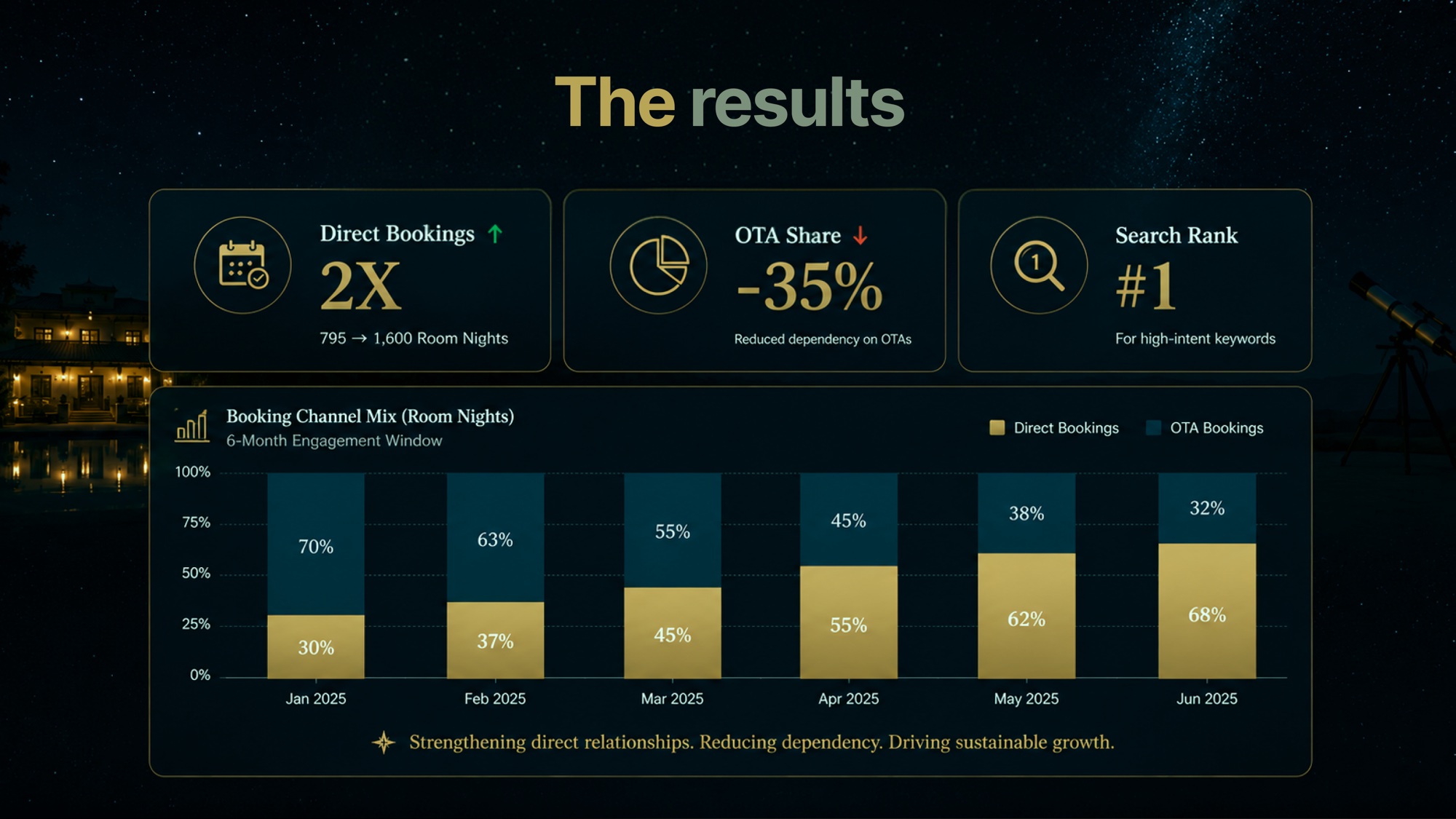
| Metric | Outcome |
|---|---|
| Direct booking channel | Built from near-zero baseline — now a primary revenue source alongside OTAs |
| OTA dependency | Materially reduced inside a 6-month window |
| Search visibility | Ranking #1 for "astronomy resort India" and adjacent long-tail queries |
| Seasonal yield | Higher room-nights captured inside the brand's narrow 6–8 month window |
| Brand Search interception | OTA paid placements on the brand's own name no longer dominant |
| City-pair page ranking | "Delhi to Sariska weekend" and similar queries on page one of Google |
| Brand storytelling | The audience now hears about the astronomy experience before the booking — instead of finding out afterwards |
Why It Worked
- Category was being built, not just captured. Most performance work in hospitality assumes the category already exists. Here, the brand and the category had to scale together.
- The brand's own search queries are the cheapest real estate it owns. Astroport was paying OTAs to intercept its own name. Taking that back was the highest-leverage move in the engagement.
- The narrow season made every direct booking worth more. A direct booking inside the 6–8 month window doesn't just save the OTA commission — it builds the relationship that drives the next year's repeat visit.
- Astronomer-narrated content beats luxury-hotel content. The differentiator is the differentiator — lean into it.
Lessons for Narrow-Season Premium Hospitality
- Defend your brand name on search before you spend anywhere else. It is almost always being intercepted by OTAs. Take it back inside week 1.
- City-pair pages punch above their weight. "Delhi to Sariska weekend" outperforms the resort's name in long-tail volume. Build a page for every meaningful origin city.
- Anchor content to the actual differentiator — not generic luxury language. "Stargazing under a Bortle-3 sky" is a stronger headline than "luxury heritage resort." The buyer can find a luxury heritage resort anywhere.
- WhatsApp belongs in the conversion path, not as a fallback. Leisure buyers want a conversation before they book.
- Season-aware planning is non-negotiable. A 6–8 month season means the strategy must be ready before the window opens. Build during the off-season.
Repeatable Playbook
The Astroport engagement is now the template for Narrow-Season Premium Hospitality inside YARD — three-pillar acquisition (search ownership + direct-booking funnel + category storytelling) tuned to a tight seasonal window. The same skeleton is being adapted for adjacent heritage Rajasthan properties (Manvar, others).
Closing Thought
The product was always good enough to win on its own terms. The marketing's job was to make sure buyers reached the property on the property's own terms — not via a generic OTA listing that didn't know what a Bortle-3 sky was. The 6-month outcome is real. The longer-term outcome is that the next astronomy-curious Delhi family that searches for a weekend will find Astroport directly.
Ageasy — How a Senior-Care Brand Scaled 3–4x by Pairing Google Search With a Real Demand-Gen Engine
Stealth REIT — Building a Regulated PropTech's Martech Stack From Zero, and Cutting CPL 67%