
Lowry Solutions — Cutting Cost Per Qualified Enterprise Lead by 75% on a Single Channel
Project Breakdown
One brand. One channel. One mission: reduce the cost of a qualified enterprise lead by 75%. We did it on Google Ads alone — by rewriting the keyword stack to match the language enterprise IT and operations buyers actually use, and by laying down an LLM-SEO base layer the category had ignored.
| Client | Lowry Solutions |
|---|---|
| Industry | B2B Enterprise Technology — IoT & Asset Visibility |
| Region | USA |
| Channel | Google Ads only |
| Engagement | B2B Performance + LLM SEO |
| Timeline | Single-channel engagement, results below |
The Client
Lowry Solutions is a US-based enterprise technology operator specialising in IoT-led asset visibility — RFID, barcode systems, mobile computing, asset tracking infrastructure — for large-scale warehouses, manufacturers, and logistics operators. The product sale is long-cycle, multi-stakeholder, and the qualifying threshold is high (real enterprise procurement, not SMB).
The category is genuinely complex. A warehouse with 200,000 SKUs needs a fundamentally different asset-visibility solution than a manufacturer with high-value WIP inventory or a logistics operator with cross-dock workflows. Lowry's product range maps to multiple use cases inside multiple verticals — and the correct configuration for any given prospect depends on stakeholder needs across IT, operations, supply chain, and finance.
The cost of acquiring a qualified enterprise lead in this category is the entire commercial conversation. Volume is irrelevant. Quality is everything. A genuinely qualified Fortune-500 warehouse-modernisation lead is worth a multiple of a hundred unqualified inbound forms from SMBs that will never close.
The Problem
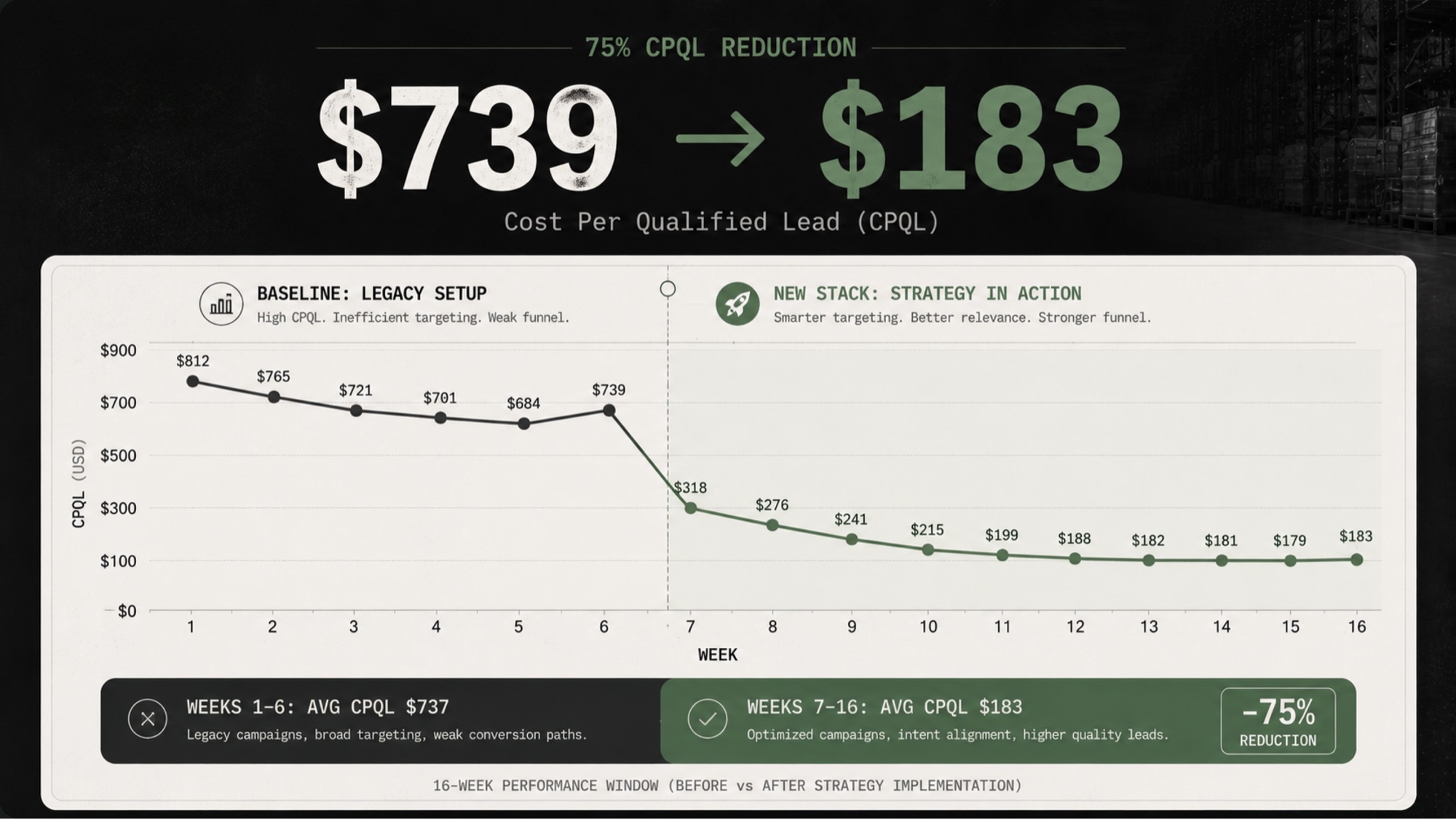
Lowry walked in with a single, very tight brief: the cost of a qualified enterprise lead was $739, and that number had to come down — substantially — without compromising lead quality.
Underneath that headline:
1. Account inheritance
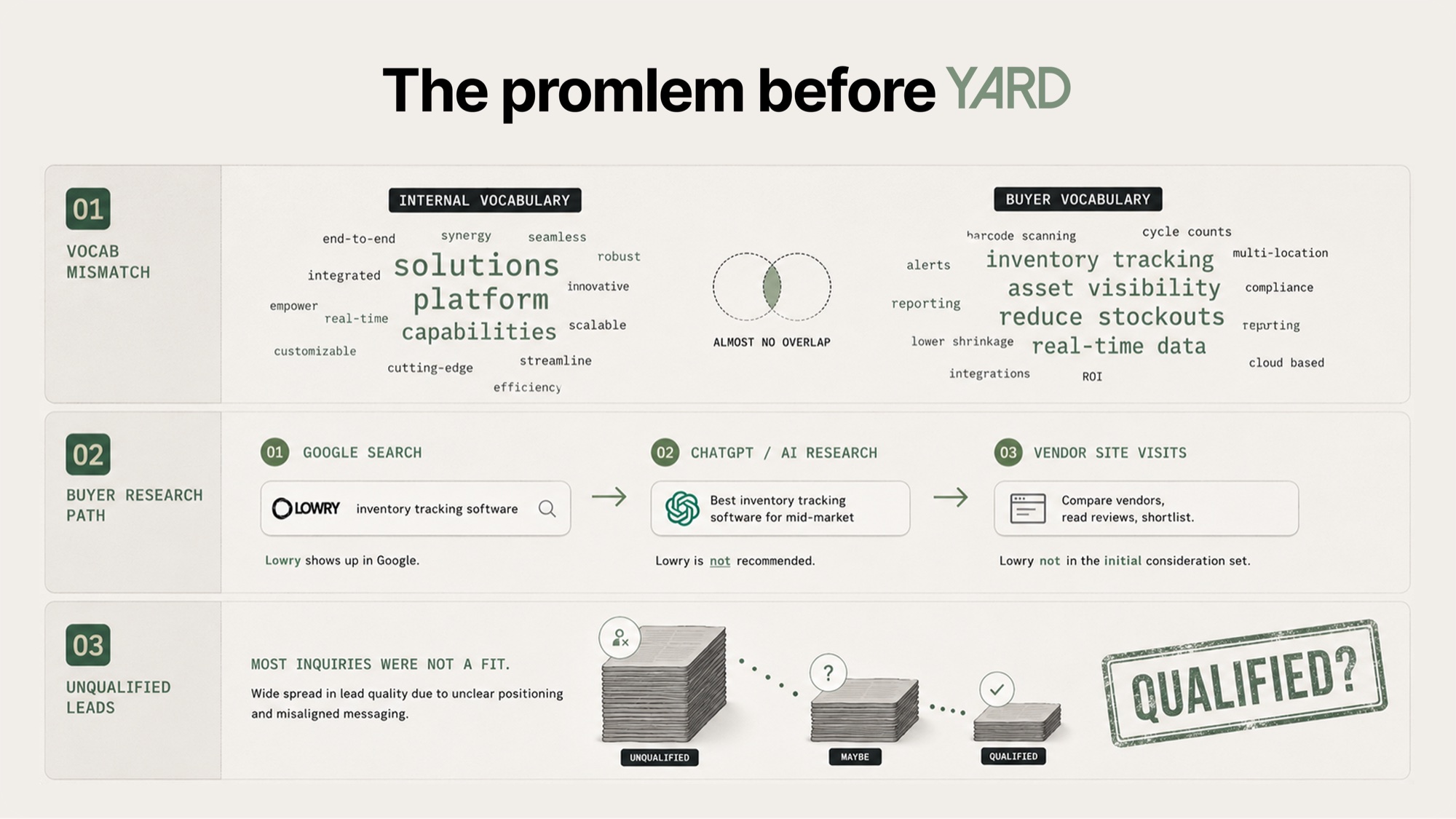
A keyword stack built around the product team's internal vocabulary, not the buyer's — heavy on jargon that enterprise IT buyers may use, but enterprise operations buyers (who own most of the actual procurement) don't. Phrases like "asset visibility platform" and "enterprise mobility ecosystem" tested well in product marketing reviews but matched almost no real search behaviour.
The deeper version of this problem: B2B keyword stacks tend to be built by the product team, signed off by marketing, and never re-validated against the actual language used in procurement RFPs or operations-buyer discovery queries. The drift between the two compounds quarter over quarter.
2. No LLM-SEO presence
Enterprise buyers researching RFID and asset-visibility now routinely include ChatGPT, Perplexity, and Gemini in their consideration set — particularly during the "longlist" phase, when an operations buyer is trying to assemble three to five vendors to invite into an RFP process. Lowry was invisible in those answers. So was every other vendor in the category who hadn't built for LLM citation.
The B2B implication is sharper than the D2C version. In D2C, an LLM citation is a recommendation; in B2B, it's vendor inclusion in the procurement shortlist. The economic value of being cited is materially higher because the alternative — being absent from the shortlist — means the entire deal cycle is closed to you before you ever know it existed.
3. Lead scoring noise
"Qualified" was defined by sales team eyeball, not by a structured scoring framework. CPQL was inflated by leads that should have been disqualified upstream — SMBs that exceeded threshold size on paper but actually had no procurement budget, IT-curious browsers who weren't decision-makers, geographic outliers, students researching for academic projects.
The diagnosis: this wasn't a bidding problem. It was a language and qualification problem.
The Strategy
A single-channel engagement on Google Ads, supported by an LLM-SEO base layer running underneath. No social. No display network. No third channel to dilute the test. The brief was tight, and the strategy stayed tight.
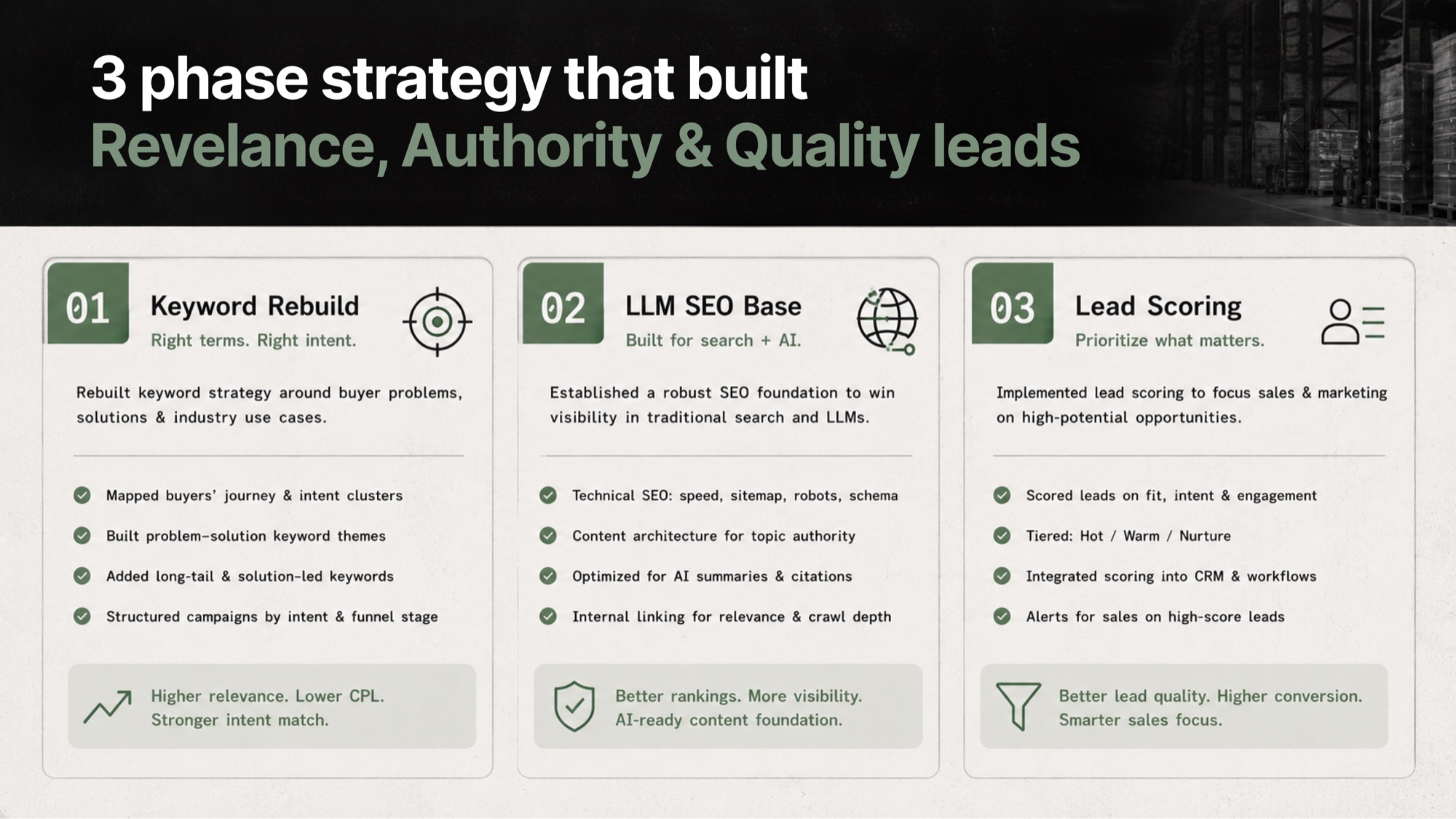
1. Rebuild the keyword stack around buyer language
Every keyword in the legacy account was audited against a freshly-built buyer-language map. The inputs included:
- Structured interviews with enterprise operations and IT buyers in the category
- Scraping of relevant procurement RFPs in publicly-accessible filings
- Search-language extraction from real enterprise discovery queries (via search-term reports inside the existing account and adjacent industry-research tooling)
- Competitor SERPs at the long-tail end of the category
The product team called it "asset visibility platform." The buyers called it "warehouse RFID system" and "inventory tracking for manufacturing." Bridging that gap was the first and biggest unlock.
We also segmented the rebuilt keyword stack by buyer role — IT-stakeholder keywords (e.g. "enterprise RFID integration"), operations-stakeholder keywords (e.g. "warehouse inventory accuracy improvement"), and supply-chain-stakeholder keywords (e.g. "asset tracking for logistics"). Each ad group was tuned to its stakeholder, with landing pages adapted to the relevant procurement framing.
2. Lay down the LLM-SEO base layer
Even though paid was the active spend channel, we deployed the YARD LLM-SEO stack against the Lowry site:
- Schema (Organization, Product, FAQPage, Article) across the pillar pages
- Sitemap + robots.txt + llms.txt
- Citation-engineered pillar content for the top-10 enterprise B2B research questions in the category — "best warehouse RFID systems for 200K+ SKU operations," "how to choose an enterprise asset visibility platform," "RFID vs barcode vs BLE for manufacturing WIP"
- LLM crawler permissions explicitly enabled
A B2B brand with a 6–18 month sales cycle compounds enormously from being cited inside AI-generated answers. Even when paid is the active spend lever, the LLM layer is where the next year of pipeline shows up. The cost of building it is small relative to the cost of being absent from procurement shortlists.
3. A real lead-qualification framework
CPQL is the metric. So we needed a structured definition of "qualified," not a sales-team eyeball. We built a lead scoring framework against:
- Company size and revenue threshold (firmographic minimum)
- Vertical fit (warehousing, manufacturing, logistics — primary; retail, healthcare, hospitality — secondary)
- Stated use case (clear procurement signal vs. exploratory research)
- Stakeholder role (decision-maker, evaluator, end-user)
- Geography (within service catchment)
- Timeline (active RFP window vs. >12 months out)
Anything below threshold was filtered upstream — and therefore stopped inflating CPQL. The sales team was relieved. The marketing team finally had a number that meant the same thing every week.
The Execution
Weeks 1–4: buyer-language interviews, keyword rebuild, schema deployment, scoring framework agreed with the sales team.
Weeks 4–8: new Google Ads architecture stood up. Old campaigns paused. Spend held at baseline while the new stack accumulated learnings. Landing pages adapted by stakeholder role.
Weeks 8–16: spend scaled gradually against the rebuilt stack. CPQL began dropping from week 6 onward, with the steepest fall once the qualification framework started filtering noise out of the numerator.
What didn't work first
Our initial pillar content was too technical. The first three articles were written by the YARD content team in close collaboration with the Lowry product team — and the product team's expertise pulled the language back toward internal vocabulary. LLM citation behaviour on those pieces was weak.
We rewrote the next round of pillars with operations-buyer framing first and product-detail second. Citation share lifted. The pattern matched what we'd seen on the Little Bansi engagement, which is now an internal rule: in any LLM-SEO content, the buyer's question must own the top of the article. The vendor's answer comes second.
We also under-estimated the importance of stakeholder-specific landing pages. Our first version used a single landing page for all paid traffic. CPQL barely moved. We split the landing experience by inferred stakeholder (based on keyword group), and conversion-to-qualified-lead ratio improved sharply.
"The bid was never the problem. The bid was the only variable the previous account had been tuning. The language was the variable. We changed the variable."
The Results
| Metric | Before | After |
|---|---|---|
| Cost Per Qualified Lead | $739 | $183 |
| CPQL reduction | — | −75% |
| Active channel | Google Ads | Google Ads only |
| LLM-SEO base layer | Absent | Live across pillar pages |
| Lead qualification | Sales-eyeball | Structured scoring framework |
| Stakeholder-segmented landing pages | None | Three role-tuned landing experiences |
| Qualified lead volume | Baseline | Lifted alongside the CPQL drop — not at its expense |
The shape of the number matters: this wasn't a 30% optimisation win. It was a 75% reset — the kind of move that only happens when the underlying problem is misdiagnosed in the first place. The cost wasn't being driven by the bid. It was being driven by the language.
The volume detail is worth pulling out separately. Most CPQL improvements come at the cost of lead volume — squeeze the funnel hard enough and the per-lead cost drops because the absolute number of leads drops faster. That's not what happened here. Volume held or lifted alongside the cost reduction, because the rebuilt keyword stack expanded into search demand the previous account had been missing entirely.
Why It Worked
- The category's keyword stacks are mostly written by product, not buyer. Diagnosing that is the entire engagement. The execution is mechanical.
- B2B with a long sales cycle compounds from LLM presence even when paid is active. The two layers feed each other across the cycle.
- CPQL is a fraction. Improve the numerator (quality of qualified leads) and the denominator (cost) at the same time and the multiplier shows up fast.
- Stakeholder-specific landing pages are underused in B2B. A single landing page averages the message across three buyers. Three landing pages target each one specifically. The lift is real.
Lessons for Enterprise B2B Performance
A handful of patterns that travelled from this engagement into the broader YARD B2B playbook:
- Don't trust the legacy keyword stack. Interview real buyers. Read real RFPs. The drift between internal and external vocabulary will surprise you.
- Publish llms.txt before your competitors do. In any B2B category where being on the procurement shortlist matters — which is most of them — early LLM presence is a structural advantage.
- Build the lead scoring framework with the sales team, not for them. Five fields they actually use beats eleven they ignore.
- Segment landing pages by stakeholder role, not just by service line. IT, operations, supply chain, and finance read the same product completely differently.
- CPQL improvements should not come at the cost of volume. If the cost is dropping and the volume is dropping faster, the keyword stack is being squeezed, not improved.
Repeatable Playbook
The Lowry engagement is now the YARD template for B2B Enterprise Lead Generation on a Single Channel — buyer-language keyword rebuild, LLM-SEO base layer, structured lead scoring. Categories where this transfers cleanly: industrial IoT, supply chain SaaS, enterprise security, healthcare tech, manufacturing software.
Closing Thought
A 75% CPQL reduction is the kind of number that should be impossible inside a category that has been worked over for a decade. It was achievable here for exactly one reason: the language had stopped matching the buyer, and almost nobody had checked. We checked. The rest was mechanical.

Ageasy — How a Senior-Care Brand Scaled 3–4x by Pairing Google Search With a Real Demand-Gen Engine

Stealth REIT — Building a Regulated PropTech's Martech Stack From Zero, and Cutting CPL 67%