
Manvar — How a Heritage Thar Desert Brand Broke Its OTA Dependency and Grew Direct Room Nights 56%
Project Breakdown
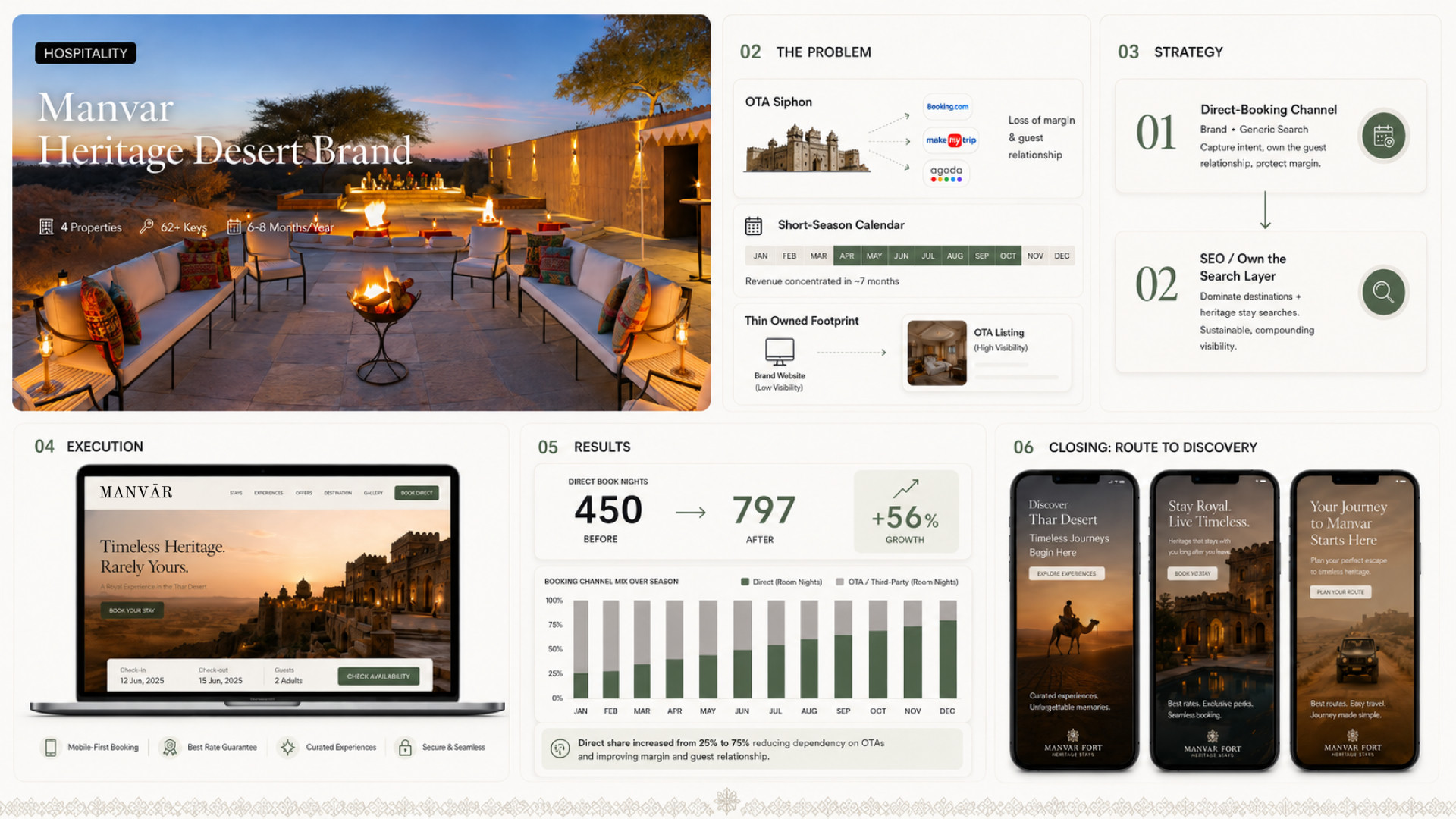
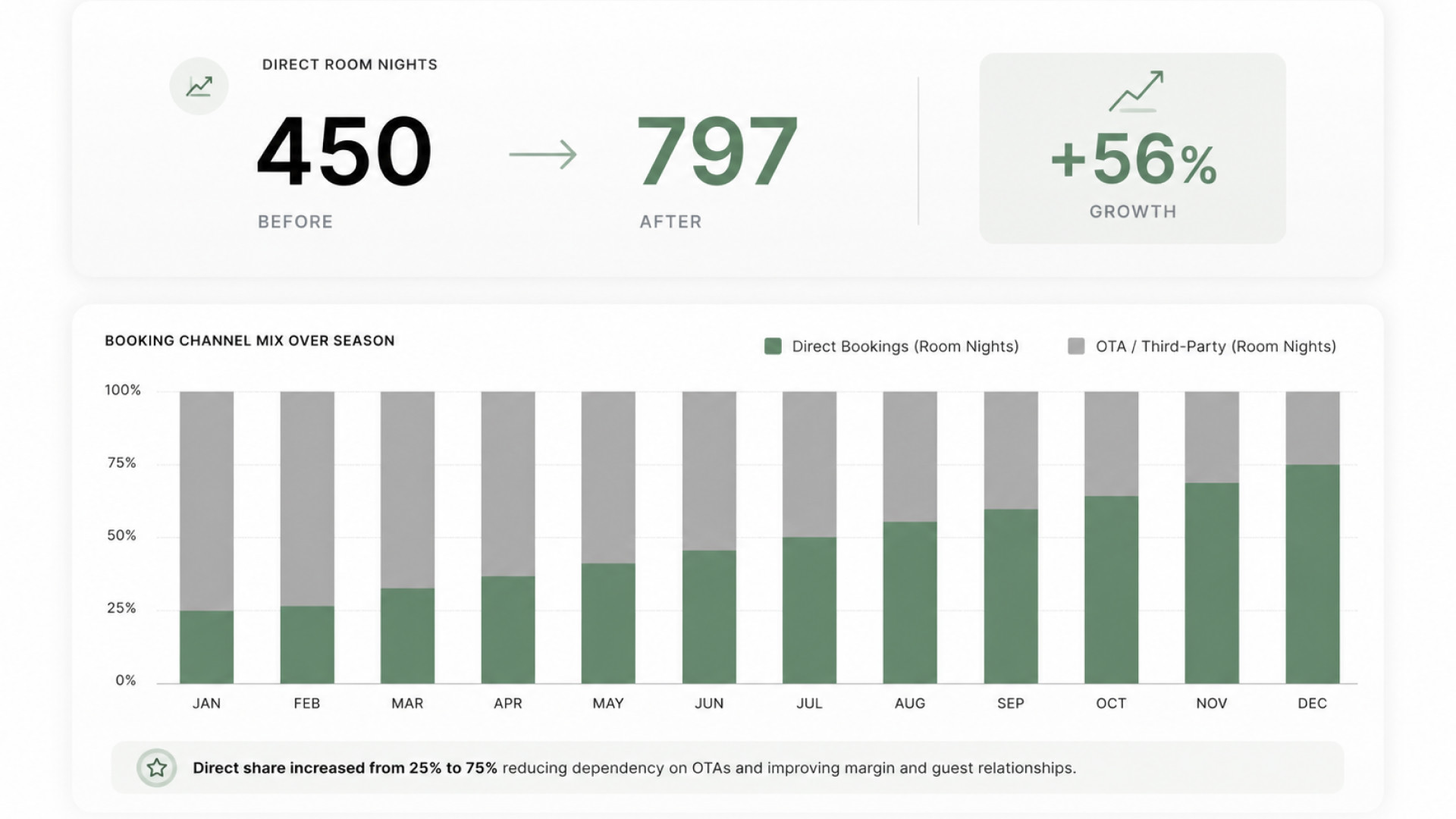
Manvar is a heritage desert brand in Rajasthan's Thar — four properties, 62+ keys, and a romantic, hard-to-reach product that most of its guests were discovering through an OTA listing rather than the brand itself. YARD built the direct-booking channel and the search layer around it, lifting direct room nights from 450 to 797 — a 56% increase — inside the brand's narrow 6–8 month revenue window.
| Client | Manvar |
|---|---|
| Industry | Heritage Hospitality · Thar Desert |
| Region | Rajasthan, India (4 properties · 62+ keys) |
| Target Market | Domestic & international heritage / desert travellers |
| Channels | Google Ads, SEO |
| Engagement | Direct Bookings + SEO |
| Timeline | Season-aligned (6–8 month revenue window) |
The Client
Manvar is a heritage desert hospitality brand built around the romance of the Thar — fort-style and tented properties on the dunes, the kind of remote, atmospheric stay that travellers seek out specifically. The portfolio runs to four properties and 62+ keys, which is a meaningful inventory to fill for a brand whose product is, almost by definition, off the beaten path.
The desert is the draw and the difficulty at once. It's what makes Manvar special — a genuine heritage experience away from the crowds — and it's also why the brand can't rely on walk-in or accidental demand the way a city hotel can. Almost every guest arrives having decided, in advance, to come. That makes the digital storefront the entire top of the funnel. And when that storefront is an OTA listing rather than the brand's own channel, the brand pays a commission, loses the relationship, and surrenders the story to a template.
The Problem
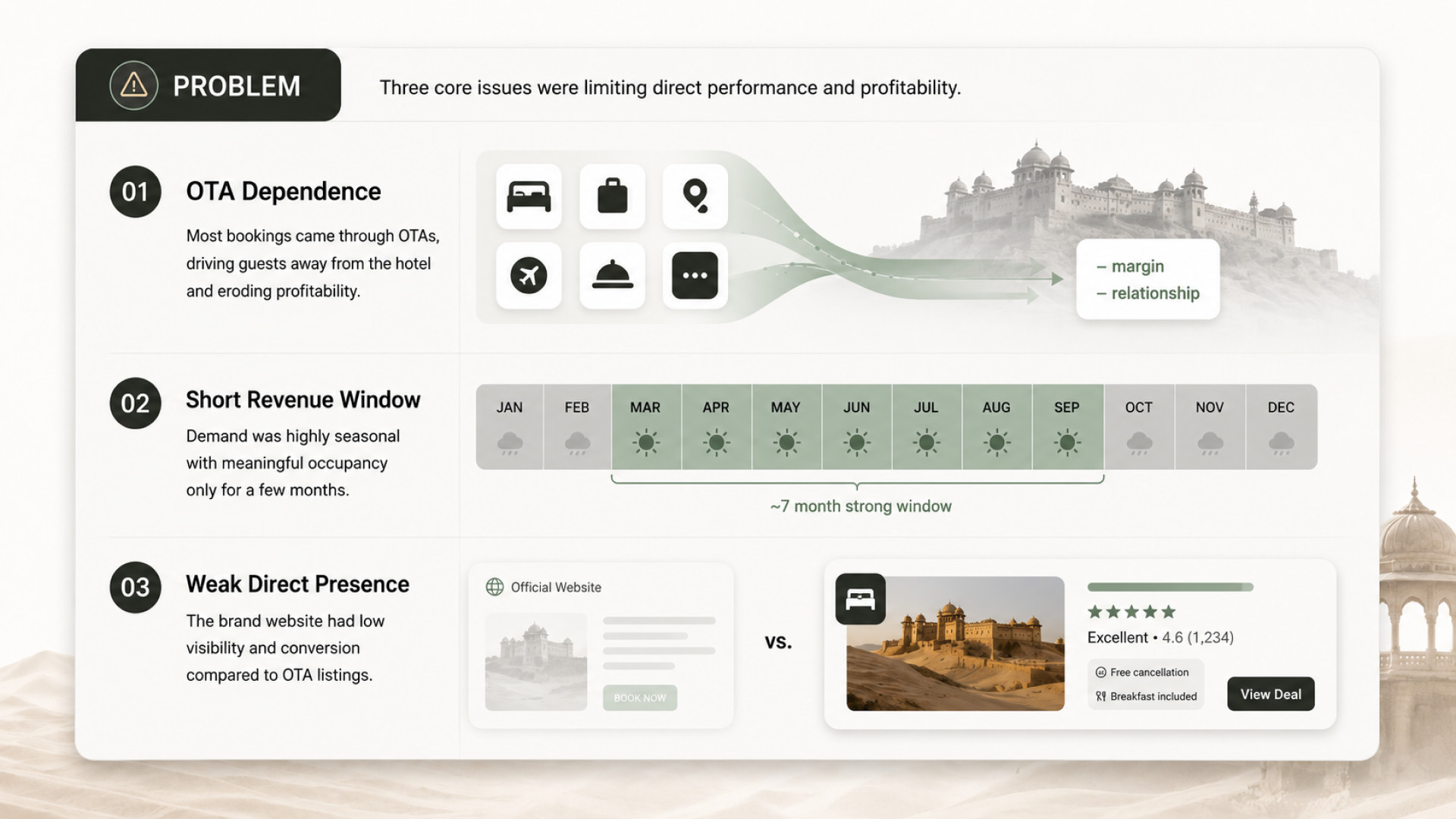
Manvar named it plainly: "Too much of our business runs through OTAs, and our season is too short to waste." Three issues stacked up: OTA dependency across the whole portfolio (thin post-commission margins, flattened storytelling, and no ownership of the guest relationship that drives repeat and referral); a 6–8 month revenue window (deep summer in the Thar closes demand, concentrating the year's revenue pressure into a narrow window where every room night carries outsized weight); and a remote, high-consideration product with a thin owned footprint (a desert stay is a researched decision, but the brand's thin owned presence pushed that research onto OTAs and aggregators).
The Strategy
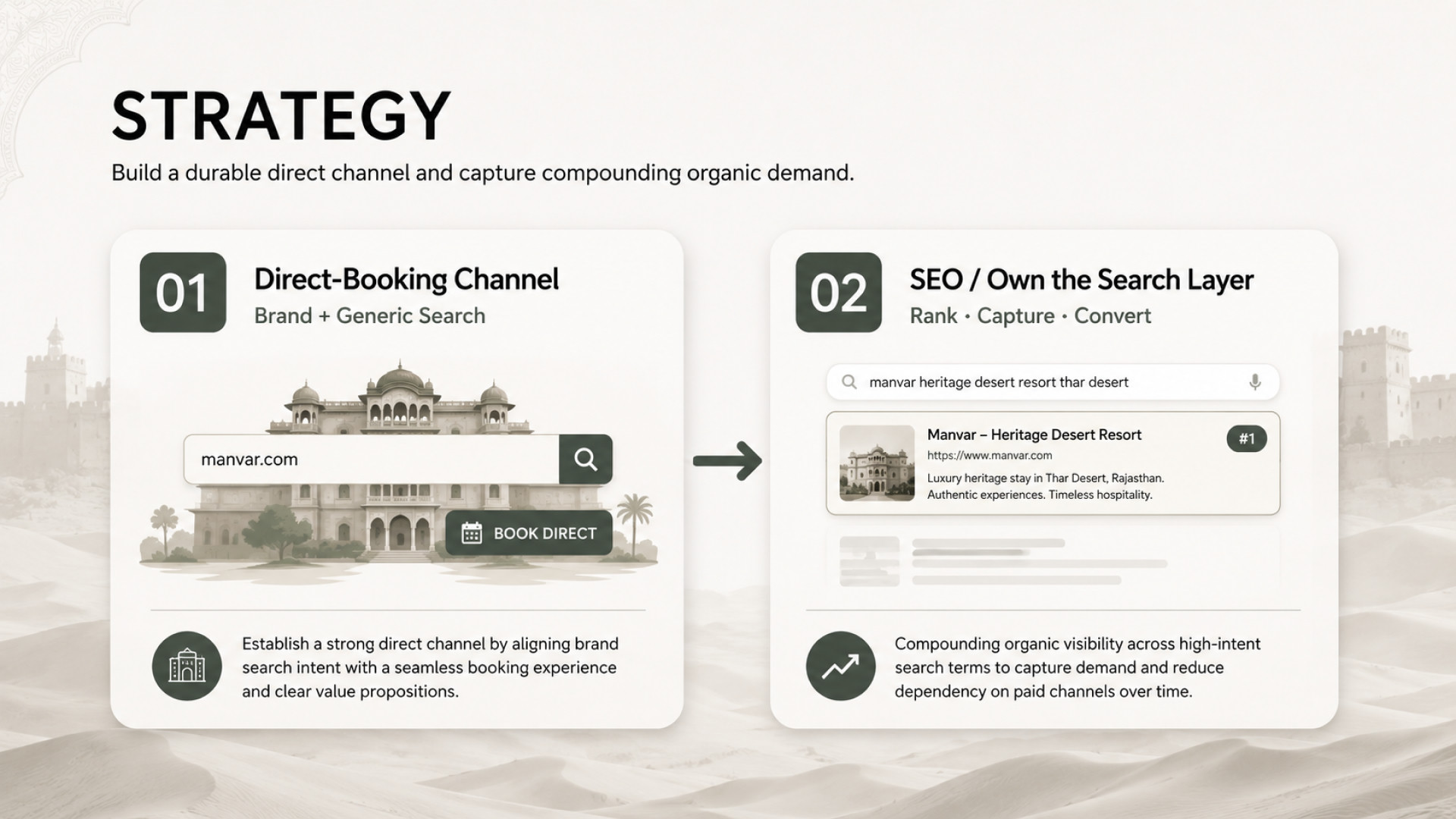
The engagement ran on narrow-season-hospitality logic: own the demand before it reaches the OTA, on a clock set by the season. Two tightly-linked pillars: (1) build the direct-booking channel — a destination that told the Manvar story properly plus a focused Google Ads stack (Brand Search to defend the brand's own name from OTA interception, Generic Search to capture "desert resort Rajasthan" / "Thar desert stay" demand before an OTA did); (2) own the search layer with SEO — a technical SEO foundation plus content tuned to how people actually search for a Thar experience (origin-city routes, experiential and seasonal queries), capturing independent researchers without paying a commission. The two pillars compound: SEO lowers the long-run cost of the demand paid media has to buy, and the direct-booking channel converts both into owned, full-margin, relationship-keeping bookings.
The Execution
The work was sequenced against the season — built and ready before the window opened. Pre-season build: direct-booking destination and search layer stood up before peak demand; Brand Search defence live early to stop OTAs intercepting the brand's own name from day one. In-season capture: Generic Search and the direct-booking funnel ran against the live demand pool, pulling high-intent travellers into the owned channel; direct room nights climbed across the open window. Compounding: SEO contribution built over the engagement, capturing independent researchers and steadily lowering reliance on both OTAs and paid clicks.
What didn't work first
The early lean was too heavily toward narrow experiential keywords — "luxury desert camp," "heritage Thar stay" — which captured the small, already-convinced audience but missed the larger pool considering Rajasthan broadly. Widening into route and region queries and using the direct-booking destination to sell the desert experience after the click expanded reach without diluting conversion. As with other heritage Indian properties, surfacing a direct, human booking channel (rather than burying it behind a form) shortened time-to-booking, because high-consideration travellers want to ask their questions before committing to a remote stay.
"A short season punishes a slow strategy. The whole plan was built to be live before the window opened — and to take back the brand's own name from the OTAs on day one."
The Results
| Metric | Before | After |
|---|---|---|
| Direct room nights | 450 | 797 (+56%) |
| OTA dependency | Dominant across the portfolio | Reduced — direct now a meaningful channel |
| Brand Search | Intercepted by OTA paid placements | Defended from early in the window |
| Organic discovery | Thin owned footprint | SEO layer capturing independent researchers |
| Seasonal yield | Revenue surrendered to commission | More full-margin room nights inside the 6–8 month window |
Why It Worked
- The brand's own name is the cheapest demand it owns. Recapturing "Manvar" searches from OTA interception was near pure margin.
- Direct bookings are worth more than the commission they save — each keeps the guest relationship a heritage product depends on.
- The narrow season forced readiness, not reaction.
- SEO and paid compound in hospitality.
Lessons for Narrow-Season Heritage Hospitality
- Defend your brand name on search before anything else.
- Build before the season, not during it.
- Sell the experience after the click, not before it.
- Protect the guest relationship.
Repeatable Playbook
The Manvar engagement reinforces YARD's Narrow-Season Heritage Hospitality template — direct-booking channel plus owned-search layer, sequenced against a tight seasonal window. It runs as a sibling to the Astroport Sariska playbook; together the two define how YARD takes OTA-dependent heritage Rajasthan properties to direct-booking strength inside a short revenue season.
Closing Thought
The desert was always going to draw the right traveller. The question was only whether that traveller would arrive through Manvar's own door or through an OTA's. Building the direct channel and the search layer around it — before the season opened, and starting with the brand's own name — is what turned 450 direct room nights into 797.

Ageasy — How a Senior-Care Brand Scaled 3–4x by Pairing Google Search With a Real Demand-Gen Engine

Stealth REIT — Building a Regulated PropTech's Martech Stack From Zero, and Cutting CPL 67%