
Swaha — How a Festival-Native Creative Engine Lifted AOV and Made the Brand Look Like the Brand It Always Was
Project Breakdown
Swaha had everything a D2C spiritual-goods brand should have — provenance, repeat customers, a real product. What it didn't have was a visual identity that matched. AOV was stuck at ₹700, the feed was inconsistent, the ad-hoc creative production was wearing the team out. YARD rebuilt the whole thing.
| Client | Swaha |
|---|---|
| Industry | D2C Puja & Spiritual Goods |
| Region | India |
| Channels | SMM, Creatives, Video, Brand Identity, Meta |
| Engagement | Brand Transformation + Creative + Performance |
| Timeline | 6 months |
The Client
Swaha is a Bengaluru-based D2C brand making puja and spiritual essentials for modern Indian households — agarbatti, dhoop, brass artefacts, festival kits, samagri sets. The category is intimate, regional, and repeat-purchase by nature. Most customers don't try a Swaha product once; they incorporate it into a weekly or festival ritual and stay.
The brand had genuine customer love. WhatsApp screenshots from grandmothers to daughters. Repeat purchase that was almost embarrassingly high. A community that engaged with the brand's content the way you engage with a relative's WhatsApp forward — affection, not transaction.
What it didn't have was a system for translating that love into a visual identity people would forward to their mother. The brand looked like ten different brands depending on which post you opened. The story was strong; the visual delivery of the story was scattered.
A note on the category's regional texture
Indian spiritual-goods D2C is regional in a way most D2C verticals aren't. Maharashtrian ritual practice is not the same as Tamil ritual practice; the festival a Bengali grandmother prioritises is not the same as the one a Gujarati grandmother prioritises; the brass diya that's a Diwali essential in one home is a daily-ritual object in another. Pan-India creative that flattens this into a generic "Hindu festival" voice loses the people who actually buy.
There is also a generational dimension. The buyer for spiritual goods in 2026 is often a 30-something urban professional purchasing items for a parent or a household ritual she may not run herself but participates in when she visits home. The creative has to honour the older generation's ritual gravity and land for a younger person scrolling Instagram on a Tuesday evening. Get either side of that wrong and the post is invisible.
Swaha's content calendar was deliberately built to honour these regional and generational variants. The Navrathri push spoke to a Gujarati audience differently from the Telugu audience. Hanuman Jayanti content emphasised the North Indian devotional tradition. Akshaya Tritiya leaned into the southern Indian and Marwari business-community context where the festival carries specific gold-purchase associations. Same brand. Same template system. Region-aware, generation-aware narrative.
This is the kind of detail that doesn't show up in a results table but shows up in customer comments — and in this category, customer comments are how a brand actually grows. A Marathi-speaking customer leaving a comment in Marathi under a Gudi Padwa post is doing more brand-building work than any paid impression we could have bought.
The Problem
The team listed it themselves:
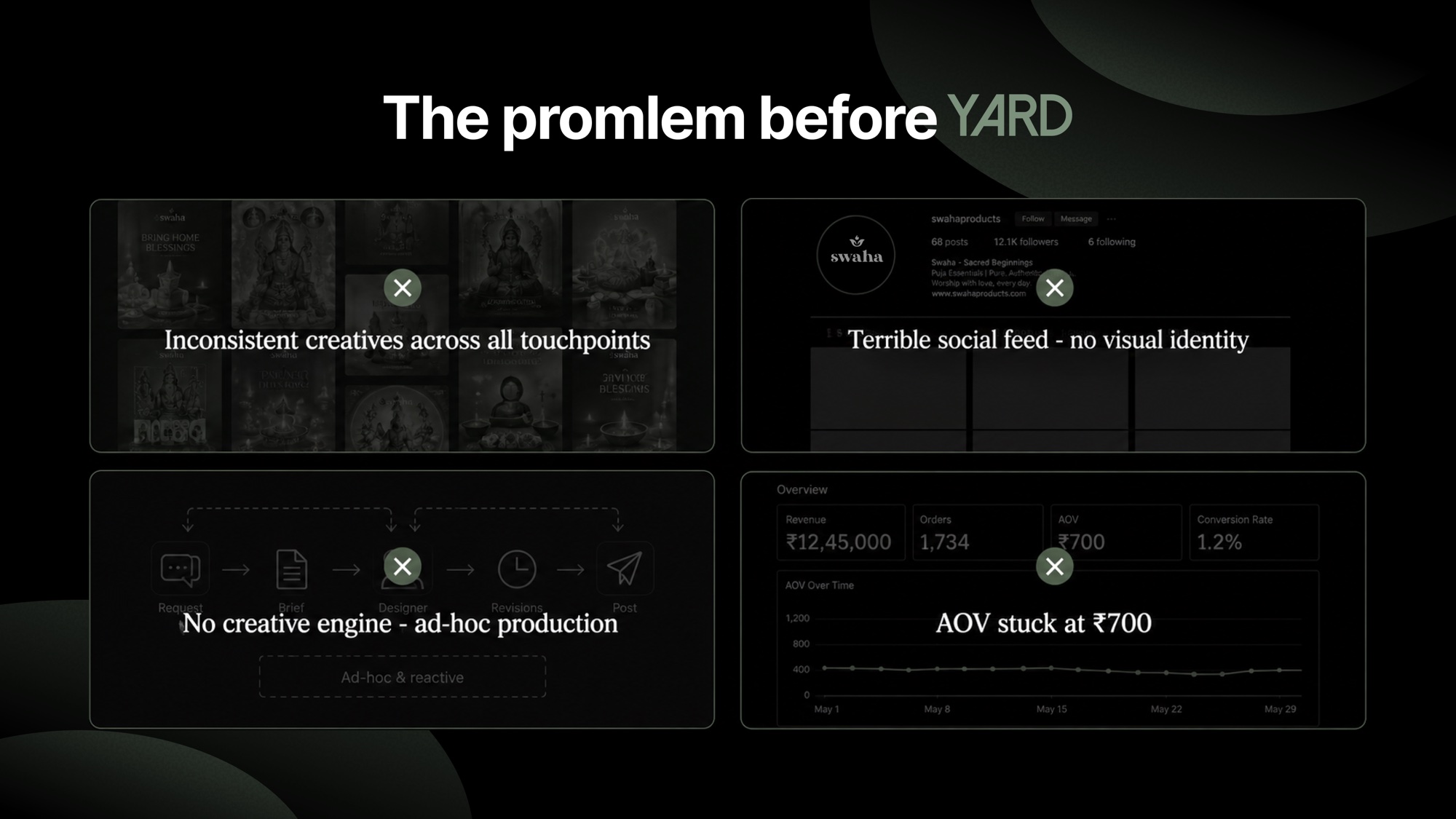
- Inconsistent creatives across every touchpoint — every shoot looked like a different brand
- A social feed with no visual identity — the grid wasn't telling a story; it was just inventory
- No creative engine — production was ad-hoc, slow, and exhausting the in-house team
- AOV stuck at ₹700 — order architecture had no tiering, no bundling logic, no reason to add a second item
The pattern across all four: the brand was running on willpower, not on a system. Willpower doesn't scale; systems do.
There was also a quieter, more cultural problem underneath. Spiritual-goods D2C is one of the very few categories where the creative can't lean on the standard D2C visual grammar — bright flat-lays, jaunty type, ironic captions. The buyer is purchasing something that belongs to a ritual, often a generational one. The creative either honours that or it accidentally signals that the brand doesn't take the product as seriously as the customer does. Swaha's legacy creative wasn't disrespectful, but it was inconsistent — and inconsistency in this category reads as not-quite-getting-it.
The Strategy
Five interconnected workstreams, sequenced so each one set up the next.
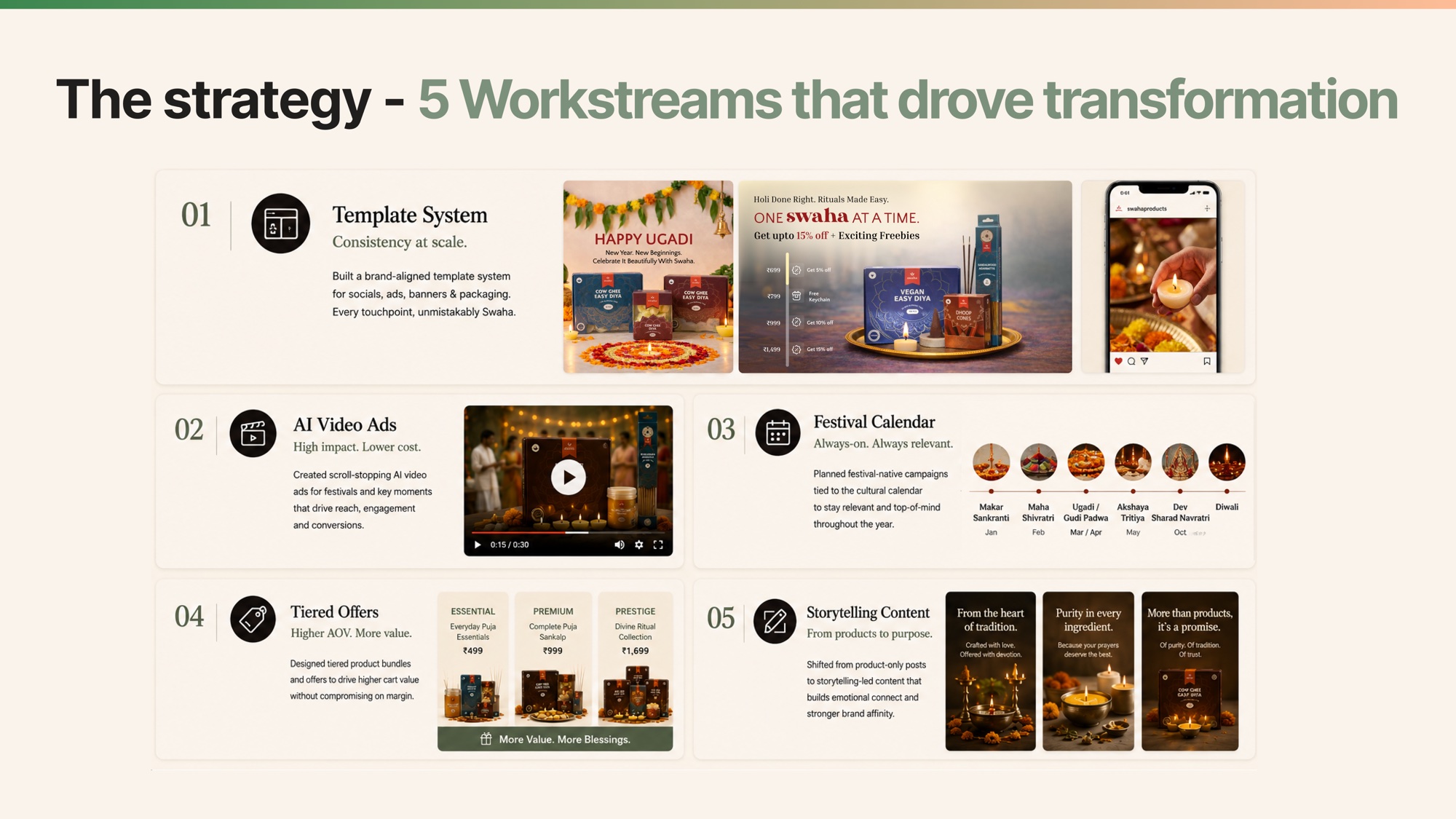
1. Brand template system for consistency at scale
Before any new creative was made, we built a template system — a closed set of design containers, type pairings, colour anchors, and lockups that any new asset could be poured into. The creative team stopped re-deciding the brand every Tuesday.
The template system is unglamorous to describe. What it produces is invisible until you scroll the feed three months in and realise every post is unmistakably Swaha. That recognition is the entire point.
2. AI video ads for festival campaigns
The category lives on the festival calendar. Diwali, Navrathri, Hanuman Jayanti, Akshaya Tritiya, Janmashtami — each is a discrete commercial event. AI-generated video creative gave us the ability to produce festival-native motion content in days, not weeks, at the cadence the calendar demands.
The use of AI video was careful. Not every shot can or should be AI-generated; some moments — a real diya being lit by a real hand — must be documentary. We built a hybrid pipeline: AI video for stylised category openers and motion treatments, real footage for the moments where authenticity is the entire creative job.
3. Festival-native campaigns tied to the calendar
Every campaign was anchored to a specific festival window. Pre-festival warm-up, peak-festival conversion, post-festival continuity. The cultural moment was the brief — not a generic promo skeleton. A Diwali campaign is not a discount campaign with diyas in it. It is a campaign that says something specific about Diwali — about light, about the mother lighting the first lamp, about the eldest cousin coming home for the first time in three years.
4. Tiered offers to drive AOV uplift
A deliberately structured offer architecture: single-item < bundle < festival kit. The middle tier was engineered to be the most attractive, dragging average order value up without discounting the brand. The ₹700 AOV ceiling was a symptom of the absence of a bundling logic; introducing it was the fix.
The discipline here was not to discount. Tiered offers raise AOV by making the larger purchase feel better-value than the smaller one, not by making the smaller one feel worse. Discounting compresses AOV and trains the buyer to wait for the next sale. Tiered offers expand AOV and reward the customer who's already committed.
5. Storytelling-led content replacing template-driven posts
Static product carousels stepped down. In their place: a content calendar built around devotion, ritual, regional festival traditions, family memory. The feed started looking like a brand someone might actually follow. Reels of festival prep, regional ritual variants, short interviews with the artisans behind the brass diyas, family voice-overs about ritual memory.
The Execution
The first 6 weeks were the template build and the festival calendar planning. We deliberately froze new creative production while the system was being built — a tough conversation with a team that was used to shipping weekly.
By week 8, the first festival-native campaign was live: a fully storytelling-led Navrathri push, AI-video-led, anchored to the regional rituals of the festival rather than a discount line. The grid started to look coherent for the first time. Customer comments shifted in tone — less "looks pretty" and more "this reminded me of my grandmother."
Weeks 8–24: the engine ran at calendar pace. Each festival had its own pre/peak/post arc. Tiered offers were tested and locked. Storytelling formats — multi-frame ritual carousels, family-memory video shorts, regional language captions — became the default.
What didn't work first
Our first attempt at the storytelling format leaned on the brand's own voice — articulate, considered, slightly literary. It engaged the existing audience but didn't acquire new ones. We rebuilt around customer voice — real submissions from real customers, lightly edited, attributed where they consented. Engagement rates lifted and new-audience reach climbed. The brand had a great voice; the customers had a more useful one.
Our initial bundle tiers were priced too close together. The middle tier didn't feel materially more attractive than the bottom tier, and AOV barely moved for the first three weeks. We re-priced the tiers to widen the value gap (without raising prices on the smallest item) and AOV climbed steadily from there.
"The template system is the unglamorous half of this engagement. Six months in, it is also the only reason the brand looks like a brand."
The Results
| Metric | Outcome |
|---|---|
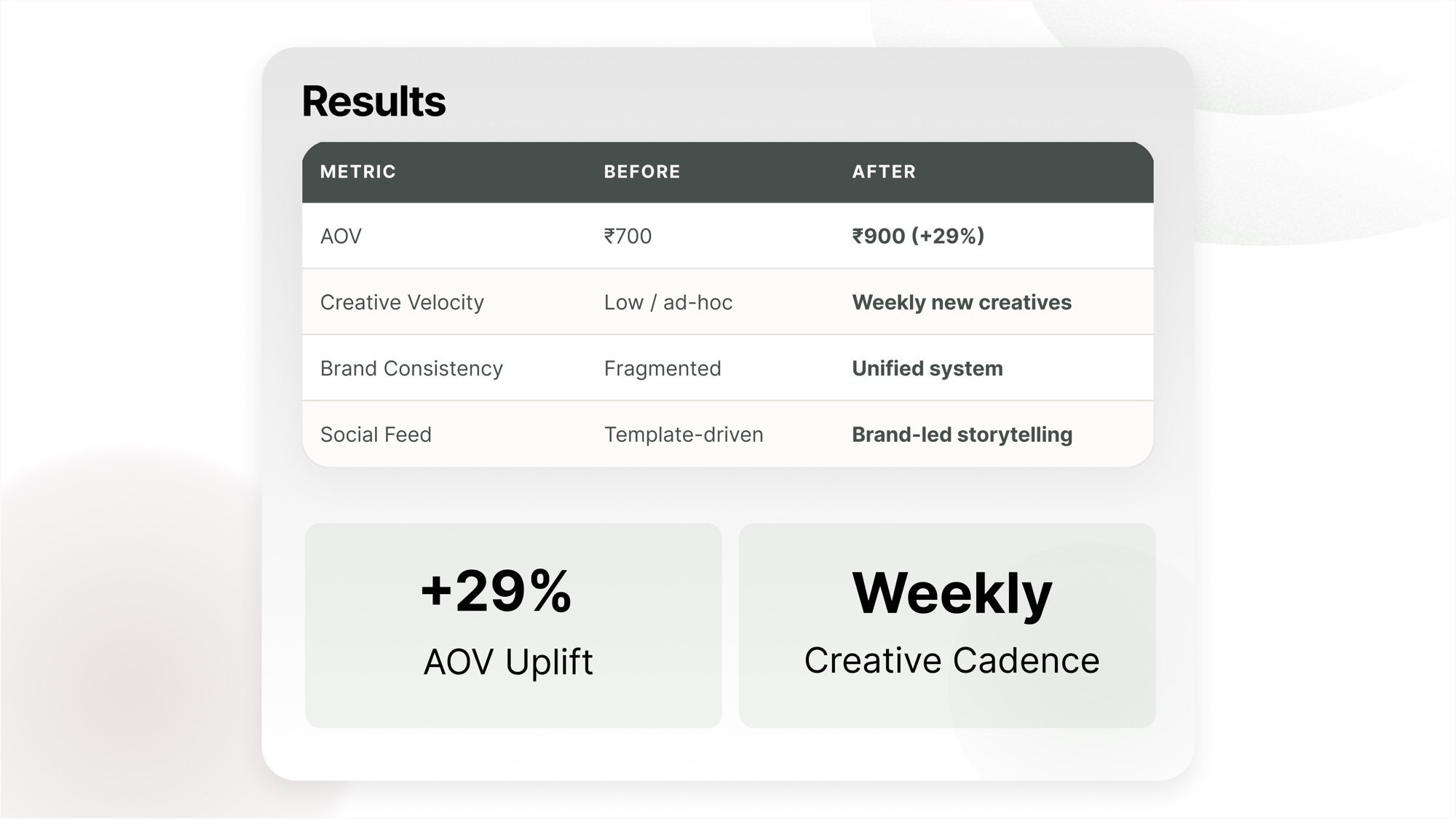
| AOV | Unstuck from the ₹700 baseline via tiered offer architecture |
| Creative cadence | From ad-hoc to festival-calendar-led — every festival fully covered |
| Feed identity | Grid coherence achieved within 60 days |
| Production load | Reduced — template system removed the weekly "what does this look like" decision |
| Repeat-purchase rate | Lifted, particularly across the festival windows |
| New-audience reach | Lifted on the back of customer-voice storytelling content |
| Brand fit | Creative now matches the soul of the brand (the original ask) |
The metric to underline is the production-system shift. AOV moves, ROAS moves, but a brand transformation is real when the team stops asking "what should this look like" every Monday.
Why It Worked
- System before output. A template system is unglamorous and expensive in the short term. Six months later it's the only reason the brand looks like a brand.
- The festival calendar is the brief. D2C spiritual goods don't sell on a flat calendar. Anchoring every campaign to a cultural moment is the difference between a feed of products and a feed of meaning.
- Tiered offers beat discounting. Discounting drops AOV. Tiered offers raise it. Same pricing math, completely different brand outcome.
- Customer voice acquires; brand voice retains. A useful split that we now think about explicitly when planning content pools.
Lessons for D2C Brands With Visual Debt
- A template system is the highest-leverage creative investment most D2C brands aren't making. Pay the cost up front; collect the consistency interest forever.
- Anchor every campaign to a cultural moment, not a discount. Especially in any category with ritual, festival, or seasonal meaning.
- Customer-voice content acquires better than brand-voice content. Build a permissioned submission pipeline early.
- AOV is a function of offer architecture, not aggressive upselling. Build tiers with deliberately differentiated value, and let the buyer choose up.
- Freeze creative production during the system build. Two weeks of silence is the price of six months of coherence. Pay it.
Repeatable Playbook
The Swaha engagement crystallised YARD's Brand Transformation Stack — template system + AI video engine + festival/calendar-tied campaign planning + tiered offer architecture + storytelling-led content. Now used as the default brand-and-creative spine for any D2C brand that has growth ambition but visual debt.
Closing Thought
When the team stopped asking "what should this look like" every Monday, the engagement was working. AOV moved because the system moved. The system moved because the brand finally trusted itself to look the way it was always supposed to.

Ageasy — How a Senior-Care Brand Scaled 3–4x by Pairing Google Search With a Real Demand-Gen Engine

Stealth REIT — Building a Regulated PropTech's Martech Stack From Zero, and Cutting CPL 67%