Stealth REIT — Building a Regulated PropTech's Martech Stack From Zero, and Cutting CPL 67%
Project Breakdown
Stealth REIT turns Dubai property into a fractional, investable product under DIFC licensing and DFSA regulation. It went to market with no martech whatsoever — no tracking, no automation, no SEO — and a 12 AED cost per lead it had no way to improve, because it had no way to see what was happening. YARD built the entire stack from zero. CPL fell to 4 AED, a 67% cut, and the channel drove 6M+ AED of investments in year one.
| Client | Stealth REIT |
|---|---|
| Industry | PropTech · Fractional Real-Estate Investment |
| Region | Dubai, UAE (DIFC-licensed · DFSA-regulated) |
| Target Market | Retail & sophisticated property investors |
| Channels | Meta, Google |
| Engagement | Martech + Performance Marketing + SEO |
| Timeline | 1 year (build → scale) |
The Client
Stealth REIT sits at the intersection of two hard things: real estate and regulated finance. It takes Dubai property — historically a high-ticket, illiquid, all-or-nothing asset — and turns it into something an investor can buy a fraction of, inside a DIFC-licensed, DFSA-regulated structure. The product is genuinely new, the compliance bar is high, and the buyer is being asked to trust a young brand with investment capital.
That combination makes the marketing stakes unusually high. A fractional-investment product lives or dies on trust and on measurement: trust, because you're asking for money under a regulator's eye; measurement, because investment funnels are long, multi-touch, and impossible to optimise if you can't see them. Stealth had the licence and the product. What it didn't have was any of the infrastructure needed to acquire investors efficiently.
The Problem
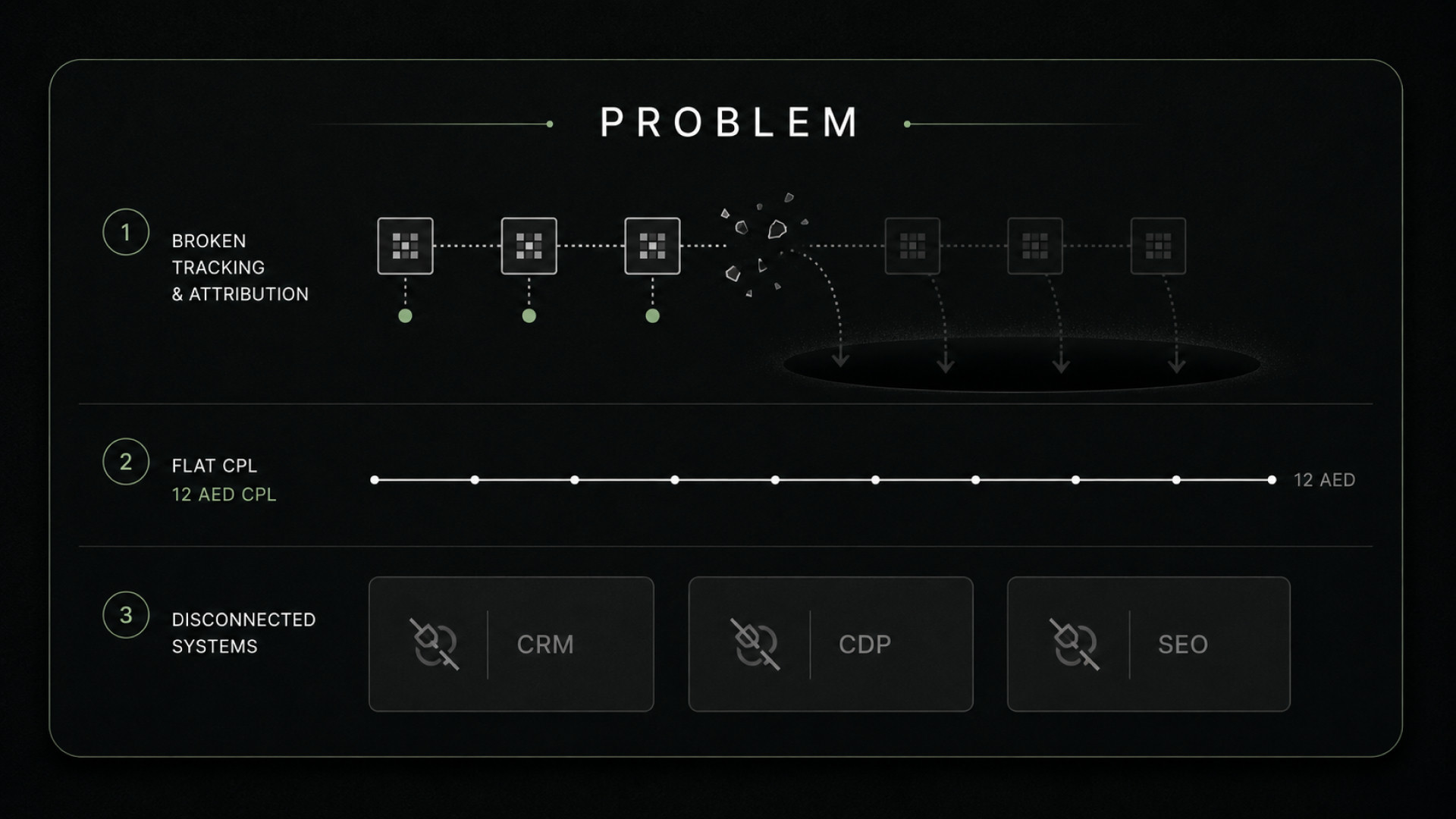
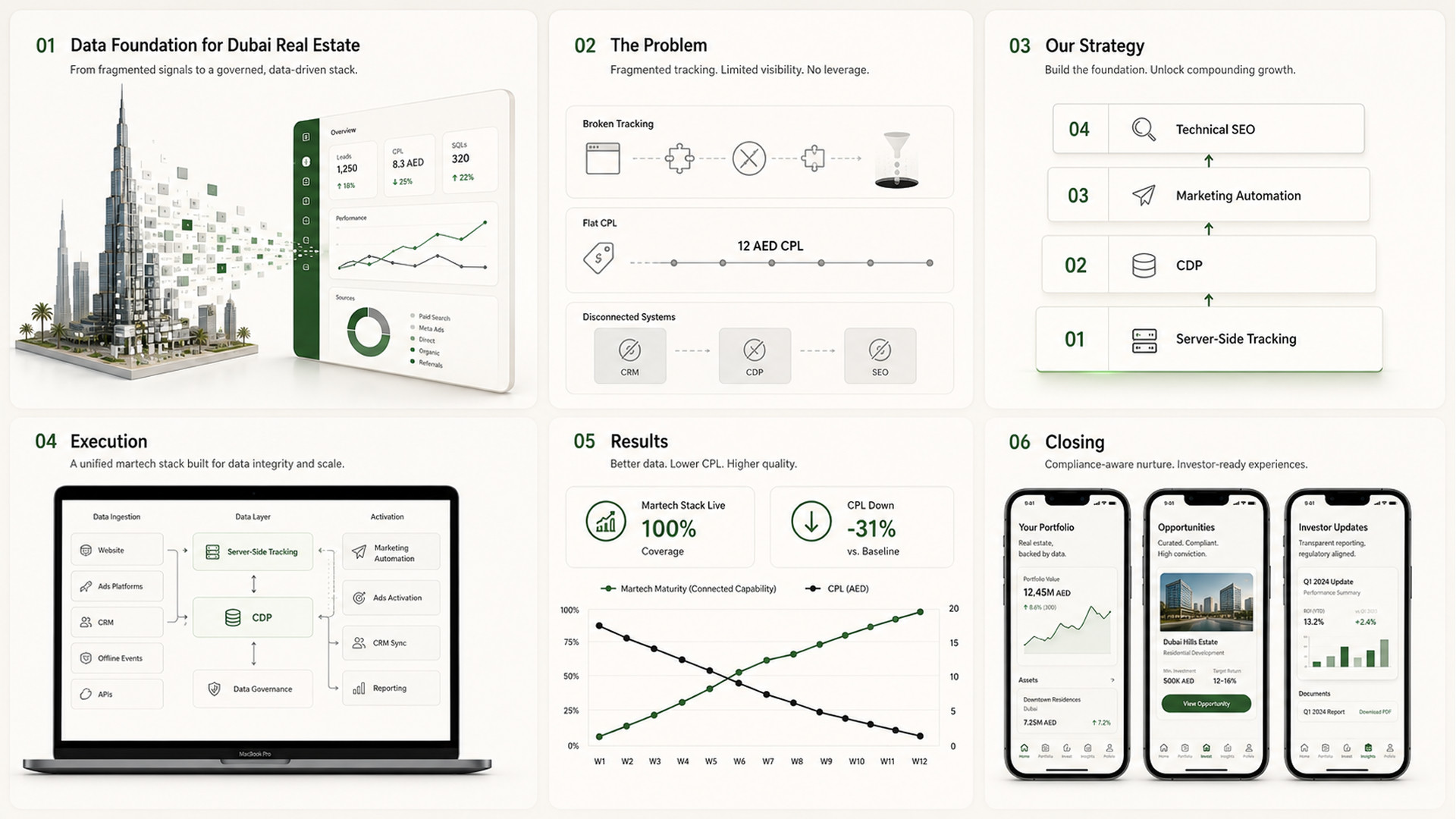
The diagnosis was blunt: the brand was flying completely blind. Every commercial problem traced back to one root — no martech at all. There was zero tracking (no Meta CAPI, no Google Enhanced Conversions, so the platforms optimised on a fraction of the real signal and a large share of conversions never made it back); a 12 AED cost per lead with no lever to move it (nothing to optimise against); and no automation, no CDP, no SEO (leads went into a void, with no nurture for a long investment cycle and no organic presence at all).
The Strategy
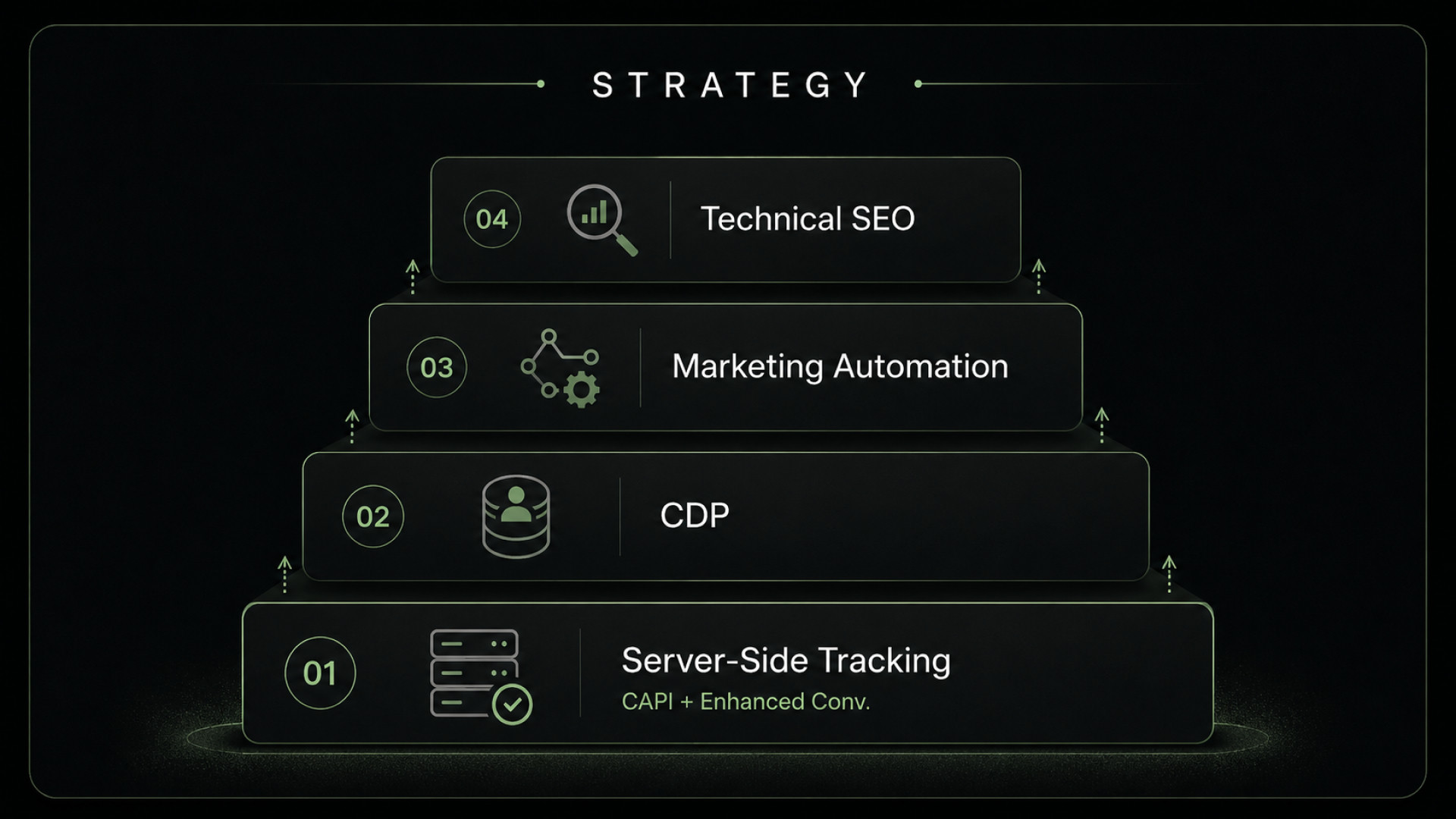
This was a martech-first engagement before it was a performance-marketing one. Four workstreams, sequenced so the foundation came before the spend: (1) server-side tracking as the foundation — Meta CAPI and Google Enhanced Conversions first, so the platforms received complete, durable conversion signal and could optimise toward real investors; (2) a CDP (Customer Labs) to capture, unify, and segment investor data across touchpoints, making intelligent retargeting and lookalike modelling possible for a long multi-touch funnel; (3) marketing automation (WebEngage) to nurture prospects across the extended consideration window; (4) technical SEO so the brand became discoverable to investors researching fractional property investment independently.
The Execution
Months 1–3 — instrument before you spend. CAPI and Enhanced Conversions went in first, then the CDP, then automation; optimisation began only once the funnel was observable. Months 3–8 — optimise on real signal. With complete conversion data flowing back, paid campaigns were tuned toward genuine investor intent and CPL began its descent from 12 AED. Months 8–12 — compound. Automation nurtured the growing lead base through the long cycle, SEO began contributing organic discovery, and the channel matured into one that converted leads into 6M+ AED of actual invested capital in the first year.
What didn't work first
The pressure was to turn on spend immediately and figure out tracking later. We held the line and built the measurement layer first — the reason the CPL improvement was real rather than illusory. An earlier instinct to optimise on platform-reported conversions (pre-CAPI) had been chasing a number that didn't reflect reality; once server-side signal was in, the true CPL became visible and improvable. For a regulated investment product, nurture content also had to do compliance-aware trust-building — the sequences that worked answered "is this safe and legitimate" before pushing "invest now."
"You can't optimise what you can't see. The whole engagement was built on one principle — instrument the funnel before you spend a dirham scaling it."
The Results
| Metric | Before | After |
|---|---|---|
| Cost per lead | 12 AED | 4 AED (−67%) |
| Investments (Year 1) | 0 | 6M+ AED |
| Martech stack | None | Full: CAPI + Enhanced Conversions + CDP + automation + technical SEO |
| Conversion tracking | None | Complete server-side signal to both ad platforms |
| Organic discovery | Invisible | Technical SEO foundation capturing independent investor research |
Why It Worked
- Measurement came before spend. Building tracking, CDP, and automation before scaling paid is why the CPL cut was real.
- Server-side tracking reset the unit economics. CAPI and Enhanced Conversions gave the platforms real signal to learn from.
- The funnel matched the product. A regulated, long-cycle investment product needs a CDP and nurture automation, not just a lead form.
- Trust-first nurture suited a regulated product.
Lessons for PropTech & Regulated-Investment Marketing
- Instrument the funnel before you scale it — server-side tracking is the first investment, not the last.
- A long investment cycle needs a CDP and automation, not just ads.
- For regulated products, build trust before urgency.
- A 67% CPL cut usually lives in the measurement layer, not the creative.
Repeatable Playbook
The Stealth REIT engagement is now YARD's template for Martech-First PropTech / Regulated-Investment Acquisition — measurement layer (CAPI + Enhanced Conversions) → CDP → automation → SEO, built before paid scale. It shares its DNA with the Ganaa martech-first healthcare playbook and rounds out YARD's UAE real-estate stack alongside MG Properties (HNI roadshow) and Aardys Properties (secondary-market efficiency).
Closing Thought
Stealth REIT had the hardest version of a launch problem: a genuinely new, regulated product and no way to see whether its marketing was working. The discipline of building the instrumentation before scaling the spend is what turned a blind 12 AED CPL into a measured, improvable 4 AED — and a standing start into 6M+ AED of real invested capital in a single year.

Ageasy — How a Senior-Care Brand Scaled 3–4x by Pairing Google Search With a Real Demand-Gen Engine

Manvar — How a Heritage Thar Desert Brand Broke Its OTA Dependency and Grew Direct Room Nights 56%